From Audi to Peugeot: The Brand Wars of Rallycross
Share This Page
The story of the brands that left their mark on rallycross history is, in fact, the sum of the answers four major manufacturers gave to one another: Audi carried all-wheel drive to the heart of rallying, Peugeot dominated world championships, Ford returned victorious in a remarkably short time, and Volkswagen, while withdrawing from the WRC, leaped into rallycross and filled the void. Here is the chronological and strategic tale of these battles.
Highlights
- The Audi Quattro was first unveiled on March 3, 1980 in Geneva and won four world championships.
- Peugeot became the manufacturer with official commitment in 2014, World RX's inaugural year.
- The Ford Focus RS RX took its first World RX victory just 5 races after its 2016 factory debut.
- PSRX Volkswagen Sweden won 8 of 12 races in 2017.
- In 2026, rallycross's top class is once again racing with 100% internal combustion engines.
Audi and quattro: How Did the All-Wheel Drive Revolution Begin?
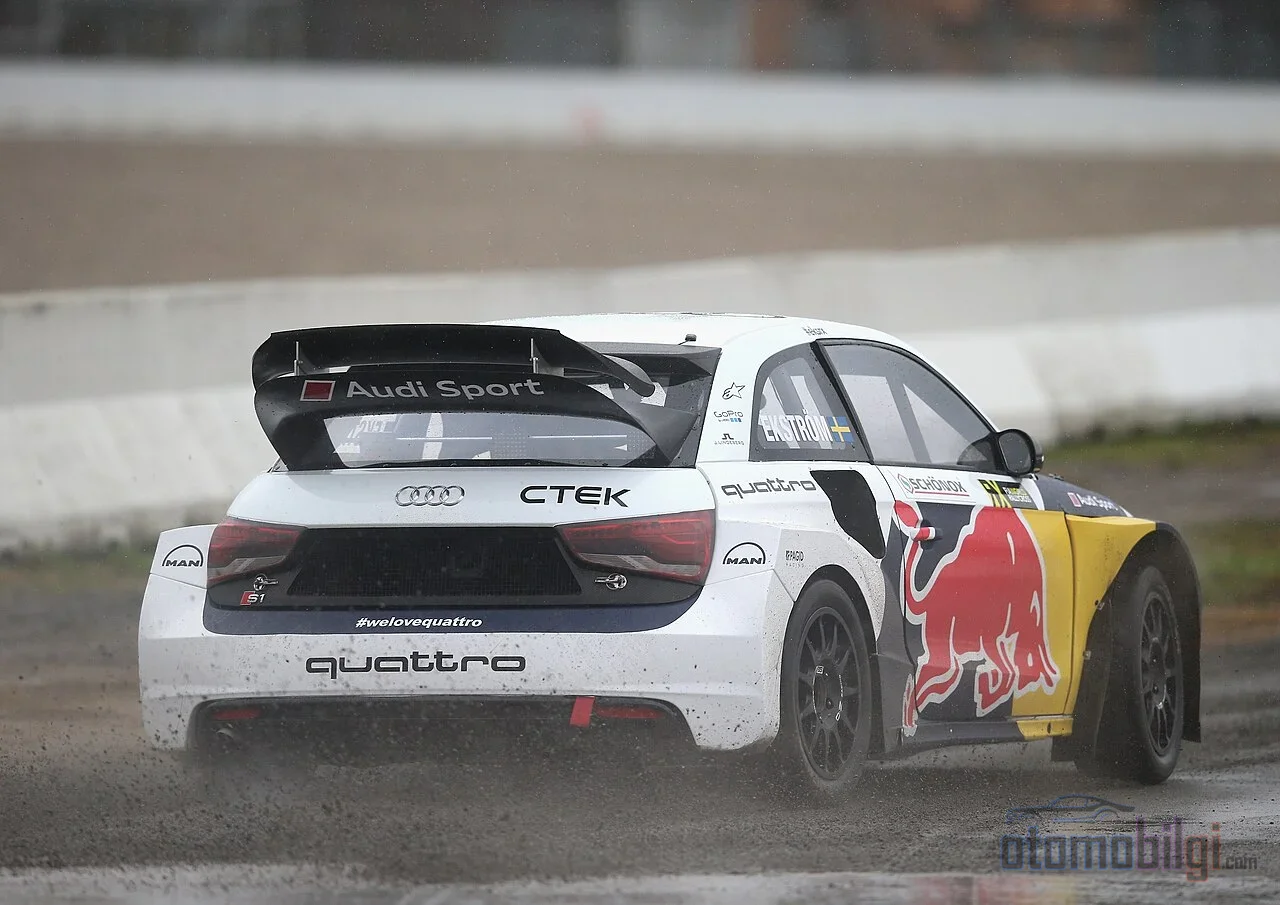
It all started with a military vehicle. In 1977, Audi chassis engineer Jörg Bensinger noticed that the Volkswagen Iltis was distinctly superior to other vehicles in snow tests. The idea born from this observation went down in history with the Audi Quattro's appearance on stage at the Geneva Motor Show on March 3, 1980. Until that date, front-wheel drive dominated rallying; with the new rules allowing all-wheel drive, Audi became the first rally car to take advantage of it.
The road version's 2,144 cc turbocharged inline 5-cylinder engine produced 200 PS and completed 0-100 km/h in 7.1 seconds. For the rally version, the displacement was reduced to 2,133 cc in order to enter the 3-liter class with a 1.4 multiplier. The combination of the five-cylinder turbo and all-wheel drive brought Audi four world championships: the 1982 manufacturers' title, the drivers' championship in 1983 with Hannu Mikkola, and in 1984 Stig Blomqvist became both drivers' and manufacturers' champion. Blomqvist's 1984 season was true dominance: winning 7 of 12 rallies, he overtook Lancia and finished 1-2 in the drivers' standings ahead of his teammate.
Michèle Mouton and the Sport Quattro Era
One of the most memorable lines of the Audi story belongs to Michèle Mouton: In 1981, she became the first female driver to win a world championship rally with the Audi Quattro. It was an achievement that shattered the molds of that era.
The Sport Quattro, introduced at the 1983 Frankfurt Motor Show for Group B homologation, was produced in approximately 220 units (sources cite varying figures between 214 and 224) and was priced at DM 203,850. The final act was magnificent: The Sport Quattro S1 E2, which arrived at the end of 1985, was officially rated at 480 PS, but with real figures it produced over 500 PS at 8,000 rpm; 0-100 km/h took just 3.1 seconds. It carried the recirculating air mechanism, considered the forerunner of today's antilag systems, and in some examples a power-shift gearbox that foreshadowed DSG. But the story ended in sorrow: After the 1986 Portuguese rally, Audi withdrew its factory team from the WRC, and Group B was abolished along with Group S following that year's fatal accidents. The 700 PS mid-engined Sport Quattro RS 002 developed for Group S never raced.
How Were the Group B Supercars Adapted for Rallycross?
This is the critical crossroads in the brand history of rallycross: Group B monsters such as the Audi Sport Quattro S1, Ford RS200 and Peugeot 205 T16 went beyond their rally purpose in the 1980s and '90s and were adapted for rallycross. In other words, rallycross became a laboratory where the major manufacturers kept supercar technology alive outside the circuits. Since we go into details such as the joker lap or circuit format on other pages, let us briefly say here: these cars were almost tailor-made for rallycross's short, intense duels.
Peugeot 208 WRX: How Did the Lion Take the World RX Stage?
Peugeot's rallycross roots run deep: The 205 T16 (Group B, 1984) was one of the first four-wheel-drive rally cars. Decades later, the brand returned to the stage in 2014 - exactly in World RX's first year - as a manufacturer officially committed to the championship. The first cars were 208 WRX versions derived from the 208T16, and they competed under Team Peugeot Hansen. Peugeot positioned this as a brand-sport investment; it was openly declared to be the year's key motorsport commitment.
The technical side is frustratingly impressive: with a turbocharged 4-cylinder engine, 600 horsepower and 0-100 km/h in under 2 seconds. The first 208 T16 WRX version had already started with 550+ horsepower. The 2017 version was unveiled at the World RX round in Barcelona, and in 2018 Team Peugeot Total became a full-fledged factory effort: its driver line-up featured nine-time WRC champion Sébastien Loeb along with Timmy and Kevin Hansen. Loeb, as the best pilot of the 208 WRX that season, was second and level with his teammate on 140 points. The answer to why the brand entered is simple: visibility and a technology showcase. As for why it withdrew, this is not explained in detail in the material, but the high cost of factory programmes always stands at the center of the equation.
Ford Focus RS RX: How Fast Does a Factory Programme Deliver Results?
The answer: five races. Ford Performance ran its factory programme in the FIA World Rallycross Championship with the Focus RS RX; the car was developed under the name "Project RX". In 2016, Hoonigan Racing Division (formerly Monster World Rally Team) fielded two factory-backed Focus RS RX cars for Ken Block and Andreas Bakkerud. Debuting in Portugal, the car completed 0-60 mph in under 2 seconds, and in the same year, its first factory season, it took its first World RX win after only 5 races. In such a short programme, that speed shows how correctly Ford's strategy was conceived: with the right drivers, the right technical infrastructure and a measured budget, the fruit of a factory effort could be harvested immediately. The car also appeared in Gymkhana videos of that era, meaning it served a marketing value beyond the race track as well.
Volkswagen Polo RX: Turning to Rallycross After Leaving WRC
Volkswagen's story is a bit different. In the WRC, a team that won both the drivers' and manufacturers' championships back to back with Ogier between 2013 and 2016 ended the program at the end of 2016. The official reason was brand repositioning and a focus on new technologies and customer motorsport; the decision came after sister company Audi withdrew from the WEC. But from the outside, the reality was a change of direction: VW's rally energy was transferred to rallycross.
The result was one of the most effective rallycross partnerships in history. The PSRX Volkswagen Sweden partnership formed with Petter Solberg's team won 8 of 12 races in 2017 with the Polo GTI - with Johan Kristoffersson at the wheel for 7 of them. The technical side is also interesting: The Polo R Supercar was based on the Polo R WRC from the WRC, and when adapted for rallycross, the roughly 34 mm air restrictor was removed and a larger one installed. In short, from the same design base, one became a rally car and the other a rallycross monster. Kristoffersson became a double world rallycross champion with this Polo and later returned with the Polo GTI RX.
| Brand | Program | Period | Notable Result |
|---|---|---|---|
| Audi | Quattro (WRC, Group B) | 1980–1986 | 4 world championships |
| Peugeot | 208 WRX, Team Peugeot Hansen / Total | 2014–2018 | 2nd place in 2018 with Loeb place |
| Ford | Focus RS RX factory program | 2016 | First win after 5 races |
| Volkswagen | PSRX Polo GTI Supercar | 2017+ | 8 wins from 12 races |
What Does Manufacturer Participation Give a Championship, and What Does Its Departure Take Away?
Manufacturer participation has two faces in rallycross. The smiling face is obvious: 600-horsepower cars, star drivers like Loeb and Block, and worldwide visibility. When VW's exit from the WRC was interpreted as a move toward rallycross, the small championship suddenly became the stage for a worldwide factory battle. Peugeot's entry in 2014 as the sole official manufacturer also lent serious credibility to World RX's founding year.
The other face is the balance of cost and competition. Factory budgets raise the level of competition but narrow the breathing room for private teams; and when a brand withdraws, a gap is left behind. In official statements, withdrawals were always described with words like strategy and technology focus, but independent assessments also emphasize the cost dimension - even without exact figures in hand, this balance is always part of the story. That's why the big change in 2026 is meaningful: The FIA canceled the world championship in 2025, returned to the European Championship for 2026, and introduced a separate World Cup status. The top class is once again filling up with internal combustion engines only; the goal is faster, safer, and more cost-effective cars. From 2028 onward, top-level rallycross cars conforming to the same general technical regulations as the 2027 WRC machines is also on the agenda. Efforts to make the sport accessible on small budgets with cheaper cars like CrossCar and Rally4 are being discussed with excitement in the communities.
Drivers or Manufacturers? Which Do You Think Wins?
Audi's pioneering with quattro, Peugeot's return to the world stage, Ford's five-race winning streak, and VW's strategic leap... Each one teaches a different lesson: winning in rallycross is not just about having the fastest car, it's about sitting at the right table at the right time. An observation of a snow test started the four-wheel drive revolution, and manufacturers' board decisions shaped the world championships. In my opinion, this choreography by the manufacturers makes rallycross much more than just a racing series - a strategy game playing out in the background while duels rage on the track. If it were you, whose table would you sit at? For a similar strategic analysis, I would also definitely recommend taking a look at the driver stories of Petter Solberg and Johan Kristoffersson.
Sources
- Motorsport history - Audi
- Audi Quattro - Wikipedia
- History - Sport Quattro
- PEUGEOT 208: A HISTORY IN MOTORSPORT - Stellantis Media
- Team PEUGEOT Total targets the top with new 2018 PEUGEOT 208 WRX - Hansen Motorsport
- World Rallycross: Team Peugeot Hansen new car - Red Bull
- Our Heritage - Peugeot Sport
- The birth of the Ford Focus RS RX - Autoweek
- Ford Focus RS RX development - RaceTech Magazine
- Ford Focus RS RX makes World Rallycross debut with Ken Block - Drive
- Official: Volkswagen to quit World Rally Championship at end of 2016 - Autocar
- The Volkswagen Polo R Supercar - Volkswagen Newsroom
- WRC History - wrc.com
- FIA sets bold new course for rallycross from 2026 - FIA
- FIA World Rallycross reverting to European championship for 2026 - Racer