How Have World RX Rules Changed Over the Years?
Imagine a racing discipline whose rules change almost every season. First there's one joker lap, then two; first the smell of gasoline, then silent electricity; first a world championship, then a European series. World RX, the top tier of rallycross, has been going through a makeover almost like a washing machine cycle since 2014. So how exactly did this rulebook evolve? Let's rewind the years!
2014: World RX Is Born and the Classic Format Takes Shape
The FIA World Rallycross Championship, or World RX, launched in 2014 as an FIA-sanctioned world championship. Rallycross itself was actually much older; the FIA European Rallycross Championship had been running since 1976. But to establish a worldwide series, a restructuring took place in 2013, and the first world season began the following year.
The first season had two classes: the top Supercar class and the supporting series RX Lites. In RX Lites, all teams raced with identical, spec vehicles; it was the driver's skill that spoke, not their budget. This class was later renamed RX2, and over time new members joined the family.
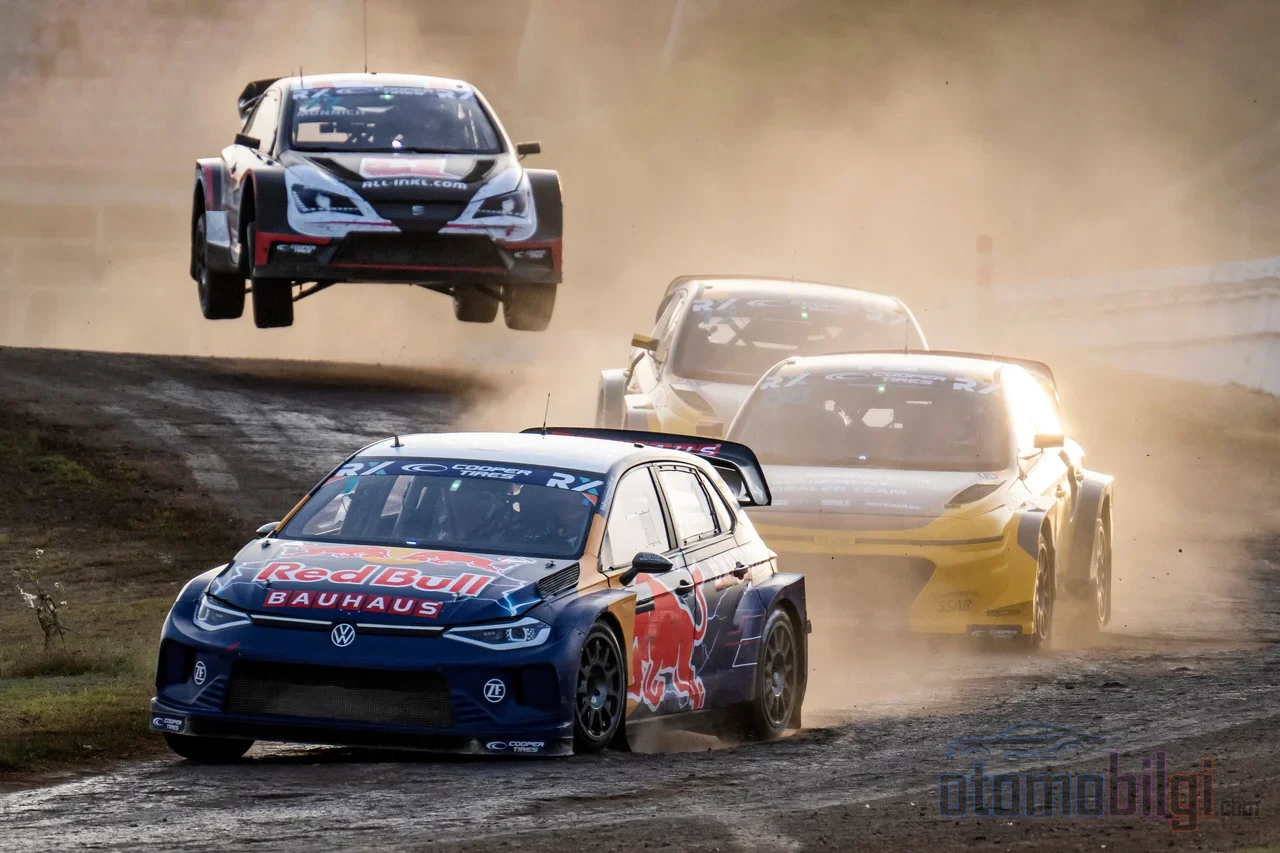
The weekend format also began in the classic form still etched in the minds of fanatics: four qualifying heats, each with short races of three to five cars; followed by two semi-finals and a six-car final. Qualifying heats ran four laps, semi-finals and finals six laps, and one joker lap was mandatory in every race. So there were hours of competition within a single day, yet the day's winner was decided by just one race, the final. This intensity was rallycross's signature.
Highlights
- World RX was established in 2014 as an FIA-sanctioned world championship.
- The electric main series RX1e started in August 2022, beginning at Holjes.
- In 2024, sustainable-fuel ICE cars returned alongside RX1e.
- In 2026, the series gave way to the European Championship and a new World Cup format.
- The new World Cup format features two mandatory joker laps per race.
The Joker Lap: One Rule, Repeatedly Revised
The rule that makes rallycross what it is, is undoubtedly the joker lap. This lap, which makes the alternative route on the track mandatory, is in a way like the flat tire on go-kart tracks: you're all racing the same race, but you have to slow down once and take a different path. When you take it, however, is pure strategy. Do you take it early to escape the traffic ahead, or save it for the end of the race and block your rivals on the straight? That's where all the mind games lie.
The rule itself didn't stay fixed either. In the classic format, a single joker lap was mandatory in every race; a driver who skipped the lap faced a hefty 30-second time penalty. But things changed in the new FIA Rallycross World Cup format announced for 2026: there are two mandatory joker laps per race in the eight-car semi-finals and finals, plus a new Superpole system was added. So the calculations played with a single joker lap were turned upside down in an instant. There are even archive clips of Petter Solberg taking a double joker lap in a single race; it's great to see how legendary names turned this type of round into a tactical weapon.
The joker round can't exactly be called free either. Fights over space can break out at the point where the alternative route merges with the main route; moments of collisions on the joker lap were recorded in European races. The rule adds excitement, but it adds risk too.
From Supercar to RX1e: How Did the Technology Inside the Box Change?
The 2014 rulebook had an interesting detail: car development was allowed throughout the season. Teams tried very different technical approaches from one another, and the cars evolved as the season progressed. The classic Supercar formula was as follows: 2.0-liter turbocharged four-cylinder engines, four-wheel drive, and a sequential gearbox. Thanks to the intake restrictor, power was held at around 570-600 hp, but if you removed the restrictor, you were talking nearly 1,000 hp. Launching a car from 0-97 km/h in under 2 seconds is a far wilder feeling than words can describe.
Then the electric idea took the stage, and even the journey of that idea was a lesson in rule evolution: in 2017 it was announced that an electric category was planned for 2020, then it was postponed to 2021 pending manufacturer interest. In 2020, an electric series called Projekt E, running parallel to the main series, came into play; body-shell cars converted with healthy electric kits took to the track. In 2021, RX2 was replaced by the electric RX2e, and the final step was taken at Holjes in August 2022: the main series began racing with the fully electric RX1e.
| Specification | Supercar (RX1) | RX1e |
|---|---|---|
| Power source | 2.0 L turbo, four cylinders | Two electric motors |
| Power | ~570-600 hp | 680 hp |
| Torque | 840-920 Nm | 880 Nm (instantaneous) |
| Weight | 1,300 kg | 1,300-1,330 kg |
| 0-97 km/h | Under 2 seconds | 1.8 seconds |
Looking at the table, the RX1e seems one step ahead; instantaneous torque is like the electric vehicle's gift of having escaped from nature's prison. But on the track, everything isn't just about numbers. In 2024, the rulebook turned again: internal combustion vehicles running on sustainable fuel were readmitted to the top tier alongside the RX1e. Thus, for two seasons there was a period in which electricity and combustion went head to head, with two different powertrains racing in a single grid. This was an experiment rarely seen in motorsport, and its results sparked debate: on one side a technology showcase, on the other the sound and spectacle fans were familiar with.
Scoring System: Why Isn't the Final Winner Always the Champion?
Here's the topic that confuses new viewers the most: in rallycross, the championship doesn't depend on a single final victory. Points are accumulated throughout the weekend in the heats, semi-finals, and final. From 2014 to 2021, a descending scale from 16 to 1 was used in the heats, a 6-1 distribution in the semi-finals, and 8-5-4-3-2-1 in the final.
In 2022 the system changed and a single 20-16-13-12-11-10-9-8-7-6-5-4-3-2-1 scale was adopted. In 2025, it grew even bigger: final scores start at 25 points in first place and go down to 18th place, with a 3-2-1 bonus point added for qualifying order. So now a single bad final doesn't ruin the season; consistency is rewarded. That's why the driver who wins the final, even if they are the absolute winner of that weekend, may not be at the top of the championship table. Confusing but logical: you're running a marathon, not a single sprint.
2025-2026: The Biggest Turning Point
The harshest revision of the rulebook wasn't technical, it was structural. On September 18, 2025, the FIA announced a sweeping plan for 2026: the top category is returning to the FIA European Rallycross Championship, with a six-race series to be held across the continent. Outside Europe, an FIA Rallycross World Cup was planned with a "showdown" race. The ending of the world championship in this form sparked sharp reactions among fan circles; some saw it as a downgrade, others as a necessary move for sustainability.
The sporting format of the new World Cup was also announced: 8-car semi-finals and finals, two mandatory joker laps in every race and a new Superpole system. The top class technically returned to internal combustion engines only; strengthening the grids and lowering costs were cited as the rationale. Looking further ahead, there is a 2028 target: adapting the new technical regulation from the top tier of the WRC to rallycross, and a sensible return to the world with modern, safe, cost-effective cars. The addition of two new base support categories to the European Championship was also approved; so the base is widening, and the top of the pyramid is being redrawn.
So Where Is Turkiye in This Story?
Good news: this story has a Turkiye page. On September 20-21, 2025, the World RX of Turkiye event was held in Istanbul, with the World and European Rallycross Championships taking to the track. Moreover, Turkiye's own national rules are going through the same evolution. In the 2013 national regulations, the joker lap was a single lap in the final only, and a driver who failed to take their lap counted as last in the final. In the 2026 national rules, however, the joker lap is defined at every stage from qualifying heats to the final; 4 laps are run in the heats, 5 laps in the semi-final, 6 laps in the final, and the total distance does not exceed 9,000 meters. So the evolution of rules on the world stage is also reflected in the local rules in Turkiye. The 2026 final race of the Turkiye Rallycross Championship is planned to be held on November 28-29; rallycross is alive and vibrant in our country too.
Why Does the Rulebook Never Stand Still?
Looking at it from start to finish, the picture is clear: World RX's rulebook is not a fixed text, but a living document. The format evolved from four heats to 8-car semi-finals; the joker lap, once a one-lap obligation, turned into a double lap; from 600-horsepower gasoline monsters to silent electric, and from there to sustainable-fuel engines; the points system was recalibrated every few years as well. The common denominator of this change was this: keeping the discipline both exciting and sustainable. Sometimes technology led, sometimes cost, and sometimes the excitement in the grandstands. Not every revision pleased everyone, but none of them touched the heart of racing - the battle fought over those brief laps. The rules change, the adrenaline stays the same. What do you think the next big rule change will be?
Sources
- FIA sets bold new course for rallycross from 2026
- FIA World Rallycross Championship
- World RX - Electric Rallycross set for introduction in 2021
- The FIA Rallycross World Cup Sporting Format is revealed
- FIA World Rallycross reverting to European championship for 2026
- Your guide to The World Rallycross Championship 2014
- 2026 National Rallycross Rules – TOSFED
- 2013 National Rallycross Regulations
- Dramatic changes: World Rallycross Championship disappears
- Türkiye Rallycross Championship Final Race 2026