Renault Announces Plan to Expand Hybrids and CNG in India
Share This Page
Renault announced that it is clearly shifting its powertrain strategy in India toward hybrid and CNG. The executive in charge of the company's India operations said that within the next two to three years, these two alternatives could account for nearly half of the brand's sales in the country; he also added that this is not an official target but a possible scenario. In India, Renault's largest growth market outside Europe, this can be read as the technical backbone of the turnaround plan from a low market share.
Highlights
- October 17, 2026: The Duster Strong Hybrid E-Tech 160 went on sale in India; starting price is Rs 16.99 lakh.
- Hybrids and CNG could make up approximately 50% of sales within two to three years, but this is not an official target.
- The CNG version of the Triber is expected by the end of 2026, with the Kiger's CNG option to follow.
- By 2030, the targets include seven models and annual export revenue of 2 billion euros in India.
What does the hybrid and CNG announcement say?
The core of the announcement is a numerical expectation: The team led by Renault India believes that models with strong hybrid and CNG powertrains could account for nearly half of the brand's sales volume in the country within the next two to three years. This is not a commitment; it is a possibility, in the management's own words. Still, for a brand like Renault, whose weight has long been built on a single platform and three models, such a profound reshaping of the sales mix shows how serious the turnaround is.
The same announcement also clarified the growth expectation: Renault announces that it will sell more vehicles each year than the previous one and is targeting double-digit annual growth. Avoiding an absolute sales target, the management brings a similarly cautious attitude to market share as well. The 3-5% band mentioned for 2030 is framed not as a target but as the natural outcome of the product strategy.
Why has the shift to hybrid become necessary in the Indian market?

There is an equation well known to those who have been following this business for years: Diesel's star in India has long faded, and regulatory pressure on gasoline engines is rising rapidly. The country approved the new CAFE-3 fuel efficiency norms on September 30, 2026. The norms will apply to passenger vehicles in the April 1, 2027 - March 31, 2032 period and will improve the fuel consumption benchmark by approximately 16.7% by 2032. For a fully electric transition that has not completely solved the charging infrastructure problem, this timeline is too tight; strong hybrids, meanwhile, stand in exactly this gap as a practical bridge, offering the electric driving experience without the need to charge.
Renault's positioning of the hybrid as the "new diesel" is part of this calculation. Better fuel economy at a similar price, lower noise and vibration levels, and the promise of driving pleasure are presented as the only reasonable candidate to replace the diesel customer. Whether the market is ready for hybrid, however, is a separate matter of debate; which we will cover in the next section.
Duster Strong Hybrid E-Tech 160: The product behind the statement
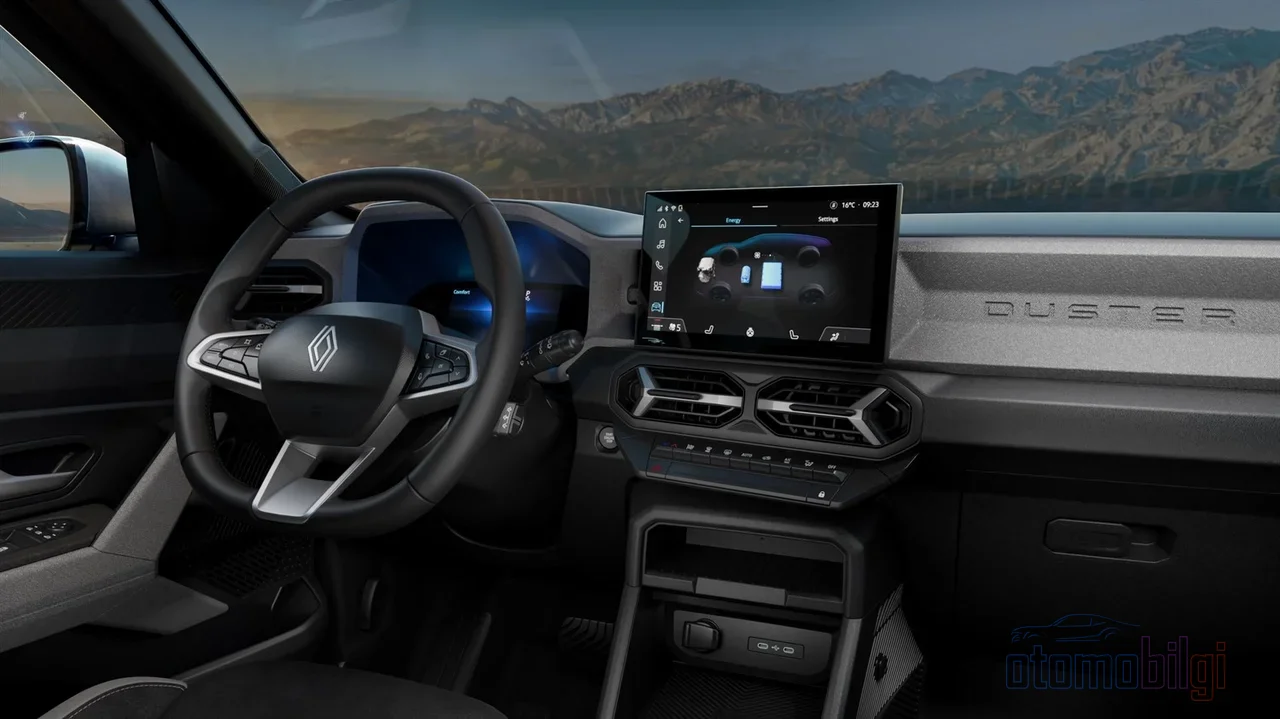
The strategy does not remain an empty promise; On October 17, the brand's first strong hybrid model, Renault Duster Strong Hybrid E-Tech 160, went on sale in India. Offered in three trim levels (Evolution, Techno, Emotion), the vehicle's technical profile has taken shape as the segment expected: a 1.8-liter gasoline engine, two electric motors and a 1.4 kWh battery, combined 160 PS output and an ARAI-certified 29 km/l fuel consumption. The fact that the hybrid mechanically does not require charging infrastructure removes the biggest obstacle in front of fully electric models in this segment.
| Feature | Duster Strong Hybrid E-Tech 160 |
|---|---|
| Engine | 1.8-liter gasoline + two electric motors |
| Battery | 1.4 kWh |
| Combined output | 160 PS |
| Fuel consumption (ARAI) | 29 km/l |
| Trim levels | Evolution, Techno, Emotion |
| Starting price | 16.99 lakh rupees (ex-showroom) |
On the CNG side, the plan: Triber and Kiger
There is another leg that is just as important as the hybrid but far more affordable: CNG. The CNG version of the Triber compact MPV is expected to launch toward the end of 2026; a CNG option will also be added to the Kiger. Management's assessment of the segment split is clear: hybrids have greater potential in models over 4 meters, while CNG has greater potential, especially through the Triber, in the under-4-meter segment with high price sensitivity.
This dual structure also helps Renault balance its sales mix extending from the entry segment to the upper segment. The current picture of the market supports optimism on the CNG side; the picture on the hybrid side, however, tells a more cautious wait-and-see story.
What is Renault's current position in India?
To correctly read the picture behind this plan, one needs to look at where Renault started. The brand's India market share, around 2.7% around 2020, had fallen to below 1% as of 2025. In August 2026, the share was measured at 0.8% and the brand took 11th place in the rankings. took its place in the ranking. For a long time, sales weight was carried by the trio of Kwid, Triber and Kiger, on a lineup based on a single entry-level platform (CMFA); this narrow structure is straining itself in a market where the segment is rapidly moving upmarket and becoming technically richer.
Signals of recovery are already visible, however. In June 2026, domestic sales reached 4,063 units with an annual increase of 55%, and the brand recorded double-digit growth for 10 consecutive months. In July, 3,293 units were sold with an increase of 28%, and in January, 3,715 units were sold with an increase of 33.6%. Across the group, India sales grew by 47.6% in the first quarter of 2026. The low base effect explains part of this, but the announced double-digit growth target rests on sustaining this momentum.
Two platforms and an expanding product range
The technical foundation of the comeback has also been established on the platform side. The old structure based on a single platform has been replaced by two different architectures: the RGEP (Renault Group Entry Platform), which supports new technologies and a broad powertrain lineup including CNG, and the RGMP (Renault Group Medium Platform), which arrives with the Duster and focuses on hybrids and electrification. The product lineup also widens from around 7 lakh rupees to 16 lakh rupees; the 9-15 lakh band, which management describes as a major opportunity, is a segment with a volume of more than 1 million vehicles.
The period ahead will be busy as well: around 10 major product and powertrain events are planned within 12 months. A model called Bridger and a larger 7-seat SUV will take the brand into upper segments; a full electric (BEV) evaluation is also on the agenda for the 2027-2028 period. The group's FutuREady strategy promises a total of seven models by the end of this decade, spanning from the entry segment to large SUVs and covering hybrid and full electric models. The target of 2 billion euro (around 25,000 crore rupees) in annual exports of vehicles, parts and services from India by 2030 is also a measure of this plan's scale.
Is the hybrid and CNG target realistic?
That is the most natural question for someone who has been reading market data for years. The picture on the hybrid side of the market is not yet hot: In August 2026, CNG accounted for 25.28% of India's passenger vehicle retail sales (21.47% a year earlier), while the total share of hybrids remained at 9.04%. The combined share of strong hybrids and plug-in hybrids was around 2% in the 2025-26 period. So Renault's 50% scenario is based not on the market's current state, but on the transformation management expects to take shape in the coming years.
The rationale behind this expectation is sound: the reason hybrid sales have not exploded so far is the small number of models and the underwhelming performance of the existing products. Demand is expected to rise with more and better hybrid models; it is thought that strong hybrids could in time reach at least the same market share as CNG vehicles. Deblaise's approach to Duster sales, which have been modest since March 2026, is also part of the same logic - it is argued that the hybrid version will reach a customer base that has not been addressed so far.
Regulation is in favor of this equation. As CAFE-3 norms tighten, hybrids effectively become an obligation for manufacturers, and the shrinking of the diesel segment is accelerating this shift. Management states that supporting strong hybrids makes sense in terms of emission reduction and public health, and that they would welcome increased government incentives; incentives are a variable that directly affects the likelihood of the scenario materializing.
Organizational background: Chennai under one roof
Behind the plan there is also an organizational change beyond the technical and commercial steps. Operations in Chennai now bring production, marketing, engineering and design together under a single executive; the old hierarchical model is assessed as having caused delays in decision-making. In the plant established more than 15 years ago under the Renault-Nissan alliance production model, Nissan transferred its shares to Renault and will produce its own vehicles on a contract basis. It is also an understandable choice that questions about capacity utilization were kept relatively secondary; at this stage the real issue is the competitiveness of the products.
On the dealer side, a revision that began 18 months ago continues, focused on improving the customer experience rather than rapidly increasing the number. For work with limited renovation costs, prices range from 25 lakh rupees up to 1.25 crore rupees for a comprehensive transformation; the main push is targeted to be completed by the end of 2027. On the technology side, localization is also an important advantage: E-Tech strong hybrid has been sold in more than 1 million vehicles worldwide since 2020 and has been localized in India with the engineering and design centers in Chennai - the largest outside Europe.
Assessment: From a low base to a high target
A more ambitious target voiced in April 2026 is also on the table: Making India one of the top three global markets for the Renault brand by 2030 and reaching approximately 5% market share. A road from 0.8% to 5% is traveled not only with a powertrain choice, but with consistency in every layer of the product - and that is exactly what Renault is doing: two platforms, a hybrid and CNG pair, an expansion into the upper segment, a dealer revision, and an organization gathered under one roof.
The risks should also be kept brief. The current share in the hybrid market is far below the 9% band, and the momentum on the CNG side may not be enough to meet Renault's hybrid expectations. Incentive policies depend on the tax structure, and each of the planned models will need to be measured against real demand in its segment. Still, for someone who has been following the twists and turns of this industry for more than thirty years, the following judgment is easy: Renault is no longer spending time in India with temporary products; it is playing with a strategy that fits the market's regulatory and pricing logic perfectly. How close the 50% target is approached two to three years from now will give this strategy its test grade.
Sources
- Renault will do exactly what the Indian market needs: CEO Stéphane Deblaise - ETAuto
- Renault India's hybrid-CNG bet could transform its sales mix - The Economic Times
- Hybrids, CNG may contribute 50% of sales in 2-3 years: Renault India CEO - YourStory/PTI
- Renault CEO sees strong hybrids matching CNG's market share in India - Business Standard
- 2026 Q1: strong growth momentum - Renault Group official press release
- Renault targets India among its top three markets by 2030, CEO says - Reuters
- Renault's India comeback relies on new strategy, old nameplate - Reuters
- New corporate average fuel economy (CAFE) norms notified - PIB
- Renault Duster Hybrid India Launch Confirmed For October 17 - NDTV
- Renault plans a 7-model lineup in India by 2030 - Autocar India