Six Cars, Six Laps: The Math of the Rallycross Final
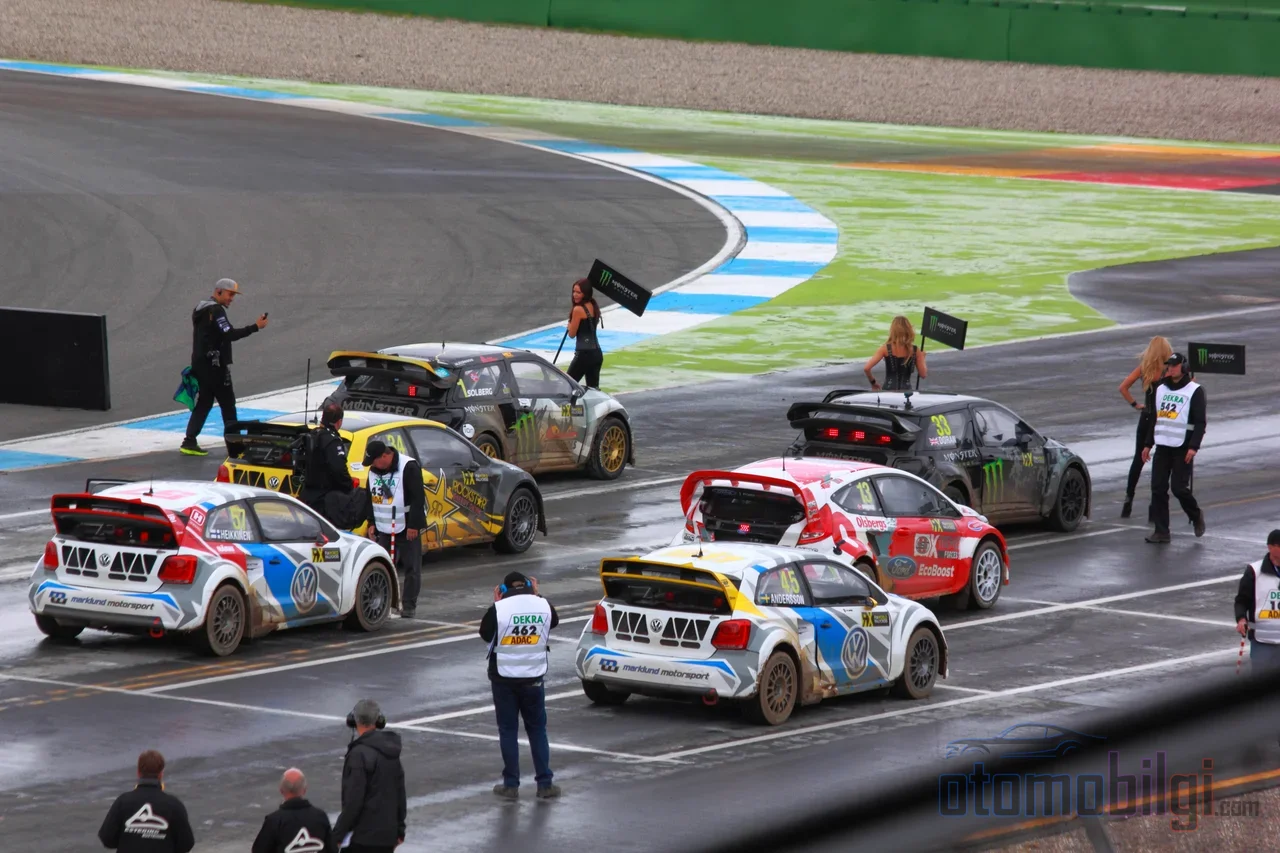
Six cars, six laps, one chance. The rallycross final offers one of motorsport's most intense five minutes, and behind that intensity lies a carefully calculated format. So where does this number six come from? Why not four, not eight, but exactly six cars? The answer rests not on a single decision; it rests on a series of choices spread across the race's structure, safety, television storytelling and the points system. On this page we go through them all one by one.
A Pyramid That Narrows Step by Step: How Does the Rallycross Format Work?
World RX events run over two days on closed circuits combining asphalt and gravel. A race weekend opens with four qualifying heats: in each, 3 to 5 cars run 4 laps including the joker lap, and the fastest total time determines the winner of that series. At the end of the qualifiers, the top 12 drivers based on intermediate points advance to the next stage.
This is where the real narrowing begins. The 12 drivers are split into two semi-finals of six cars each. Each semi-final lasts six laps, and the first three names to cross the line book their place in the final. Three plus three... there is your final: six cars, six laps, one joker lap. In the championship's classic era, this structure has been documented as the core format since the first season in 2014. So the number six is as much a deliberate design choice as it is a mathematical consequence of two semi-finals.
Highlights
- In the classic World RX format, the final is run over 6 cars and 6 laps, joker lap included.
- The top 3 of each 6-car semi-final advances to the final: 3+3=6.
- In 2022, the starting order changed so that 5 cars line up side by side.
- World RX came to an end in 2025; the 2026 FIA Rallycross World Cup brings 8-car finals.
- In 2023, Johan Kristoffersson completed his sixth world championship.
Why Exactly Six Cars? The Logic of the Structure
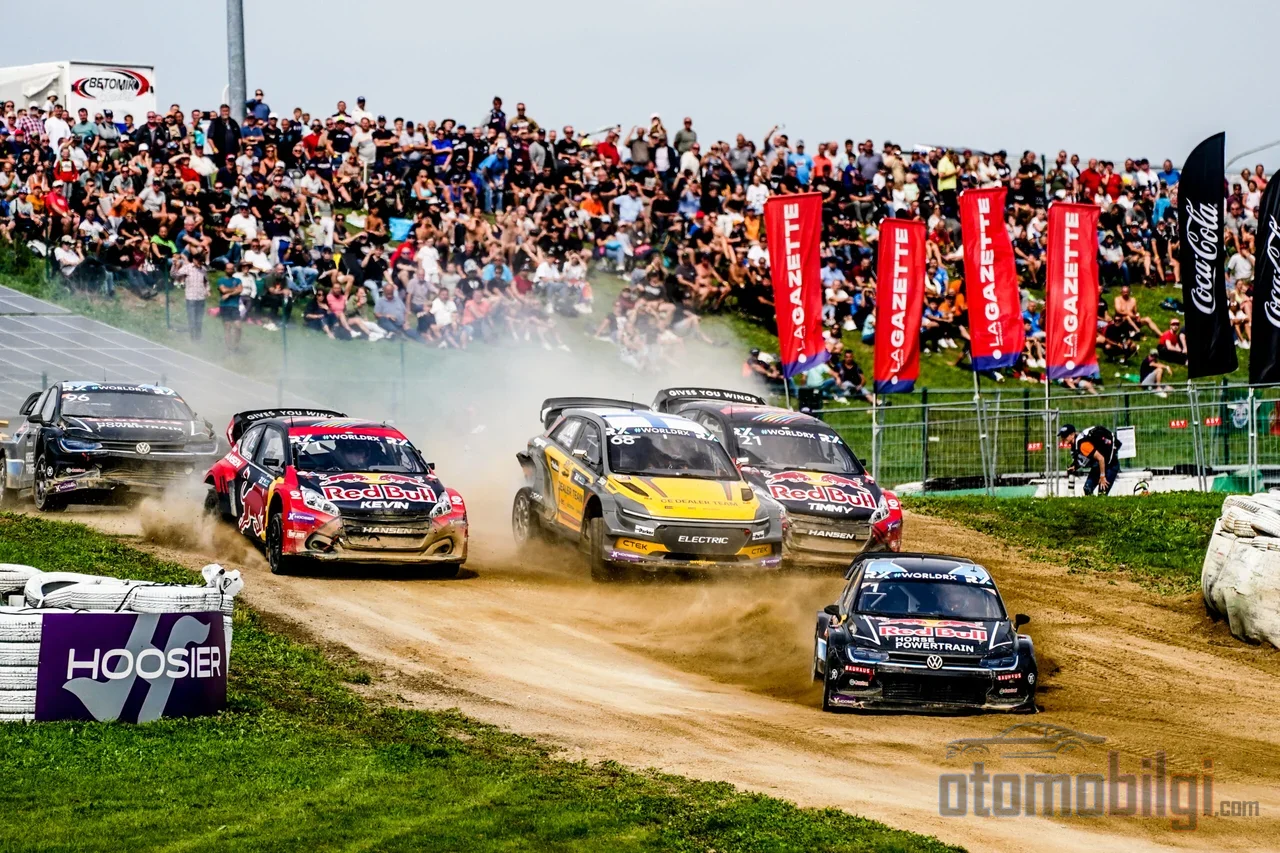
If you have watched rallycross circuits even once, you have seen the answer with your own eyes: these circuits are short and narrow. A straight of a few seconds, a sharp corner, immediately followed by a gravel section... On a track of no more than 1.4 kilometers, constantly interrupted, ten cars diving side by side into the first corner pushes the risk of crashes and traffic to a locking point. Six cars is the number that can line up in a 2x2 layout on the starting grid and leave each car enough room to breathe until the first corner. Imagine: would you want five people trying to push past you in a school corridor? A six-car grid is exactly that crowd brought under control.
On the other hand, six is not too few either. There is a constant potential for contact between the car ahead and the one behind, a position battle corner by corner; so for the viewer, wheel-to-wheel battles are never lacking. Manufacturer teams openly state that the short and fierce race format draws young audiences and suits video and television storytelling very well. Six cars is the ideal density for building a clear, followable story on screen: who is in front, who has taken their joker lap, who will pass whom when... You can see them all in a single frame.
Let's be honest: there is no official rule text stating that the number of six cars was chosen directly for safety reasons. However, the fact that in 2022 the starting format was reduced from six to five cars, and that grid capacity in different series flexes according to track width, clearly shows that the number of cars is adjusted based on such practical concerns.
The Impact of Six Cars on Strategy: The Joker Lap Tactic
The joker lap is a longer alternative route of the main track, and every driver must use it at least once per race. In a six-car final, this obligation turns the strategy into a game of chess: should you take the joker early, or save it to avoid traffic?
The examples are there to see. In Portugal, Johan Kristoffersson took his joker lap early in the semi-final, lost the lead, and won pole position for the final. In Hungary, Timmy Hansen took his joker on the fourth of six laps and came out ahead by a narrow margin. The Höljes 2020 final was a classic clash: while Mattias Ekstrom took his joker early, Kristoffersson stayed on the main track, trying to build enough of an advantage before entering his joker lap. Watching two opposite strategies battle head-to-head in the same final is proof of how deep a tactical field the six-car setup opens up.
Six cars is a number that also makes the joker tactic readable. With fewer cars, different strategies would never intersect; with more cars, no one could follow the traffic. Six drivers is a balance point where everyone can see which tactic each one is following on television.
The Final, Intertwined with the Points System
Here is the detail most viewers miss: the winner of the final does not have to be the driver who collects the most championship points at the event. Points accumulate starting from the qualifying races, and each stage rewards with its own scale.
In the classic era, there were stage-specific scales: in ranking races points were distributed from 16 to 1, in semi-finals 6-5-4-3-2-1, and in the final 8-5-4-3-2-1. Between 2022 and 2024, the final scale turned into 20-16-13-12-11-10... and so on; while in 2025 it moved to a 25-20-17-15-14-13... band. So the six-car final is not just a one-day victory stage, but the peak of a points architecture that rewards the entire weekend.
What If the Semi-Final Cannot Be Run?
The 2026 RX sporting regulations contain an interesting backup plan: if the semi-finals cannot be run, the final lineup is determined by the top six cars in the qualifying classification. In other words, the six-car final is protected even through alternative formation methods. The figure is not just a mathematical outcome, but a constant embedded in the constitution of the format.
How Did the Rule Change Over Time?
Six cars is not an absolute rule, and history has shown this repeatedly. In 2022, World RX switched to a new format in which five cars started side by side in the semi-finals and final; innovations such as the race winner choosing the first grid slot came in the same package. That same year, the series switched to the electric RX1e class: Machines producing 680 hp and 880 Nm of torque, reaching 0-97 km/h in 1.8 seconds, took to the track.
But the real big rupture came in 2025: The World RX championship was cancelled that season and, for 2026, replaced with the European Rallycross Championship. The FIA Rallycross World Cup, which will run its first season in Jakarta in 2026, brought a radical format revolution: eight-car semifinals and finals, two mandatory joker laps per race, and a completely new Superpole format. According to the FIA's framework, the goal is to put more drivers into the battle for victory compared to traditional rallycross events. From the quarterfinals, the top four advance to the semifinals; from the semifinals, the top four advance to the eight-car final, and all deciding races run six laps.
Other series are also broadening the picture: In Rallycross France semifinals, eight drivers race and the top four advance; while in RallyX's 2026 Montalegre Global Final, qualifying races are run with a maximum of five cars, and the six-car limit is maintained in the CrossCar classes. In short, the number of cars is an adjustment screw that flexes according to the character of the series and the track.
| Format | Semifinal | Final | Joker Lap |
|---|---|---|---|
| Classic World RX (2014-2021) | 2x6 cars, 6 laps | 6 cars, 6 laps | 1 mandatory |
| World RX (2022-2024) | 5 cars side by side | 5-car start grid | 1 mandatory |
| FIA Rallycross World Cup (2026) | 8 cars | 8 cars | 2 mandatory |
| Rallycross France | 8 drivers | Top 4 advance | 1 mandatory |
Short Answer: Why Are There Six Cars in a Rallycross Final?
Here is the summary of the summary: Six cars race in a rallycross final because the top three drivers from each of the two six-car semifinals advance to the final, meaning 3+3=6. This number leaves a controllable contact area on short and narrow tracks, provides a safe first corner with a 2x2 start layout, and creates a watchable, tactically satisfying story on television; it also creates a race structure that works intertwined with the tiered points system and joker lap strategy. But six is not a written destiny: The 2026 World Cup format now runs finals with eight cars.
The Lasting Legacy of the Six-Car Final
Even though the format has changed, the spirit of the six-car final is etched into the identity of rallycross. This structure showcased the joker lap mastery of six-time world champion Johan Kristoffersson, Timmy Hansen's final-corner attacks, and the strategic rivalry between Ekstrom and Kristoffersson. Six cars; stood like a golden ratio in a sport where too few feel cramped and too many turn into chaos. Although the new eight-car era adds excitement, those classic six-car finals produced some of the most memorable moments in rallycross history and left a legacy that will continue to produce them.
Sources
- FIA World Rallycross Championship
- WRX: All you need to know about FIA Rallycross
- New sporting format and Jakarta circuit unveiled for inaugural FIA Rallycross World Cup
- Calendar and format changes for the 2022 FIA World Rallycross Championship announced
- New 2026 FIA RX Sporting Regulations
- RallyX Global Final: How the sporting format will work in Montalegre
- Rallycross France Playing Rules
- World RX - Kristoffersson completes sixth World Rallycross title