Audi Investing $4 Billion in Georgia for Its First US Plant
Share This Page
Four billion dollars, marked on Georgia's dry state map as a point in the middle of Peach County. For the first time in the brand's hundred-year history, Audi will produce cars on American soil. The announcement was made on Saturday evening, October 24, in the town of Perry, on the stage of Donald Trump's midterm rally; for the first time, Ingolstadt's polished corporate world and the exuberance of a campaign rally became so obviously intertwined. So what brought Audi, after years of searching for US production, to precisely this point?
The stage: Perry, Georgia: The Factory Decision Announced at the Rally
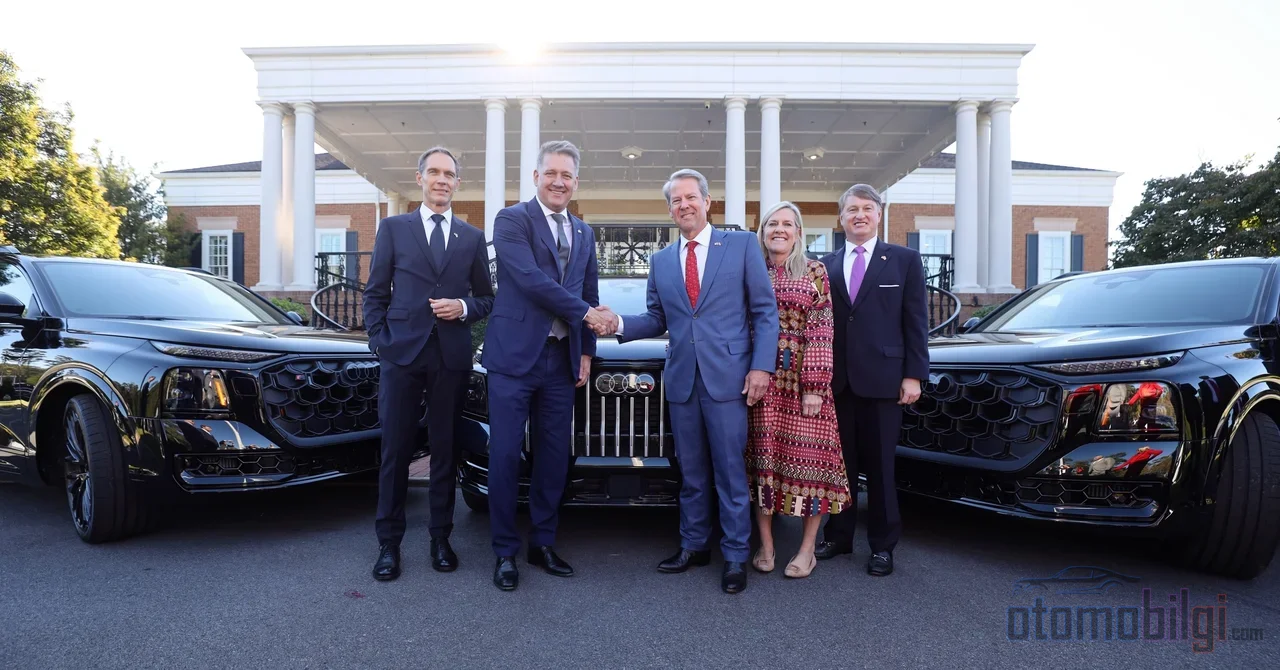
Georgia Governor Brian Kemp announced on October 24 that Audi will invest approximately 4 billion dollars in the Middle Georgia Megasite located in the town of Perry near Macon. Audi's own press release puts the figure at 4 billion dollars, with the jobs created at 4,500 people; some reports also mention a figure of 4.2 billion dollars. Such small discrepancies are common in major investment announcements; budgets not yet settled to the last cent get rounded differently in early news reports.
What really drew attention was the venue where the announcement was made. Audi CEO Gernot Döllner appeared on stage at Trump's midterm campaign rally in Georgia. It is not a usual piece of corporate choreography for the top executive of a German automaker to be seen alongside an American president in the middle of an election season; Döllner addressed this as well, emphasizing that the invitation was accepted within the framework of showing respect to the country receiving the investment. Details, including whether the deal includes a tariff reduction for Audi, were not disclosed.
This scene takes the news beyond being merely an industrial story. The Trump administration wanted to use this announcement as concrete proof that the 25% tariffs it imposed on car imports are bringing factories to America; the timing of the announcement is no coincidence either, coming at a time when Georgia has competitive elections for both the Senate and the governorship.
Highlights
- 4 billion dollars investment, Middle Georgia Megasite (Perry, Peach County) - Audi's first production facility in the US
- Annual production of up to 200,000 units; the Q7, Q8, and Q9 SUVs will be produced
- Construction begins in 2027, with full capacity expected in 2031
- 4,500 new jobs; the project has not yet passed approval by the VW Group supervisory board
- Tariffs cost Audi approximately 1.2 billion euros last year
Where Is the Factory, What Will It Produce, and When?
The Middle Georgia Megasite is one of the state's carefully developed ready-made industrial sites; just south of Macon, within the borders of Peach County. The facility Audi will build there was designed with an annual production capacity of up to 200,000 units. On social media, bolder figures of up to 350,000 are also circulating, but the official statement does not exceed 200,000; this gap between capacity estimates stems from the fact that the project is still at the commitment stage.
| Subject | Information |
|---|---|
| Location | Middle Georgia Megasite, Perry, Peach County (near Macon) |
| Investment | Approximately 4 billion dollars (some reports cite 4.2 billion dollars) |
| Models | Q7, Q8 and Q9 SUVs |
| Capacity | Up to 200,000 units per year |
| Timeline | Grading and excavation in 2027, main construction in 2028, production in the early 2030s |
| Full capacity | 2031 |
| Employment | 4,500 people |
The production list is also meaningful. The Q7 and Q8 are the large SUVs that form the backbone of Audi's sales in America; the Q9, which has not yet hit the market, is the brand's new flagship SUV set to occupy its top segment. Audi states that vehicles customized for North American customers will be produced at the facility. In the past, a car rolling out of a German factory would enter through the door of whatever market it pleased; now models, equipment, and technical content are differentiated by market. Production being close to the consumer is a natural consequence of this.
Why Now? Tariffs and Exchange Rate Risk Accounting
Behind this decision there is not a single reason, but two structural pressures that feed each other. The first is import tariffs: The 25% tax the Trump administration imposed on automobile imports seriously disrupted Audi's calculations. Last year, tariffs cost the brand approximately 1.2 billion euros - roughly 1.4 billion dollars. Across the VW Group the picture is even heavier; in 2025 the group's tariff costs were put at around 4 billion dollars, and even in just the first nine months of the year a burden of 2.5 billion dollars had already accumulated.
The second pressure is the exchange rate. Audi currently imports every vehicle sold in the US market from Europe or Mexico. This means the currency rate ties itself around the brand's ankles with every sale. Fluctuations between the euro and the dollar constantly force cost and pricing calculations to be rewritten. According to Automotive News, the currency position was also among the factors determining the plant's final location. For anyone who has been in this business for years, it is no surprise: a brand that wants to hold serious volume in the US market will eventually either produce locally or write off the exchange rate difference as an excuse against margin profit. Audi may be considered late, but it made its decision appearing determined.
It should also be added: Audi had been cooking up this decision for a long time. Döllner had previously announced that 10 new model launches were planned for the US and that production locations would be announced in 2026. In June 2026, it was reported that the brand was considering a greenfield facility in the southern US costing over 4 billion dollars. So the Georgia decision is not yesterday's brainchild, but the concluded result of a planning effort spread over months. However, one of the most critical thresholds of the road has not yet been crossed: the project has not passed the VW Group supervisory board. In German co-determination companies, this board has the final say on spending decisions, and the weight of worker representation is felt there.
Audi's Place in the VW Group's North America Strategy
Audi's Georgia move should not be read in isolation. The Volkswagen Group aims to significantly grow its market share in North America; the regional CEO's target is a 5% US market share, and the group had committed a five-year $7.1 billion product investment to the region in recent years. While the group plans more rugged and off-road-focused vehicles for the US, it is also narrowing down its model lineup. This is not a strategy of growing freely, but of growing selectively.
In this picture, Audi's first American factory is the group's most expensive and most symbolic asset in the region. The group's second Audi factory plans, once frozen under Oliver Blume's leadership, had been shelved due to capital constraints and tariff uncertainty. Now a similar project is back on the table - with clearer figures, no less. The difference is that tariffs are no longer a threat but a cost item factored into the calculation: Producing in the US shrinks the volume of imports subject to tariffs, closing the group's most vulnerable point.
How Was It Received in Germany?
The decision was not warmly welcomed in Germany. Criticism from the IG Metall camp says the hand extended to Trump just before an election period is hard to understand; the union's assessment is plain: Trump is a president who wants to weaken his own economy and especially the automotive sector, and the hand extended to him in this picture will be questioned. Union leader and VW supervisory board deputy chairwoman Christiane Benner, however, speaks more moderately: Strengthening the position in the US market with a new factory is right and necessary, but in return, clear expectations must be defined for workers at all locations in Germany.
Behind this friction lies cost pressure. As tariffs squeeze the profit margins of European industry, the tension between VW management and workers over layoffs and a possible factory closure agenda deepens. Every new line opened in the US inevitably raises the question of overcapacity in Germany. Olaf Lies, the premier of Lower Saxony - VW's second-largest shareholder - is on a line trying to manage this tension: Expanding production in the US is an opportunity as long as it also benefits German workers.
Within the US as well, tariff opponents argue that the taxes raise vehicle prices and delay some automotive investments; in other words, in the face of Trump's success story on the rally stage, there are dissenting voices in his own country too. Considering that Audi delivered 39,751 vehicles in the US in the third quarter of this year and worked with 38,030 vehicles in the second quarter, when the factory begins production it will meet a significant portion of this volume with local production, fundamentally changing the brand's profitability equation.
When and How Will the Investment Be Realized?
The upcoming schedule works as follows: Excavation and grading at the Middle Georgia Megasite in 2027, main construction in 2028, production starting in the early 2030s, and reaching full capacity in 2031. So the decision announced today will take five years to reach the consumer. Such slow maturation of major factory decisions is nothing new in the automotive industry; it used to be known that a plant would wait at least five years before its first car. What has changed is that no one can guarantee anymore how many times tariffs, election cycles, and currency waves will shift within that five-year window.
It is also worth recalling the legal knot: The project has not yet passed the approval of the VW Group supervisory board. Döllner may have taken the stage together with Trump; but the final form of this investment will be discussed at the supervisory board table between Ingolstadt and Wolfsburg. In the German co-determination system, the voice of worker representatives may not make the approval path easy until the plant's impact on capacity in Germany becomes clear.
Conclusion: Is Audi's US Move a Strategic Gain or a Political Necessity?
The real answer is most likely somewhere in between. Audi tied the way to sustain profitable growth in the US market under a 25% tariff and currency risk to local production; an investment that will eliminate part of a burden of roughly 1.2 billion euros per year is defensible in purely mathematical terms. But the same decision means a German brand being drawn onto the most tense stage of American domestic politics, and this will be questioned at the supervisory board and among the labor front in Germany. The land in Georgia will start being excavated in 2027; the real test will show under what calculations the logo on the first Q7 produced on that land won.
Sources
- Audi to establish first U.S. production site in Georgia, investing $4 billion and creating 4,500 jobs - Audi MediaCenter
- Audi makes long-term commitment to America - Audi USA Newsroom
- Gov. Kemp: Audi AG Selects Georgia to Invest $4 Billion in First US Manufacturing Facility
- Audi defends decision to stand by Trump on $4 billion US factory in Georgia - Reuters
- Audi defends plans for a $4 billion Georgia plant amid VW... - CNBC
- How Audi picked Georgia for first U.S. plant - Automotive News
- Audi to Build Factory in Georgia, Trump Says - The New York Times
- Audi's first US production plant: carmaker strikes deal with Trump - Euronews
- Audi to invest $4.2 billion in first US factory, create 4500 jobs - ET Auto
- Volkswagen unveils $7.1 billion commitment to boost product... - VW Media
- VW Group plans more 'rugged vehicles' for US... - WardsAuto