Do the Cost Math Before Buying Your Second Car
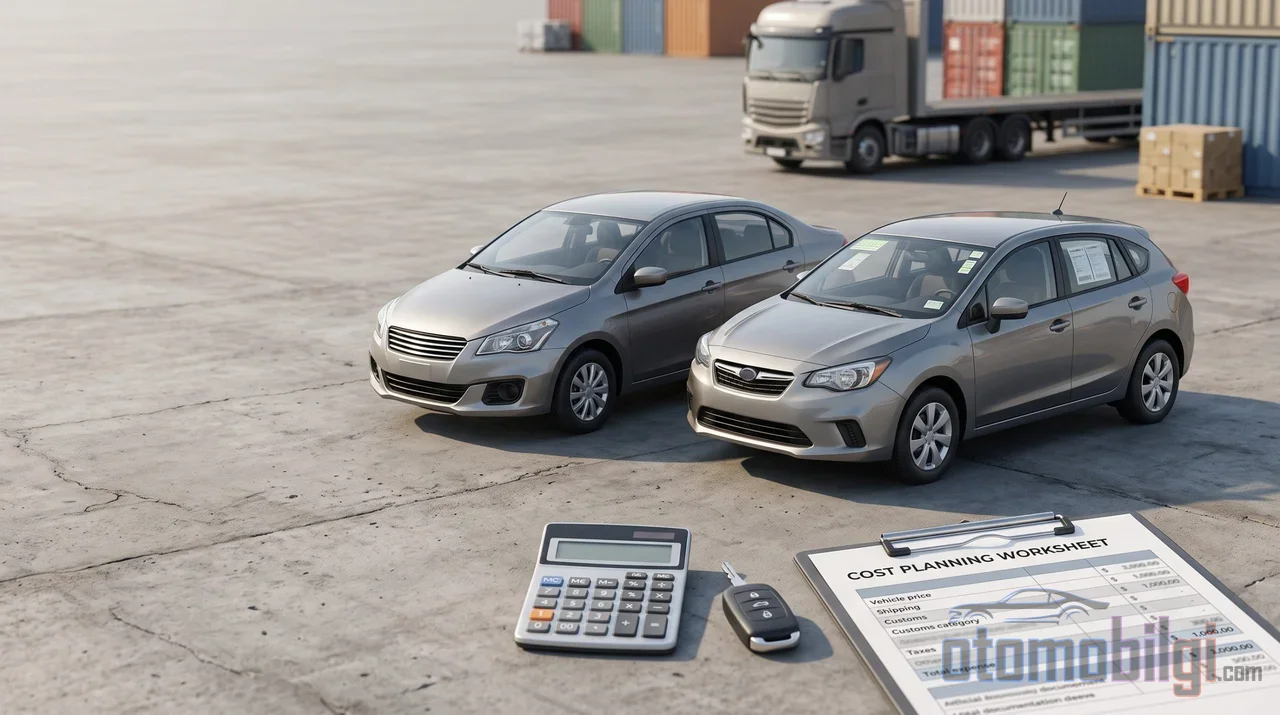
The discussion about a family's second car is almost always carried out on an emotional plane: one spouse's commute, the children's school service, weekend country roads... The suggestion seems reasonable, it even feels inevitable. Yet the math of this purchase is completely different from that of the first car. A second car is, by definition, a vehicle that will be used sparingly; and a sparingly used vehicle spreads its fixed costs over few kilometers traveled, seriously inflating the cost per kilometer. In this article, we will calculate step by step, using the total cost of ownership (TCO) method, what a second car actually adds to a family's budget.
What Is Total Cost of Ownership, and Why Is It More Critical for a Second Car?
Total cost of ownership is the annual budget of running a car, which is not limited to fuel alone: comprehensive insurance, traffic insurance, Motor Vehicles Tax, periodic technical inspection, scheduled maintenance, tires, parking, toll fees, financing costs if any, and the depreciation of the vehicle. Most families see only the fuel and maintenance portions of these items; yet invisible items such as insurance, taxes, and depreciation can exceed half of the total.
For a second car, this calculation is even more decisive than for the first. The reason is simple: the first car is usually the family's main means of transportation and covers 15,000-20,000 kilometers a year. A second car, in most families, stays limited to short weekday distances, and its annual mileage remains far below that figure. Fixed costs are paid regardless of kilometers; as the mileage drops, the same expense is divided over fewer kilometers and the unit cost climbs. In other words, the question of whether a second car is economical depends largely on the answer to the question "how many kilometers will you drive per year".
Highlights
- Fixed costs (Motor Vehicles Tax, insurance, comprehensive coverage, inspection) do not depend on kilometers; in a sparingly used vehicle, the cost per kilometer rises.
- In the sample TCO calculation, nearly half of the annual total cost comes from depreciation and financing.
- In Turkiye, average annual vehicle usage falls in the range of 12,000-18,000 km.
- The insurance premium for a second car can come out higher than for the first; segment, registration city, and no-claims record are decisive in the premium.
- For short one-way trips, taxis, and for full-day and long-distance trips, rentals are often more economical than a second car.
How to Calculate TCO: Formulas
The calculation works with two large groups: fixed costs that do not depend on kilometers (such as Motor Vehicles Tax, traffic insurance, comprehensive coverage, inspection, parking subscription) and variable costs that increase with usage (fuel, maintenance, tires, washing). To this are added depreciation, calculated as the difference between the purchase price and the sale price, and loan installments if any.
- Annual fuel cost = Annual kilometers x (fuel consumption in liters per 100 km / 100) x price per liter.
- Total annual cost = fuel + insurance + taxes + maintenance/tires + usage costs (parking, tolls, washing) + financing + depreciation.
- Monthly average = Total annual / 12.
- Cost per kilometer = Total annual / annual kilometers.
You can estimate value loss with the simple linear method: according to the depreciation formula, the annual amount is the difference between the purchase price and the estimated sale price, divided by the planned disposal period. In accounting practice, the depreciation rate is the inverse of the economic life. This method certainly cannot capture real market fluctuations exactly; but it is sufficient to reveal the second car's annual burden on the budget.
Sample Calculation: It Is the Method, Not the Price, That Teaches
To make the concept concrete, let us go through an example that contains no market prices and only demonstrates the calculation mechanics. Consider a vehicle that covers 15,000 kilometers a year, consumes 7.2 liters per 100 kilometers, and fuel costs 48 units per liter. This vehicle consumes 51,840 units of fuel per year. Adding 30,000 units for insurance, 8,000 for MTV, 20,000 for maintenance and tires, 12,000 for parking-toll-washing, 25,000 units for financing, and 70,000 units as annual value loss, the total is 216,840 units/year, or roughly 18,070 units per month. This vehicle's cost per kilometer is around 14.5 units.
Now apply the same table to the second car. The fuel, maintenance, and tire items shrink with mileage; but insurance, MTV, inspection, and comprehensive coverage do not shrink. Value loss also feeds more on age than on mileage; it decreases, but never reaches zero. If a family drives the same car 5,000 kilometers a year, the fixed-weight items are divided over a third of the distance, and the cost per kilometer climbs to nearly double. The second car's real cost lies hidden here: it emerges not at every trip to the pump, but in the annual total and the unit cost.
Anatomy of Fixed Expenses: MTV, Insurance, Comprehensive Coverage, Inspection
In Turkiye, MTV is determined by vehicle type, engine displacement, vehicle age, first registration date, and in some cases the vehicle's value. Contrary to common belief, the tax is tiered by engine capacity, not by exhaust emissions; fully electric vehicles pay about a quarter of the MTV of an equivalent internal combustion vehicle. The tax decreases gradually as the vehicle ages; a 2-3 year old vehicle pays somewhat lower MTV than its brand-new counterpart. The Motor Vehicles Insurance Value List is used as the basis for the MTV amount; the refund of the tax overpaid in an amount exceeding 5 percent of the insurance value can be requested from the tax office or via the Digital Tax Office. In an aging second vehicle, this refund mechanism is an item that can return to the budget, however small.
The comprehensive coverage premium depends on the vehicle's current market value; a new car's comprehensive coverage is more expensive than its second-hand counterpart because of its higher value. This eases the insurance side of an old, low-value vehicle if a second car is to be purchased. However, the second car's traffic insurance may come out higher than the first vehicle's: the premium is shaped by the vehicle's segment, the city where it is registered, and the driver's no-claims history. The no-claims discount is evaluated on a vehicle and driver basis; that is, accident-free years on one vehicle may not automatically carry over to the other vehicle's policy. Insurance companies have introduced limits in the new regulations regarding the number of vehicles that can be linked to a single person and the purchase-sale dates; before buying a second vehicle, it is necessary to clarify under which conditions the policy will be written.
On the inspection side, the first inspection for cars is done 3 years after registration. For an overdue inspection, an additional 5 percent of the fee is paid for each month of delay; this increase foreseen in Article 35 of the Highways Traffic Law is a classic trap that is overlooked with a rarely used second vehicle. When the car is driven little, the calendar is forgotten too.
Depreciation: The Largest and Most Invisible Item
The heaviest cost of car ownership is depreciation, an item that is usually never invoiced. The classic rule of mature markets is this: a car loses about one fifth of its value in its first year, and close to one third in the first three years. In Turkiye, high inflation and currency movements push prices upward in lira terms; this does not mean the vehicle has "appreciated". What really needs to be examined is how much cheaper the car is compared to today's equivalent new model, that is, the real depreciation.
The tax structure determines part of this loss in advance: about 43-48 percent of an economy car's final price consists of taxes such as the Special Consumption Tax and VAT, and these burdens are paid once, upfront, at the new purchase; they do not come back at resale. Depreciation is harshest in the first few years, then slows down. The reverse reading is also possible: a 3-5 year old low-mileage vehicle is a sensible range in terms of the price-performance balance, because the steepest loss has been borne by the previous owner. Choosing a 2-3 year old vehicle when buying a second car is the most practical way of, in effect, renting out the harsh depreciation of the early years.
Low Mileage Is Not Always Profit
The market gives a premium to vehicles with mileage significantly below average; in Turkiye, average annual usage is in the 12,000-18,000 kilometer band. Roughly, vehicles in the 0-30,000 kilometer range are sold at a premium of 3-8 percent above the market average, while a loss of 5-15 percent occurs at the psychological threshold of 100,000 kilometers; after 150,000 kilometers the pool of buyers narrows and the loss exceeds 10-20 percent.
However, in the second-vehicle context there is a subtle paradox here. In vehicles that are used little for long periods, tires age, battery life shortens, and fluids and electrical connections can cause problems; a low-mileage vehicle with neglected maintenance is riskier than a high-mileage vehicle with regular maintenance. Mileage alone is not a valuation criterion; it must be read together with the service record. Buying a second car with the thought "we will use it little" and leaving it idle for long periods both raises the unit cost and technically ages the vehicle.
Comparison with Alternatives: When Are Taxi and Rental Cheaper?
If the second vehicle's TCO turns out high, the only alternative is not to turn into the family taxi driver. The comparison is made between two figures: the real monthly cost of a second car versus the cost of meeting the same need by taxi or rental. As a rough rule of thumb, taxi is advantageous for short, one-way trips; for long distances and all-day use, renting a car is often more economical. Daily rental lowers the unit cost on heavily used days; economy segment cars offer a clear advantage over SUVs both in daily rate and fuel consumption.
The decision principle is this: convert your own usage pattern into a number. For a monthly need of 400 kilometers, carrying a car with fixed costs can turn out more expensive than covering the same distance by taxi. If the same family regularly drives 600 kilometers of country roads on weekends, the equation reverses. The truth is not a universal answer, but a calculation method to be applied to each family's own kilometer table.
When Is a Second Car Economical?
Everyone who runs the numbers reaches the same conclusion: a second car is economical when it is used enough to justify its fixed costs. Let's make it concrete.
- If two working parents' commute hours do not overlap and public transport is insufficient, the second car enters daily use; kilometers increase, unit cost falls.
- If the family regularly takes long weekend trips, the combined taxi and rental total quickly approaches the annual cost of a second car.
- If the second car is chosen as a 2-3 year old, low-mileage second-hand vehicle with regular service records, the steepest depreciation and heavy comprehensive insurance premium remain with the previous owner.
- If the vehicle is electric, the roughly one-quarter lower annual motor vehicle tax compared to an equivalent internal combustion vehicle eases the fixed cost side.
The opposite scenario is just as clear: a second car that sits in the garage on weekdays and makes a few short trips a month deducts a regular monthly amount from the family budget and offers few kilometers in return. Moreover, the battery, tire and fluid problems brought on by infrequent use can inflate the maintenance item.
Conclusion: Decision Statement
The summary of the summary is this: a second car is worth it when its annual total cost (fixed costs + variable costs + depreciation) falls below the cost of meeting the same need by taxi and rental. To reach that threshold, the vehicle must cover enough kilometers, that is, the fixed costs must be spread over distance. If it will be used little, a rental and taxi combination when needed remains more sensible for most family budgets than buying a second car. Provided you keep the figures up to date, applying the four formulas in this article to your own family's kilometer and cost table is the kind of task that will clarify the decision overnight. The observation of someone who has been in this business for thirty years is this: the cost of the second car in the garage is understood not at purchase, but at the first insurance renewal and the first annual depreciation.
Sources
- Vehicle Total Cost of Ownership Calculator | Monthly and Annual
- New Car or 2-3 Year Old Second-Hand? Depreciation Calculation
- How Does Mileage Affect Vehicle Value?
- 7 Factors Affecting 2026 Second-Hand Vehicle Prices
- 2. Will Compulsory Traffic Insurance Turn Out to Be Expensive?
- Motor Vehicles Tax - TSB
- Excess MTV Paid on Amounts Exceeding 5% of the Comprehensive Insurance Value
- 2026 Current Vehicle Inspection Price List - TÜVTÜRK
- What Is Depreciation and How Is It Calculated? - QNB
- Rent a Car or Taxi?