Leclerc Lost Two Points with the Lawson Collision
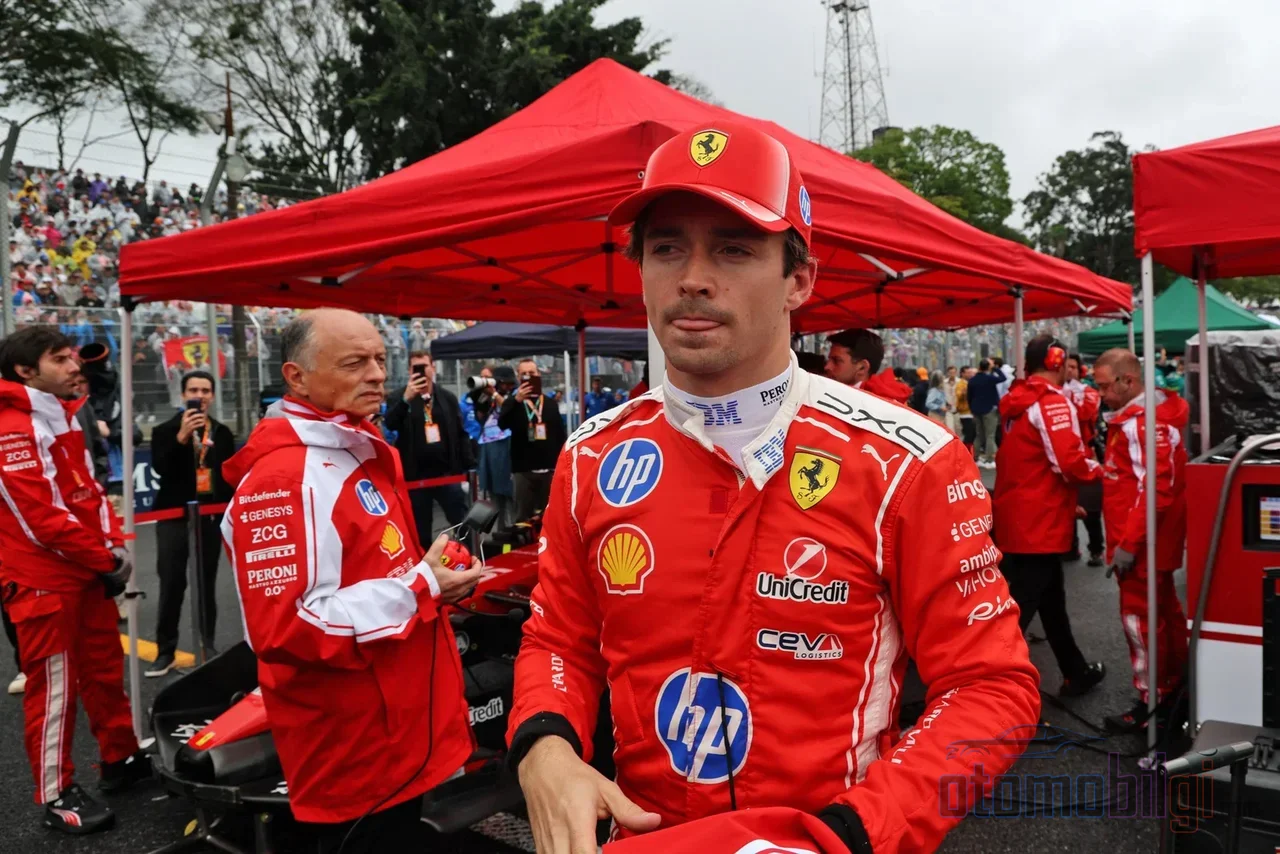
69th lap at Interlagos. An overtaking attempt starting at the Juncao corner at the end of the lap turned into a stewards' file that carried a position battle with no connection to the podium into the middle of the night. Charles Leclerc paid the price for his contact with Liam Lawson at the Sao Paulo Grand Prix after the race was over: A 5-second time penalty, two super licence points, and a drop from seventh to eighth. So what deserved such a harsh penalty?
How Did the Contact at Juncao Unfold?
Leclerc had started the race from 14th place and went through the opening stint at a pace he himself described as terrible. After switching to intermediate tyres, Ferrari became competitive again, and the Monegasque driver closed in on Lawson's Racing Bulls in the final laps, fighting for seventh.
At the end of lap 69, entering Interlagos' famous uphill run to Juncao, Leclerc launched his overtaking attempt. His front wing touched Lawson's left rear tyre; the contact was small but clear. Immediately after this touch, Leclerc managed to get ahead five corners later at the exit of the Senna S and finished the race in seventh, 1.816 seconds ahead of his New Zealand rival.
This gap would determine the penalty decision: When the 5-second time penalty was applied after the race, Leclerc's razor-thin advantage over Lawson evaporated and the order changed.
Highlights
- Leclerc was given a 5-second time penalty and 2 super licence points
- The contact occurred at Juncao at the end of lap 69; Leclerc had finished 1.816 seconds ahead
- The penalty dropped Leclerc from 7th to 8th, Lawson moved ahead with 6 points
- Mercedes secured the Constructors' with a 142-point margin
Which Decision Did the Stewards Reach?
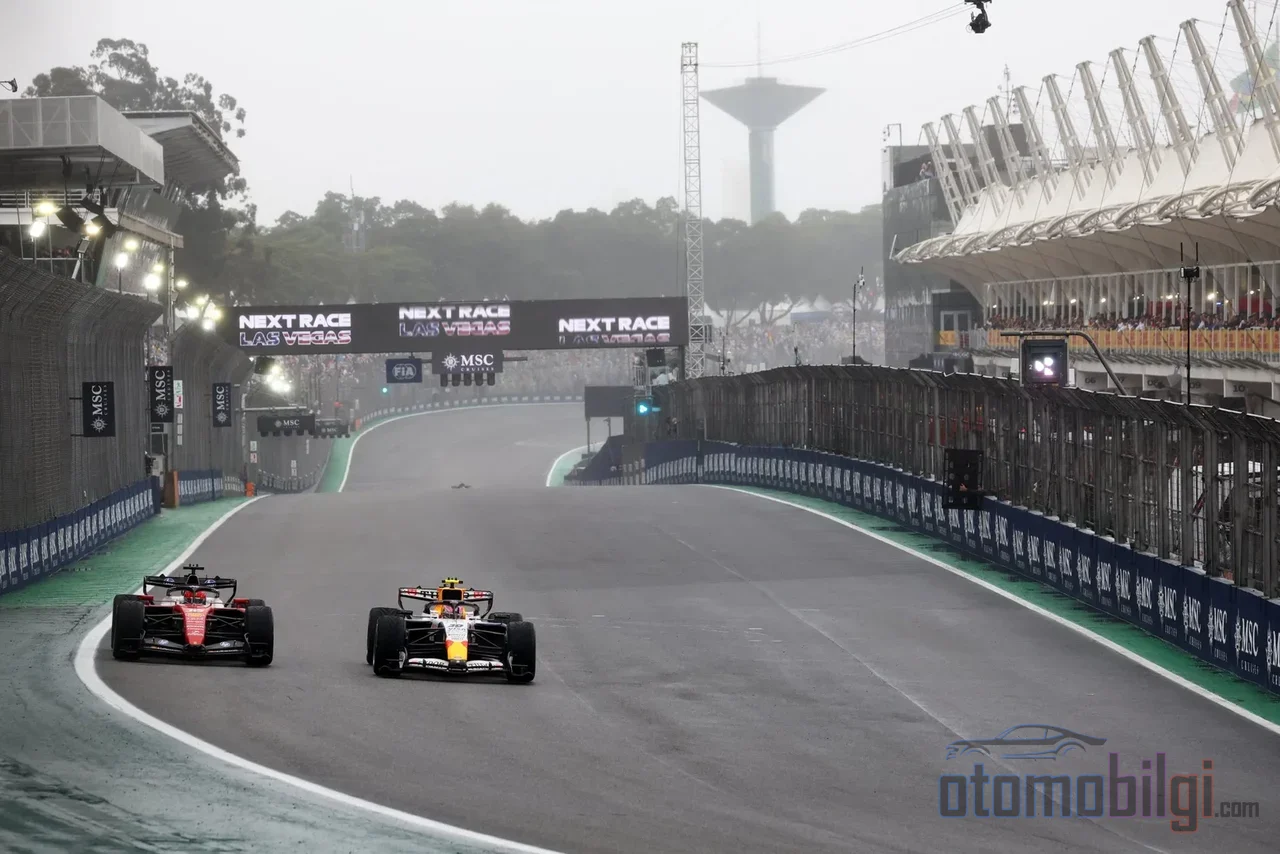
The stewards heard both drivers and team representatives; they examined positioning data, television footage, and onboard cameras. The reasoning behind the decision rested on two pillars. First, although the contact was minor, it clearly produced a sporting consequence: the touch damaged Lawson's left rear wheel and enabled Leclerc to get close thanks to the contact and complete the pass shortly afterwards. Second, under the driving standards rules, Lawson was defined as the driver entitled to the line in the corner; the obligation to avoid a collision lay with the driver attempting the pass, that is, Leclerc.
Mitigating factors were also included in the file. The wet track conditions and the smallness of the contact influenced the stewards to rule a 5-second penalty instead of the standard 10-second penalty. Leclerc's defence that the contact was insignificant and produced no obvious sporting consequence was not accepted.
There is also an interesting technical detail: Since Lewis Hamilton was ninth and a lap behind, an even larger penalty would not have dropped Leclerc behind the Briton. So the weight of the penalty was not the issue, but rather the split second between him and Lawson.
What Is the 'GP2 Move' and Why Is It Back in the Spotlight?
Lawson pressed on with the incident in front of the press after the race. The New Zealand driver openly expressed doubts about the legality of the move, stating that what was done to him was exactly identical to the move made on Alexander Albon in GP2 in Abu Dhabi nine years earlier.
The reference here goes back to the 2017 season, the year Leclerc dominated the Formula 2 championship. On the final lap of the sprint race in Abu Dhabi, Leclerc had touched the back of Albon's car to take the lead and claim victory. From Lawson's point of view, this is a maneuver that falls within a driver's area of expertise; the stewards, however, reversed the positions this time and penalized the maneuver.
Looking at it in terms of the championship, the paths of the two drivers are particularly interesting: Leclerc leaves Brazil with 249 points along with the penalty, while Lawson emerged from a battle that was turned into a crisis without a podium, with 89 points and two bonus championship points.
The Penalty's Impact on the Championship Table
What looked like a single position swap also affected the championship math. Lawson, who took over seventh place, gained 6 points while Leclerc's gain dropped to 4 points. On the teams' side, Mercedes secured the Constructors' Championship with 652 points, and the gap to Ferrari grew to 142 points; Racing Bulls, meanwhile, remained on 114 points.
| Driver / Team | Points after Brazil |
|---|---|
| Charles Leclerc | 249 |
| Liam Lawson | 89 |
| Mercedes | 652 |
| Ferrari | 510 |
| Racing Bulls | 114 |
Three More Separate Penalties in the Same Race
The Leclerc case was not the only steward decision at Interlagos. The FIA handed out a total of three 5-second post-race penalties.
- Kimi Antonelli (Mercedes) received 5 seconds for unsafely cutting across Franco Colapinto's path at the pit exit; the penalty increased the gap to Lando Norris from 36.017 seconds to 41.017 seconds, but he kept fifth place.
- Oliver Bearman (Haas) received a 5-second penalty for being released in an unsafe manner while Leclerc was in the pit lane; Leclerc had been forced to brake and squeeze toward the pit wall. Bearman remained in 17th place.
These penalties turned the provisional result into the final classification and determined the final order of the post-race standings.
Reactions Divided in the Paddock Camps
The decision divided the paddock just as much as the spectators. Lando Norris found the penalty excessively harsh, arguing that Leclerc's move was defensible. The Lawson camp, meanwhile, emphasized that the contact happened in the form of a hit to their tires and that they were lucky. On social media, while some saw the incident as an ordinary racing accident and considered the penalty unnecessary, others argued that a pass made by hitting the wheels could not go unpunished.
In cases like this, a wet surface is always a difficult parameter; a loss of grip can shift a driver's braking point by meters. The stewards settling the decision at 5 seconds instead of 10 was a sign that they took the conditions into account. However, the sport's trend in recent years is clear: in contact that produces a result, the side attempting the pass bears the full risk. Such a maneuver, which was deemed to have no result in Abu Dhabi 2017, was billed with points, positions, and two super license points at Interlagos 2026.