When Is the Red Flag Waved in MotoGP?
Share This Page
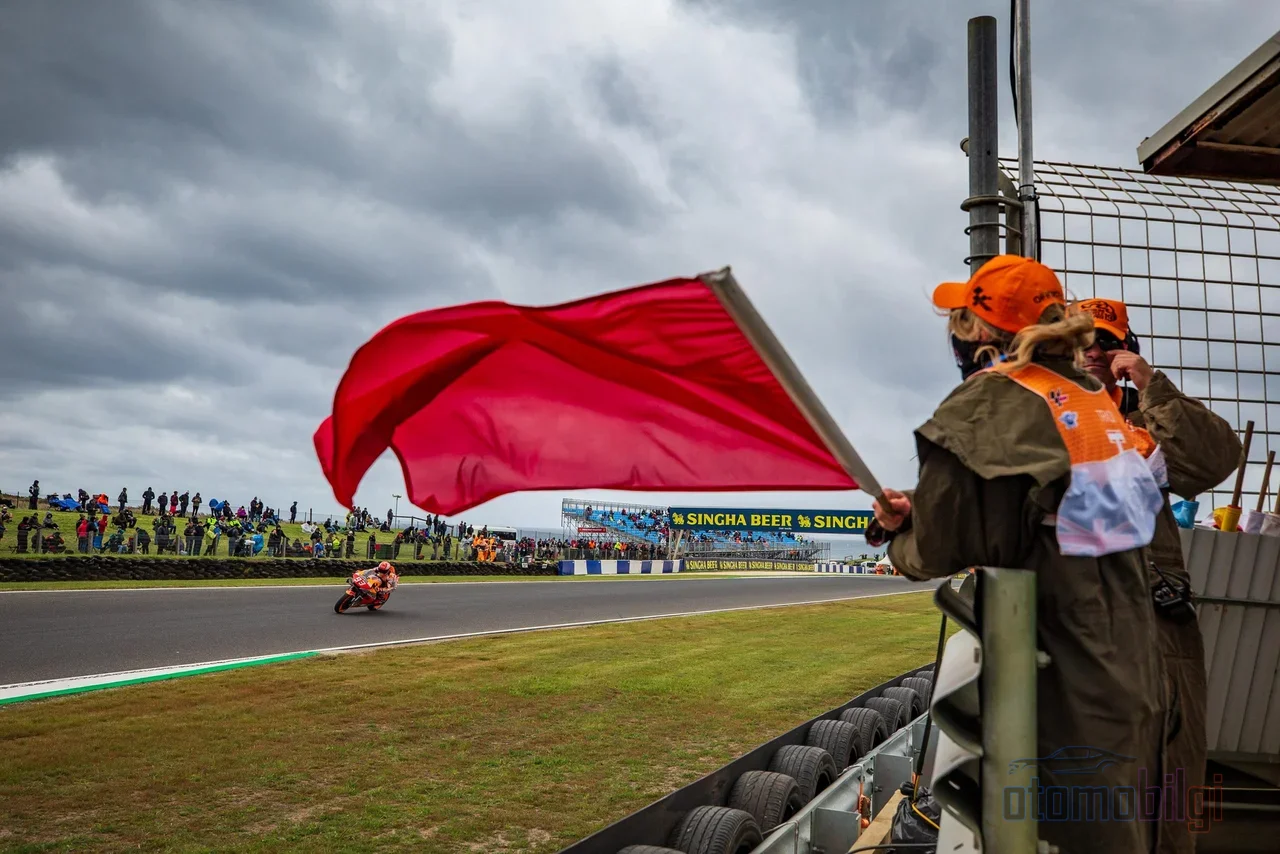
A red flag in MotoGP means the race is stopped immediately by a Race Direction decision on safety grounds: red flags are waved at all flag points around the track, red lights come on, and riders slow down and return to the pit lane. What happens to the race depends entirely on the number of laps completed; the race is either restarted or concluded with the current standings, and points are distributed accordingly.
Key Highlights
- Under a red flag, riders must return to the pit lane with their motorcycles within 5 minutes.
- If fewer than 3 laps have been completed, the race is declared void and an entirely new race is run.
- In MotoGP, if 3/4 of the race distance has been completed, the race counts in full and full points are awarded.
- 2023 Catalan GP: two red flags and three race starts in a single weekend.
- From 2026 onwards, restarting the motorcycle on track after a crash is prohibited.
Imagine this: a teenager used to turtle-slow traffic having to manage dozens of prototypes cornering at 360 km/h all at once. That's exactly why the red flag exists in MotoGP - the big emergency stop button that freezes everything when things spiral out of control. So when exactly is it waved, and what happens to the race afterwards? Let's go step by step.
When Is the Red Flag Waved?
The decision rests entirely with Race Direction, and the reason is always the same: rider safety. The flag is not shown unless an immediate risk in track conditions is deemed to exist. The moment the flag is waved, red flags go up at every flag point around the track, and the red lights along the edge of the track come on too. Riders don't accelerate; they slow down carefully and return to the pit lane. When the pit exit is closed, no one can re-enter the track from the pit lane. Moreover, riders must reach the pit lane with their motorcycles within 5 minutes - a rather short time to get back to the pits from a crowded race track.
There are three classic reasons for a red flag:
- Severe weather conditions: The rain intensifies to the point where racing is no longer safe.
- Dangerous track surface: An oil spill, debris, or anything else that renders the track unusable.
- Multiple or dramatic crashes: Not a single crash, but major incidents blocking the track at multiple points.
And here's the lesser-known side of things: not just races, but practice and qualifying sessions can also be stopped with a red flag. For example, in 2026 a practice session at Phillip Island was stopped with a red flag because a kangaroo wandered onto the track. In Australia, the track is sometimes owned by a marsupial - go figure.
When Are Points Full, and When Are They Halved?
This is the most confusing part of the red flag. The rule is split into three scenarios based on the number of laps completed, and the scenarios use slightly different criteria for MotoGP versus Moto2/Moto3. The best analogy: if a fire drill interrupts a movie halfway through at the cinema, do you get a full or partial refund on your ticket? MotoGP has a clear answer to that question.
| Distance Completed | Result | Points |
|---|---|---|
| Less than 3 laps (all classes) | Race is declared invalid and canceled if it cannot be restarted | No championship points |
| 3+ laps but less than 3/4 of the distance (MotoGP) or less than 2/3 of it (Moto2, Moto3) | Race is considered incomplete and is restarted | If it cannot be restarted: half points if less than 50% of the distance is completed, full points if 50% or more is completed |
| 3/4 or more of the distance (MotoGP) or 2/3 or more of it (Moto2, Moto3) | Race is considered complete | Full championship points |
The best real-life example of this table is the 2023 Japanese GP. The 24-lap race was stopped with a red flag after 12 laps due to heavy rain. It was below the 3/4 distance criterion, meaning the race should normally have been restarted - but the conditions never improved. Since 50% of the full distance had been completed, full points were awarded and Jorge Martin closed to within 3 points of leader Francesco Bagnaia. So a single race can change the championship standings without ever being run again.
How Is the Order Determined When a Race Restarts?
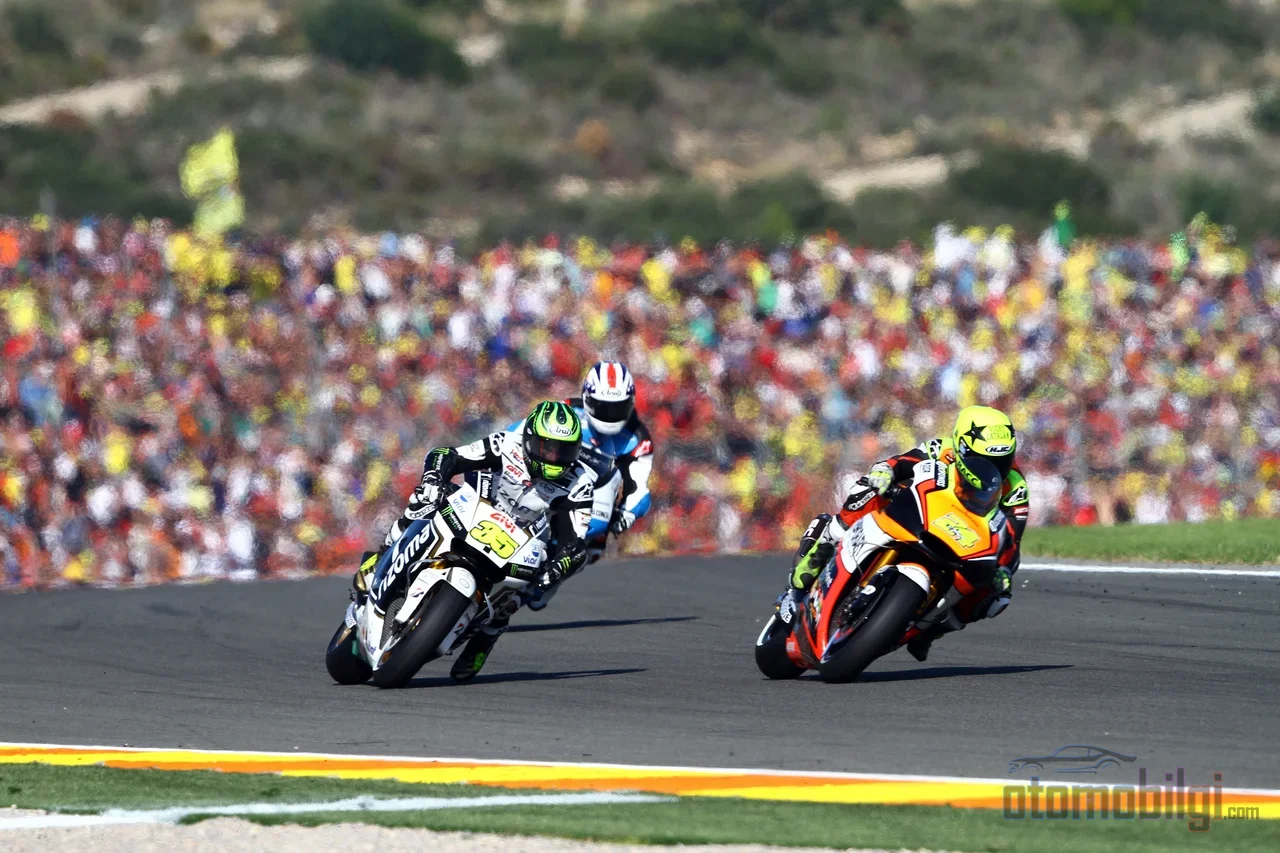
Restart rules also vary depending on the laps completed, and the logic here is actually very easy to understand: if the race has not yet started, everyone's chances are equalized; if the race has progressed somewhat, the results achieved so far are respected.
If Fewer Than 3 Laps Were Completed
The race is considered to have barely been run at all. All riders - including those who had not even completed the original warm-up lap - can start. The grid is set just like in the original race, and in MotoGP the new race distance is one lap less than the original distance. In Moto2 and Moto3, the new distance is calculated by rounding down to 2/3 of the original.
If 3 or More Laps Were Completed
This is where things get serious. Only riders classified as finishers in the first race can restart - that is, those counted as having finished the race. Those who crashed out sit and watch. The grid is also formed according to the finishing order of the first race. Those who lost a lap to the leader start from pit lane, and those who lost two or more laps cannot start at all. In MotoGP, the number of remaining laps is enough to complete the original distance, and this is never less than 5 laps. Also, penalties given in the first part but not yet served (for example, a Long Lap) carry over to the restarted race - there is no escaping a penalty by deferring it to the restart.
In races stopped due to weather and restarted on a wet track, teams switch to wet tires and settings. In short-distance restarts, on the other hand, you can see more aggressive tire and tactical choices; the calculations change when there aren't 15 laps left to lose.
What Is the Difference Between a Red Flag and Flag-to-Flag?
These two are often confused, but the difference is as clear as night and day. In a flag-to-flag race, when the track starts raining, a white flag is shown and, by Race Direction decision, the race switches to flag-to-flag rules: the race never stops, and riders pit to switch to their second motorcycles. Under a red flag, the race comes to a complete stop, everything halts, and the lap rules described above come into play. In one, you change tires while the race continues; in the other, you press a button and take a coffee break - they don't actually drink coffee, but you get my point.
There's another detail people wonder about: what happens if the red flag is shown after the checkered flag? In that case, how riders on different laps will be classified is affected; in other words, the classification calculation is redone based on the exact moment the flag came out.
Unforgettable Red Flag Moments from History
To understand what the red flag is for, it's better to look at these moments rather than the list of rules. Each one is like a lesson from a different scenario.
- 2023 Catalan GP: Perhaps the wildest weekend of recent years. Bagnaia took 2nd. 2 and almost at the same moment, a multi-rider crash occurred at turn 1. The race was immediately stopped and the red flag came out. Bagnaia couldn't take part in the restart but still secured the championship. On Turkish social media, this weekend is still remembered as "two red flags and a race started three times."
- 2010 Spanish GP, Moto2: An oil patch on the track caused a multi-rider crash, the red flag came out, and the race was rerun over 17 laps. A classic example of how the distance rule is shortened in practice.
- 2020 Austrian GP: The incredible crash between Johann Zarco and Franco Morbidelli at turn 3 - as the motorcycles danced in the air, debris flew right past the riders' noses. The red flag and red lights came into effect instantly. This crash is one of the clearest demonstrations of how fast the system works.
- 2021 Algarve GP: After the crash involving Lecuona and Oliveira, the race ended under a red flag with only 2 laps remaining.
If you've noticed, they all have one thing in common: the flag never shows any delay. When in doubt, the race is stopped, because the cost of losing a few laps can never be compared to the cost of losing a rider.
Rules Changing in 2026: The Restart Ban and the New Grid
There's also a current chapter in the red flag story. Starting from the 2026 season, the FIM has banned restarting motorcycles on the track or in the run-off area after a crash or major technical failure. The machine must now be moved to the service lane or a safely protected area. The official rationale is to minimize track officials' exposure to danger. Some have called this ban a soft ban, and the debate hasn't ended: while marshal safety is protected, there's discussion about whether pushing or carrying a rider's motorcycle elsewhere might put them in a risky position. I think this debate will continue to be discussed throughout the season - let's wait and see.
Another innovation concerns the starting formation. In the new grid layout used for the first time at the German GP, the distance between riders was increased from 3 meters to 4 meters, and the gap between rows was also increased. The aim is to improve safety at the moment of the start - since restarts in MotoGP are already done from a full grid start in a world without a safety car, this also directly affects starts after a red flag. By the way, a quick note: There is no safety car in MotoGP. There is no Formula 1-style system of getting in the car behind yellow flags and lining up in order here; either the race stops or the race continues, there is no in-between format.
The Fine Line at the Moment of Decision: Fairness or Safety?
The debates around the red flag are also interesting. First, grid fairness: according to some fans, it would have been fairer for the riders who crashed to start from the back of the grid rather than their original positions - the official rule, however, bases it on the finishing order of the first race in a 3+ lap scenario. Second, the timing of the decision: in some cases, whether it was right not to red-flag the race is being debated; it is said that riders already knew the conditions were similar throughout the day, and a reminder is made - there is a mechanism by which riders can also trigger a red flag. So the decision is not always a one-sided order; riders can also voice safety concerns.
In conclusion, the red flag is one of MotoGP's harshest but most vital tools: along with the 5-minute pit return, lap-based points tables, restart grids and 2026's new bans, these rules are the silent heroes that ensure everyone comes home safe in the world's fastest motorcycle championship. Next time the red lights come on, you will now know what is happening, why the points are split in two, or who is starting the restart and who is watching from the sidelines. Do you think the grid order in a restart is fair? My opinion is clear: when safety wins, motorcycle racing wins.
Sources
- What Happens if a MotoGP™ Race is Red-Flagged?
- How Does the Flag System Work in MotoGP™?
- MotoGP™ Rules and Regs: Red Flags after the chequered flag
- What is the MotoGP™ Points System? - all you need to know
- FIM Bans Track Side Restarts In WorldSBK And MotoGP
- MotoGP improves marshal safety with 2026 rule change
- MotoGP riders react to new starting grid rules after German GP sprint
- MotoGP's new 'soft ban' on crash restarts explained