How Is Safety Equipment Set Up in Drift Racing?
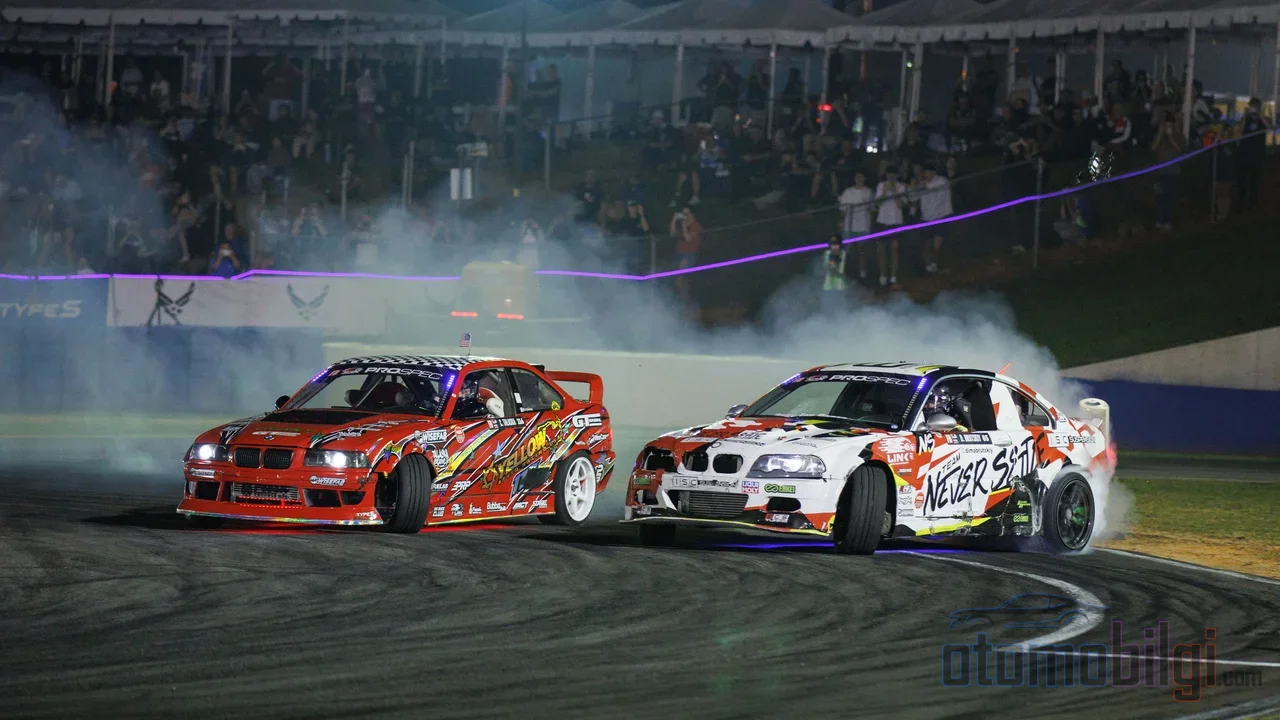
Sideways slides of nearly two meters on the track, a car disappearing inside burning tire smoke, and a driver laughing inside it... Drifting is one of the most enjoyable motorsports to watch, but what happens inside the car is not so cheerful. A head hitting the roof while sliding sideways, a cabin being crushed in an overturned vehicle... That is exactly why safety equipment in a drift car is subject to far stricter rules than in a road car. So what really makes a drift car safe? Is it the cage, the seat, the harness, or something that comes before all of them? Let's take a look one by one.
Why Does a Drift Car Need Safety Different From a Regular Car?
In a road car, safety mostly comes from the factory: airbags, crash tests, a durable body. In a drift car, most of the factory solutions are either removed or replaced with an entirely new structure. Because drifting is a discipline where the car constantly operates at its limit, sliding sideways and sometimes scraping against walls. This puts the burden of safety on parts added one by one: the roll cage, racing seat, multi-point harness, fire suppression system, kill switch, and the right helmet and clothing.
Internationally, the FIA's technical regulation for drift cars sets out detailed requirements for each of these parts. On the Turkiye side, TOSFED's 2026 National Drift Technical Rules draw a similar framework, from the fire suppression system to the side window net, and from the harness to the head and neck support system. So neither at the international level nor in the Turkish championship can you say "I set it up however I wanted."
Highlights
- In the FIA drift technical rule, the cage is attached to the chassis with 8 mounting points; the mounting plates must be at least 2 mm thick with a surface area of 120 cm².
- In the harness, the shoulder straps are mounted at an angle between 0° and −20°; a 6-point FIA-approved harness is the standard recommendation.
- The external kill switch must be located next to the driver's door, with a blue triangle marker of 120 mm diameter.
- The FIA drift event guide requires two extinguishers trackside, each of at least 6 kg.
Roll Cage: Not Just Pipes, But a Work of Engineering
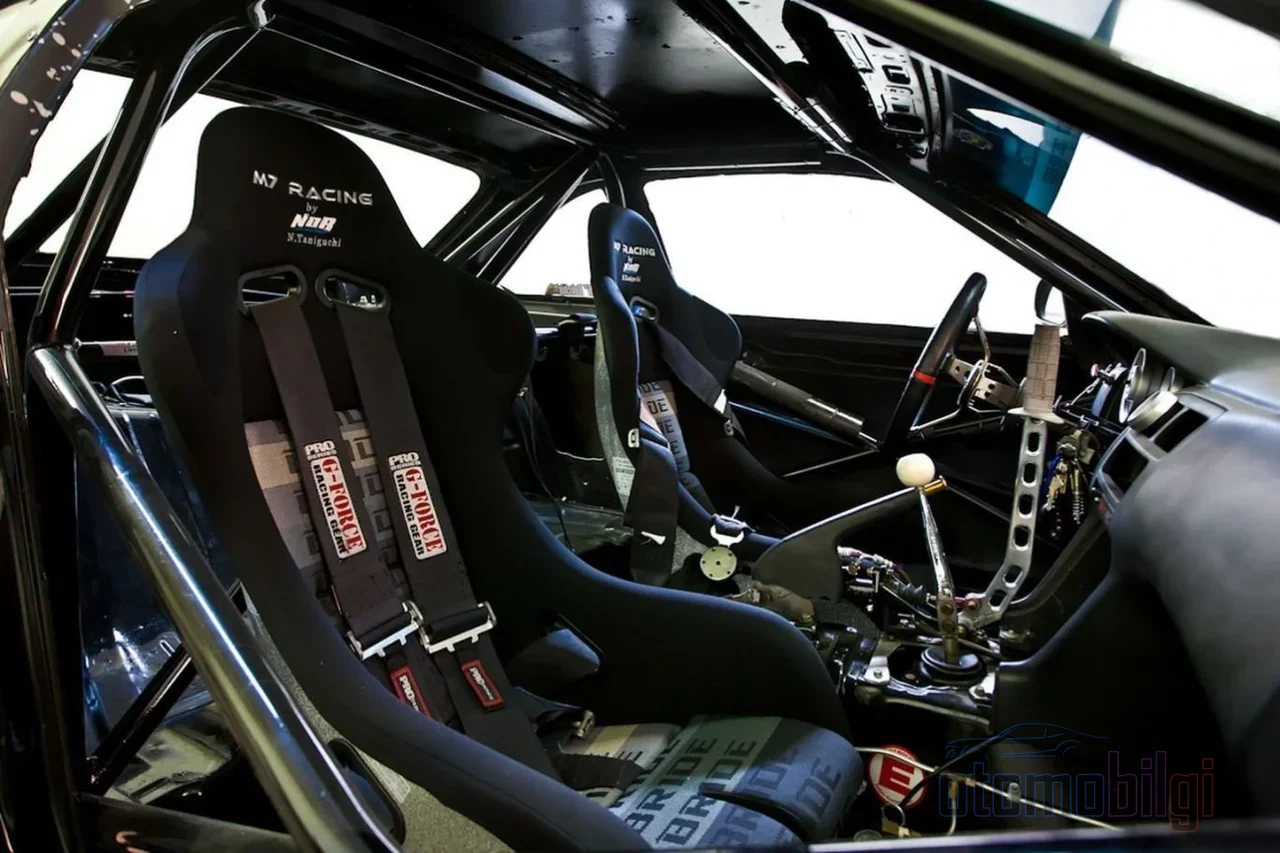
Most of us think of the cage as "a pipe structure installed inside," but a serious drift cage is a skeleton designed together with the vehicle's structure. The FIA drift technical rule requires the cage to be attached to the chassis with eight mounting points. The mounting feet must be at least 2 mm thick with a surface area of at least 120 cm², and must be fixed to the body either by welding or bolting. So you cannot simply say "I just installed it" and move on; the connection points themselves are also subject to regulation.
Pipe Selection, Bending, and Welding: Details Save Lives
The pipes to be used are not arbitrary either: there is a requirement of cold-drawn seamless steel, low carbon content, and a minimum strength of 350 N/mm². For the main roll bar, pipes of at least 45x2.5 mm or 50x2.0 mm are used; the dimensions shrink slightly for the other elements. Bends must be made by cold working and the bend radius must be at least three times the pipe diameter so the metal doesn't lose its internal structure. As for welding, it must be full penetration, all the way around, and preferably done by the TIG method; grinding down the weld seam, i.e. weakening it, is forbidden. Does that sound excessive? But think about it: the sole job of these pipes is to carry the load that presses on the roof the instant the car rolls over.
Geometry is critical too. The main roll bar may be inclined at most ±10° relative to the vertical axis; the rear support braces must angle rearward at no less than 30° from vertical. Door protection bars may be X-shaped, parallel, or NASCAR-style, but they may not enter the A or B pillar or extend into the chassis. Every pipe the helmet could touch must be covered with a special energy-absorbing pad, and the pad must be secured so it cannot shift on the pipe. A simple analogy: the cage is a hidden suit of armor inside the car; if even one piece of that armor is missing, its purpose is diminished.
Welded or bolted?
This is one of the classic debates in the drift world. The FIA rule allows both methods, but imposes additional requirements for bolted installations. A drift league in the UK wants a minimum 6-point cage and a single door bar for the 2026 season; and again, it doesn't matter whether it's welded or bolted. A bolted cage is easy to install and removable; a welded cage is more integrated with the body. Here's the difference: if you choose the bolted option, you must meet the additional requirements the regulations set out for bolted installations to the letter.
How to Choose a Racing Seat and a 6-Point Harness?
The factory seat is not designed to hold you in place in a side impact; nor does it support a body leaning sideways for hours while drifting. That's why the driver's seat must comply with one of the FIA 8855-1999, 8855-2021, or 8862-2009 standards. The FIA treats the seat as an integral part of the driver's safety restraint system; in other words, the seat is not just something you sit in - it's a link in the safety chain.
There's similar seriousness on the harness side. FIA or SFI approved harnesses are standard; a six-point harness is the strongly recommended option. So why does the five versus six point difference matter? Multi-point harnesses are designed to work together with the seat; installation is not carried out without checking the compatibility of the seat and harness. The most critical detail of the installation is the shoulder straps: they must run at shoulder height or just below it, straight back, and attach to the roll bar or harness bar at an angle of 0° to −20°. A minimum distance of 90 mm between the harness bar pivot and the seat backrest is required. If you'll be using a HANS device, remember the harness must also be HANS compatible; these harnesses are produced with a special design to work with the device.
Steering: Quick Release, Angle Kit, and Removing the Lock
In a drift car, the steering doesn't just set direction; it's the primary tool that keeps you balanced while sliding. That's why modifications to steering components are widely permitted, but an interesting requirement has also been added: the factory steering lock, i.e. the lock stop, should be removed. Otherwise, when the car goes into reverse lock, a spin-out awaits you. Angle kits are therefore indispensable in the drift world; a good kit can increase the steering angle up to 74°.
The quick release system is both a comfort and a safety component. It can bring the steering wheel about 60 mm closer to the driver, speeds up getting in and out, and makes emergency evacuation easier. Think about it: if you have to get out of a closed cockpit quickly, and the steering wheel stays in place, getting through the narrow opening becomes even harder. Brands like Works Bell, Sparco, OMP, and Sabelt are common in this field. The hydraulic handbrake is connected to the rear brakes and is released freely; but hydraulic locking valves are banned, let's note that too.
Where Are the Fire Extinguisher and Cut-Off Switch Installed?
A drift car is an environment where fuel lines and hot mechanical components coexist; the fire risk is not zero. The FIA drift rule requires separating the engine compartment from the driver's cabin with a fireproof and fluid-proof partition, i.e. having a firewall: at least 0.8 mm steel or 1.5 mm aluminum. In addition, the only pressurized container allowed inside the vehicle is the fire suppression system.
The cut-off switch, i.e. the circuit breaker, is mandatory in every vehicle. It must cut all electrical circuits and stop the engine; it must also not create sparks. It should be located where the driver can reach it from inside, triggered from outside via the lower area of the driver's side A-pillar, and its position must be marked with a blue triangle symbol on a 120 mm base. Why so much detail? Because when an accident happens on the track, the response team needs to cut the electricity and stop the engine within seconds; every second in between makes a big difference.
Evacuation time is also now regulated: the driver must be able to exit the cockpit in 8 seconds (through the driver's door) or 14 seconds (through the passenger door). There is responsibility on the organizer's side too; the FIA's drift event guide requires two fire extinguishers, each with a capacity of at least 6 kg, to be kept near the track. So safety is not only in your car, but also in the equipment of the team watching you.
Helmet and Clothing: FIA, D1, and Turkiye Rules
The helmet is the driver's most personal safety item, and each series has its own rules. Japan's long-running series D1 Grand Prix bans helmets older than 10 years from the date of manufacture in its 2024 rules. Formula Drift accepts only certified helmets during on-track sessions; no one is allowed on the track without a helmet. In Turkiye, TOSFED's 2018 national drift rules require drivers of open-top cars to wear FIA-approved visor helmets in every class; you cannot start without a helmet. As for racing suits, TOSFED's 2021 bulletin allows the use of FIA or CIK-FIA certified suits.
HANS-compatible harnesses are also part of this picture; head and neck support systems appear as a separate heading in TOSFED's 2026 technical rules. In other words, helmet, suit, HANS and belts are not chosen independently of each other; they are all parts of a whole.
D1, Formula Drift and Turkiye: A Rules Comparison
When you put the three regimes side by side, the picture becomes clear: international rules are stricter and spell out every condition one by one; under FIA's approach, everything not explicitly permitted is considered forbidden. TOSFED's regulation in Turkiye, on the other hand, draws a somewhat more flexible framework by allowing unlimited additional reinforcement tubes and supports inside the safety cage. But this flexibility does not mean "looser safety"; from fire suppression to the side window net, from belts to head and neck support, all mandatory items are present here too.
| Equipment | FIA Drift Technical Rule | Turkiye (TOSFED) |
|---|---|---|
| Roll cage | Mandatory, 8 mounting points, strict tube and geometry requirements | Mandatory; unlimited additional reinforcement allowed within the cage |
| Safety harness | Shoulder strap angle 0° to −20°, min. 90 mm belt bar distance | A requirement regulated under a separate heading |
| Helmet | Certified helmet required | FIA-homologated visor helmet mandatory in open-top cars |
| Racing suit | Covers standard requirements | Allows use of FIA or CIK-FIA certified suits |
| Fire safety | Firewall, evacuation time, 2×6 kg track extinguisher | Fire suppression system as a separate heading |
| Kill switch | Mandatory, blue triangle marking required | Within general safety requirements |
Let's add a note: some helmet and harness details about Formula Drift driver equipment circulating online do not come from the primary rulebook but from social media posts. The official source is directly FD's PRO/AM safety regulation; buying equipment without verifying the helmet-harness requirement is risky.
Things an Amateur Driver Should Never Skip at the Track
Okay, you are not racing in D1, maybe you are going to a local track day. Even so, the things that must not be skipped are clear. In order:
- Approved roll cage: Regulation-compliant tube dimensions, correct mounting points, and pads where the helmet makes contact. Even if you choose a bolted one, a rules-compliant installation is essential.
- FIA-standard racing seat and at least a 5, ideally 6-point approved harness: Setting the shoulder strap angle correctly and checking that the seat is compatible with the harness is free safety.
- Kill switch: The external trigger should be in place, with the blue triangle marking printed on it. Small part, big difference.
- Fire suppression system and firewall: There must be no other pressurized container in the cabin; the engine bay separation should be fully completed.
- Certified helmet and proper suit: Pay attention to the production year; an old helmet loses its protective strength.
- Quick-ratio steering and the right angle kit: Your transition speed and control at the counter-steer lock moment come from here.
The final word is this: drifting is beautiful as a show, but safety is the unseen hero of the stage. Every detail, from the roll cage tube diameter to the harness shoulder angle, is a lesson drawn from accidents someone experienced before. When you strengthen your car, strengthen your equipment too; the only way to have fun on the track is to make it home safely. Now tell me, how many items from this list is your car missing?
Sources
- FIA Technical Regulations for DC1 Drift Vehicles
- TOSFED 2026 National Drift Technical Rules
- TOSFED 2018 National Drift Rules
- TOSFED Bulletin 2021/09
- Formula Drift PRO/AM Safety Regulations
- D1 Grand Prix Series Regulations 2024
- FIA Standard Guidelines - Safety Harnesses
- FIA Standard Guidelines - Competition Seats
- FIA Guidelines for Drifting Events
- Drift League Entry Rules and Regulations 2026
- Motorsport Australia - Schedule H: Fire Extinguishers
- SLR Speed - Angle Kits for Drift & Race
- Sweet Manufacturing - Types of Quick Release Steering Wheels
- Custom Cages - Roll Cage Types