Why Power Isn't Everything? The Logic Behind Drift-Specific Car Setup
Share This Page
Horsepower alone is not enough for drifting; what actually lets you slide the car in a controllable way is the harmony between the torque band, gear ratios, differential type, suspension setup, and weight transfer. While excessive power makes the slide uncontrollable, with the right setup a car with much lower power can perform long, consistent drifts. On this page, we explain the "why" through the logic of the setup.
Highlights
- 250-400 HP is considered the sweet spot for most drift cars; below 200 HP it's momentum drifting, above 500 HP the professional level begins.
- Drifting wants low-end torque: it is measured in Nm within the 2,000-4,000 RPM range.
- A stock open differential is unsuitable for drifting; the most common options are a welded differential and a 2-way LSD.
- A typical drift suspension is set up with springs of 8-12 kg/mm at the front and 6-10 kg/mm at the rear.
How Much Does Power Matter? The Ideal Horsepower Range for Drifting
Think about it this way: your right foot is flat to the floor, but the car isn't listening to you. That's what too much power looks like in drifting. Too much power pushes the drift angle beyond the point of no return; with too little power, the tires keep their grip and the slide refuses to start. horsepower is how many people you can run with, torque is how strong your legs are. both ends need to be in balance. Throttle control is as decisive as the horsepower itself.
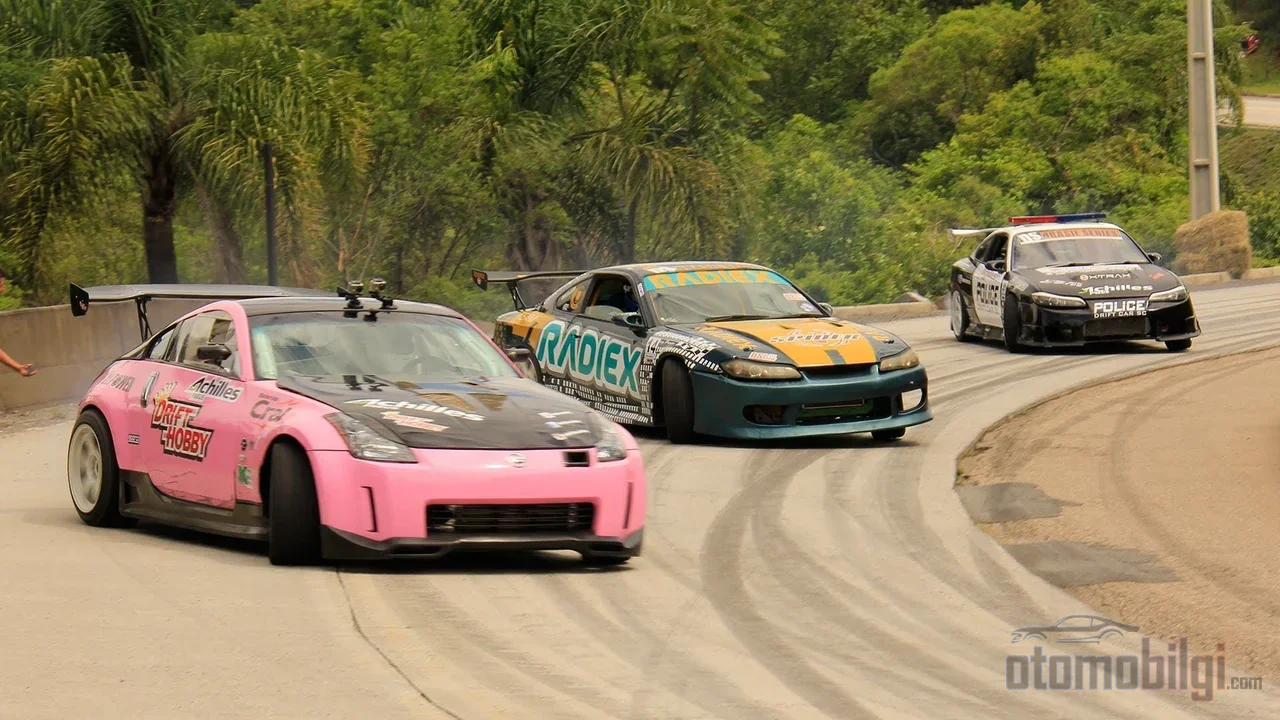
In practice, power levels fall into three bands. Cars below 200 HP suit the style we call momentum drifting; you slide using speed and weight transfer, not engine power. The Mazda Miata and Toyota AE86 are classics of this style. The 250-400 HP range is the sweet spot for most drift builds: cars like the BMW E36, Nissan 350Z, or 240SX feel at home in this band. 500 HP and above is the professional level; that's where the Ford Mustang, Chevrolet Corvette, or high-boost turbo builds come into the picture.
There's also the cost side. It's said that drifting a low-power car doesn't require an expensive professional setup; even free adjustments, like lowering front tire pressure and raising the rear, change the sliding feel significantly. But the other side has a fair point too: the real expense isn't in the setup, but in maintenance, tires, and the car's depreciation. So power alone isn't a sufficient measure when thinking about your wallet either.
The Torque Band: Why Does a Drift Engine Speak at 2,000-4,000 RPM?
Think of the difference between horsepower and torque like this: Horsepower is how many people you can run with, while torque is how strong your foot is. What we want in drifting is power that responds instantly under our foot while the rev counter sits mid-range and the car is rotating. That's why drifting wants low-end torque, not high-rev torque; the job is measured in Nm within the 2,000-4,000 RPM band. A high-revving, aggressive engine may shine at the drag strip, but in drifting it can leave you stranded when the revs drop: revs fall, torque disappears, and the slide comes to an end.
This is where the gearbox comes into play. The gearbox is a trade-off machine between torque and speed: low gears give the wheels a higher torque multiplication but limit speed. When choosing the right gear ratio, the goal is to make the widest possible use of the area under the torque curve within the engine's operating range. In other words, finding ratios that keep the engine in the band where torque is strongest for as long as possible.
Professional drift cars even carry a dedicated solution for this: quick-change gearboxes. As the track, surface and tires change, you can swap the gear ratio within minutes. If you consider that professional-level drifting requires adjustments with the precision of moving between curb and wall on the street, this alone seems like proof of the collapse of the "power is everything" thesis.
Differential Choice: Open Diff, Welded Diff or LSD?
The rear differential is the small but stubborn part at the heart of a drift car. The open differential in stock cars sends power to the wheel that can handle the traction; in drifting, that means the inner wheel, and the result is an unpredictable slide. So trying to drift with an open diff is like cracking eggs with a slippery shovel: it can be done, but you get a surprise every time.
There are two real alternatives. A welded differential permanently locks the two rear wheels together; because it keeps the wheel speeds equal, it makes it easier for the car to enter a drift, and since it's a cheap solution, it's especially popular at the beginner level. On the other hand, the 2-way mechanical LSD is the professionals' standard: it distributes power more evenly to the two rear wheels, gives a locking feel even when lifting off and getting back on the throttle, and transitions become both faster and more controlled. Advocates of the welded diff say it's sufficient for certain drift styles; the argument on the LSD side is clear: a welded diff holds you back as you progress, and the right LSD means more control.
In short, the ranking is this: an open diff is completely inadequate for drifting, a welded diff is a cheap and working starting point, and the LSD is the path to serious driving. Which one you choose depends on your budget and your goals; but none of them can save the "whatever came from the factory" option.
Suspension and Weight Transfer: Who Controls the Slide?
Why does the car slide? Partly worn tires, partly throttle, but the real hero is weight transfer. When you brake, weight shifts forward, the rear lightens and grip decreases; drifting starts exactly at that moment. The job of the suspension is to make this weight transfer predictable. In a typical drift setup, front springs are chosen at a stiffness of 8-12 kg/mm; this reduces body roll and sharpens response. Rear springs stay at softer values like 6-10 kg/mm, because we want a bit more weight transfer at the rear - the force that initiates and sustains the slide comes from there.
Balance also plays a big role in weight distribution. In race cars, the distribution is kept close to stock; approximately 55-45% or 60/40% front weight is considered typical. Installing a heavier engine may give a "feels better" impression, but it actually disrupts this balance. Excessive front weight makes sliding harder, while weight added to the rear also changes the car's character. That's why drifting is like music: if you press too hard on one of the instruments, the melody falls apart.
Steering Angle: Why Do You Need an Angle Kit for Counter-Steering?
One of the sneakiest limits of stock cars is the steering angle. During a drift, while the car's nose points into the corner, you go into counter-steer; if the stock angle isn't enough, the car spins without holding a proper slide. The solution path is clear: angle kits that replace the stock knuckle and tie rod, steering rack spacers, and modified front control arms. Since most drift cars are built on original road cars, that car's own arms or their derivatives are usually used as the base; the difference is that components demanding high adjustability and durability are installed instead of the street car's comfort-oriented parts.
Hydraulic Handbrake: The Logic of Starting the Slide by Hand
The hydraulic handbrake is drift's most honest tool: whatever you do to the rear, you do it yourself. Its job is simple - to lock the rear wheels quickly and in a controlled manner, independent of the main braking system. It is used to initiate the slide at corner entry or to correct the car's position during a run. From rally to drifting, it shows up everywhere you need to manage oversteer by hand.
Why not a regular handbrake? Because the hydraulic system completely bypasses the main brake circuit, and the more you pull the lever, the more lock you get. There's one more subtle detail: the hydraulic fluid heats up with use, and as it heats up, less pressure is needed to lock the rear wheels. In other words, the system becomes more sensitive as it warms up; this allows the driver to make entry and recovery inputs with much finer adjustments. This is actually where drifting begins - not with excessive power, but with that fine line drawn by hand.
Why Isn't a Factory Car Directly Suitable for Drifting?
The factory tunes a car for comfort: soft suspension, narrow steering angle, open differential. In terms of drifting, these three are a triple obstacle. Soft stock suspension reacts much more slowly than a modified setup; the car follows your thinking by several characters behind. But there's an interesting point: the lessons learned from learning to drive with these limitations are considered very valuable. Starting in stock form teaches you to listen to what the car is doing; then, as you change each part, you truly understand what does what.
When it comes to platform choice, the picture is clear: popular drift bases are almost entirely rear-wheel-drive cars with balanced chassis and strong aftermarket support. BMW E36 and E46, Nissan 240SX, 350Z and 370Z, Mazda RX-7 and Miata, the Toyota GT86 and Subaru BRZ siblings, Ford Mustang, Corvette C5 and C6, and Lexus IS300 are the classics of this list. Look at what they have in common: it's not power, brand, or engine - it's balance and the spare parts ecosystem.
Everything Working Together: Setup Is a Matter of Orchestra
The essence of drift-specific setup logic is this: no single part wins on its own. The torque band gives you a strong midrange, the gear ratios keep the engine always in that band, the differential distributes power evenly to the two rear wheels, the suspension makes weight transfer predictable, and the hydraulic handbrake lets you start and correct a slide by hand. Horsepower is one instrument of this orchestra; the conductor is your right foot and hands.
It's nice to see that this pursuit has reached a serious level in Türkiye as well. In the general classification of the 2026 Apex Masters Türkiye Drift Championship, Abdullah Bostan leads with 127 points; Çağlar Küçükdumlu with 125 and Enver Haskasap with 103 points follow behind him. The season final will be run on Sunday, October 25, 2026 at TOSFED İstanbul Park. When you watch those cars, pay attention to this: it's not the power figure, it's the control that lands on the same point at every corner entry that tells the real story. Power arrives with the sound of the turbo; victory leaves with the silent mathematics of the setup.
Sources
- The Ultimate Guide to Drifting & Building the Perfect Drift Car
- What Is Race Car Drifting and How Does It Work?
- What Is The Best Drift Car Mechanical And Performance Setup
- How to drift a car with low horsepower: The basics
- How to pick the right gear ratio for your needs
- Welded vs LSD vs Open Diff for Drifting (2026 Pro Guide)
- The Truth About Welded vs LSD: What Drifters Shouldn't Ignore
- Why Do Drift Cars Weld the Rear Differential?
- Drift Car Set Up
- Drift Suspension Setup: Best Alignment & Coilover Settings
- Hydraulic handbrake for drift – how it works
- Hydraulic Handbrakes 101
- Catch My Drift: Tuning Your Own Stock Car
- APEXMASTERS – Türkiye Drift Championship
- Türkiye Drift Championship Round 4
- TOSFED Drift Cup Rules