Basic Techniques in Drifting: Clutch Kick, Feint, and Beyond
Share This Page
Drift initiation techniques are maneuvers where you deliberately break the grip of the car's rear tires and, while sliding, keep the car protected with throttle and steering. Clutch kick raises the revs and sends a sudden surge of power, feint uses weight transfer, the handbrake locks the rear wheels, power over relies on power, and shift lock relies on engine braking.
Highlights
- Clutch kick is taught at beginner level: steady throttle, press the clutch, raise the revs to around 3,000 RPM and release quickly.
- Feint entries are the most suitable technique for high-speed tracks and tandem battles; manji is its advanced version.
- An electric handbrake is almost useless for drifting without modification; a hydraulic system is a clear advantage.
- Shift lock is the technique that strains the drivetrain the most and is recommended for advanced drivers.
Everyone watching drifting asks the same question: how does that guy slide the car like that? The answer is usually not a single magic move; it's several clear techniques applied behind the wheel kicking in at the right place, at the right speed. In this article I'll go through those techniques one by one: how it's done, in which car and at what speed it's preferred, what the advantages are, and what the risks are. Buckle up, let's get started.
How Does a Drift Start in a Corner? The Mechanics of Initiation
First, let's lay the foundation. Drifting is a driving technique in which the driver deliberately produces oversteer, meaning rear slide, and drives while maintaining control of the car as it loses traction. In other words, the tires are sliding but the car is in your hands; that's the difference.
Every drift opens with a starting point, in drift language initiation . The driver picks a point on entry, positions the steering wheel, applies the chosen trigger (kick, pull, or flick), and immediately brings the throttle into play to settle the angle. On the track this usually happens at the beginning or end of a corner. The golden rule of a good initiation is this: the rear tires should lose grip but the front tires should keep theirs. Once the slide has started, the job continues with countersteer, meaning turning the wheel in the direction of the slide, and precise throttle control.
The most critical balance here is in the throttle. Too much throttle widens the angle but at some point spins the car around, meaning a spin-out. Too little throttle kills the drift and the car straightens out. Then there's the eyes: look where you want to go. The steering follows your eyes, I'm serious.
Clutch Kick: Shock Therapy for the Transmission
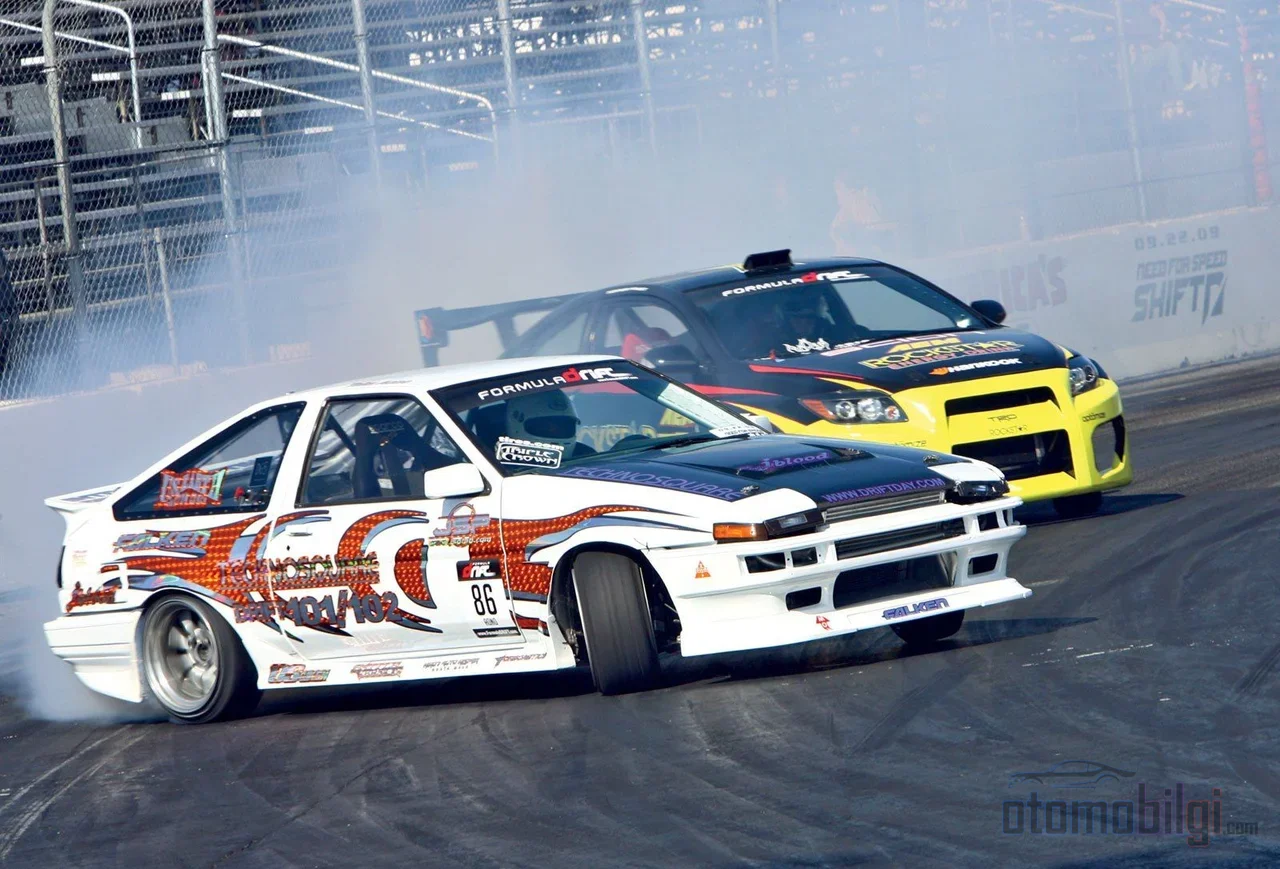
Clutch kick, or as some call it the clutch slap, is one of the most fundamental initiation tools in drifting. The logic is simple but clever: "shocking" the transmission system to break the rear tires' grip. When you press the clutch, you raise the revs; when you release it, a sudden surge of power goes to the rear wheels, and this surge exceeds the tire's grip capacity. The result: oversteer.
The step-by-step application is as follows:
- Enter the corner wide from the outside and load the weight toward the outside of the corner.
- Press the clutch and raise the revs to around 3,000 RPM .
- Release the clutch quickly. The rear tires lose grip.
- Catch the oversteer with countersteer and maintain throttle.
The basic formula is always the same: hold steady throttle, push the clutch in quickly, release it quickly. The hard part of the technique is applying it in the right dose; if you are aggressive the car can spin out excessively, if you are too soft nothing happens and you just get tired. That's why clutch kick is used especially to initiate at low speeds, to adjust the angle mid-corner, or to save a drift that is starting to straighten out. It is taught at the beginner level and is particularly the savior of low-powered rear-wheel-drive cars: this is the way to keep control in a car with little power without ever touching the handbrake.
So, Does It Damage the Car?
The honest answer: yes, this technique shocks the drivetrain. A more interesting detail is this: during a drift, when the clutch is disengaged the rear tires approach ground speed and the rubber performs better; when the clutch re-engages, the inertia accumulated in the flywheel creates a sudden burst of grip with far more force than the engine could ever produce. At the advanced level this is a trick that can be used to regain grip, but instructors describe it as a technique to be avoided rather than ideal. There is also an obvious warning: it should be done while the car is moving, not stationary; a kick applied to a stationary car can cause serious damage to the components. The same logic applies to shift lock, which I will come back to shortly.
Feint and Manji: Sliding with Weight Transfer
Now we come to the most dance-like technique of all. Feint, also known as the "Scandinavian flick", has this beauty about it: you don't make a mechanical move, you use the car's own momentum. Just before entering the corner, you turn the steering wheel in the opposite direction of the corner; the car loads up on one side, then the sudden weight shift loads the suspension and the grip of the rear tires breaks naturally. Let me give you a simple analogy: it's like pushing a rolling cabinet in one direction and then quickly yanking it back the other way. The cabinet swings out much harder than you do, thanks to its own momentum.
The greatest advantage of the feint is that you can initiate the drift with just timing, without braking, without touching the clutch. That's why it is the most suitable technique for high-speed tracks and tandem battles; it is recommended for intermediate drivers. A short steering input creates oversteer and allows you to take the corner at a higher speed. The advanced form of the feint entry is called manji ; this entry, made with large, wide swings, is a discipline of mastery in its own right. The common point of all these techniques that use weight transfer, from a short flick in the opposite direction to a long manji slide, is this: you work with natural physics, you don't force mechanical parts. Your drivetrain will thank you.
Handbrake (E-Brake): The Most Practical Initiator
The handbrake is the Swiss Army knife of drifting. Especially in hydraulic systems, it locks the rear wheels and initiates the slide without the need for power or clutch movement; in terms of weight transfer it is a "relatively neutral" technique, meaning you don't need to rock the car. The rear locks, the car starts to slide, done. Think of it like pulling the brakes on a wheelchair: the locked part stops, the rear end slides.
The most suitable use cases are tight corners, race entries, and low-horsepower cars. It is also ideal for beginners because it is the easiest way to practice entry angles and slow drift entries. A pro tip: practice releasing the handbrake and clutch at the same time to keep the slide smooth. Interestingly, even D1 competitors in Japan sometimes use the handbrake, especially when starting from high speed; so this does not mean it is a "beginner's tool".
The functional distinction also matters: the handbrake is generally used to increase angle mid-corner, while the foot brake is used for other purposes. On the hardware side there is a clear fact: a manual, hydraulic handbrake has a clear advantage for drifting; the electric handbrake in modern cars is nearly useless without modification. One small warning: if you yank the lever and hold it, the grip is killed and the slide ends itself. Pull the lever smoothly, release it quickly.
Power Over and Shift Lock: With Power, or With Braking?
These two behave like exact opposites of each other, but both fall into the "little effort, big effect" category and both demand caution.
Power Over: Breaking Traction with Power
Power over lives up to its name: you load up the throttle in the corner and push the rear tires into oversteer. This is the luxury of high-horsepower cars like V8 drift builds. Dramatic and incredibly fun, but unpredictable on tight tracks; without good control it is not suitable for racing use. That is why it is recommended for open tracks and wet surfaces. On a wet surface the tire already has less grip, so you get the same effect with less power - a perfect practice environment for beginners.
Shift Lock: Locking with Engine Braking
Shift lock, on the other hand, is for high-speed entries or downshift zones. When you downshift without rev-matching - that is, without touching the throttle - engine braking momentarily locks the rear wheels and the drift begins. It is very useful on descents and in areas with frequent gear changes, but there is a price: since this technique works with clutchless downshifting, it is one of the methods that strains the drivetrain the most. Just like clutch kick on a stationary car, it delivers harsh shocks to the gearbox and driveshaft. That is why it is recommended for advanced drivers; if you are new, watch first, then try.
Which Technique to Use When?
When you put all these techniques side by side, the picture becomes clear. Each has a condition where it is "best" and a difficulty level:
| Technique | Best Use | Level |
|---|---|---|
| Clutch Kick | Low-power drift cars | Beginner |
| Handbrake (E-Brake) | Technical tracks, racing | Beginner-Intermediate |
| Feint | High-speed corners | Intermediate |
| Power Over | Open tracks, wet surfaces | Beginner |
| Shift Lock | Descents or tight transitions | Advanced |
In real life, especially in racing and tandem driving, these techniques are used not one by one but in combination. Let's give an example: entering with a feint and adding a clutch kick to adjust speed mid-corner, or aligning the car with a quick handbrake tap in the middle of a chicane are perfectly standard moves. There is no single correct initiation method; drivers choose or blend them according to conditions. As for the brakes: brakes are not very useful for starting or maintaining a drift, and at best they slow the drift down and "correct" it. In other words, hitting the brakes in a panic doesn't save a drift, it ends it.
Vehicle, Surface, and Safety Conditions for Beginners
Knowing the techniques by heart is not enough; if we don't practice in the right conditions, it all goes to waste. The basic checklist for a novice driver is as follows:
- A manual transmission is a must (or an automatic car with approval from the school), and the vehicle must absolutely be rear-wheel drive.
- Practicing on a wet track is ideal for beginners; a dry track requires much more precise car and throttle control.
- Tires are the most important component of drifting; tire pressure should be checked before every session.
- Practicing off the track, in traffic, is strictly forbidden; this is the cleanest rule of drift schools.
The safety side is serious at racing events too: there are special run-up sections for building speed on the track. You also need to know how to deal with failure; for example, if a clutch kick doesn't work, a bigger kick can be attempted with a full throttle + clutch release combination, but if you spin, you need to reduce the amount. Every car's grip behaves differently; you develop feel, not rules.
Final Word: Techniques Are Learned, Feel Is Earned
You learn drift techniques by reading, but you earn them by spending hours on the track. The clutch kick teaches you sudden power, the feint weight transfer, the handbrake a quick and predictable start, while power over and shift lock teach advanced control. The best drivers are those who carry all five tools in the same toolbox: they know which one is the right answer for which corner. Now it's your turn; but please, on the track.
Sources
- Clutch Kick Drift Technique: How It Works (With Diagrams) - Texas Drift Academy
- Drifting Techniques Explained: From Clutch Kick to Scandinavian Flick - SLRspeed
- Clutch Kicking Explained - Team O'Neil
- Drift Feint Entry (Manji) - Pro Technique Explained - Texas Drift Academy
- How to Drift - Sixth Lesson: Scandinavian Flick / Feint - autoevolution
- Starting to drift: the complete guide - Torque School
- What are the rules of drifting? - Red Bull
- Start drifting: techniques, cars and practical advice - GoToTheGrid
- Tech & Car Prep Tips for Drifting Beginners - Australian Drift Club
- Drift School Rules & Safety - Bay Area Drifting
- A Realist's Guide to Drift with FWD - DigitalRC
- Mastered the throttle already? Here's a hidden clutch technique
- A clutch kick is one of the most useful tools in drifting - Texas Drift Academy
- Clutch kick vs hand brake - r/Drifting
- Clutch Kick | Drift Techniques
- What is drifting? How to drift? - Milliyet Molatik
- How to Drift? - Arabam.com
- Initiation - Drift Terminology - Apex Masters
- Drifting (motorsport) - Turkish Wikipedia