Why Tire Choice in Drifting Is Half of the Winning Setup
Share This Page
In drifting, tire choice is the real determining factor that comes before the car's power or chassis setup: the rubber's compound, tread pattern, and pressure setting directly determine the density of the smoke, the consistency of grip, and the transition speed. The right tire varies depending on the car's power and the driver's goals; the most expensive tire is not always the best. In other words, half the setup is won when the tire is picked off the shelf.
Highlights
- Tire surface temperature during a slide can reach several hundred degrees; the smoke is formed by the rubber breaking down under this heat.
- 200TW tires offer high grip and speed but have a short lifespan; 300TW is a more balanced choice for the hobby driver.
- A common starting pressure for drifting is around 28-32 PSI depending on the load.
- Budget tires significantly reduce the per-meter cost on practice days.
- In D1GP, tire manufacturers are part of team strategy even in the rules; a tire brand can be used in the team name.
What Is the Smoke, Really? The Science of Rubber
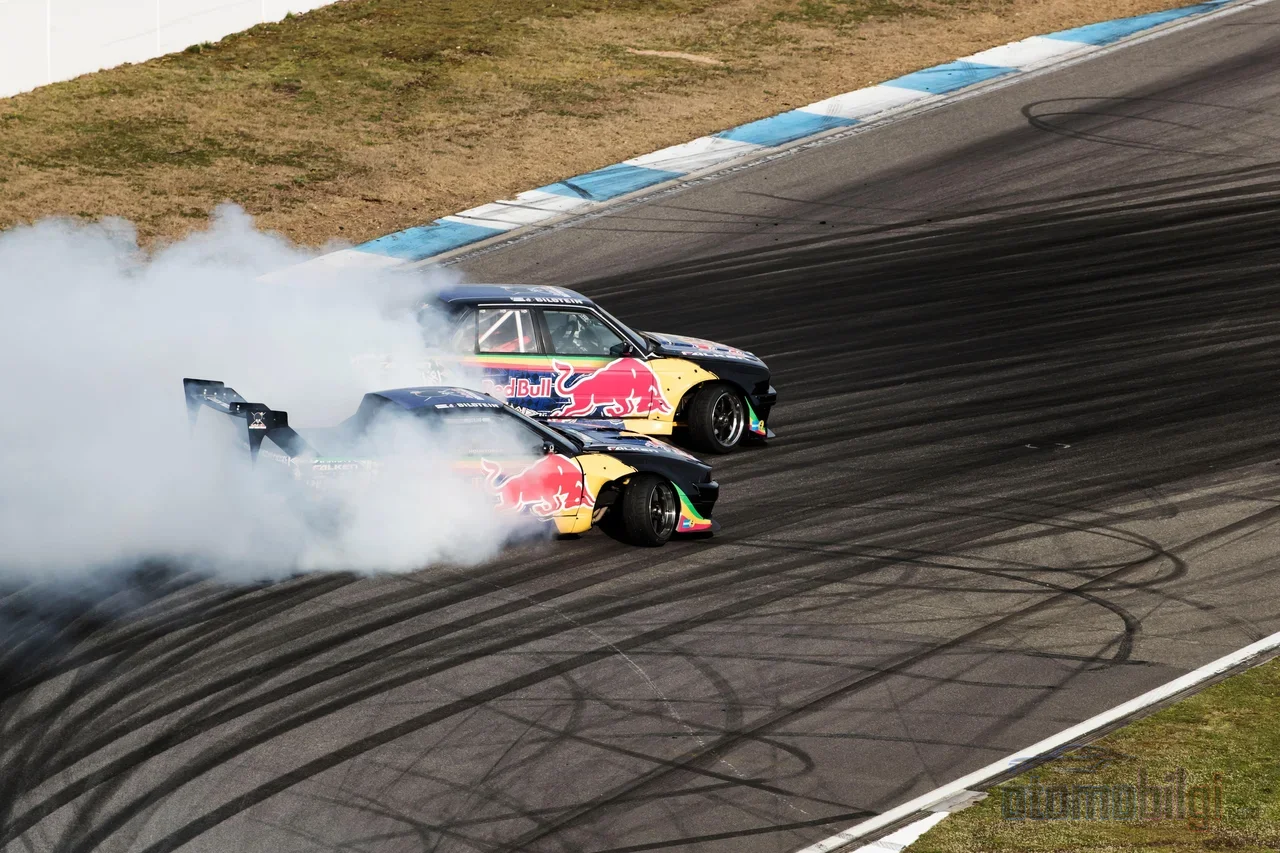
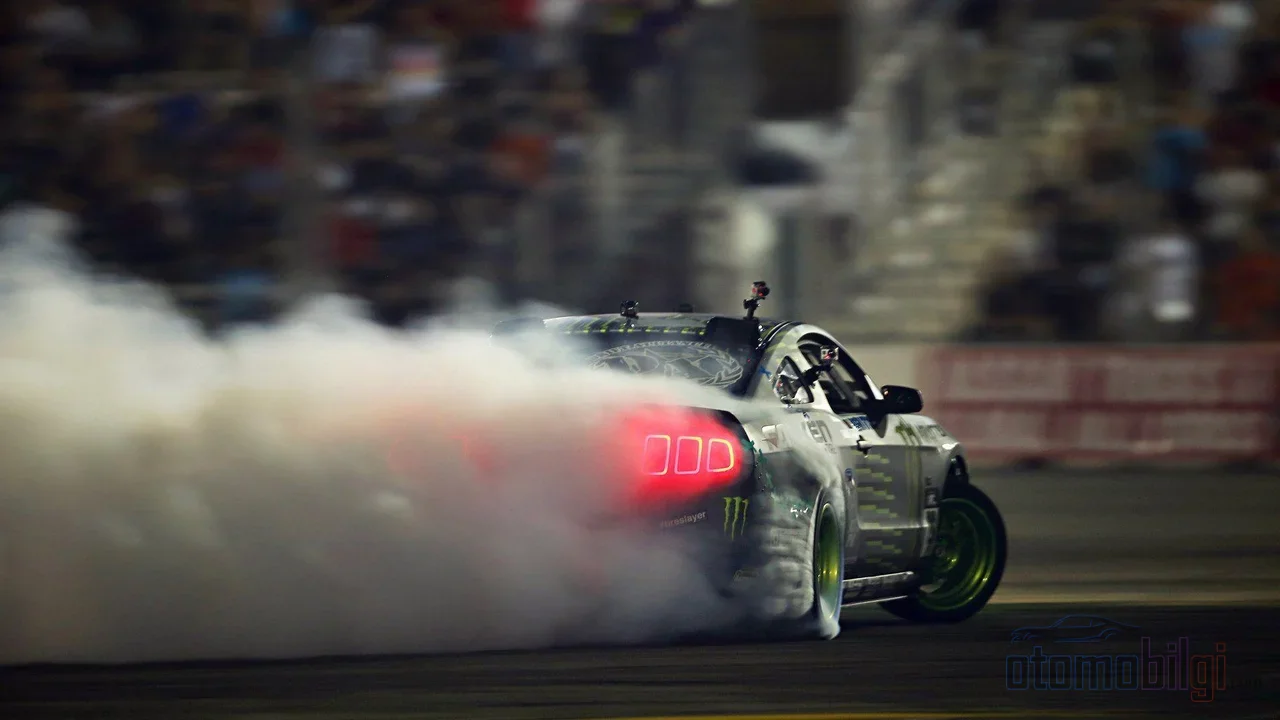
Let's start with a simple question: Where does that legendary white smoke come from? The answer isn't pretty but it's very clear: the tire produces smoke by sacrificing itself. While the rear wheels slide constantly, the rubber heats up from intense friction, the surface temperature climbs to several hundred degrees, and the rubber begins to physically break down. The white cloud that emerges, in other words the smoke, is actually proof that the tire has been sacrificed. That's why a drift team's tire stock is as critical as its fuel stock; a tire can be used up in just a few minutes of practice.
Heat doesn't just produce smoke, it also destroys the tire. An overheated tread surface first blisters; this is called blistering. The blistered surface loses its grip, and the tire becomes unpredictable. If things go further, the rubber separates from the carcass, meaning delamination occurs. Nobody wants to experience this while sliding at high speed on the track, which is why heat management is at the center of tire selection.
There's an interesting debate here: for drifting, soft or hard compound? One camp advocates soft compounds, which keep the contact alive for controlled sliding. The other side says that drift-specific tires are deliberately made with harder compounds, because the damage that soft rubber suffers under extreme heat, such as chunking and blistering, needs to be prevented. In practice, most drivers settle somewhere in between: mid-range performance tires capture that golden balance between grip and lifespan. If I have to make an analogy, a car tire is like a pencil: a very soft lead writes quickly but runs out fast, while a very hard one lasts long but leaves a faint mark. In drifting, you want something in between.
Treadwear Grade: How to Read the Tire's Report Card?
The TW, or treadwear value, you see on the tire's sidewall is an indicator of the rubber's lifespan. And in drifting, knowing these two numbers is enough: 200 and 300. The easiest way to understand the differences is to compare:
| Feature | 200TW | 300TW |
|---|---|---|
| Grip and speed potential | High | Good |
| Lifespan | Short | Longer |
| Heat load | High | More tolerable |
| Power and cooling demand | Suitable for high-power cars | Ideal for low-to-medium power |
| Best-suited user | Race-oriented, powerful car | Hobby and practice driver |
The general rule is this: high TW, meaning a firmer feel, means longer life and suitability for low-power cars. Low TW means more grip, but in return you're borrowing from both your wallet and your car's power. In the 200TW range, there are options that are legal in many drift series; forward and lateral grip is strong but their life is short. 300TW tires, on the other hand, are easy to rotate, life-friendly and hold their smoke consistently. If your own car is around 200 horsepower and you fit giant tires with super grip, you'll struggle to rotate the tire; this is a real trap for low-power cars.
Pressure: A Performance Gain Acquired for Zero Dollars
Now let me give you the most honest tip in the drift world: pressure adjustment is free. Without taking any chore from the battery, without changing a single part, you can change your car's character with an air pump. So how does it work?
- Low pressure: The contact patch grows, grip increases but the tire wears out faster.
- High pressure: Grip decreases, starting and maintaining a drift becomes easier; but heat also rises faster and control decreases.
A common starting point for drifting, depending on load, is 28-32 PSI or so; simulation communities confirm the same relationship. If you're practicing with a normal road tire, a practical tactic: aim for the factory pressure when the tire is hot, in other words let some air out if needed. Most importantly, keep notes. Record the pressure at every session, compare the values after leaving the track; only this way will you find which pressure gives you the most predictable slide. Even Formula DRIFT teams value this adjustment enough to talk about tire pressure in special content; why? Because it really makes a difference.
Part of heat management is also between practice sessions: keeping the tires cool between race blocks, doing cooldown laps, and updating the pressure log. You can look at what professional teams do and build your own garage version; all you need is a notebook and a pressure gauge.
Width, Tread Pattern and Heat Cycling
Tire width is also a matter of balance. A wide tire means a larger contact patch and better heat distribution; this provides consistency and longevity. But if you overdo it, you suppress the available horsepower and make the car sluggish. The correct width is chosen according to your car's power; the rule is simple: tire proportional to power. As for those asking whether a narrow tire is better, the answer depends on the car; especially in light and low-power cars, a reasonably wide tire provides an advantage because it's rotatable.
As for tread pattern, the distinguishing feature of drift tires is complex patterns that evacuate water efficiently. Additionally, the tread on drift tires is generally designed shallower; the goal is to manage heat and keep the slide controlled. A structure that maintains grip on slick asphalt is also a lifesaver on wet surfaces.
There is also a process that most beginners have never heard of: heat cycling. The new tire is carefully heated and then fully cooled; this process slightly hardens the compound and extends its life. In return, there is a small loss in peak grip. Considering the cost per kilometer on practice days, this trade-off is often absolutely worth it.
How Does Tire Strategy Work in the Pro Series?
Coming from Japan, the homeland of drifting, D1 Grand Prix treats tires not just as a part but as a corporate strategy. D1GP regulations explicitly allow tire manufacturer names and brands to be used in team and car names. In other words, the tire brand sits right at the heart of the sponsorship ecosystem, which shows how much importance manufacturers place on teams.
The examples are concrete: Toyo Tire has been racing in D1GP with its own team since 2007 and has won numerous championships to date. A Linglong-supported team finished the D1GP 2020 series as team champion. The picture did not change in the 2026 season either; in the season opener on May 9, a driver from a tire-brand-supported team finished second on the podium. The West Coast's answer, Formula Drift operates with similar professionalism; the fact that teams explain on their official channels that they place tire pressure at the center of their practice programs is proof of how much serious benefit they get from this setup.
There is an interesting parallel on a small scale too: even in the RC drift world, tire choice directly affects grip, consistency, steering response, and angle hold. Tires are often fixed in competitions to reduce the race down to the driver's skill. So when it comes to tires, scale does not matter: the same decisions are made at every level.
Is an Expensive Tire Really Always Better?
Come to the most crucial question. Advertisements tell us to buy premium tires, but the picture on the drift track is completely different. There is a common belief in the drift community: tire quality is not that directly related to drifting ability; if you are going to drift, you are going to eat tires, that is the nature of the job. So the right question to ask is not which tire is more expensive, but which one gives you more track time and bolder driving.
Let's make it concrete. Budget tires provide a cost-per-meter advantage on practice days and are surprisingly resistant to blistering. In performance comparisons, the picture is as follows: a 200TW tire in the premium segment gets full marks for grip while scoring much lower on longevity; the 300TW version is balanced in all three areas. In the budget segment, grip is lower but longevity is reasonable, and the price is wallet-friendly. So for practice, a budget tire; for racing, a performance tire that strikes the right balance; the math is that clear.
Let's not skip a warning: being on the track with a tire whose tread depth is very worn is risky; in extreme cases, the tire can blow out. Budget obsession becomes dangerous at this point. The best drift tire is not the most expensive or the grippiest tire; it is the tire that speaks to your car's power, your goals, and your budget. This sentence could be the essence of this article.
A Practical Starting Recipe for Amateurs
Theory is all nice, but what will you do when you get to the garage? Here's my summary:
- Be honest about your car's power: if you're low on power, look in the 300TW range; if you're medium-to-high power, aim toward 200TW.
- Match the width to the power; wider is not always better.
- Start pressure in the 28-32 PSI range, note the hot values, and compare lap by lap.
- Consider a budget tire for practice days; use heat cycling to extend its life.
- Never use a tire with worn-out tread depth on the track.
One final word, with a big sibling attitude: chassis kits, angle kits, power upgrades are all great, but they're all built on that palm-sized patch of surface where the tire touches the asphalt. If you choose that surface right, half the car is ready. See you at the track!
References
- Choosing Drift Tires: Grip, Life, Smoke and Treadwear - Driftaholic Racing
- Drifting and Tyres | The Science Behind the Smoke - EverTyres
- Drift Tyres vs Regular Tyres - Tire Streets
- Drifting Tires 101: Mastering the Slide with the Right Rubber - WheelSetGo
- Drift Tires | How to Choose the Best Setup for Your Car - Priority Tire
- TOYO TIRES Participates in the 2021 D1GP Series - Toyo Tires
- Linglong Tire Drift Team Orange Won the Championship - Linglong Tire
- D1 Grand Prix Series Regulations
- Let's Talk Tire Pressure | Royal Purple Drift Prep - Formula DRIFT
- Car Setup - Japanese Drift Master
- RC Drift Wheels & Tyres Guide - DriftmanJrRC