Mercedes MB Drive Assist Pro Brings Hands-Free Highway Driving
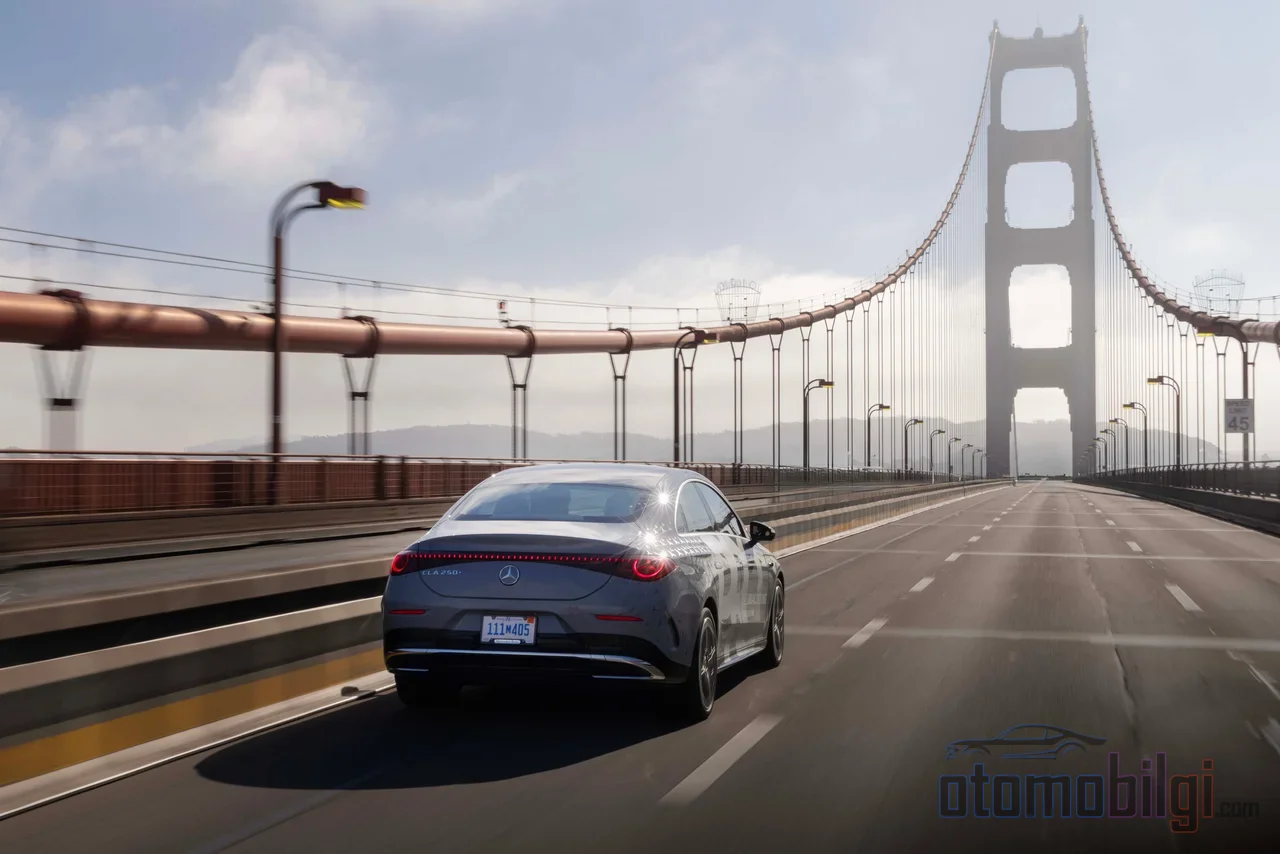
Mercedes-Benz is bringing point-to-point driving support to the US market with MB.DRIVE Assist Pro, and it is doing so starting from the very bottom of the price pyramid, with the CLA. This is a far more vulnerable segment than the S-Class customer at the top of the electric class: the entry-level buyer's decision is determined not by showiness but by the price/performance balance. In this narrow gap between Tesla's FSD and GM Super Cruise, the real question is how Mercedes strengthens its hand.
The system itself is not new; it has been on the roads in China since late 2025 with the launch of the new CLA. The US plan, introduced at CES in January 2026, is now starting to take concrete shape. On November 16, 2026, the brand announced that the MB.DRIVE portfolio had been upgraded, and the timeline has become clear: early access for select customers in California starting from December 2026, with a nationwide rollout throughout 2027.
What the System Does, and What It Does Not
MB.DRIVE Assist Pro is an SAE Level 2 system that combines navigation and driving support. In Mercedes' own words, it is a kind of "Level 2-plus-plus": the vehicle can drive the entire route on its own, including city streets, from start to destination; but the driver remains responsible throughout and must be ready to take over at any moment.
It is necessary to pay attention to the layering distinctions within the portfolio. Hands-free Assist, activated by a button on the steering wheel, allows the hands to be taken off the wheel on suitably controlled-access highways, and does so up to 85 mph, that is, 137 km/h. Proactive Lane Change Assist performs lane changes on its own to pass a slower vehicle or enter an exit lane. MB.DRIVE Assist Pro, on top of all this, adds its city capabilities: Driving Assist City Pro, stop sign and traffic light support.
The principle is stated openly and honestly: hands-free, but eyes on the road. Interior cameras monitor the driver's eyes and hands; a safety timer occasionally requires the hands to touch the steering wheel to confirm the driver is still at the wheel.
Highlights
- Hands-free Assist offers hands-off-the-wheel driving on the highway up to 137 km/h
- US early access begins in California in December 2026, with nationwide rollout in 2027
- 3-year package for $3,950; subscription options are also coming
- The system uses 10 cameras, 5 radars, 12 ultrasonic sensors and 254 TOPS of processing power
- In 2027: CLA Electric, GLE, GLS and S-Class; expanding lineup in the 2028 model year
Hardware: Why Cameras Are Not Enough for Mercedes
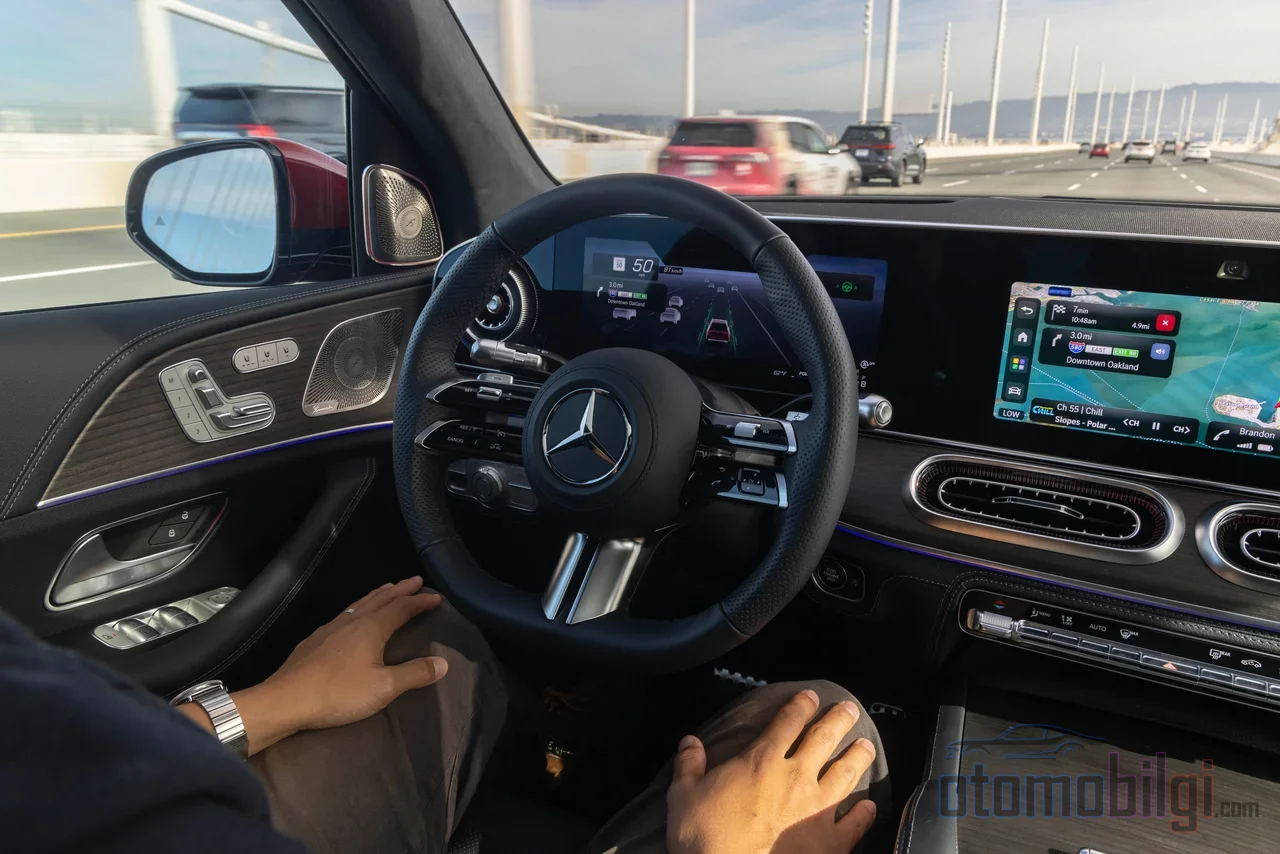
We all know that Tesla FSD relies on cameras almost exclusively. Mercedes chose a different path: 27 sensing components, namely 10 cameras, 5 radar sensors and 12 ultrasonic sensors, plus a high-performance onboard computer capable of processing up to 254 TOPS per second. The MB.OS operating system is combined with NVIDIA's Hyperion processor and sensor architecture; NVIDIA is the brand's first strategic partner in automated driving.
The difference on the software side is even more interesting. The artificial intelligence works together with map data and generates 10 possible outcomes with every control change; when it agrees on 8 of them being on a safe path, the system executes the maneuver. There is no lidar, but this multi-sensor approach supported by radar and ultrasonic also brings different limits than what camera-focused rivals allow: the system cannot be set to exceed the speed limit.
It should also be added that the system is geographically limited, meaning geofenced. It works only in regions where map data is ready; first the East and West Coast metropolises, over time other cities.
Experiences: The San Francisco Exam
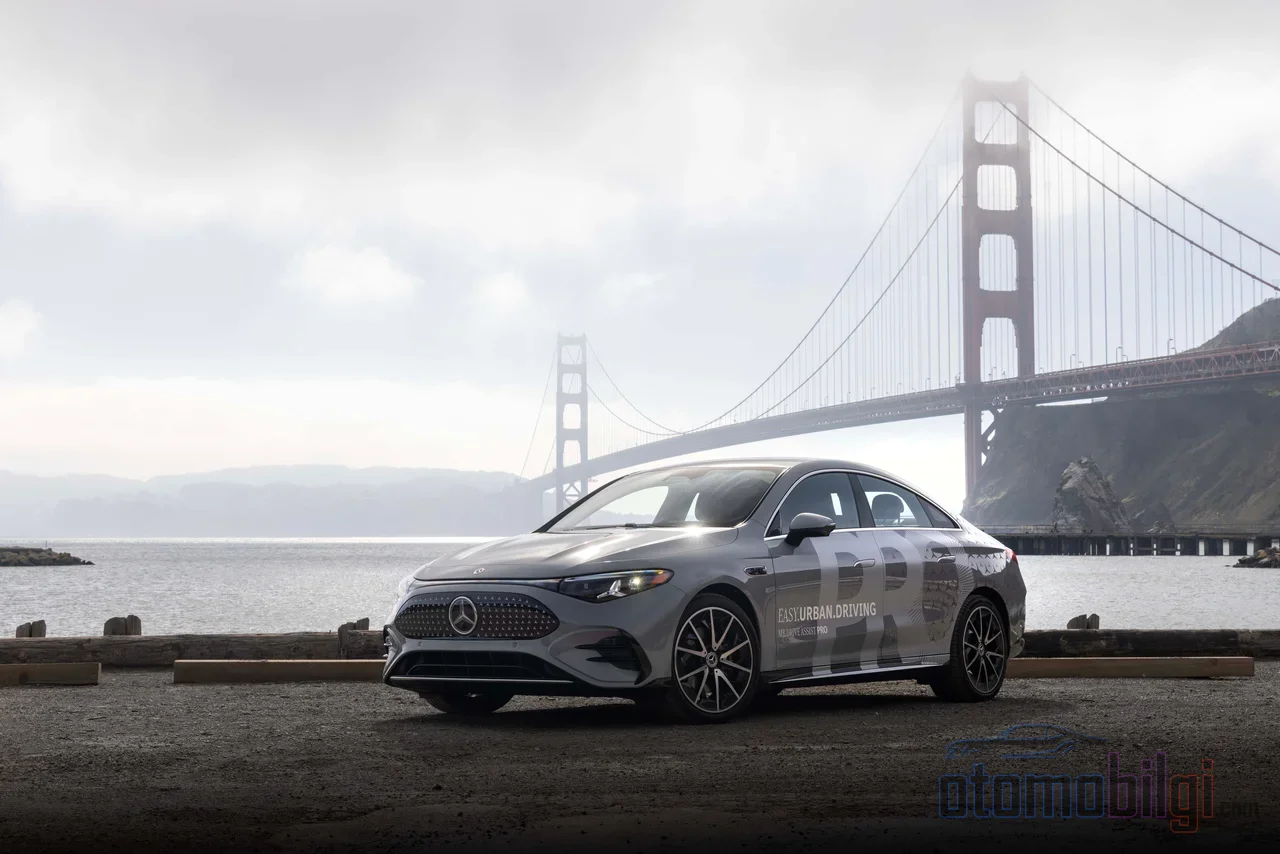
The US press's test drives give quite a few clues about the system's maturity. In a one-hour trial conducted on San Francisco's steep streets, the car handled double-parked vehicles, road works, cyclists, and pedestrians; the driver held the wheel only once due to a safety timer requirement and because of a sudden maneuver by a Tesla Model 3. The highway section, however, was not as convincing as city driving; lane changes took longer than expected.
In another test, during a 35-minute Bay Area drive, no intervention or error was seen at all; after the driver took over, the system's behavior of instantly returning to self-driving on its own, described as cooperative steering, was reported with praise. It was noted that the system held up even in unusual field scenarios such as complying with traffic lights, yielding right of way, and even navigating around broken robotaxis.
Opposing voices are not absent either. One evaluation from the same trial period still finds Tesla's system better for similar capabilities. Mercedes' response to this is measured: neither semi-autonomous system replaces the driver, it helps them.
Models and Prices: The Strategy Starting from the CLA
This is the most critical part of the news. The system can currently be tried in the 2026 CLA, and the early access program in December also covers Hands-free Assist in California. Certain eligible 2027 models come with the required hardware: CLA Electric, GLE, GLS, and S-Class. 2028 model year vehicles will include this hardware and software across a broader range. MB.DRIVE Assist Pro will be offered in the first half of 2027 in Germany and the US across all drivetrain types, including electric and internal combustion.
Eligibly equipped current vehicles will be able to receive the functions via over-the-air (OTA) update after the full market launch. On the pricing side, there are two tiers: a 3-year package for $3,950; in addition, multi-year, single-year, and monthly subscription options will be offered in California, but these subscription prices have not yet been announced. Models and exact prices will be clarified before each launch.
What Is Changing in the Level 2 Market
In the US, the Level 2 race has long appeared to be two-poled: Tesla FSD (Supervised) with its aggressive technology claim, and GM Super Cruise and Ford BlueCruise with their map-approved highway formula. Mercedes is now opening a third way between the two: safe operation in approved zones like Super Cruise, the point-to-point urban goal like FSD; but with multi-sensor hardware and a gradual, map-based rollout.
Starting with the entry-level CLA, meanwhile, is meaningful in a psychological sense. This technology is no longer a flagship privilege, but an affordable feature trickling down to the brand's volume models. With a lower-tier rival entering the price band where Tesla is most aggressive with a hands-free driving card, it shows that Level 2 is no longer a luxury showpiece but a bargaining chip.
Where Is Level 3: The Quiet Shift in the Strategy
Mercedes was the Level 3 pioneer in this field; DRIVE PILOT is still supported only on the S-Class and EQS Sedan today. However, there are reports that for the US market the brand is, for now, pulling back DRIVE PILOT and placing a big bet on the NVIDIA-backed Drive Assist Pro. This is a finding from a single source that does not fully align with the brand's official pages; still, the direction of the strategy is unclear.
One point must be clear: Drive Assist Pro is not an evolution of DRIVE PILOT, but a separate feature with its own capabilities. Mercedes also holds the position of the first brand to bring point-to-point driving to Germany; an order opening was announced for October 21, 2026, the two systems are coming to Germany at the end of 2026, and early access programs in Stuttgart and Munich begin in December. On the US front, the reason the launch timing is not finalized is regulatory hurdles; Mercedes is fully confident about the launch within the year.
What Does the Driver Have to Do: The Short Answer
The clear answer that sums up the page is this: MB.DRIVE Assist Pro will launch in the US in December 2026 with early access in California and roll out nationwide in 2027; across the lineup extending from the entry-level CLA to the S-Class, it will offer hands-free driving up to 137 km/h on the highway and point-to-point Level 2 driving in the city with eyes kept on the road; the 3-year package is $3,950, and responsibility will rest with the driver under all conditions.
Thirty years ago even ABS was optional; now an entry-level sedan is bargaining with an AI-powered driving assist backed by 10 cameras. The direction of change is beyond dispute. With this move by Mercedes, the Level 2 competition is evolving from a technology showcase into a sellable product category; and the hardest collision appears set to be experienced not by the most expensive models, but by the most crowded segment.
Sources
- MB.DRIVE ASSIST PRO: Navigation and driving assistance merge - Mercedes-Benz Group
- Mercedes-Benz's New Driving-Assist Tech Puts Tesla on Notice - Car and Driver
- We Sample Mercedes-Benz's MB.Drive Assist Pro - Car and Driver
- Mercedes' Hands-Free Driving Assist Tackled San Fran's Steepest Streets - The Drive
- Mercedes-Benz takes on Tesla FSD with new point-to-point city driving assist - The Verge
- I Tried Mercedes MB.Drive Assist Pro. It's Like Tesla FSD, But With One Catch - InsideEVs
- Driving (Mostly) Hands-Free In a 2026 Mercedes-Benz CLA - Motor Trend
- We Tried Mercedes' New Semi-Autonomous-Driving Tech. Tesla's Is Better. - Motor Trend
- Hands off! An on-the-road demo of Mercedes' advanced new driver assist - Ars Technica