Small Tank, Big Range: The Hybrid's Tank Math
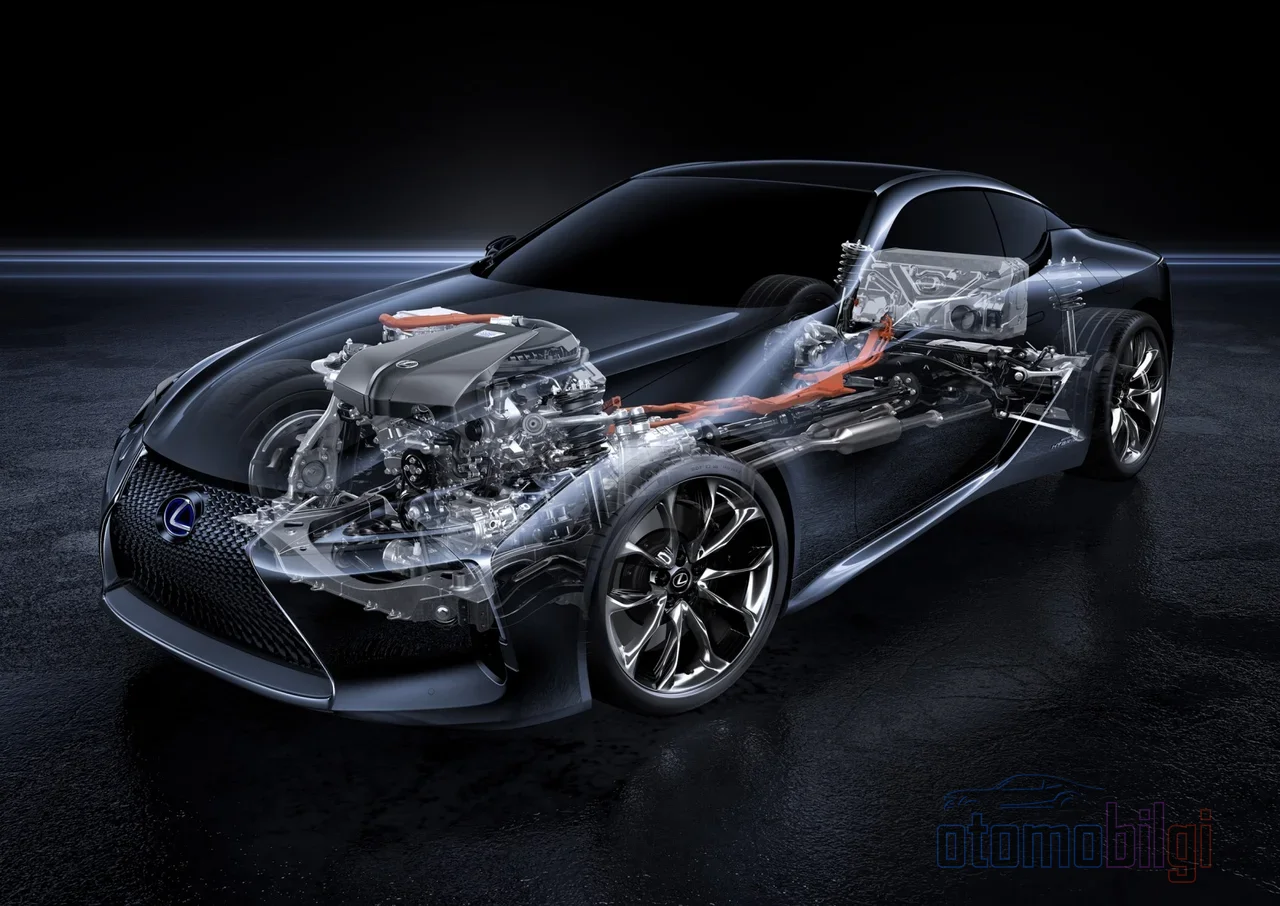
It is easy to look at a hybrid car's fuel tank and be disappointed: to make room for the battery pack, most models set off with a tank that is noticeably smaller than the gasoline equivalent's. The figure looks insufficient on paper. But in reality the picture is the other way around; the kilometers you cover per liter increase so much that the small tank often delivers a longer range than the big tank of a gasoline car. This page answers exactly that question: how many kilometers does a full tank take you in a hybrid vehicle, and under what conditions does this range change and how?
Why Is the Hybrid Tank Small but the Range Long?
The first rule that determines tank capacity is mechanical: the high-voltage battery pack wants a volume under the vehicle floor that competes with the fuel tank. Manufacturers resolve this sharing in favor of the battery in most models and cut back on fuel volume. The result is that tanks reaching 55-60 liters in gasoline versions typically drop to 40-50 liters in their hybrid counterparts.
On the consumption side, an equally clear inverse ratio comes into play. Most hybrid SUVs do more than 35 miles per liter, and most hybrid sedans more than 45 miles per liter; that is roughly a 40 percent improvement over gasoline equivalents. To make a more measured generalization, a hybrid powertrain delivers at least 25 percent, and frequently more than 33 percent, better fuel economy compared with a gasoline engine. The small tank is more than compensated by this distance gained per liter.
Highlights
- Most internal combustion cars travel 645-965 km on the highway with a full tank; a range over 1,050 km is the exception.
- Hybrids can exceed 50 miles per liter in the city; the typical gain over gasoline is 25-40 percent.
- In cold weather hybrid consumption can worsen by 30-34 percent; air conditioning in extreme heat causes a loss of more than 25 percent on short trips.
- On the highway, when speed rises from 70 mph to 80, consumption visibly drops; a model delivering 25 mpg at 70 mph can fall to 21 mpg at 80.
How Is Full Tank Range Measured?

The range calculation is in principle a simple multiplication: tank capacity multiplied by the distance covered per liter. The real question is which consumption figure goes into the multiplication. Real-world consumption obtained from highway tests at a constant speed of about 120 km/h gives a more realistic result than the catalog figure; the result is rounded down to trim away the optimism margin.
Measurements made with this method show that most internal combustion cars go 400-600 miles, that is approximately 645-965 kilometers, on a full tank on the highway. A range above 650 miles is achievable but remains an exceptional zone; one of the models at the top of the list is the Porsche Panamera at approximately 1,207 km, and another is a Ram with the Hurricane engine at approximately 1,062 km. On the hybrid side, the owner of a 2022 Toyota Camry Hybrid reports covering approximately 1,126 km on a single tank with slow driving that favors electric mode. The small tank is far from a bottleneck here.
City, Mixed and Highway: How Does Range Change by Profile?
A hybrid's advantage is not evenly distributed across the three usage profiles, and the range calculation changes according to this distribution.
City driving and stop-and-go traffic
This is where the efficiency gains are greatest. At low speeds and in stop-and-go traffic the electric motor kicks in, regenerative braking recovers energy, and the gasoline engine is kept away from its inefficient operating zone. Real-world data confirms this: a Ford Maverick Hybrid owner reports an average of 56 mpg in the city, while the 11th-generation Honda Civic forums show city figures approaching 50 mpg, with the combined average represented by a sample of 46.64 mpg. The 2026 Toyota Prius carries the best consumption in its class with 57 mpg combined.
Mixed usage
The mixed profile is the average of the two regimes and gives the most realistic figure for most drivers. For a driver with a 60 percent highway, 40 percent city profile, the realistic combined consumption of the 2026 Camry Hybrid measures in the 48-51 mpg range. The real-world highway consumption of the 2026 Toyota RAV4 Hybrid is typically 35-38 mpg, meaning 15-16 km per liter.
Highway and high speeds
Here the hybrid's trump card weakens. At constant high speed the electric motor disengages, aerodynamic drag grows, and the system operates like an ordinary gasoline car. The 2026 Santa Fe Hybrid, with EPA figures of 37 mpg city / 36 mpg highway, has one of the narrowest city-highway gaps among hybrids; meaning the highway advantage can be nearly zeroed out depending on the model. The effect of speed is harsher: a Hybrid Max model delivers only 25 mpg at 70 mph, dropping to 21 mpg at 80 mph. For highway-heavy usage, expecting mpg in the mid-30s is realistic, and range shortens accordingly. A common observation among hybrid owner communities is that fuel savings decrease noticeably on long highway distances.
Factors That Reduce Range: Cold, Air Conditioning, Trailers and Mountains
Cold weather
The effect of cold on hybrids is typically stronger than on gasoline cars; depending on conditions, fuel economy can drop by about 30-34 percent. One Maverick Hybrid owner reports that his city consumption fell from the upper 40s to the upper 20s, low 30s; in another user's data, a 3-4 mpg loss in the cold is considered normal. There is also a compensating mechanism: the hybrid system helps preserve some of the efficiency by running the gasoline engine purposefully and preventing a constantly cold-engine cycle.
Air conditioning and hot weather
Air conditioning can cut fuel economy by more than 25 percent on short trips in extreme heat. One Ford Escape Hybrid owner's data is concrete: with an average of 53 mpg without air conditioning, consumption drops to the 42-47 mpg band on trips with the AC on. The extra load on the engines' cooling systems at high temperatures also drags efficiency down.
Trailer, mountain road and road load
When pulling a trailer, the hybrid system's contribution is practically negligible; the battery is not large enough and the electric motor is not powerful enough to meet the assistance demand. In hilly terrain, an interesting limit comes into play: when the high-voltage battery is completely full, regeneration stops during descents and the energy that could be recovered goes to waste. All of this shows that full-tank range is a function not only of the vehicle but also of the usage scenario.
A 40-50 Liter Tank Means 55-60 Liters' Worth of Range
Let's put the math together. A gasoline car's 55-60 liter tank, combined with real highway consumption, mostly produces a band of 645-965 km. A hybrid's 40-50 liter tank, on the other hand, when multiplied by distances exceeding 20 km per liter in a city-heavy profile, lands on the same band; examples exceeding 1,100 km in calm driving suited to stop-and-go traffic have been documented. In a highway-heavy and fast profile, however, the equation flips and the hybrid's range advantage drops to a few percent, and it can disappear entirely if the model has a narrow city-highway gap.
How Much Does Driving Style Affect Range?
The variable that moves range the most in the same vehicle is the driver themselves. Gentle throttle responses favoring electric mode, anticipatory braking, and avoiding high speeds are the common denominators of the 1,126 km single-tank results in the Camry Hybrid example. In the opposite direction, increasing speed from 70 to 80 mph alone brings a consumption increase of over 15 percent. When cold weather or air conditioning is added, the same tank in the same vehicle can produce a range difference of up to 40 percent among three different drivers.
Short Answer: How Many Kilometers Does a Hybrid Vehicle Go on a Full Tank?
The clear answer based on measured data is: in city-heavy and mixed use, a good hybrid sedan or SUV with a 40-50 liter tank typically travels between 900-1,100 km on a full tank; this is a figure equal to or above the highway range of a gasoline equivalent with a 55-60 liter tank. In highway-heavy, fast use under load, the range becomes similar to a gasoline car's. What determines range is not the tank size, but how efficiently you empty the tank.
When buying a hybrid, full-tank range should be considered together with your annual mileage and usage profile: a driver covering 15,000 miles a year can calculate roughly 600-700 dollars in fuel savings compared to a gasoline equivalent, thanks to the hybrid's per-liter advantage. The tank looks small; but the right question to ask is not the tank's volume, but where it takes you when you fill it up.
Sources
- These Models Can Go 650-Plus Miles on a Full Tank of Gas
- Are Hybrids a Smart Choice Right Now?
- Fuel Economy Comparison: Hybrid vs Diesel vs Gas
- Hybrid Cars With the Best MPG for 2026 and 2027
- Gas mileage in Hybrid is Horrendous in the Cold
- Hybrid Summer Fuel Economy: 7 Fixes for MPG Loss
- Towing with a Hybrid - Low Gas Mileage
- Behavior of Hybrid System in Hilly Terrain
- Hybrid vs. Gas Cars: How Much Can You Save
- The Santa Fe Hybrid Loses Efficiency on Road Trips