Trailer and Heavy Loads with a Hybrid Car: Does the Savings Equation Change?
Share This Page
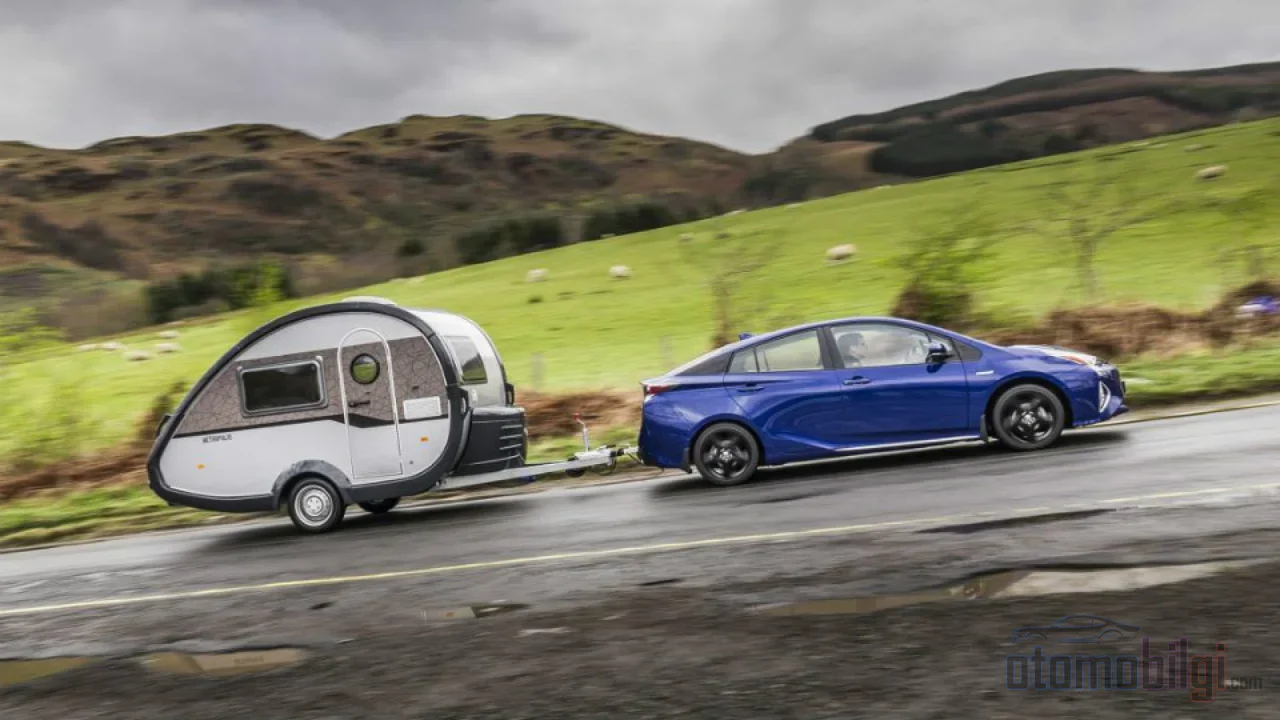
A hybrid car's city savings largely evaporate when a trailer is hitched: a hybrid SUV that delivers 30-35 mpg in mixed use drops to the 22-28 mpg range with a trailer; this means roughly a 25-35% increase in consumption. Because the gasoline engine is constantly strained under heavy load, the electric motor's support is limited, the stop-and-go efficiency that is the hybrid's core advantage is disabled, and the gap with the gasoline equivalent begins to close quickly. Still, there are scenarios where the hybrid still makes sense on hilly mountain roads thanks to regenerative braking and intelligent load management.
Highlights
- Hybrid SUV in mixed driving: 30-35 mpg, with trailer use drops to 22-28 mpg levels.
- Roof bars increase consumption at a steady 55 mph by 7.1-12.7% .
- Regenerative braking recovers roughly half of braking energy, contributing 10-25% to overall efficiency.
- In cold weather, around 20°F (-6.7°C), hybrids lose an average of 22.8% in fuel economy.
- Many hybrid models have lower towing capacity than their gasoline versions.
How Does Towing a Trailer Change the Hybrid's Consumption Math?
The hybrid system's math is simple: at the moments when the gasoline engine runs least efficiently - at takeoff, at low speeds, in stop-and-go traffic - the electric motor kicks in, and that is where gasoline savings come from. With a trailer, this equation reverses. A vehicle pulling a load constantly demands high power; the gasoline engine runs without rest instead of short rest intervals spread over time. The electric motor is no longer an assistant that eases the engine, but turns into an extra consumer that drains the battery quickly.
Real-world data shows this picture in clear terms. Hybrid SUVs running in the 30-35 mpg band in mixed driving drop to 22-28 mpg when a trailer is attached - when converted to liters, a serious jump. Owner reports give even more striking figures: one Ford Kuga PHEV owner reports seeing about 70 mpg when driving alone, dropping to 30-35 mpg with a trailer. Such individual data is not a laboratory measurement, but the direction is consistent: the trailer is the biggest enemy of the hybrid's consumption advantage.
Manufacturers openly acknowledge this reality. Toyota states that the weight and aerodynamic drag of the towed load increases fuel consumption and that the electric motor is used less. So the source of the problem is not just the added weight; it's the hybrid system taking its electric side out of the equation at high speeds and high power demands.
Why is towing capacity lower than the gasoline version?
Many buyers find this surprising: the hybrid's electric motor produces instant torque, which seems tailor-made for towing. However, towing capacity is determined less by torque and more by cooling, transmission durability, and overall combined weight limits. The battery, electric motor, and power electronics added to hybrid versions increase curb weight; this also eats into the loaded total weight budget. A concrete example: Ford Escape Hybrid, approximately 2,000 pounds pulls less and its own towing capacity is only 1,500 pounds.
The picture becomes clear when you look at the list. Standing out as the best-towing hybrid, Toyota Sienna Hybrid reaches a maximum of 3,500 lbs, while the Kia Carnival Hybrid sits at 2,500 lbs. Toyota Grand Highlander Hybrid MAX is an exceptional model that can go up to 5,000 lbs. On the pick-up side, the Ford F-150 PowerBoost is in a league of its own with roughly 12,700 lbs ; however, owner data indicating it drops into the 11-14 mpg band when towing at 80% load show that even in a hybrid pick-up, a heavy trailer swallows the savings. The general observation on the forums points the same way: most hybrids are not towing-certified, most models cap out at 5,000 lbs, and with trailer use the hybrid-vs-gasoline difference can drop to the 1-2 mpg level.
Roof Load and Roof Racks: The Invisible Penalty

Although not as dramatic as a trailer, roof load is the second major factor that quietly erodes a hybrid's efficiency. A peer-reviewed scientific study measured that roof-mounted light bars increase consumption at a steady 55 mph by 7.1% to 12.7% , while in general driving conditions the increase averages 7.5% . The same study calculated that roof rails were responsible for 0.8% of light vehicle consumption in the US in 2015 - roughly 100 million gallons of fuel. That is the combined effect of metal parts sitting permanently on top of millions of vehicles, generating drag even when unused.
Real-world tests overlap as well: in one magazine test, when the Kia Carnival's factory roof bars were removed, an improvement of 3 mpg was observed at 75 mph. A loaded roof - a bike carrier, a cargo box - further disrupts aerodynamics and seriously reduces efficiency. From an engineering standpoint the logic is simple: at a steady 100-120 km/h, most of the energy goes into overcoming air resistance, and every additional surface on the roof increases this resistance quadratically. Its reflection on the hybrid system is a small-scale repetition of the trailer mechanism: the engine works harder, electric support decreases, and consumption approaches gasoline levels.
How Much Does Regenerative Braking Compensate on Hills?
Mountain roads are a two-way test for a hybrid. On the climb, the same scenario as with a trailer plays out: high power demand limits electric support, the gasoline engine strains, and consumption soars. But on the descent, the balance returns. Regenerative braking recovers roughly half of the energy that would otherwise be lost to the brakes; this means a contribution of 10-25% to overall efficiency. On a long mountain descent, a hybrid comes out clearly ahead of a gasoline vehicle in both consumption and brake wear, because instead of heating its brake pads it converts kinetic energy into charge.
That said, there is a limit to compensation. The energy recovered on a descent returns only a fraction of what was spent climbing; a descent after a heavily loaded ascent improves the consumption average but does not reset it. Also, on cold mountain mornings, some hybrid systems restrict or delay full electric support until the battery and motor warm up sufficiently; a slight drop in power and consumption is normal under these conditions. Cold is generally the hybrid's enemy: AAA's test showed that hybrids lost an average of 22.8% of their fuel economy at 20°F (-6.7°C). Electric vehicles lose about 39% of their range under the same conditions - meaning the hybrid is far more resilient than an EV in the cold, but gives up a sliver in the heat.
In Which Scenarios Does a Hybrid Still Make Sense?
When you put load and road combinations side by side, the decision matrix forms itself. The general data: compared to a gasoline engine, a hybrid delivers fuel economy gains of at least 25% and often more than 33% - but the source of this difference is city and stop-and-go traffic. In weekend use involving light loads, medium distances, and plenty of braking, the hybrid's advantage stays intact. With a trailer on flat ground and measured towing speeds, the gap narrows; on a trip with a trailer, a fully loaded roof, cold weather, and mountain passes, the savings effectively disappear.
| Scenario | Hybrid's standing | Typical effect |
|---|---|---|
| City, without a trailer | Strongest advantage | 25%+ savings versus gasoline |
| Mixed driving, without a trailer | Advantage holds | 30-35 mpg real consumption |
| With a trailer, flat road | Advantage narrows | 22-28 mpg, gap can drop to 1-2 mpg |
| Roof rack/cargo box | Advantage wears down | 7-12.7% extra consumption at constant speed |
| Mountain descent | Compensation zone | Roughly half of braking energy is recovered |
| Mountain ascent, cold | Weakest point | Economy drops ~22.8% in the cold |
The practical conclusion from this table is this: if towing is only two weeks of your year, the savings gained in city traffic during the remaining fifty weeks still make the hybrid a sensible choice. If towing is a constant, heavy part of the job - boat, caravan, or horse trailer on the road every week - the hybrid premium becomes an expense that never pays back; in this scenario, a gasoline or diesel engine with high towing capacity is the more appropriate vehicle. As an exception, Grand Highlander Hybrid MAX models reaching 5,000 lbs and hybrid pickups like the F-150 PowerBoost try to hit the middle ground with both capacity and acceptable consumption.
Ways to Preserve Savings When Using a Hybrid with Heavy Loads
It is not possible to completely eliminate a hybrid's weakness under load, but it can be managed. First, verify the towing capacity from the catalog; the hybrid version may have a lower limit than its gasoline sibling, and pushing that boundary proves costly both in terms of safety and consumption. Second, remove unnecessary resistance: detach the roof bar on days you are not using it, and fit the cargo box only when genuinely needed - according to the figures, this alone makes a difference of over 7% at constant highway speed. Third, reduce your speed under load; the penalty of roof load grows rapidly as speed rises from 55 mph to 75 mph, so on a trip with a trailer, 90-100 km/h instead of 100-110 km/h reduces both range loss and stress.
Finally, use descents deliberately. Rely on regeneration with braking as low as possible, and leave the battery as full as possible at the end of the descent so that the next climb or city section can begin with electric support. In cold weather, adjust your expectations from the start: partial electric support during the heating phase is normal, and accepting the initial warm-up period is both safer and more economical than giving in to the urge to floor it unnecessarily.
Conclusion: The Savings Equation Must Be Rebuilt With Load Included
A hybrid car's catalog figures are written for trailer-free, light use. A trailer, a full roof, and cold weather push these figures onto unrealistic ground: consumption rises 25-35% with a trailer, the gap to the gasoline version can drop to 1-2 mpg, and economy loses 22.8% in the cold. Even so, an occasional light towing task that fits alongside city-oriented use does not ruin the hybrid's equation. The right question is not whether the car should be a hybrid; it is how much load you carry in how many weeks of the year. As the answer gets heavier, the hybrid's brilliant city math turns into an ordinary vehicle on the road.
Sources
- Best Hybrid Cars for Towing for 2026
- The 10 Small Hybrid SUVs With The Best Towing
- Real-World Towing and Load Performance of Hybrid SUVs
- Can you tow with a hybrid car?
- Fuel consumption impacts of auto roof racks
- Tested: How Much Do Roof Racks Affect Fuel Economy?
- Regenerative braking
- Temperature Effects on Electric and Hybrid Vehicle Efficiency - AAA Newsroom
- How Do Hybrid Cars Work?
- Understanding Hybrid Vehicle Fuel Economy
- Are Hybrids Good for Long-Distance Driving?