Is a Hybrid More Sensible in the City, or on the Highway?
Share This Page
Hybrid cars consume noticeably less fuel in the city and in stop-and-go traffic; on the highway and at high speeds this advantage shrinks but never disappears completely. The electric motor and regenerative braking recover energy in low-speed driving involving frequent braking and acceleration, while at steady high speeds the internal combustion engine runs under continuous load and the hybrid system has fewer opportunities to engage. The result: the right profile determines the magnitude of the savings.
Highlights
- Full hybrids reduce consumption on main city-type roads by an average of 58%, and on the highway by 39.3% reducing
- Honda Civic Hybrid: 50 mpg city, 47 mpg highway - in the gasoline version this ranking is reversed
- The average gap between catalog and real-world consumption in gasoline cars 21.1% (2022 EU data)
- In cold weather, hybrid efficiency can drop by up to 30-34% according to user reports
Why do hybrids save more in the city and less on the highway?
The answer lies in the operating conditions of two mechanisms. The first is electric propulsion: electric motors are most efficient in situations requiring low power - gentle acceleration, low speed, frequent stops. In these modes the gasoline engine stops or only provides support. The second is regenerative braking: during braking, energy that would normally be lost as heat is captured and reused in the next acceleration.
Stop-and-go traffic is exactly the environment where these two mechanisms work the most. For a gasoline vehicle, city driving is the worst scenario: frequent braking wastes energy, repeated acceleration increases consumption, and short trips do not even allow the engine to fully warm up. For a hybrid, the same environment is the best scenario - every stop is a recovery opportunity to recharge the battery.
On the highway, the picture changes. At a steady speed of 100-130 km/h, the vehicle makes no stops; the opportunity for regenerative braking almost disappears. The electric motors also lack the power or battery capacity to take over from the internal combustion engine at high speeds. In other words, the hybrid's two gains in the city shrink at the same time here. Still, the advantage is not zeroed out: the system can run the engine at slightly higher but efficient revs than necessary and direct the extra power to the motor-generator to charge the battery. High-speed steady driving is also less taxing on the battery since it does not experience frequent charge-discharge cycles.
Profile comparison in numbers: what do the catalog values say?
Placing the catalog values of the gasoline and hybrid versions of the same model side by side shows most clearly in which profile the hybrid's advantage grows. Two well-documented examples:
| Model | City | Highway | Combined / Note |
|---|---|---|---|
| Honda Civic gasoline | 32 mpg | 41 mpg | Classic gasoline curve: highway better than city |
| Honda Civic Hybrid | 50 mpg | 47 mpg | City consumption exceeds highway |
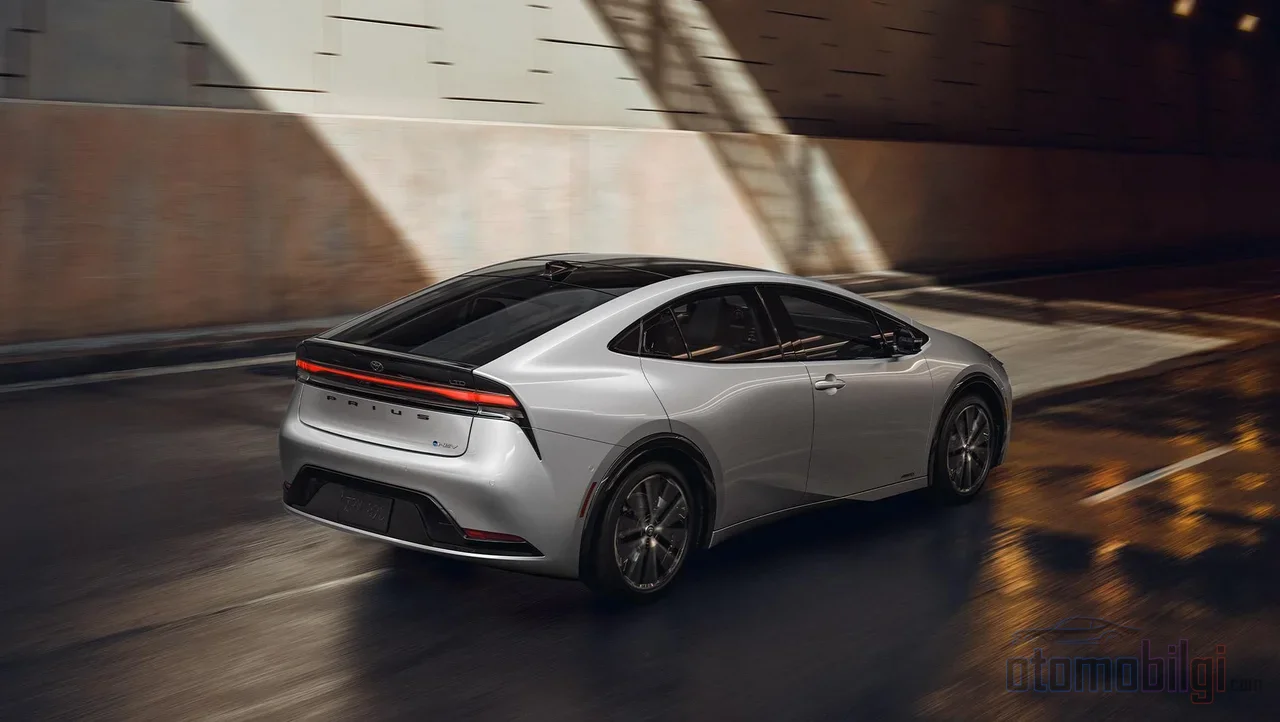
| Toyota Prius (full hybrid) | 57 mpg | 56 mpg | Top-level in both profiles |
| Prius PHEV | 53 mpg | 51 mpg | The weight of the large battery reduces efficiency on long journeys |
The engineering lesson from the table is simple: in a gasoline car the city-highway ranking favors the highway, while in a hybrid this ranking flips in favor of the city. In other words, the hybrid's identity is that of a city car; on the highway it is still better than its gasoline sibling, but the gap is narrow. A similar picture emerges on the range side: while the Prius full hybrid version goes roughly 630 miles on the highway with its 11.3-gallon tank, the PHEV stays around 540 miles with 10.6 gallons and 51 mpg - even when electric range is added, the gap does not close on the first tank.
Another important question is which profile the catalog reflects. Standard cycles measure at mild temperatures, moderate accelerations and medium speeds; that is, the catalog value best represents a mild mix of urban and short highway driving within metropolitan areas. Conditions such as harsh winter, sustained 130 km/h or loaded climbs are outside the scope of the catalog.
How does consumption change as speed increases?

Official data sets modeling fuel economy by driving speed show that in mid-range cars consumption drops up to a certain speed and then rises rapidly. The physics rationale is straightforward: air resistance grows with the square of speed, and at high speed the aerodynamic loss overwhelms the gain in engine efficiency. An indicative split from practical sources: at around 120 km/h, consumption is roughly 20% higher than at a slower steady speed; beyond this band, the increase accelerates.
What this means for hybrids is the following: at a steady 90 km/h highway cruise the hybrid system can still provide an efficiency contribution; at 130 km/h the engine runs at nearly full load continuously, electric support becomes marginal, and consumption approaches that of a gasoline car. Real-world user data confirms this as well: one RAV4 Hybrid owner reports measuring about 30 mpg on a two-hour commute at 75 mph (approximately 120 km/h) - noticeably below the catalog highway value.
Real-world data: how many points do hybrids gain?
The most striking quantified result is the real consumption difference measured by road type for full hybrids compared to internal combustion vehicles: on highways and expressways an average of 39.3% less fuel, and on main road (arterial) type roads 58.0% less fuel. The arterial improvement being larger than the highway one translates the city and stop-and-go advantage directly into numbers. A large-scale comparative study also gives a consistent range: full hybrids improve real-world fuel economy by 40-45% . Current consumer tests paint a similar picture - most hybrid SUVs are above 35 mpg and most hybrid sedans above 45 mpg; this means roughly a 40% improvement compared to non-hybrids.
Why is the catalog value so optimistic?
The gap between the catalog and reality is not unique to hybrids, but hybrids are more susceptible to the misconception. In gasoline cars, according to first registration data, the average deviation between catalog and real values is 21.1% (approximately 1.3 L/100 km). In actual hybrids, however, real-world measurements show the improvement stays within the 40-45% band - meaning close to what the catalog promises but usually slightly below. The lasting rule is this: when comparing two vehicles, base your decision on the real-world improvement rate, not the catalog difference.
With plug-in hybrids, the picture is much harsher. In Europe, PHEVs' real-world consumption has been measured at 4.0-4.4 L/100 km for private vehicles and 7.6-8.4 L/100 km for company cars, while catalog combined figures are recorded in the 1.67-1.73 L/100 km band. Real CO2 emissions are roughly six times the WLTP value - PHEVs registered in 2024 emitted an average of 145 g/km while the catalog says 24 g/km. On short trips a PHEV is genuinely efficient; however, once the battery is depleted it operates like a regular hybrid, and the weight of the large battery being carried drags down efficiency on long journeys. If you drive mostly long distances, it is more realistic to calibrate your expectations to a full hybrid.
What should you expect based on your profile?
Placing yourself in one of the profiles below makes your expectation measurable:
- Stop-and-go and heavy city traffic: The hybrid's best-case scenario. Improvement of up to 58% on arterial-type roads and the reversal of the mpg ranking in the Civic example define this profile. For a high-mileage city driver, the savings potential is greatest here.
- Mixed use (city + moderate-speed highway): You can expect the typical real-world improvement in the 40-45% band. This profile is the closest to the catalog cycle.
- Continuous high-speed long-distance driving: The advantage is narrowest here. At constant speeds above 120 km/h the hybrid approaches the gasoline car; user measurements show it can fall noticeably below catalog values. Even so, the hybrid is generally slightly ahead in this profile as well.
- Short, cold trips: A cautious exception: on very short trips with cold starts, the city advantage may not always appear - one owner measured only 32 mpg on a 5-mile trip in freezing weather, despite gentle driving and regen modes. The system cannot reach full efficiency before the engine warms up.
Cold weather and other conditions that erode the advantage
At low temperatures battery efficiency drops and the batteries take longer to warm up; there are user reports stating drops of up to 30-34% in hybrid winter economy - this figure is not an official measurement and should be read as forum-sourced user experience. The assessment of official testing organizations points in the same direction: at temperatures near freezing, hybrids' efficiency drops significantly, though the decline is somewhat smaller than in fully electric vehicles, and the hybrid's fast refueling advantage provides practical compensation. Modern hybrids are being built to adapt to this; the internal combustion engine prevents continuous cold operation, offsetting part of the loss.
Other conditions that push consumption up along with the cold should not be forgotten: continuously hilly mountain roads, towing a trailer or load, and high altitude all increase the engine's shortness of breath. None of these break the hybrid's basic mechanism in the city - energy is gained even on descents through regenerative braking - but they push your average consumption away from the catalog figure.
The savings math: your mileage profile determines the gain
The formula for savings is simple: the annual fuel cost is found by dividing the fuel price by the combined efficiency; the hybrid's return is the difference between these values for the two vehicles multiplied by the annual mileage. Reference points: based on 15,000 miles/year (approximately 24,000 km), a hybrid with ~52 mpg combined consumption can save over $800 in fuel per year; a ~40 mpg hybrid falls in the $500-600 range. Under the same use, a gasoline model's annual fuel cost is calculated at approximately $1,434.
There is a subtlety to note here: mpg improvement does not reflect linearly on fuel cost. Assuming a $4/gallon price, a 35 mpg vehicle burns 8.57 gallons ($34.28) over 100 miles, while a 45 mpg vehicle burns 6.7 gallons ($26.67) - a 10-point efficiency gain yields roughly $7.60. The same 10 points would provide a much larger gain in a move from 15 to 25 mpg. That is why switching from an already efficient vehicle to an even more efficient one follows an asymptotic curve in terms of absolute savings.
As a result, the math rewards your profile: a driver who spends most of their annual mileage in the city and heavy traffic closes the hybrid's higher initial cost noticeably faster than a gasoline model. For a highway-heavy driver, the break-even period extends; this is not a problem, just an honest output of the calculation.
Driving techniques that improve efficiency regardless of profile
Whatever profile you drive in, the same principles apply:
- Use the accelerator pedal gently. Hard, aggressive starts engage the gasoline engine more than necessary and too early; the goal is to stay in EV mode as much as possible.
- Use ECO mode; it softens throttle response and limits the impact of consumers like air conditioning.
- Accelerate with the gasoline engine, and when you reach about 35-40 mph (55-65 km/h), release the accelerator briefly - this is an adapted version of the pulse-and-glide technique, a practical way to hand propulsion over to electric mode.
- Keep tire pressures at the manufacturer's values and remove unnecessary load from the trunk.
One final note: how aggressively regenerative braking should best be used is still a debated issue; there is no one-sided answer valid in every condition. In practice, anticipatory driving - easing off the accelerator early, avoiding hard braking - provides the safest gain in every case.
Summary: which profile gets which savings?
The hybrid's efficiency identity is written in the city: the trio of stop-and-go traffic, regenerative braking, and electric propulsion produces real improvement in the 40-45% band, and up to 58% in main-street type use. On the highway, the advantage drops to around 39% and can melt away quickly above 120 km/h; winter, mountain roads, and trailers narrow it even further. When making the purchase decision, the single right question to ask is this: how many of my annual kilometers are spent in stop-and-go and city driving? The size of the answer is the size of the money the hybrid will save you.
Sources
- Are Hybrids Good for Long-Distance Driving?
- Fuel consumption of hybrid electric vehicles under real-world conditions
- Comparative Study of Fuel and Greenhouse Gas Emissions
- Maps and Data - Fuel Economy at Various Driving Speeds
- Electric Vehicle Benefits and Considerations
- Publication of real-world CO2 emissions and fuel consumption
- Real-world usage of plug-in hybrid vehicles in Europe
- Plug-in hybrids pollute almost as much as petrol cars
- Are Hybrids a Smart Choice Right Now?
- Why Do Hybrids Get Great City Gas Mileage?
- Hybrid vs. Gas: Break-Even Fuel Savings
- Hybrid vs. Gas Cars: How Much Can You Save
- Understanding Hybrid Vehicle Fuel Economy
- How Hot & Cold Temperatures Affect the Range of EVs & Hybrids
- Hybrid driving tips for best fuel economy
- How to Get Maximum MPG Out of Your Hybrid
- Plug-in hybrid vehicles over short vs long trips