Up to What Speed Does a Hybrid Car Go in EV Mode?
Share This Page
The EV mode of hybrid cars runs fully electric up to about 40 km/h (25 mph) in most models; but this limit is not a fixed value - it varies depending on throttle sensitivity, battery charge level and road conditions. On level ground with light throttle, some models can drive electrically up to 72-80 km/h, while aggressive throttle input engages the engine instantly. EV mode is not a sustained cruising mode, but a short-term tactical option designed for low-speed environments.
Highlights
- According to Toyota's official definition, EV Mode runs fully electric over short distances up to about 40 km/h (25 mph).
- Some drivers report electric driving at 72-80 km/h on level ground with light throttle input in the 2024 RAV4 XSE Hybrid.
- The switch from electric to gasoline occurs in the 24-40 km/h range in most full hybrids.
- When battery charge drops below about 20%, the system shuts down EV mode or makes it unavailable.
- In full hybrids, the difference between real-world and catalog fuel consumption is generally much smaller than in PHEVs.
Up to what speed does EV mode work: The difference between the official limit and the real limit
The manufacturers' official definition is clear: According to Toyota, EV Mode runs the vehicle fully electric over short distances up to about 25 mph, that is 40 km/h, and returns to standard hybrid mode once this speed is exceeded. For this reason, the mode is designed for environments where speed limits drop below 40 km/h, such as university campuses, school zones, city centers and covered parking exits. From an engineering standpoint, this is not a marketing constraint but a natural consequence of the thermal and power limits of the small hybrid battery and electric motor.
In reality, however, the limit is not a firm line but a sliding band. According to driver reports, the 2024 RAV4 XSE Hybrid can progress on electricity alone up to 72-80 km/h (45-50 mph) on level ground with light throttle input. Some owners of older hybrids, on the other hand, say they saw electric cruising up to the point of about 64 km/h, where the battery could sustain a certain acceleration. These values do not contradict the official definition: the official 40 km/h figure refers to the limit guaranteed under all conditions. Engine-off electric driving can momentarily continue above this limit as long as acceleration is light and power demand is low.
| Condition | Approximate EV speed | Note |
|---|---|---|
| Official definition (Toyota) | ~40 km/h | Limit guaranteed under all conditions |
| Aggressive throttle input | Below the limit | Mode is deactivated instantly |
| Level ground, light throttle (driver report) | 72-80 km/h | 2024 RAV4 XSE Hybrid |
| Uphill, under load | Lower | Engine engages earlier |
When does the engine engage: Four conditions that cut off EV mode
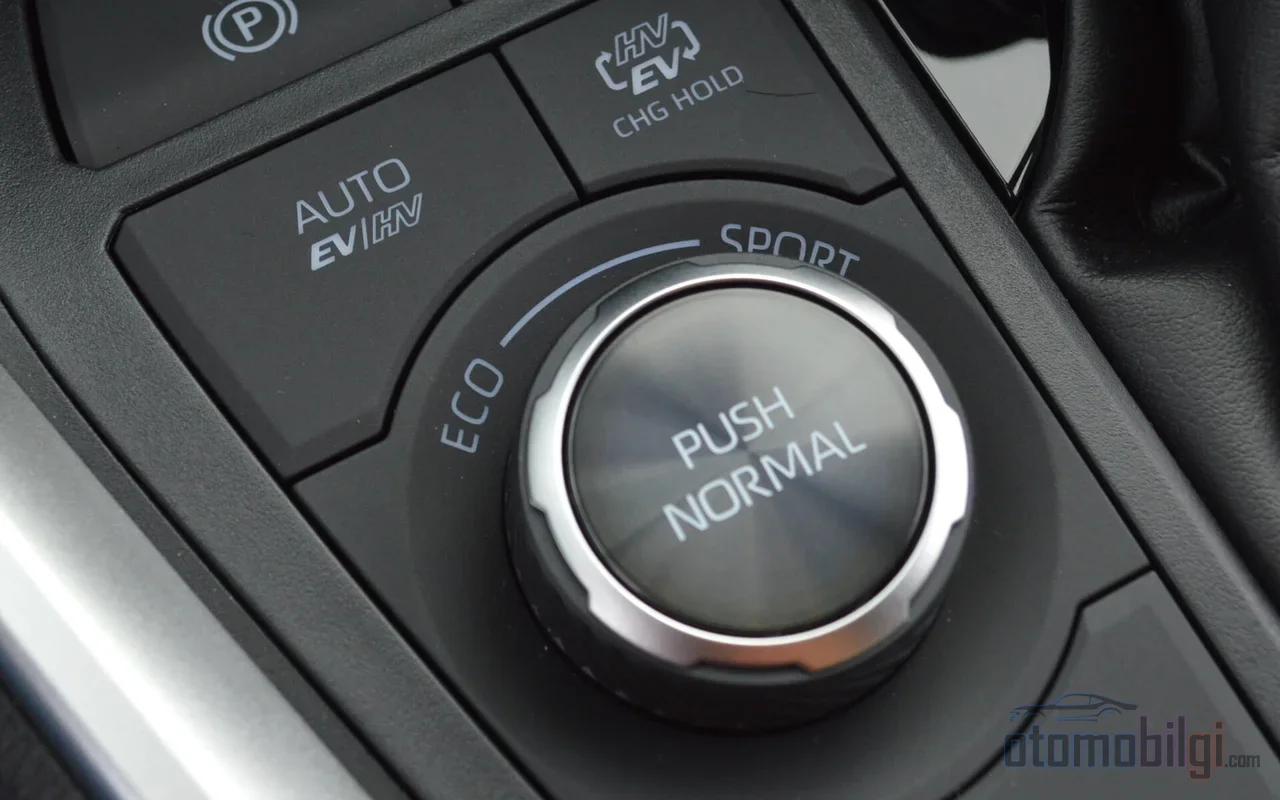
To predict when EV mode will shut down, it is enough to monitor four variables. One of these is a simple threshold that kicks in when the speed is exceeded; the other three are embedded in the system's decision logic.
- Speed: The mode does not work when cruising above 40 km/h; the system automatically switches to hybrid mode.
- Throttle pedal: Excessive throttle input instantly disables the mode; the system returns to Normal Mode for full power.
- Comfort demand: If engine operation is required for the A/C compressor or defroster, EV mode is cut off or delayed.
- Battery charge: When the battery drops below approximately 20%, the display shows an "EV mode not available" warning and the vehicle stays in Normal Mode.
The system rejecting EV mode due to insufficient battery charge is a result of its design: the small hybrid battery needs a certain charge band for full performance both during pull-away and regenerative braking. Cold weather narrows this balance even further; a cold battery and cold engine cause the gasoline engine to run more frequently in winter. Having shorter electric segments during this period is not a sign of a fault, but an indication that the system is working correctly.
Is the EV button really necessary?
This is the question many drivers ask, and the answer is close to no in most scenarios. Full hybrids switch automatically between gasoline and electricity, and this transition is generally not under the user's control. When leaving the garage in the morning, the engine usually does not run at all; it stays silent at traffic lights and stop signs, is off in parking lots, and normally disengages when coasting downhill or freewheeling. All of this happens without touching the mode button. The real contribution of the EV button is to consciously lock this automatic behavior into uninterrupted electric driving for a few minutes: in a minutes-long queue at the exit of an indoor parking lot, the engine never runs and you move forward silently and emission-free. At high speeds where the engine is most efficient, when rapid acceleration is needed, and on hills, the system will already switch to gasoline.
The way to extend the electric range: How much difference does driving style make?
The main variable that determines the EV mode's speed limit is the driver's own foot. The electric motor can handle short bursts of high power, but every aggressive acceleration engages the engine and rapidly drains the battery. Measurements made on electric vehicles show that two different drivers in the same vehicle can see a 20-30% range difference depending on acceleration style, speed choice, and use of auxiliary systems; when applied to hybrids, this ratio directly affects the length of the electric segments and total consumption.
In practice, the steps are simple and measurable:
- Use Eco mode, which softens throttle input; the softer pedal response prevents the engine from engaging early.
- Make the most of regenerative braking during urban deceleration; the lost kinetic energy returns to the battery and feeds the next electric segment.
- Drive at as steady a speed as possible; cruise control provides finer throttle management than the microprocessor can achieve.
- Keep tire pressure at the manufacturer's specified values; low pressure both increases consumption and raises rolling resistance.
One of these strategies is the question of sequencing: starting on electricity on an urban route and switching to gasoline once the battery drops to a certain threshold means keeping the battery in reserve, covering the low-speed zone where the engine is least efficient entirely with electricity. What you use, and when, makes more of a difference than how much you use.
How big is the gap between catalog consumption and real-world consumption?
This is the most critical question when buying a hybrid, and the answer varies considerably depending on the type of technology. In full hybrids the gap is relatively modest: in a real-world test conducted in Australia, a hybrid with a laboratory value of 4.6 L/100 km consumed 4.9 L/100 km on the road - a difference of roughly 0.3 liters. Driver data points to the same picture: the 2021 Honda Jazz hybrid achieved a real-world 50 mpg against an official 62 mpg, while the 2023 Toyota Corolla hybrid reached a real-world 58 mpg against an official 64 mpg. This shows that the hybrid remains one of the technologies that stays closest to its catalog promise in the real world.
The absolutely low stated values inflate the percentage difference: in an academic review, all manufacturer claims for the hybrids examined were already below 1.6 L/100 km (1.13-1.55 L/100 km). Consuming 2.0 liters in reality when the claim is 1.3 liters is a small absolute deviation but one of over 50% in percentage terms. On the PHEV side the picture is harsher: according to a major study, plug-in hybrids that are never charged can consume up to three times their official figures. This scenario does not exist in a full hybrid, because the battery is already refilled from gasoline and the system is forced to use electricity at every opportunity. The claim in some online test videos that hybrids consume up to 33% more than advertised is based on isolated measurements and should not be read as a generalizable conclusion.
Where does the hybrid win, and where does it lose?
The hybrid's mathematical advantage is concentrated in one place: stop-and-go traffic. Urban fuel economy is the hybrid's biggest gain; energy is recovered during braking, the engine falls silent at stops, and the entire low-speed zone is covered electrically. The 2026 Camry hybrid shows the upper limit of this potential: according to EPA figures, it can reach up to 51 mpg combined consumption. At highway speeds, however, the widespread belief that electric driving is wasteful rests largely on a misunderstanding; even with the engine running, the system is still as efficient as it is in stop-and-go traffic - only the hybrid advantage is not as pronounced as in the city.
The scenarios that erode the advantage are also measurably clear. Sustained hard acceleration, long climbs, and loaded cruising deplete the battery quickly, increasing the engine's share of operation; on mountain roads and when towing a trailer, the marked reduction in hybrid advantage is therefore inevitable. Cold weather works in the same direction: heating demand and a cold battery lower the threshold at which the engine kicks in. Under these conditions, the hybrid doesn't perform poorly; it simply can't reach its full potential.
The savings calculation depends on mileage
The return on a hybrid is directly proportional to annual mileage and usage profile. For a driver who mostly travels within the city and covers high mileage per year, the savings in stop-and-go traffic quickly recoup the break-even point; with highway-heavy, low-mileage use, the gap narrows. On the PHEV side, the picture is different: Models like the RAV4 Prime can travel even at highway speeds on electricity alone with an electric range of up to 70 km (44 miles), and some PHEVs' total range exceeds 600 miles - but this is an advantage that depends on a regular charging discipline. In fact, today hybrids already hold a larger share of the US market than pure EVs, on the grounds of charging infrastructure and practicality; this trend is the most tangible proof that the hybrid's promise of savings in city use still holds true.
Summary: The real limits of EV mode, in numbers
There are four numbers you need to keep in mind to use EV mode correctly. The official warranty limit is ~40 km/h; the instantaneous upper limit drivers see under ideal conditions is 72-80 km/h; the typical gasoline transition band is 24-40 km/h; and the battery level at which the mode shuts off is ~20%. A driver who knows these four values sees EV mode as neither an illusion nor an unnecessary button: it becomes clear that it is a tactical tool that provides minutes of uninterrupted electric driving in low-speed environments, while being automatically managed by the system at every other moment. What determines the limit is always the sensitivity of your pedal and the charge level of your battery.
Sources
- How do hybrid driving modes change my driving experience? – Toyota Support
- I'm Seeing Confusion About How Toyota Hybrid-Electric Vehicles' EV Mode Works – Torque News
- What is EV Mode in Toyota Hybrid? – Toyota of Cedar Park
- When does a hybrid vehicle switch from gas to electric? – Lexus Support
- How Do Hybrid Cars Work? – Consumer Reports
- How Hybrid Cars Transition Between Battery and Petrol Power – Exclusively Hybrid
- EV Mode Efficiency & Engine Warm-Up Strategies – Toyota Cleveland Heights
- Hybrid driving tips for best fuel economy – Toyota UK Magazine
- Hybrid Driving Tips – GreenCars
- Maximizing EV Range Through Driving Habits – EvDances
- 10 Ways to Squeeze the Most Driving Range from an EV – Car and Driver
- MPG efficiency figures further from 'real world' than ever – PistonHeads
- PHEVs Promised Efficiency, Drivers Are Burning Three Times More – Carscoops
- Grid use and real world fuel consumption gaps in hybrid vehicles – Springer
- Hybrid car fuel efficiency: claimed vs real world – RACV
- Toyota Hybrid Benefits for City Driving – NewRochelle Toyota
- Which 2026 Toyota Camry drive mode is best – Toyota of Kirkland
- EV mode up to 45-50 mph – ToyotaNation
- EV mode is wasteful on the highway misconception – Rav4World