What Does Regenerative Braking Provide for Hybrids in City Traffic?
Share This Page
Regenerative braking is a recovery mechanism that converts a portion of the kinetic energy into electrical energy and stores it in the battery every time you slow down a hybrid vehicle. It can recover roughly half of the energy lost during braking; in stop-and-go traffic, this means gains of up to 10-25% in overall efficiency. City driving provides approximately three times more energy recovery compared to highway driving.
Highlights
- Approximately 50% of braking energy can be recovered through regeneration.
- In hybrids, under typical mixed driving, recovery amounts to roughly 5-9% of driving energy ; in fully electric vehicles, this figure rises to around 22%.
- City driving delivers 3 times more regeneration than highway driving.
- Thanks to regeneration, brake pads can achieve lifespans exceeding 160,000 km.
- A fully charged battery limits regeneration; at low speeds, friction braking kicks in.
How Does the Motor Turn Into a Generator? Working Principle Step by Step

The electric motor at the heart of the hybrid system works in both directions: when supplying energy, it propels the vehicle; when absorbing energy, it generates electricity. When you release the accelerator pedal or press the brake pedal, the control software switches the motor into generator mode. At this point, the rotation of the wheels turns the motor, and the kinetic energy of the moving vehicle is converted into electrical current.
In a conventional vehicle, the same deceleration occurs through friction brakes: the excess kinetic energy turns into heat in the pads and discs and is lost forever. In a regenerative system, this energy is stored in the battery and reused as propulsion at the next launch. So the same intersection, the same red light, the same deceleration - but in one case the energy dissipates into the air as heat, while in the other it waits in the battery for the next launch.
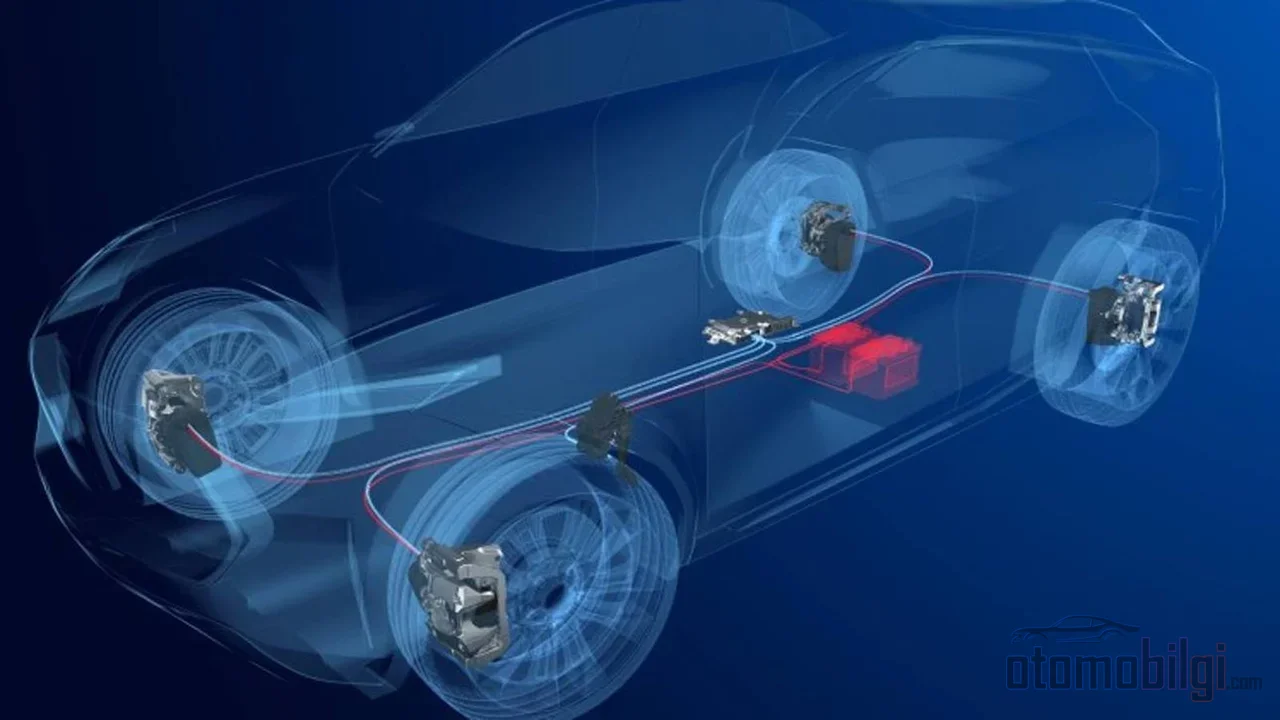
In practice, this mechanism does not work on its own. Regenerative braking alone is not enough to bring the vehicle to a safe stop, and its effect diminishes noticeably at low speeds; the final stop is completed by the friction brakes. Power distribution between the two systems is handled by brake-by-wire control - the first vehicle to implement this approach in series production was the GM EV-1 .
Battery or capacitor?
The recovered energy does not always have to go to a lithium-ion battery. The i-ELOOP system used by Mazda in some 2018 model vehicles uses a capacitor instead of a battery. A capacitor can store peak energy much faster and allows higher voltages; it is a sensible choice for capturing the sudden bursts of energy from short, hard braking. In hydraulic hybrids, energy can even be stored as compressed air.
How Much Energy Is Recovered? Concrete Figures
To read the numbers in the right context, we first need to distinguish what is being measured. The general rule is this: regenerative braking can recover about half of the energy lost in braking. This means gains of 10-25% in overall driving efficiency.
The share of energy lost in braking within total driving energy varies depending on the scenario. This is why you see different percentages in different sources: in hybrids, under typical mixed driving, the recoverable energy is around 5-9% of driving energy ; in fully electric vehicles, where braking is done by a vehicle carrying a heavier battery, this rate rises to approximately 22%. Manufacturer-sourced figures in the 10-30% range also appear - because this range describes which band the recovery capacity moves within depending on traffic, not what percentage of the energy is actually recovered.
| Scenario | Contribution of Regeneration | Note |
|---|---|---|
| Hybrid, mixed driving | ~5-9% of driving energy | Typical mixed-use profile |
| Fully electric vehicle | ~22% of driving energy | Typical average in modern EVs |
| Braking energy (general) | ~50% recovery | Maximum theoretical band |
| City driving | ~3 times that of the highway | Frequent stops = frequent recovery opportunities |
| Downhill descent | Most efficient scenario | Long-term recovery of potential energy |
The main message from this table is clear: The percentages depend on traffic, not on the vehicle. The same hybrid, the same battery, the same engine - but on a city route with heavy traffic lights, the contribution of regeneration to the total equation is many times greater than in uninterrupted highway cruising.
Why Is Stop-and-Go Traffic the Hybrid's Best Friend?
In stop-and-go traffic, every stop is an energy recovery opportunity. In traffic that progresses from intersection to intersection, from scenario to scenario, regeneration is triggered continuously; on the highway, since braking is rarely done, the system has little to do. Field studies (Björnsson, 2016) showing that the regeneration potential per kilometer is markedly higher in low-average-speed urban conditions quantitatively confirm this relationship.
The other side of the equation is equally important: sudden acceleration and hard braking can reduce fuel economy by 15-30% at highway speeds, and by 10-40% in stop-and-go traffic. The hybrid's city advantage emerges precisely here: in stop-and-go traffic, the missed energy is recovered through regeneration, and the least efficient internal combustion engine operation during starts is shared with electric propulsion powered by the battery. It is no coincidence that manufacturers frequently claim 48-60 MPG values (approximately 4.9-3.9 L/100 km) for hybrids, and that hybrids typically show better fuel economy in stop-and-go city traffic - every component of the system is designed for this profile.
How does the recovered energy turn into fuel savings?
The chain is simple: energy stored in the battery at the moment of braking reduces the engine's load at the next start. Since the engine is strained less, it burns less fuel. Since the number of starts is high in city traffic, this cycle is repeated hundreds of times a day, and small recovery pieces turn into a measurable difference in total consumption. On the highway, however, since the system is given almost no opportunity in a single long trip, the same mechanism is effectively disabled.
Frequent Braking or Rare Braking? Evaluate Your Own Usage Profile
How much regenerative braking gains you depends on how often you brake - but the relationship is not as linear as you might think. The frequent-braking city driver makes a small recovery every time they stop; the highway driver brakes rarely, but because each braking event happens from high speed, the absolute amount of energy is large. An example often discussed on driver forums summarizes the issue well: a single deceleration from 50 km/h to 15 km/h can save more energy than dozens of stops from 10 to 0 km/h - because kinetic energy grows with the square of speed. This assessment is not a verified measurement but user experience; however, the physics behind it is consistent.
The second, lesser-known gain of regeneration is brake wear. Since the regenerative system takes over most routine braking, the pads and discs are used far less; in hybrid and electric vehicles, brake pad life is said to be able to exceed 160,000 km (100,000 miles). In addition, regenerative braking can add 10-20% to an electric vehicle's range - in hybrids, this contribution is more modest depending on traffic.
- City-oriented usage (short distances, frequent intersections): The profile where regeneration provides maximum benefit; the hybrid's natural habitat.
- Mixed usage: Moderate contribution; urban sections make the difference.
- Highway-oriented usage: Regeneration is minimal; the hybrid's efficiency advantage narrows noticeably.
Technical Limits of Regeneration: Battery Charge Level and Low Speed
Regeneration is limited by the battery's charge acceptance capacity. When you set off with a fully charged battery, the system disables or severely throttles energy recovery; on a long downhill stretch with a full battery, friction brakes handle most of the deceleration, and that energy is this time truly lost as heat. Moreover, regeneration can only be applied to the driven wheels - in a two-wheel-drive vehicle, the mechanical system must always remain engaged so that all four wheels can be braked safely.
The effect also diminishes at low speeds: with current technology, regenerative braking cannot bring the vehicle to a complete stop at a reasonable speed. Therefore, not every stop is equal; the most efficient recovery occurs in decelerations that start from high speed and last a long time in the regenerative zone.
Effect on battery life: good or bad?
Giving a single answer to this question would be misleading. Everyday observation may give the impression that regeneration wears out the battery; however, a peer-reviewed study (MDPI, 2023) paints a more nuanced picture: the charging current coming from long-term regenerative braking is among the prominent factors in battery degradation regardless of current magnitude. In other words, regeneration itself is not the problem, but rather the cumulative effect of repeated charging behavior on cell chemistry. Practical takeaway: use the system as is, but know that the system automatically reduces regeneration under conditions where the battery is warm and full - this is not a flaw, it is a protection mechanism.
How Much Money Does Regenerative Braking Save in City Traffic?
The magnitude of savings depends on annual mileage and usage profile. In sample calculations based on roughly 24,000 km/year (15,000 miles), the annual fuel cost of a gasoline model comes to around $1,434; there are scenarios in which hybrids significantly reduce this cost and annual fuel savings exceeding $800 are calculated for some hybrid models - since this last figure comes from a dealer source, it is fair to read it as an optimistic upper-bound estimate. On the payback side, it is estimated that for most drivers the hybrid pays for itself within 3-9 years; whether the period shortens or lengthens depends entirely on annual mileage and the weight of city driving.
Conditions that erode the advantage should also be known: in cold weather, battery efficiency drops and fuel economy slightly decreases - the loss is more pronounced when the engine is cold because a rich mixture is burned, but the hybrid's internal combustion engine compensates for part of this loss. On long highway trips, the hybrid's city advantage naturally narrows; in high-load scenarios such as mountain roads or towing a trailer, regeneration alone cannot establish the balance.
Summary: What the Numbers Say
Regenerative braking is not a miracle, but a solid engineering balance: it recovers about half of the energy lost during braking, saves 5-9% of the total driving energy in hybrids, and maximizes this contribution in city traffic. For a driver with frequent stop-and-go use, the difference appears on the fuel bill every week; for a predominantly highway user, the justification for buying a hybrid should be sought elsewhere. If you are thinking about the number of junctions on your own route and your average speed, you have largely also thought about how much regeneration will gain you.
Sources
- Regenerative braking - Wikipedia
- Full Hybrid: Braking - Alternative Fuels Data Center (U.S. DOE)
- Efficient Driving to Conserve Fuel - Alternative Fuels Data Center
- The Future of Braking Is Electrified - Car and Driver
- How to Maximise EV Range with Regenerative Braking - go-e
- The potential for brake energy regeneration under Swedish conditions - Björnsson et al., 2016
- Effect of Regenerative Braking on Battery Life - MDPI, 2023
- Fuel economy of hybrid-electric versus conventional vehicles - Zahabi et al., 2014
- Why Do Hybrids Get Great City Gas Mileage? - Kelley Blue Book
- Hybrid vs. Gas in 2026 - Kelley Blue Book
- What Is Regenerative Braking and How Does It Work?
- What is Regenerative Braking in Hybrid Cars?
- What Is Regenerative Braking and How Does it Work? - Mazda USA
- What Is Ford Regenerative Braking?
- Vehicle Cost Calculator - Alternative Fuels Data Center