Why Do Carbon Brakes Heat Up So Fast in MotoGP?
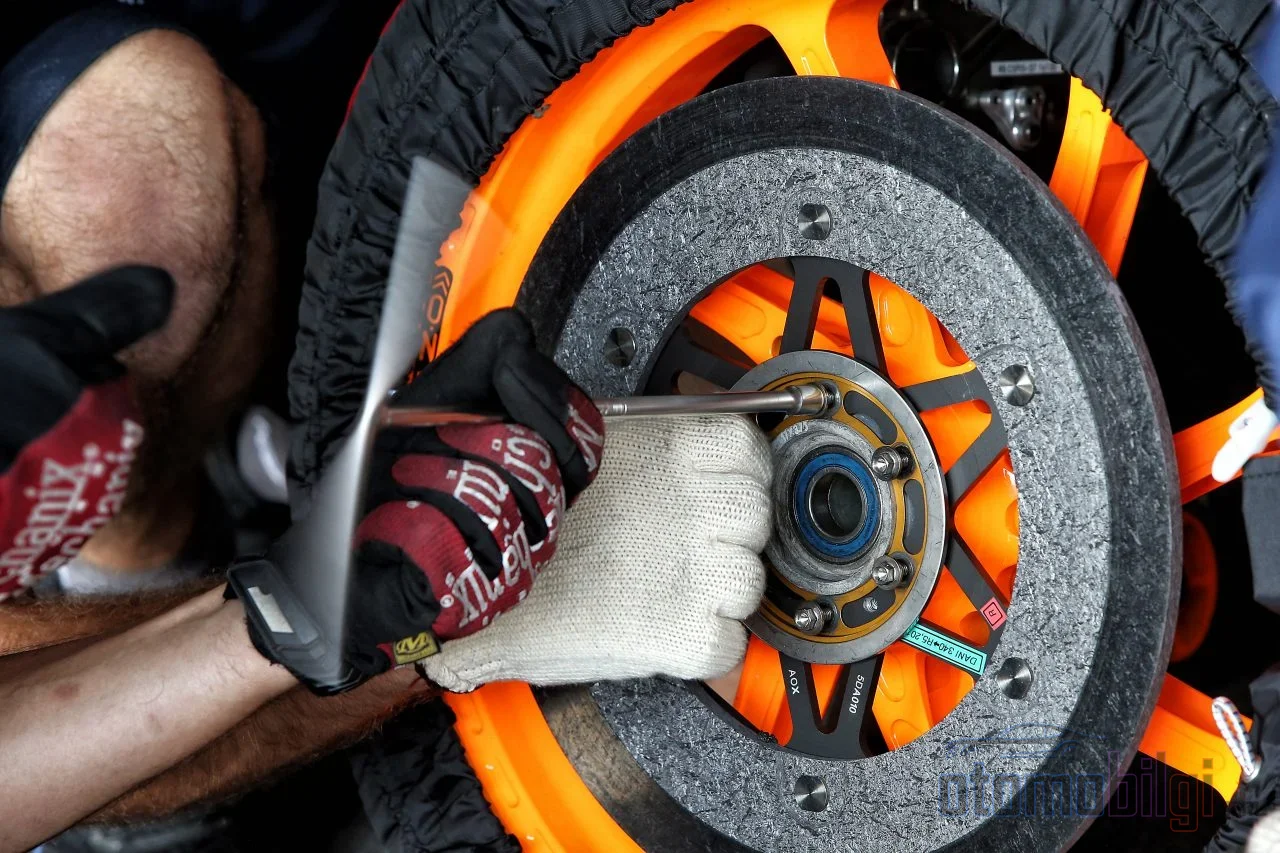
A MotoGP rider dives into the first corner, squeezes the front brake without easing off at all, and drops from 340 km/h to almost a standstill. But would that same brake work if it were brought to life in a crowded departure area? Probably not. Because these brakes only brake when they're red hot. It may sound strange to you, but in MotoGP the brake's enemy is cold, and its friend is fire. Let's dive into this contradiction, because the answer is far more interesting than you think.
Highlights
- During a race, the front carbon disc temperature typically runs in the 600°C–1000°C+ band
- Carbon brakes must reach at least 200°C–250°C for effective friction
- A 340 mm carbon disc weighs about 1.2 kg; its steel equivalent is around 2.2 kg
- A team can spend up to €70,000 per season for a front brake kit
- Carbon discs last a maximum of 2 Grand Prix weekends
What is a carbon brake, and how does it differ from a steel brake?
First, let's clarify the name. The system used in MotoGP is based on a structure called carbon-carbon composite: both the disc and the pads are made of carbon fiber reinforced with a carbon matrix. This should not be confused with the carbon-ceramic brakes in road bicycles or sports cars; those work across a much wider temperature range, even when cold. Carbon-carbon, on the contrary, demands a high operating temperature. So while your road car's brake stops you at the crack of dawn, the MotoGP brake hasn't woken up yet.
So why is this risky material still being used? Because once it reaches operating temperature, carbon-carbon produces a very high coefficient of friction and delivers far greater braking force than steel. Even better, as the temperature rises, friction performance improves instead of declining. It works consistently throughout the race, and the loss of pedal/lever force known as brake fade stays at a minimum. There's also the weight issue: a complete 340 mm front carbon disc weighs about 1.2 kg; a steel disc of the same size weighs around 2.2 kg. Don't underestimate the difference; because this is rotating, unsprung mass, it directly affects the suspension's response speed and the motorcycle's maneuverability. In short, a light brake both stops and turns.
The story of this technology actually began not on the track but in the sky: carbon brakes were developed for aircraft in aviation and defense, moved into Formula 1 in the late 1970s, and quickly became standard in the 1980s. The same decade, they also entered motorcycle racing, in the 125cc, 250cc and 500cc classes. The first serious attempt in the top class came in 1988, and just five years later carbon had become the absolute standard. Currently, all the teams on the grid use the same brake supplier; but this isn't a requirement, it's the teams' common preference. The supplier also contributes to TV graphics as the official brake data partner.
How hot do brake discs get during a race?
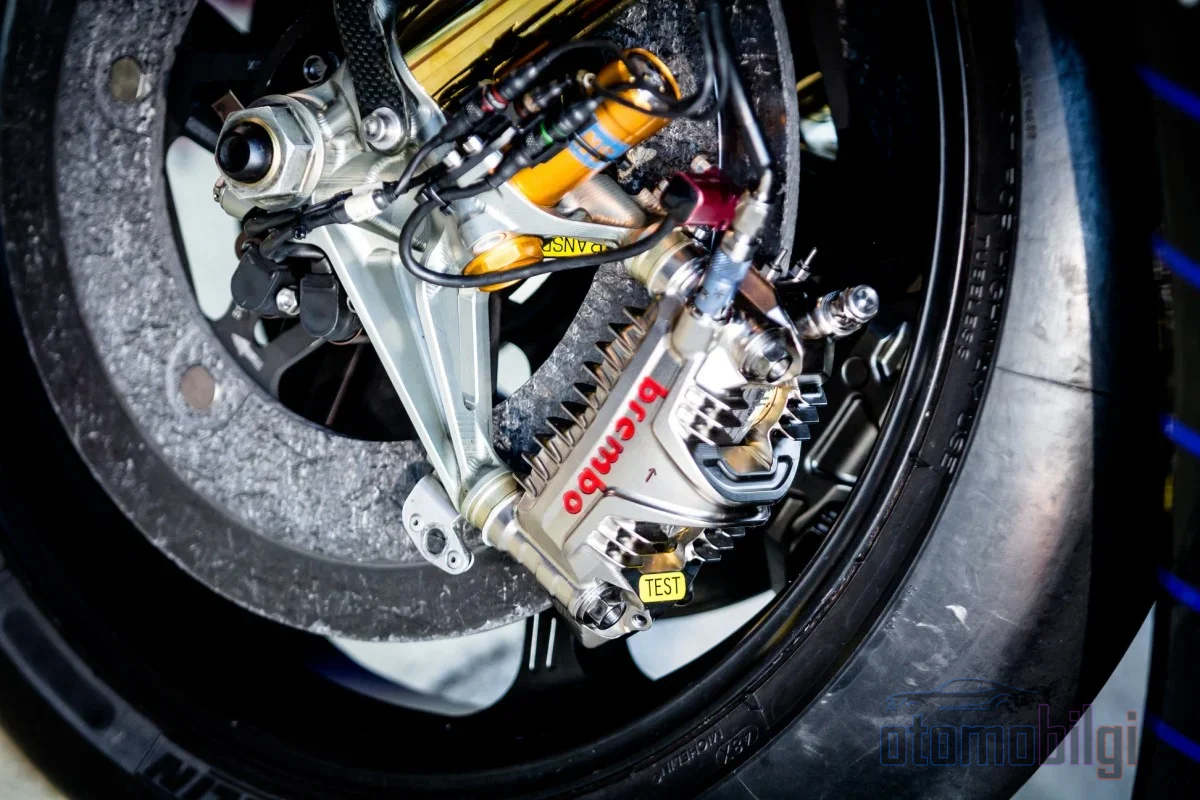
Well, the answer to this question is the heart of the matter. While racing, the front disc temperature typically runs between 600°C and 1000°C; on the most demanding circuits, temperatures above 1000°C are measured regularly. To put this into real-world terms: a pizza stone inside an oven, the neck of a candle flame, the inside of a pot of melted coffee... all of them travel within that band. And at the center of a motorcycle's front wheel, in that wind, at that speed. Just imagine it!
The source of these temperatures is pure physics. MotoGP riders brake incredibly late; all the kinetic energy at massive speed is dumped as heat from the brake discs in just a few seconds. Let's give a concrete example: at the first corner of a circuit, a motorcycle drops from 344 km/h to 179 km/h in 4.2 seconds. At another classic braking point, speed drops from over 340 km/h to 100 km/h in just a few seconds. What's more, the downforce produced by modern prototypes and the tires' load pressing against the ground further increase this energy flow. So the brake is the motorcycle's hardest-working organ.
What happens if you enter a corner with cold brakes?
This is where your headline comes in. If you enter a corner with cold carbon brakes, the motorcycle won't stop. Seriously: the carbon-carbon material must reach at least 200°C, or 250°C with the manufacturer's tolerance, to generate effective friction. Below this band, braking power drops and becomes inconsistent; where the pedal or lever would normally hold firm, braking slows to a beach-walk pace. What's more, coldness doesn't just mean a lack of power. If the material doesn't reach sufficient temperature, an effect called glazing can occur on the surface; the brake pad becomes shiny and slippery, and the brake becomes even more stubborn.
The sneakiest part is this: even with aggressive braking in cold weather conditions, you may not be able to bring the disc up to the required temperature. So effort alone isn't always enough. That's why teams preserve the disc's heat with brake duct covers and insulating materials; the goal is not to let the heat escape. In cars, brake discs are usually recessed inside the wheel, so they retain some heat; on a motorcycle, the disc spins in the open air, the wind hits it directly, and it cools much faster. Sometimes this is an advantage, sometimes a complete nightmare. When it rains, the situation becomes truly dire: water gets between the disc and the pads and acts almost like a coolant, making braking unpredictable.
But what if there's a race in the rain? In the old days, carbon was abandoned for this reason and riders switched to steel discs. But the 2017 Japanese Grand Prix marked a turning point: despite rain lasting 24 laps and an asphalt temperature of only 15°C, all the riders in the top 9 positions used carbon discs. Increasing engine power, improved tires, and more efficient brake ducts made this boldness possible. So technology has learned to fight even against water. Although there's still a mystery behind the warm-up laps to be told.
How do riders prepare their brakes during the warm-up lap?
Now we've come to the part you're really curious about. The warm-up lap is an untimed lap before the sprint or the race; the goal isn't just to warm the tires, but also to wake up the brakes. The riders deliberately perform a few hard braking actions in this lap, pushing the disc toward its operating temperature. This is a small ritual that guarantees the brake is fully awake before entering the first corner of the race. Sometimes an energetic-looking braking is actually a life-saving safety measure; only those who know how this disc works can tell the difference.
Pay attention, there is one remaining question: what if the brakes are still cold right before the race starts? This is exactly why, at the start, brake feel is one of the most nerve-wracking first seconds of every rider's life. The job of the disc cover and insulation is precisely this: to preserve the heat, to slow down the drop. So that breathtaking danger at a pre-race start is a battle not only with mechanical power, but with thermal management. I think you can now feel that famous first-corner fear much more deeply.
Disc sizes, rules and cost
Carbon brakes cannot be chosen at each team's whim. The rules clearly define the permitted disc diameters: 320 mm, 340 mm and 355 mm. Most riders prefer 340 mm. In addition, there are High Mass (wide surface) and Standard (narrow surface) variants depending on surface width; the manufacturer also offers a lightweight Light disc in 340 mm. Two different carbon composites are available for each size; one stands out for its initial bite feel, the other for high-temperature resistance. Their combination gives a total of 10 different disc options. The team looks at the braking demand of the track and makes its choice: on a high-speed track demanding hard braking, the large 340 or 355 mm, and in more moderate places the small 320 mm.
| Feature | Value |
|---|---|
| Permitted disc diameters | 320 mm, 340 mm, 355 mm |
| Most common preference | 340 mm |
| 340 mm disc weight | ~1.2 kg |
| 355 mm disc weight | ~1.4 kg |
| Steel disc weight (for comparison) | ~2.2 kg |
| Total disc options | 10 |
| Lifespan of a disc | At most 2 Grand Prix weekends |
As for the price side, your eyes will widen. A MotoGP team can spend up to €70,000 per season, the spending cap, for a front brake kit; this kit consists of 10 carbon discs and 28 brake pads. A complete front brake system can reach the level of €20,000. And the most striking detail: these expensive carbon discs last at most 2 Grand Prix weekends. So you use a disc, and then dispose of it. You are looking at a consumable, not a luxury toy.
Why isn't carbon in every class?
A surprising fact: Carbon brakes are banned in Moto2 and Moto3, the reason being cost. So young riders moving up from the lower classes have to completely relearn braking when they reach MotoGP. On the WorldSBK side, stainless steel discs have been used since 1994; the cost balance of production-based motorcycles and their closeness to road use require this. So the carbon brake is a privileged and expensive signature of the MotoGP prototype world.
How are the brakes connected to tire choice?
Let us say right away that this brake does not work on its own. Like carbon brakes, racing tires also require high surface temperature; if the tire is not at the right temperature, friction falls short and the immense force the brake generates cannot be fully transferred to the asphalt. The wrong tire choice can render even the best brake useless and directly cost the race. That is why teams consider brake and tire decisions together; meaning this freedom of choice remains active even in the final years before the transition. Meanwhile, a small technical detail: every MotoGP tire carries an embedded RFID chip holding its production data; so even the tire carries its own identity with it.
2027 and beyond: the new era of brakes
Traditionally, the world of brakes never stands still. A major regulation change is expected for the 2027 MotoGP season: engine capacity is dropping from 1000cc to 850cc and the brake manufacturer is preparing for this big change. In the 2026 season, teams will continue to choose between different brake specifications; meaning that even in the final years before the switch, this freedom of choice remained active. The manufacturer had previously developed larger 355 mm discs for Austria's double-header race weekend; so the character of the track has always guided brake design, and it will continue to do so.
In conclusion: the speed and power of the carbon brake in MotoGP are entirely made possible by fire. Cold, it behaves like a flower; when heated, like a dragon. The riders' hard braking on the warm-up lap, the teams' disc cover decisions, and those dazzling figures in the cost cap are all tied to the same story: a brake only brakes when it is red-hot. Next time you hold your breath at the first corner of a race, imagine the fire inside that brake; you will understand right then why we are talking about this.