Agostini's Eight Championships and the Forgotten Golden Age of 500cc
Share This Page
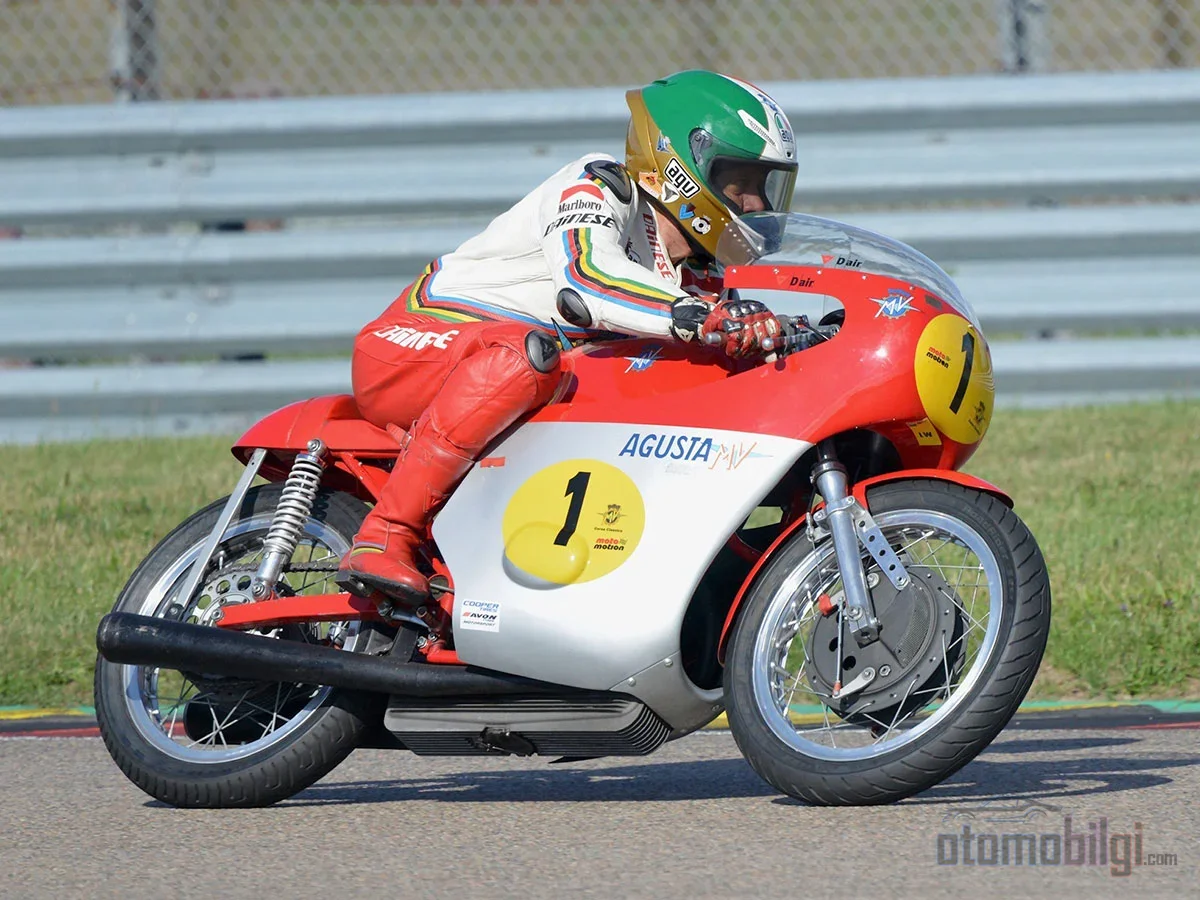
Giacomo Agostini, in the history of the 500cc Grand Prix, considered the ancestor of MotoGP, in the top class 8 world championships (1966-1972 and 1975), and across all classes 15 championships he still holds an unbroken record. So what made this Italian legend so special? Come on, let's jump into the time machine and look at the story of the MV Agusta era, the two-stroke monsters, and today's record hunts!
Highlights
- Giacomo Agostini: 15 world championships and 122 Grand Prix victories the most successful rider in Grand Prix history
- In the top class (500cc) 8-time world champion: 1966, 1967, 1968, 1969, 1970, 1971, 1972 and 1975
- Between 1968 and 1970, he strung together 58 consecutive victories in a row
- Marc Márquez equaled Agostini's 500cc record with his 68th top-class victory at Assen 2026
- 500cc two-strokes were not banned; the 990cc four-stroke rule in 2002 ended the era
Now let me ask you a question: picture a rider who wins the championship in the same class for seven straight years, then leaves and wins with a different machine too. For someone watching MotoGP today, this is almost science fiction, right? But in the 1960s and 70s, Giacomo Agostini did exactly that. When I first read this man's story, I shook my head and stared at the screen in disbelief; I hope you get the same feeling.
Who Is Agostini and How Did He Win His 8 Championships?
Giacomo Agostini June 16, 1942 was born in the city of Brescia, Italy, and grew up in Lovere. Here's the funny part: his father never approved of motorcycle racing! So in his early years, Ago raced in secret from his family. Imagine telling your mom "I'm going to a match" while chasing championships on the track. A risky but legendary start, isn't it?
His rise was swift. In 1963, at age 21, he won the Italian 175cc championship with Moto Morini. A year later he became the Italian 350cc champion. And in 1965 the doors opened: Count Domenico Agusta signed him to the MV Agusta factory team, as a teammate of Mike Hailwood, the superstar of that era. Think of it this way: you join your biggest goal as an apprentice, in the world's best team, next to the world's best rider. My big sister says: he graduated from apprenticeship in no time.
Timeline of the Championships: From 1966 to 1975
In 1966, when Hailwood moved to Honda, Ago became MV Agusta's number one rider and won his first 500cc championship. Moreover, this was the first Italian 500cc championship since 1957. Then it continued like dominoes: 1967, 1968, 1969, 1970, 1971, 1972... Seven years in a row! And his fourth championship with Yamaha, on a two-stroke motorcycle, came in 1975. The idea of leaving MV Agusta had been declared almost "treason" by the Italian press; he answered on the track.
Let's fit the numbers into a table, because some of them are truly mind-boggling:
| Record | Agostini's Career |
|---|---|
| Total world championships | 15 (across all classes, the all-time record) |
| 500cc championships | 8 (1966-1972, 1975) |
| 350cc championships | 7 (1968-1974 consecutive) |
| Grand Prix starts | 207 |
| Grand Prix wins | 122 |
| 500cc win rate | More than 52% (68 out of 130 races) |
| Fastest laps | 117 |
There's also the Isle of Man TT: between 1965 and 1972 he entered eight TTs, 10 wins and 13 podiums. We'll talk in a bit about just how brutal that circuit is, so keep this number in mind.
The 58-Win Streak and the Tense Finale of 1967
The 1967 season is a movie script all on its own. The championship remained uncertain until the very last race, and the points were tied with Hailwood. What broke the tie? The number of second places! Agostini became champion with 3 second places against Hailwood's 2. In other words, a man whose career includes "a championship won on second-place count." If such a tie-breaker existed today, social media would be on fire for two days, I think.
The real madness came between 1968 and 1970: Agostini won every 350cc and 500cc race he entered. The streak only ended with a mechanical failure at the 1971 Junior TT, and by that point he had accumulated a total of 58 consecutive wins (26 in 350cc, 32 in 500cc). In 1972, he defended the title with 11 wins in a 13-race season; this record remained unbroken until Mick Doohan took 12 wins in a single season, that is, until 1997.
What Kind of a Racing Era Were the 500cc Two-Strokes?
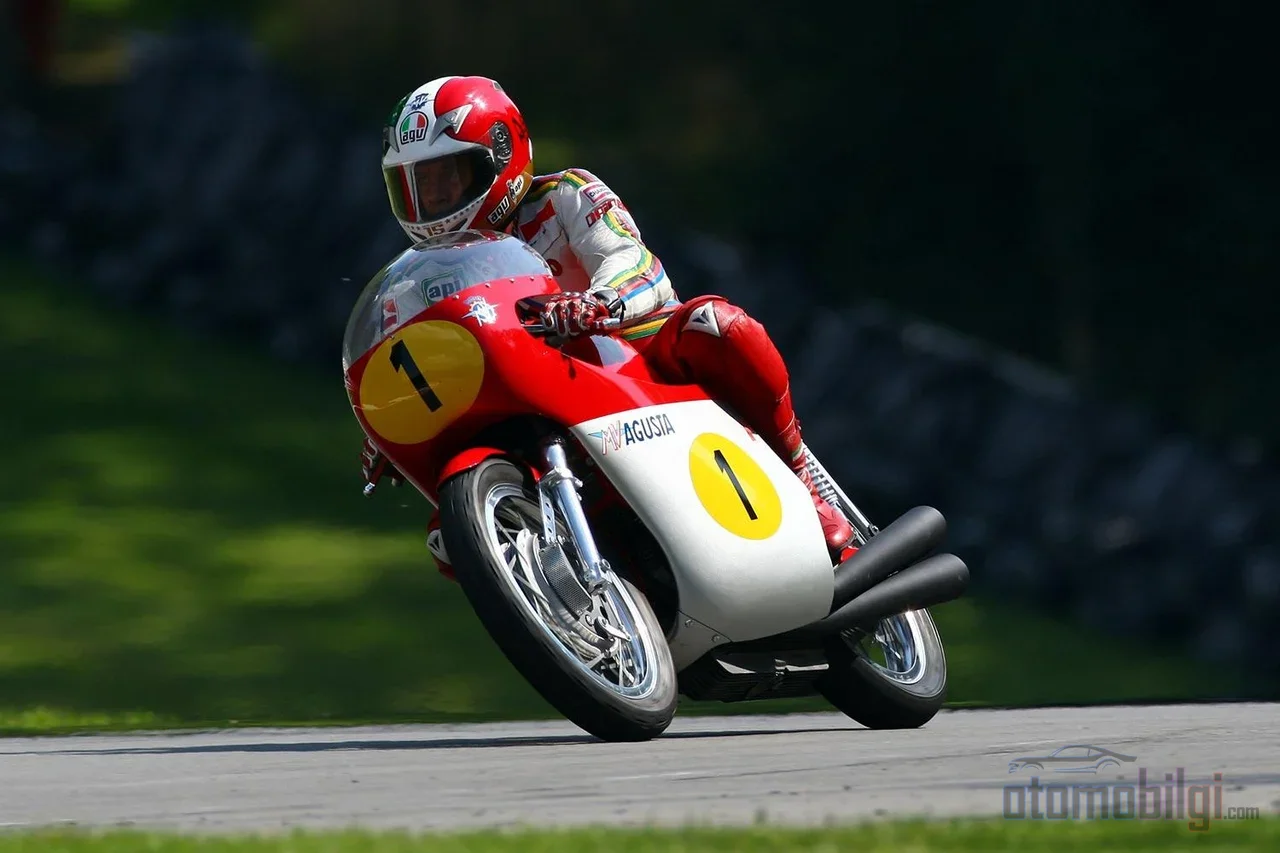
Now let's get into the technical part, but don't worry, I'll keep it simple. The premier class, the top category of Grand Prix, was raced as 500cc from 1949 to 2001. In Agostini's early years, the machines were four-strokes; MV Agusta's four-cylinder monsters were the kings of this era. The 1968 FIM rules also set the terms: four cylinders in 500cc, four cylinders in 350cc, and lower cylinder limits in the smaller classes. This rule made two-stroke engines advantageous in the smaller classes, and the result? Honda, racing with four-strokes, withdrew from motorsport, and Hailwood went to Formula 1. Agostini's biggest rival disappeared; this detail is not forgotten when the records are discussed.
Let me explain the two-stroke engine like this: in a normal car engine (a four-stroke), combustion happens in four steps; in a two-stroke, in two steps per revolution. In other words, it "fires" more often despite being the same size. The result, along with the power, is the sound and a livelier character. In 1970, Ginger Molloy finished second in 500cc on the Kawasaki H1R two-stroke; that's how the rise of the two-strokes began, and in 1974 Suzuki introduced the first two-stroke 500cc racing machine. In 1982, Honda built its own two-stroke as well. By the 1990s, the era of 500cc two-strokes without traction control and without electronics was underway; these machines are also remembered for high-grade highside crashes. Among the iconic names we can mention the Honda NSR500 and the square-four Suzuki designed by Makoto Hase, the RG500.
The Move to Yamaha and Victory with the Two-Stroke
So why did Ago leave MV Agusta? The 1973 season had turned into a nightmare: mechanical failures, the cancellation of the Nations GP following the deaths of Jarno Saarinen and Renzo Pasolini, a boycott of the Yugoslavian GP... His teammate Phil Read won the 500cc championship that year, but Agostini, after 10 years and 13 championships, wanted to prove something: can I also win with a two-stroke? In 1974 he moved to Yamaha with a six-figure contract and gave his answer immediately. With the new Yamaha TZ750 he won the Daytona 200, and a month later he beat the young Kenny Roberts at the Imola 200. That same year he became the 350cc champion on the Yamaha TZ350; this was the first 350cc title won by a two-stroke engine. And in 1975 he reached his eighth 500cc championship. His final victory was the 1976 500cc German GP.
Why Was the Isle of Man TT Removed From the Championship?
The story of this section is the most painful face of that era. The Isle of Man TT was run on a massive road course of 37.73 miles (approximately 60 kilometers). Riders raced alongside houses, walls, trees and hay bales, and even next to iron barriers. For someone accustomed to today's track safety standards, it is daunting even to think about, isn't it? In those days, deaths were unfortunately just ordinary news.
At the 1972 TT, Agostini's close friend Gilberto Parlotti lost his life. Ago boycotted the event, declaring that this track could no longer be considered safe. The champion's word carried weight: other stars also withdrew, and as a result the FIM removed the TT from the world championship calendar (it was run for the last time in 1976). Creating such a change single-handedly as an athlete? In my view, that is a legacy even greater than his 8 championships.
Agostini, Rossi and Marquez: Where Do the Records Stand Today?
Now let's come to the question everyone is pondering: Agostini, Rossi or Marquez? Let's talk numbers. Agostini has 122 GP wins in his career, and this keeps him ahead of Valentino Rossi (115); Agostini is the only Grand Prix rider with more wins than Rossi. Marc Marquez, meanwhile, reached his 68th win in the premier class at the 2026 Assen Dutch GP, equaling Agostini's 500cc record. So there is now a tie in top-class wins; but in total Grand Prix wins, Ago is still 32 wins ahead.
So what does "better" mean? A comparison table makes our job easier:
| Criterion | Agostini | Rossi | Marquez |
|---|---|---|---|
| Total GP wins | 122 | 115 | 32 behind Agostini |
| Top-class wins | 68 | - | 68 (equaled at the 2026 Assen) |
| Total world championships | 15 | - | - |
| Top-class championships | 8 | At the top with 9 | At the top with 9 |
| Most wins in a single season | - | - | Record holder |
Let's honestly note something here: critics say that for a large part of Agostini's career, after Honda's withdrawal, he raced with a dominant MV Agusta only against privateer pilots riding aging machines. The counterargument, in my opinion, carries more weight: back then, deaths were commonplace, and he raced on tracks lined with iron barriers and hay bales. As for the win ratio section, there is no need for debate: while Agostini has a ratio exceeding 52% in the 500cc class, Rossi's ratio is around 24%. Comparing different eras is always difficult, but the numbers certainly speak for Ago.
From the 500cc Era to Today's MotoGP: How Have the Classes and Rules Changed?
There was a big leap in 2002: the category was named MotoGP and the grid was opened to purpose-built 990cc four-strokes. Let's clarify this because everyone gets it wrong: the 500cc two-strokes were not banned; the rule change simply closed the era. In the first year, either 500cc two-strokes or 990cc four-strokes could compete, but the power advantage of the four-strokes was so evident that the two-strokes naturally faded into history. Just like old phones weren't shut down, but new technology buried them in history.
Today's structure is as follows: there are the MotoGP, Moto2 and Moto3 classes, and all three race with four-stroke prototypes. Moto2 is the intermediate class; 600cc engines with a single supplier (Honda since 2010, Triumph engine since 2019). Moto3 is the entry class. There is also the MotoE electric class. Making Moto3 single-brand from 2028 onwards is on the agenda. The points system? Points for the top 15 in the main race (winner gets 25), top 9 in the Sprint (winner gets 12). Add to that an allocation of 7 engines per season, limited tires, and a minimum of 22 liters of fuel. So compared to the 1970s world of "may the fastest bike win," it's a completely different discipline.
Of course, Türkiye has a share in this story too: at the 2026 Japanese GP, Toprak Razgatlıoğlu finished the race in 17th place; Márquez won the race. The fact that our riders also take part on this stage is, in my opinion, proof that the path Agostini opened is still alive.
Why Is Agostini's Legacy Still Talked About Today?
Let's sum up: Agostini is not just numbers, but the spirit of an era. Racing in his time meant risking your life every Saturday; today's safety standards were built on the price that generation paid. The TT boycott is the most tangible proof of this. On the engine side, the transition from two-stroke to four-stroke is the most dramatic chapter in the technology story of motorcycle racing. The track legacy is also strong: Assen's "Cathedral" was built in 1955 and was handed down as a fast-flowing road circuit; the first 500cc Dutch TT was run in 1977. Sachsenring's connection to motorcycle racing goes back to 1927; unfortunately, Bill Ivy lost his life there during practice in 1969.
Let me leave you with one final question: If Agostini raced in today's MotoGP, with those electronics-filled prototypes, would the same picture still appear on the charts? I'm not sure; what do you think? But one thing I can say with confidence: When everyone celebrated Márquez's 68th win at Assen in 2026, the first name that came to mind was Agostini. Isn't the fact that a record could still make news as "equalled" even 50 years later, proof of just how colossal it is?
Sources
- Giacomo Agostini
- Giacomo Agostini - MotoGP™ Riders
- Giacomo Agostini: News, Photos, Stats and more | Crash.net
- Giacomo Agostini - Red Bull Ring Legends Parade
- Giacomo Agostini - Laureus
- Grand Prix motorcycle racing
- Who is the Best MotoGP™ Rider of All Time? - MotoGP.com
- Agostini's and Rossi's MotoGP records are now within Márquez's grasp - Motorsport Magazine
- MotoGP™ records: The 10 most impressive milestones - Red Bull
- History of the 500cc two-stroke Grand Prix bike - Bennetts
- Best 500cc MotoGP Bikes Ever - TopSpeed
- Grand Prix racing explained - MotoGP.com
- What is the MotoGP™ Points System? - MotoGP.com
- 2026 MotoGP World Championship - Wikipedia
- MotoGP - Turkish Wikipedia
- What is the Difference Between MotoGP™, Moto2™ and Moto3™ - MotoGP.com
- Why Will Moto3 Become a Single Brand From 2028? - TRF1
- The Best MotoGP Riders of All Time - RTR Sports TR
- TT Circuit Assen - Wikipedia
- TT Circuit Assen History - assenmotogp.com
- Sachsenring - Motorsport Guides
- MotoGP news - Motorsport.com TR
- Marc Márquez equals Giacomo Agostini - Autohebdo