A 3% Reduction in Rolling Resistance Means 1% Fuel
The most talked-about ways to reduce your hybrid car's consumption are driving style, weight and aerodynamics. Yet the four points where the car touches the ground, namely the tires, are responsible for 20 to 30 percent of fuel consumption in an internal combustion car. In hybrids, this ratio becomes even more critical: when you switch to the silence of the electric motor, the engine noise disappears and rolling noise is carried into the cabin; and regenerative braking interacts directly with the tire construction. So how many liters do the so-called eco tires, or low rolling resistance tires, really save on hybrid consumption? The answer lies in the letters on the tire label and a few basic conversion rules.
What Is Rolling Resistance and Why Does It Determine Consumption?
As a tire rolls over the surface, it undergoes constant deformation; this deformation, along with friction on the contact surface and air drag, together make up rolling resistance. As resistance increases, more energy is needed to keep the car at the same speed, and this energy is reflected in the bill as fuel. Since part of this energy in a hybrid car comes from the battery, low resistance has a direct effect not only on gasoline but also on electric range.
There is a conversion rule accepted in the industry: a 3 percent reduction in rolling resistance provides about a 1 percent saving in fuel consumption. The same logic works in the opposite direction; if resistance increases by 10 percent, consumption is negatively affected. The rule may seem rough, but it is a sufficient yardstick for quickly calculating the cost of a tire choice.
Label Classes: How Many Liters Is the Difference Between A and E?
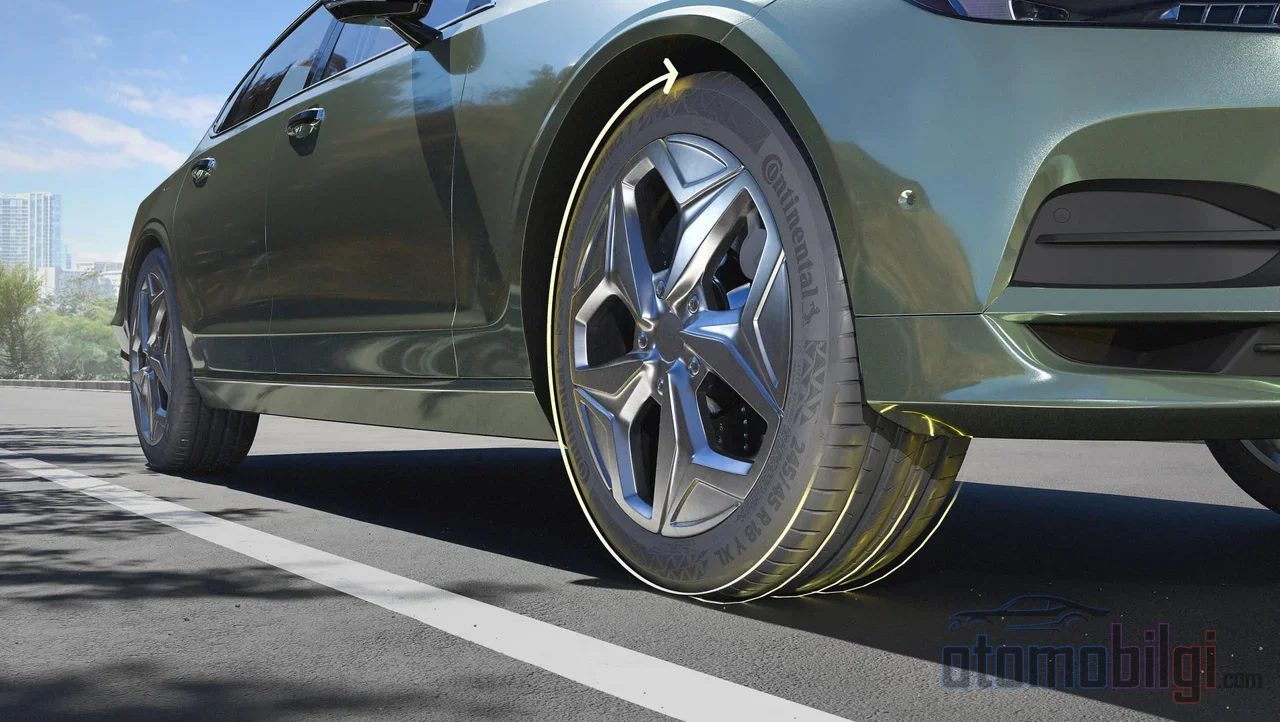
The European Union tire label classifies rolling resistance from A to E. The difference here is not cosmetic: An A-class tire provides a fuel saving of about 0.5 liters per 100 km compared to an E-class tire of the same size. This corresponds to roughly a 7.5 percent efficiency improvement. This value, measured in internal combustion vehicles, is also considered valid by manufacturers for electric range and hybrid efficiency.
Highlights
- An A-class tire provides a saving of about 0.5 liters per 100 km compared to E-class (roughly 7.5 percent).
- A 3 percent drop in rolling resistance means a 1 percent fuel saving.
- At 15,000 km per year, the A-E difference amounts to about 75 liters of gasoline.
- A tire pressure 0.3 bar below spec increases rolling resistance by 6 percent.
- With low-resistance tires, there is a risk of compromising grip and tread life.
To translate these 0.5 liters into daily use, simple arithmetic is enough: a driver covering 15,000 km a year saves about 75 liters of gasoline annually by fitting A-class tires instead of E-class. For a heavy user covering 25,000 km a year, the same difference rises to 125 liters. A real example sold on the market makes it even more concrete: A low-resistance tire aimed at hybrid and electric vehicles, such as the Michelin e·PRIMACY, provides a saving of about 0.21 liters per 100 km in the use phase; this corresponds to approximately 80 euros over the life of the tire, calculated on the basis of 35,000 km and 1.46 euros per liter.
Why Is Tire Selection More Critical in Hybrids?
Regenerative braking interaction
The biggest efficiency weapon of hybrids is regenerative braking: while slowing down, kinetic energy that would otherwise be lost as heat is recovered and sent to the battery. Low rolling resistance tires pair well with this system; because part of the energy reaching the wheel is already lost as heat inside the tire. The less energy lost in the tire, the lower the consumption and the less unnecessary tire wear. On the other hand, regenerative braking shifts braking stress to the front axle, and instantaneous motor torque loads the tread pattern in a way not seen in internal combustion vehicles. This shows that tire selection in a hybrid is not only a matter of consumption but also of wear symmetry.
Silence and noise
At highway speeds, tires can generate up to 70 decibels of noise. In an internal combustion vehicle, this noise is lost within the engine sound; but when a hybrid switches to EV mode, the engine sound disappears completely and rolling noise becomes the most prominent sound source in the cabin. That is why tires designed for electric and hybrid vehicles are optimized to reduce road noise. A low rolling resistance tire can also mean a quieter cabin.
Battery weight and torque
When a plug-in hybrid vehicle is in fully electric mode, it faces the same tire problems as a fully electric vehicle: battery weight, instantaneous motor torque and rolling resistance. Weight increases the load on the tire, while torque increases the shear force the tread block is subjected to. Some tires developed for PHEVs on the market can offer up to 7 percent more electric range thanks to their low resistance. As a reference point: a low resistance tire was measured to provide approximately 30 km on the basis of a 400 km range in a tested electric car, equivalent to a 7 percent range increase.
Pressure and Maintenance Must Not Be Forgotten: The Invisible Amplifiers of Resistance
Just as much as tire type, pressure determines resistance. Road studies show that more than half of vehicles are used with at least 0.3 bar less pressure than required. This deficiency alone increases rolling resistance by 6 percent; with 1 bar missing, the increase goes up to 30 percent. Using an A-class tire below ideal pressure means silently giving back part of the savings gained. For the eco tire investment to be meaningful, pressure checks must become a habit.
In extreme scenarios the effect grows even larger: in a scientific study, an increase in the rolling resistance coefficient from 0.004 to 0.013 led to up to 68 percent higher fuel consumption in high-demand usage scenarios. In normal driving this difference never appears at this scale, but it shows that the effect of resistance on consumption is not linear and grows in heavy load and low speed combinations.
Grip and Longevity Trade-Off: Does the Eco Tire Have a Price?
Reducing rolling resistance may require sacrificing other characteristics in tire construction. Low-resistance tires deliver higher fuel economy; however, tread life, comfort and, in some cases, wet grip levels may show a decline. For example, in some models recommended in the fuel-efficient class, the grip level is slightly lower than equivalent standard tires, and this is a fact that also appears in manufacturers' own promotions.
The trade-off is not the same size in every model. Good engineering tries to offer low resistance together with B-class wet grip and long tread life; for example, some low-resistance tires tested still pass wet braking standards even after 30,000 km. When making a purchase decision, the three values on the label should be read together: rolling resistance class, wet grip class and noise level. Looking only at the first letter can prove costly on wet roads in winter.
This trade-off has also moved to the center of regulatory debates. California's new eco-tire rules in September 2026 were criticized on the grounds that consumers would pay higher prices for tires with noticeably shorter tread life and weaker weather grip. The criticism has an objective core: reducing resistance is not always free. On the other hand, market data points in the opposite direction: products that compromise wet grip, tread life or resistance are observed to struggle to gain manufacturer approval, and the world's major tire manufacturers are seen to shape their low-resistance portfolios around hybrid and electric vehicles.
What Do the Example Models on the Market Promise?
| Tire | Key Promise | Warranty / Life |
|---|---|---|
| Michelin Energy Saver A/S | Claim of up to 7 percent MPG improvement | 65,000-mile tread life warranty |
| Continental TrueContact Tour | Good wet and dry performance, low highway noise | 80,000-mile treadwear warranty |
| Bridgestone Ecopia EP422 Plus | Low resistance for hybrids, good wet performance | 70,000-mile warranty |
| Goodyear Assurance Fuel Max | Expected 1-2 mpg improvement in normal use | Manufacturer data not provided |
| Michelin e·PRIMACY | 0.21 L savings per 100 km, approximately 80 euros over the life of the set | Calculated on a 35,000 km basis |
Attention must be paid to the type of figures in the table: MPG improvement claims are manufacturer statements; the actual gain varies according to vehicle weight, speed and usage profile. However, the orders of magnitude are consistent; all point to the fact that every improvement in rolling resistance has a measurable equivalent in liters. In consumer tests, as of 2026, Michelin ranks at the top because it offers a good mix of grip, road holding and long tread life in most tire categories; the general finding of independent tests is also that a 10 percent reduction in resistance brings a fuel economy improvement close to 1 percent.
How Many Liters Does the Eco Tire Save a Hybrid? Clear Answer
The question can be answered in a single sentence: An eco tire with class A rolling resistance saves a hybrid car around 0.5 liters per 100 km compared to a class E tire; at 15,000 km per year this is about 75 liters, while for a more modest low-resistance model it is 0.21 liters per 100 km, or 31.5 liters a year. The percentage of the gain varies according to the vehicle's total consumption: in a low-consumption hybrid, a 0.5-liter difference represents a larger proportion than in a high-consumption vehicle.
When making your decision, weigh three variables together: your annual mileage, your typical speed profile and the climate of your region. In stop-and-go city use with high annual mileage, the payback period of a class A tire shortens; for a driver covering 8,000-10,000 km a year and living in a rainy climate, the wet grip class might make sacrificing one class of resistance worth considering. The tire is the only component through which everything the car transfers to the road passes; chosen correctly, it works on every kilometer for years; chosen wrongly, it silently leaks fuel for the same duration.
Sources
- What impact does tyre rolling resistance on fuel efficiency
- Rolling Resistance of Car Tires
- Low-Rolling-Resistance Tires Can Save You Money at the Pump
- How Low Rolling Resistance Tires Boost Fuel Efficiency
- Low-Rolling-Resistance Tires For Your Hybrid SUVs
- Low-resistance tires improve fuel economy
- Analysis of Fuel Economy Due to Rolling Resistance
- Plug-In Hybrid Vehicle
- How Regenerative Braking Affects Tire Wear
- Best Tire Brands of 2026