Why Does Fuel Consumption Skyrocket When a Plug-in Hybrid Isn't Charged?
Share This Page
An uncharged plug-in hybrid burns typically two to four times the fuel consumption stated in the catalog; because the vehicle is designed to be powered by electricity, and if it is not charged, it has to carry the battery's weight and surplus engine power on gasoline alone. While the WLTP combined consumption of an average plug-in appears at around 1.5 liters, this figure rises to the 6 L/100 km range when charging discipline breaks down. This page explains, with numbers, the engineering reasons for this gap between the catalog and the pump.
Highlights
- Real-world consumption is on average 2–4 times
- the type approval figures. Average WLTP consumption ~1.57 L/100 km; when used without charging ~6 L/100 km
- For every 10 kW removed from system power, real consumption drops by 2–4% reduces
- For every 10 km of additional electric range, real figures improve by 8–14% improves
- Compared to a HEV with daily charging, a consumption advantage of up to 69% is possible
How Is the Catalog Value Produced, and Why Doesn't Real Consumption Match It?
A plug-in hybrid's (PHEV) type approval consumption is based on the assumption that the vehicle will complete a certain portion of the cycle on electricity and the remainder on gasoline. The concept defining this assumption is called the Utility Factor, i.e. the electric driving share. In type approval, this share is taken as approximately 69% for private vehicles. In real life, however, the same share drops to an average of 37% for private use and only 20% for company vehicles.
The share lagging so far behind has a single consequence: The gasoline engine runs far beyond the kilometers allotted to it in the catalog calculation. A large-scale real-world analysis of roughly 100,000 plug-in hybrids has revealed that tailpipe consumption reaches 2–4 times the type approval value for private vehicles and 3–4 times for company vehicles. While an average PHEV's WLTP combined value is ~1.57 L/100 km , the mathematics of it leaping to the 6 L/100 km level in real use is this: more than three times the official value.
The Penalty of an Empty Battery: How Do Weight and Surplus Power Burn Fuel?
The cleanest way to understand an uncharged plug-in is to see it as a two-phase balancing problem. On one side is the mass it carries, on the other the system that moves this mass. You lose on both sides.
How large is the battery weight penalty?
A PHEV battery typically carries around 15 kWh of capacity, which means a mass reaching into the hundreds of kilograms. The extra weight of the battery and electric motor can push consumption above even a comparable gasoline vehicle. The effect of battery weight on hybrid efficiency has also been quantitatively measured: as the battery grows, hybrid mode efficiency drops from 49.1 mpg to 45.2 mpg - meaning an 8% penalty solely due to mass. This energy never comes back from anywhere; as a load carried on gasoline, it is paid at every kilometer on the highway.
Why does engine power increase consumption?
The second issue is the system's power. Most plug-in hybrids, for marketing performance reasons, run both the gasoline engine and the electric motor together at high output. But power means friction, rollover loss and low efficiency at partial load along with mass. The analysis data ties this to a clear coefficient: every 10 kW of power taken from the system reduces real consumption and CO2 by 2-4%. On the range side the correlation points the same way: every 10 km of additional electric range improves the real-world figures by 8-14%. In other words, the powerful engine + small battery combination gives the worst result in the real world; the solution is to take power away from the engine and spend it on range.
How Big Is the Difference Between an Uncharged PHEV and a Full Hybrid?
A full hybrid (HEV) is a vehicle without a charging port; it fills its small battery by recharging itself through regenerative braking and the gasoline engine. The system is dimensioned entirely around this balance: small battery, low additional mass, power distribution calibrated to the gasoline engine.
An uncharged plug-in is in exactly the opposite situation of this balance. It carries the weight of its large battery in vain, becomes far more dependent on the gasoline engine, and the manufacturers themselves note that in this scenario the vehicle operates less efficiently than even its full hybrid sibling of similar size. It has been measured that in mixed city/highway use plug-ins lag slightly behind their full hybrid siblings. The energy authority's official statement also points to the same point: PHEV consumption depends on the distance between charges, and if the vehicle is never charged, fuel economy drops roughly to the level of a hybrid of similar size - meaning all of the plug-in's electric advantages disappear and the mass penalty remains.
| Scenario | Electric driving share | Result |
|---|---|---|
| Daily charging | 77% | Consumption falls by 69% compared to HEV |
| Occasional charging | 48% | The advantage clearly erodes |
| No charging at all | Approximately zero | Efficiency below a hybrid of similar size |
The first row of the table shows how effective the technology is when used correctly: when a PHEV with a 15 kWh battery is charged every day, its consumption falls by 69% compared to a full hybrid. The same vehicle gives back all of this advantage and a bit more when charging discipline breaks down.
How Do Charging Habits Reverse the Numbers?
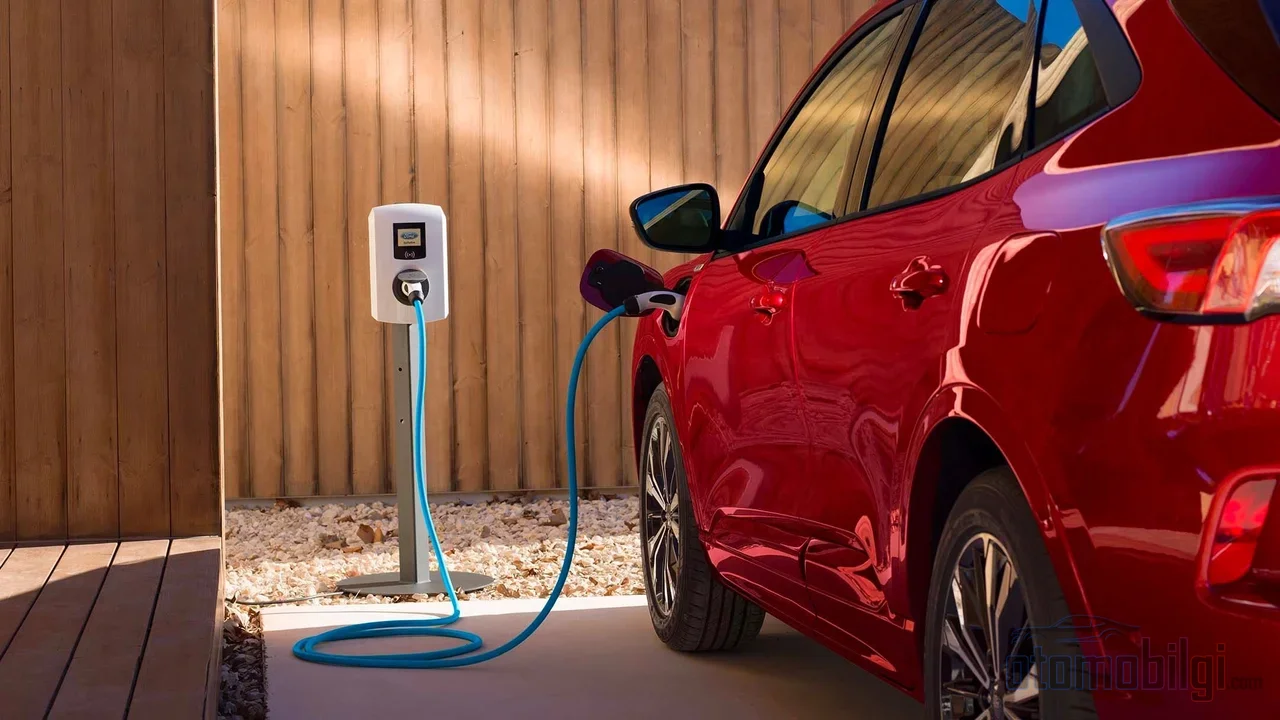
A plug-in hybrid's economy depends on how many kilometers the energy in its battery is spent over. Most PHEVs have a type-approved electric range between 30-60 km, and with regular charging these vehicles cover 5,000-10,000 km electrically per year. In models with a range above 80 km, this figure rises to the 12,000-20,000 km/year level; today many models offer around 100 km of electric range. In other words, the same car diverges dramatically in annual fuel bills between a homeowner connected to a charging point and a user who is not.
Why is there such a wide band? Because the electric driving share depends on four variables: daily distance, charging frequency, battery capacity, and driving profile. International comparison makes this clear - the highest real electric share is in the 53-54% band in the USA and Norway, while in examples with weak charging infrastructure and habits it drops to as low as 24-26%; in company vehicles this share falls to around 18%. The low charging motivation of company vehicle drivers means that those who do not pay for fuel personally pay the technology's bill, and we see the worst real-world results in this group.
Charging once or twice a week is not entirely useless. The large battery acts as a buffer between charges; some plug-ins, thanks to this buffer, can achieve better economy than standard hybrids. But for the advantage to reach its true size, daily charging must be the basis - that is the plug-in's design purpose.
Does Running the Battery Down Only Affect Consumption?
No; there is also a long-term cost. Manufacturers explicitly state that a PHEV battery may degrade faster under low charge and infrequent use conditions. Ideal use is to keep the state of charge within the 20-80% range. A plug-in used for months without charging both burns every liter at a higher cost and shortens the life of its most expensive component.
Regenerative braking provides a real but limited contribution in this picture. In stop-and-go traffic, energy recovery slightly recharges the battery; user measurements point to roughly up to 4% of a fuel economy contribution. This does not replace a charging point - it only recovers a portion of braking energy. Also, when the battery is at low charge, the system's electronic protection pushes consumption up; as the battery empties, the vehicle relying on the gasoline engine is inevitable.
For Which User Is a Plug-in Hybrid Sensible, and in Which Case Is It a Trap?
The decision tree actually comes down to a single question: does a battery that can be topped up before leaving home cover your daily driving?
- If the daily distance is within the electric range and there is home charging: The technology works as designed; up to a 69% consumption advantage compared to HEV and tens of thousands of electric kilometers per year are possible.
- If charging opportunity is partial: The electric share falls to the 48% band; there is an advantage, but far behind the catalog promise. Models with large batteries may still make sense here.
- If it can never be charged (for example, if a home charging setup cannot be installed): A plug-in consumes worse than a full hybrid of similar size; in this scenario, a full hybrid is the more correct choice.
The cost side must also be read honestly: current ownership analyses conclude that for most drivers, a PHEV will not create monetary gains in the first few years - perhaps ever. Savings depend not on fuel prices and kilometers, but first on charging habits.
Summary: Three Numbers, One Conclusion
The catalog says 1.57 L/100 km; the user who never charges sees 6 L/100 km; the user who charges properly goes well below the HEV. The single variable linking these three numbers is charging discipline. A plug-in hybrid is a vehicle whose electric tank is kept regularly full; when that tank runs empty, what remains is a heavy, over-engineered surplus burden, cursed to the gasoline engine, fitted with an 8% mass penalty and excess motor power. If you have no way to charge, the problem is not with the vehicle but with the vehicle choice.
Sources
- Real-world usage of plug-in hybrid electric vehicles - ICCT
- PHEVs Promised Efficiency, Drivers Are Burning Three Times More Fuel - Carscoops
- Do You Have to Charge a Hybrid Vehicle? - Mazda USA
- Plug-In Hybrid Electric Vehicles - Alternative Fuels Data Center (DOE)
- Hybrid vehicle information - Green Vehicle Guide
- Evaluation of plug-in hybrid vehicles in real-world - Dauphin et al., ScienceDirect
- Plug-in hybrid electric vehicles in Europe - an empirical analysis, IOP Science
- Impact of Battery Weight and Charging Patterns - Shiau et al., CMU
- Why the Actual Fuel Consumption of Plug-in Hybrids Is Often Higher - Newswise
- Will a Plug-In Hybrid Save You Money? - Consumer Reports