IGTC Points System: Five Continents, One Points Table
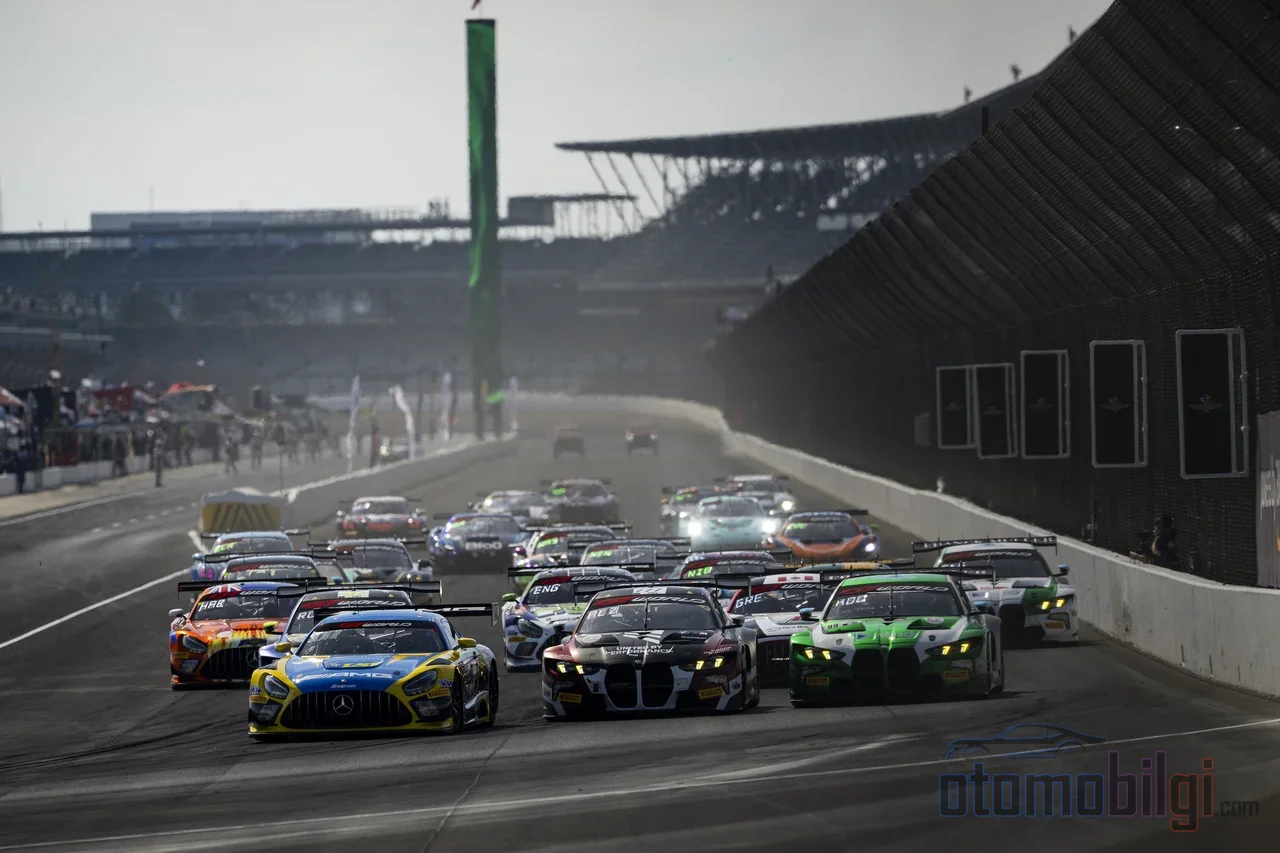
Imagine that in February at Bathurst, for 12 hours, in June at Spa for a full day, and in October at Indianapolis for 8 hours, the same brands are battling it out. And do all these races count toward the same championship? Yes - and with a system so peculiar that a driver can finish in the top three in a 30-car field and still not earn a single point. Did that sound absurd? A little. The Intercontinental GT Challenge, or IGTC, is precisely why it's the hardest puzzle to solve in the GT world.
On this page, we unpack the scoring and manufacturer representation side of that puzzle: why only selected cars score points, why manufacturers don't field their own teams, and how two completely different worlds like Bathurst and Spa come together in a single championship. Ready? Let's get started.
What Is the IGTC, and How Does It Differ from Other GT Championships?
The Intercontinental GT Challenge is a global endurance series founded by SRO Group in 2016, run with cars that comply with FIA GT3 regulations. It describes itself as the world's only global GT3 series, and that claim is no exaggeration: While GT World Challenge runs separate championships on a continental basis, the IGTC brings together elite independent endurance races from all around the world under a single umbrella. So this is not your classic "same track every week, same calendar" series; five iconic circuits from five continents, races that are each a legend in their own right.
In the inaugural 2016 season, there were four manufacturers: Audi, Bentley, McLaren, and Mercedes. By 2026, the field had grown; returning BMW, Ferrari, Mercedes-AMG, and Porsche were joined by Chevrolet and Ford, making this the largest IGTC field seen since 2020.
Key Highlights
- The IGTC is the world's only global GT3 series, organized by SRO Group since 2016.
- A manufacturer can enter up to four cars per race, but only its best two cars score points.
- Every driver finishing in the top ten of the drivers' championship scores points, regardless of which manufacturer they race for.
- In 2026, 6 manufacturers registered: the largest field since 2020.
- To score points, a car must complete at least 75% of the winner's distance.
Races Are Independent but the Championship Is One: The Calendar Logic

The most interesting thing about the IGTC is that its calendar doesn't actually consist of its own races. The rounds here are either independent events like the Suzuka 1000km and Bathurst 12 Hour, or races run within other championships like the 24 Hours of Spa or the Indianapolis 8 Hour. Since all of them are run with cars complying with the same technical regulations, the IGTC overlays its own points table on top of these events. Think of it as five different hosts sharing a single guest book.
The 2026 calendar is a fine example of this logic: It opens in February with the Bathurst 12 Hour, followed by the Nurburgring 24 Hours in May, the CrowdStrike 24 Hours of Spa in June, the Suzuka 1000km in September, and a finale in October with the Indianapolis 8 Hour. The calendar has been carefully arranged so that no two 24-hour races fall back to back. Each round brings its own character to the championship: A twisting track like Bathurst's mountain roads, Spa's changeable weather, Suzuka's technically demanding corners, Indianapolis' banked oval-opening turns... The same points system, completely different exams.
How Does the Manufacturer Scoring Work?
Now let's get to the heart of the matter. The IGTC is primarily a manufacturers' championship: the main title goes to the manufacturer that collects the most points by the end of the season. But the scoring logic here is different from what we're used to, because instead of fielding their own cars, manufacturers support local teams at selected events. So you won't see a factory team; the manufacturer's brand places its hand on the shoulder of the teams already racing that weekend.
Four cars enter, two cars score
The rule is clear: a manufacturer can be represented by up to four cars at each event, but points are only collected for its two highest-finishing cars. Imagine this: no matter how well the brand's third and fourth cars race, their contribution to the manufacturer's tally is zero. This is an elegant balancing rule that encourages manufacturers to build a quality combination of two or three cars rather than piling four cars onto the grid.
Who is eligible to score, and who isn't?
This is the part most viewers overlook: there may be 27 cars on the grid, but not all of them collect IGTC points. Cars of manufacturers with a full-season contract are eligible to score points; the others simply race among themselves within that race. Before the record-breaking 30-car field at the 2022 Gulf 12 Hours, only 16 cars were eligible for points. At the 2026 Indianapolis 8 Hour too, only 21 cars out of the 27-car field, those affiliated with the four registered manufacturers - BMW, Ferrari, Mercedes-AMG and Porsche - could take IGTC points.
There is also a classification requirement: In the 2026 season, a car had to complete at least 75% of the race distance covered by the winning car to score points. So seeing the finish line isn't enough; staying on the track long enough is also a must.
What does the points table look like?
The standard points framework of the SRO world works like this: first place takes 25 points, second 18, third 15, fourth 12, fifth 10, and the table goes down to tenth. In the IGTC in 2026 as well, points were distributed to the top ten positions in every race. So winning a single race means 25 points; in a five-race season, every point is worth its weight in gold.
Why Do Drivers Only Score Points in Selected Races?
On the drivers' side, the logic is more democratic: every name finishing in the top ten of the championship drivers' standings collects points, regardless of which manufacturer they race for. But for a driver to score points, they must be part of an eligible entry in that race; full-season manufacturers determine in advance which cars will score points at each event. That's why even if a driver finishes fifth in the race's overall classification, if the car is not on the eligible list, nothing is added to the driver's championship tally.
There is also a limit on the driver quota side: each manufacturer's four-car entry is allowed three Pro entries. So a manufacturer that enters four cars cannot fill all four with fully professional lineups; at least one car is evaluated in a different category. This is another rule that preserves the balance between full-throttle factory power and customer racing.
How Have the Rules Evolved Over Time?
The IGTC's points system is not something that has remained unchanged. Driver regulations were updated ahead of the 2020 season. Afterwards, in the period before the 2024 rule change, manufacturers had to register their cars separately; then the rules were opened up and all cars and drivers in the main GT3 class automatically became eligible. In 2024, the manufacturer points system was thoroughly overhauled; according to Sportscar365, the manufacturer points system was revised and the drivers' ranking gained a top-ten points logic independent of the manufacturer.
Supporting titles also transformed over time: in 2016 there was the Am category, in 2018-19 Bronze, in 2021-22 Pro-Am, and from 2023 onward the Independent Cup. While the main drivers' title is awarded in the Pro category, there is a separate title designation on the Am side for drivers rated Bronze in the FIA ranking.
Does the System Work? The Answer of the 2026 Season
Since our calendar has reached the end of 2026, we can also see the fruit of the system. Maxime Martin won the 2026 drivers' championship with 72 points on behalf of Mercedes-AMG; the championship was settled after the Indianapolis 8 Hour. His teammate Maro Engel finished second with 68 points, and Luca Stolz third with 61 points. The manufacturers' championship, meanwhile, went to Porsche. In the Independent Cup, Kerong Li settled at the top with 93 points; Ralf Bohn's Indianapolis victory brought him second place.
Looking at history, the system has worked consistently: Audi won the manufacturers' title in 2016, 2017, 2018 and 2021, Porsche in 2019, 2020 and 2024, Mercedes-AMG in 2022 and 2023, and BMW in 2025. On the drivers' side, names such as Laurens Vanthoor, Dennis Olsen, Jules Gounon, Charles Weerts and Kelvin van der Linde have been written into the list. Kenny Habul, by winning titles in the supporting categories exactly four times, has become an inseparable face of this world.
In short: How Does the IGTC Points System Work?
Let's sum it up, because you've earned a clear answer to the question: In the IGTC, the championship title is awarded to manufacturers; a manufacturer is represented by up to four cars at each event but scores points only for its two best results. In the drivers' ranking, points are distributed to the top ten of each race regardless of manufacturer; only drivers in cars designated as points-eligible by full-season manufacturers can collect these points. To score points, the car must complete at least 75% of the winner's distance.
So on one side there is the crowded but selective manufacturer calculation, and on the other, the drivers' table that rewards individual effort. The two operate on the same field, in the same race, under the same rules, but with entirely different logics. It is this delicate balance that keeps the most global series of the GT3 world standing. Next time you watch the Bathurst, take another look at the grid: Now you know how many of those 27 cars are actually racing for the real championship.
Sources
- Official Intercontinental GT Challenge Website
- 2026 Driver Standings - Intercontinental GT Challenge
- Intercontinental GT Challenge - Wikipedia
- Sporting & Technical Regulations (PDF)
- IGTC Overhauls Manufacturers Points System - Sportscar365
- Chat GT3: How Are Points Calculated?
- Intercontinental GT Challenge - SRO Motorsports Group