The Unique Challenges Mount Panorama Poses for the Bathurst 12 Hour
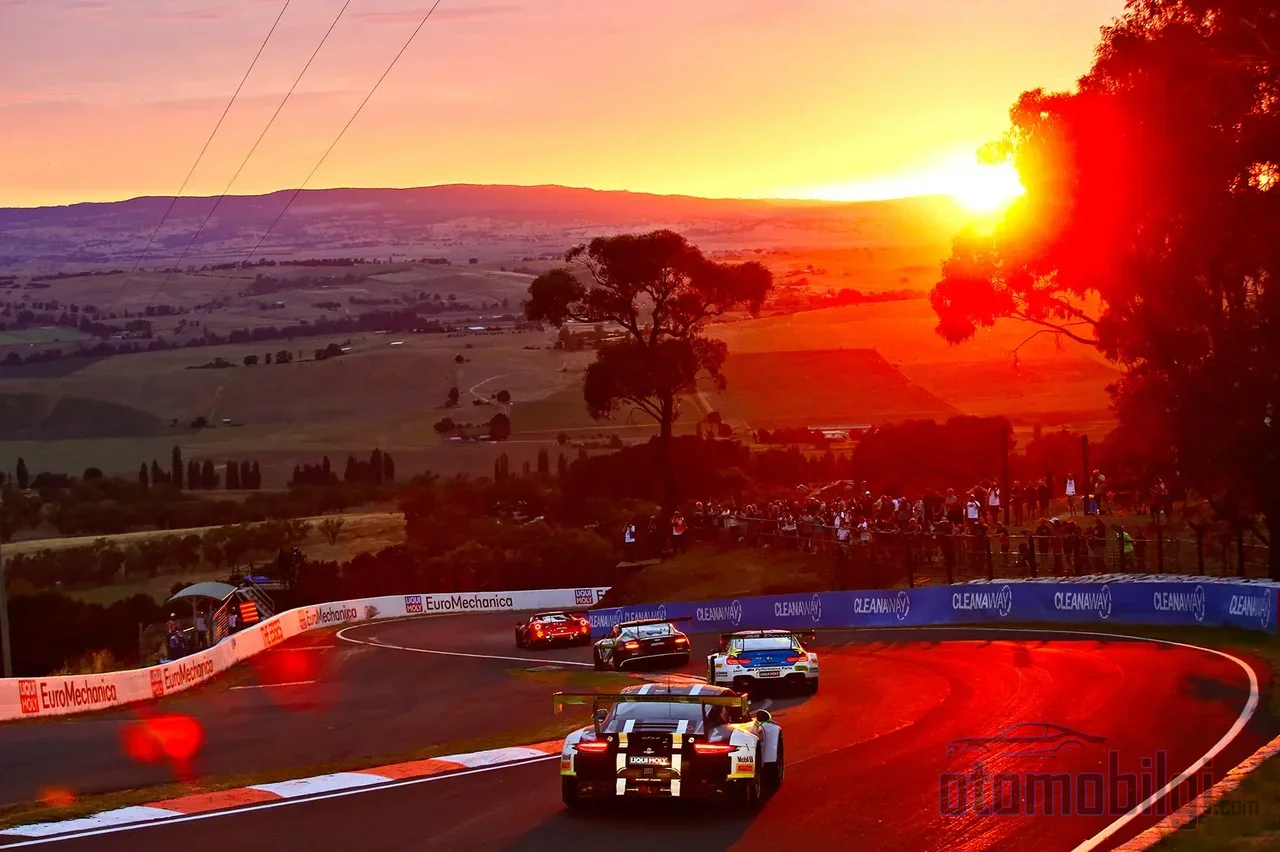
Which frame is the cameramen's favorite, in your opinion: Spa's Eau Rouge or the Nurburgring's Karussell? My answer is neither. As dawn is about to break and more than 40 GT3 cars start screaming their way up Mountain Straight, world motorsport pauses on a hill in the middle of Australia. On this page, we will talk about what sets the Bathurst 12 Hour apart from the world's other endurance classics - namely, how the track itself dictates the fate of the race.
Spa and the Nurburgring are hard too, there's no doubt about that. But Mount Panorama's difficulty comes from somewhere else: this track is actually an ordinary road on top of a mountain. And it is precisely because of this that it presents teams with problems no other GT classic in the world has.
From a Public Road to the World's Toughest Track
What hits you when you first hear it is this: Mount Panorama, 6.213 km long with 23 corners, is a fully public road outside race weekends. That means, when there's no race, you can drive your family car on this track at a 60 km/h speed limit, right where a GT3 car that handles like French custard would carve a corner. The Bathurst police strictly enforce the speed limit, and many of the residences here have their only access via the track itself. Yes, people really live on this track.
The track opened on March 17, 1938 and is FIA Grade 3 certified. It being Grade 3 is no coincidence: the track's infrastructure is not like a Formula 1 circuit, it is like a mountain road. The 174-meter vertical difference between the highest and lowest points, and gradients reaching up to 9.27 degrees, make it resemble a mountain rally stage more than a flat circuit. The highest point sits 862 meters above sea level.
The track divides into three sections: the short pit straight and the steep climb of Mountain Straight, the narrow and twisting section at the top of the mountain, then the long descent of Conrod Straight and The Chase. So within a single lap there is both a climb and a descent, plus narrow sections at the top of the mountain like a Macau street circuit. While Alexandre Prémat describes the place as a mix of the Nordschleife, Petit Le Mans and Laguna Seca, Nurburgring 24 Hour winner Kévin Estre put it more directly: half the track is the Nordschleife, half is Macau. These descriptions are no exaggeration; while climbing the mountain you think you're in Germany, and at the summit, scraping walls between the corners, you think you're in Macau.
Highlights
- Mount Panorama is a public road 6.213 km long, with 23 corners and a 174 m vertical elevation difference.
- Conrod Straight is 1.916 km long and is the fastest section of the track; speeds approach 300 km/h.
- The lap record belongs to Christopher Mies: 1:59.2910 in an Audi R8 LMS (2018).
- The Bathurst 12 Hour was the opening round of the 2026 Intercontinental GT Challenge season, with 35 cars taking part.
- Throughout the race, safety car periods occur on average every 45 minutes.
What Do the Climb and Descent Do to GT3 Cars?
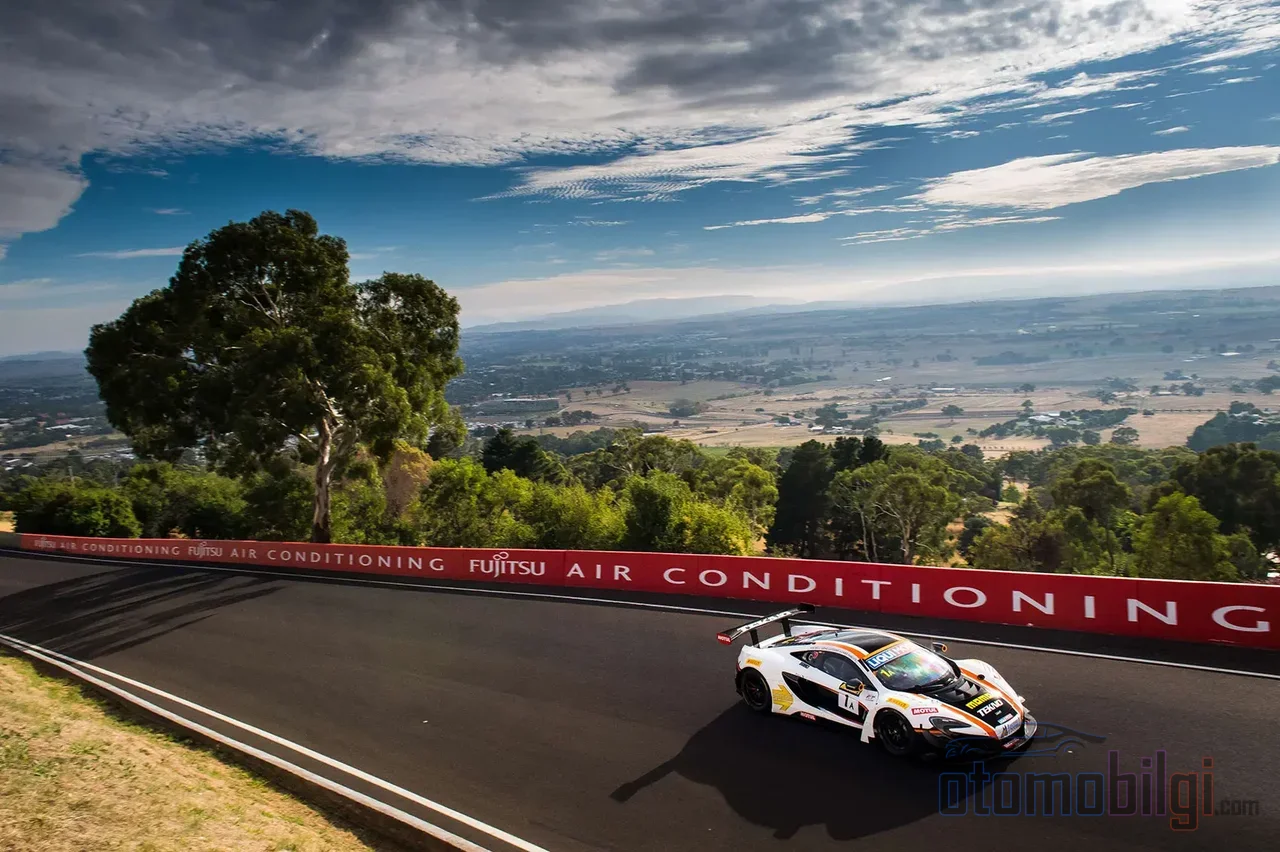
Climbing the Mountain: Mountain Straight and the Summit Section
The first problem GT3 cars face when they arrive here every February is that the track is not symmetrical. Mountain Straight is, as the name suggests, a climb; the V8 Supercars reach 290 km/h up to the braking point of Griffins Bend, but that speed is gained on an uphill slope. While the car is at full throttle going uphill, the engine and gearbox are constantly under load, while the cooling system is swallowing air that has heated up in the mountain sun.
At Griffins Bend, the job changes: the corner has a negative slope, meaning it banks outward rather than inward. If the driver gets a bit too much throttle on exit, the car slides outward, and there is neither a wide runoff area nor a grass area there; there is a wall. Toward the summit, the descent begins at Skyline, and through the Esses the car is constantly changing load. The Dipper, the third corner of the Esses, is famous as the corner where cars lift two wheels off the ground due to a dip in the road surface and the steep drop at the edge; it is often compared to the Corkscrew at Laguna Seca. Forrest's Elbow is a steeply descending, off-camber left corner; the exit line drifts straight toward the outside wall.
The Descent: Conrod Straight and The Chase
The descent from the mountain is the section that takes the heaviest toll on the GT3 cars' brakes and tires. Conrod Straight, at 1,916 km long, is the fastest section of the track; the V8 Supercars reach nearly 300 km/h here. But this straight is actually like a roller coaster track with two distinct crests. The cars go light over the crests, the aerodynamic load drops to zero for a moment, and then they need to stick back to the asphalt for braking at The Chase.
The story of The Chase is also instructive: it was added in 1987 because of the FIA rule that straights could not exceed 1,200 meters. In the first section speeds rise above 290 km/h, followed by a sharp left corner taken at 120 km/h. The Chase is actually a safety measure; six of the seven driver deaths in the track's history occurred at Conrod, and cars lifting off the ground over the crests contributed to those accidents. Today, GT3 cars lap more than 20 seconds faster than the Group A cars of 1985, and most of that increase in speed comes in the sections at the top of the mountain. The sand trap at McPhillamy Park has had to be enlarged over time; because the crest before the corner hides the entry, drivers have to stay close to the wall. Sulman Park, meanwhile, has the nickname Metal Grate because of the drainage grate at the point where maximum lateral and longitudinal loads are experienced.
Heat, Tires and the Safety Car Game
February is the middle of summer in Australia, and the midday heat at Bathurst puts tire and brake management at the center of the race. Now, let's be honest here: there is no race-specific numerical data on the effect of temperature on tire and brake management, but no numbers are needed to understand the mechanism. The constant load changes at the top of the mountain wear out the tires, the hard braking at Conrod heats up the discs, and a GT3 car lives through this cycle again and again for 12 hours. The strategy preferred by the teams is the answer to this: draining the tank almost completely and changing the tires at every pit stop.
The safety car is the backbone of strategy at Bathurst. Here, a safety car period happens on average every 45 minutes; with walls this close, contact is inevitable and the race slows down frequently. The 2019 race is a good example of this: the winning car was the only one among the first seven cars to pit for tires during the final safety car period that came through unscathed, and thanks to the right timing it went on to victory. So at Bathurst, speed alone isn't enough; you need to predict when the safety car will come out and catch the pit window correctly.
The 2026 race was also a witness to this chaos: Mercedes won by just 1 second, kangaroo chaos unfolded on the track, and a spectator record was broken. While Porsche customer team High Class Racing finished second overall, the 35-car grid opened the 2026 Intercontinental GT Challenge season. The Allan Simonsen Pole Award is decided by a 15-minute qualifying session called the Pirelli Pole Battle.
The Night Section and the Walls: The Things Spa Doesn't Have
So what really sets the Bathurst 12 Hour apart from Spa and Nurburgring? That's where the night and the walls come into play. The Nurburgring 24 Hours grid features 160 cars and more than 20 classes; the Spa 24 Hours is known as the biggest GT race and hosts even more cars. But at those two circuits, even in the darkness of night, run-off areas and wide spaces give drivers room to breathe. At Mount Panorama, there is no such margin.
The race starting just before dawn is this place's signature; the climb of more than 40 cars up Mountain Straight mesmerizes onlookers. But as the race progresses and night falls, things get harder: track lighting is limited, the walls sit right at the edge of the corners, and drivers are required to leave no more than five cars' worth of gap. The lights are usually switched off at the entrance to The Chase, and the rules require drivers to be given adequate warning. In short, if night driving at Spa is a tough exam, the same exam at Bathurst is taken in the shadow of the walls.
Classes, Format and Debates
The Bathurst 12 Hour was first run for production cars at Easter in 1991 (some records date the first race to 1995), was revived in 2007, and is now held every February. In 2011, a new class was added for GT3 and other GT cars, and the race became one of the standout rounds of the international GT3 calendar. Today the outright category is reserved exclusively for FIA-homologated GT3 cars and is divided into subclasses such as GT3 PRO based on driver ratings.
The circuit also generates debate. Recently, voices have been raised criticizing the grid filling up with GT4 and invitational cars; some argue that these cars are uncompetitive and the circuit is not suited to multi-class racing, even suggesting that in the future the race should be open only to GT3 cars. Safety car management is also debated every year; Ahead of the 2026 race, race control was asked why so many cars were retired despite knowing that, with the track closed, the safety car should be kept to a minimum. When a track gets this chaotic, managing the rules becomes a job of its own.
Time Zone and Lap Records
Bathurst being inside Australia is a serious logistical burden for the teams. For Europe-based teams, the first major GT3 test of the season is a challenge entered with both a long flight and a completely different time zone. We cannot detail the teams' adjustments to sleep and work schedules with the information we have; but we can clearly say that in the race run in 2020, the lap record was broken with 314 laps, covering a distance of 1,950.88 km. The shortest Bathurst 12 Hour was run in 2010.
On the lap record side, two names stand out: Christopher Mies set a 1:59.2910 lap in 2018 with an unrestricted Audi R8 LMS. Then Jules Gounon surpassed that time with 1:56.6054 in an unrestricted Mercedes-AMG GT3 the day before the 2024 race, and a week later Romain Dumas logged an unofficial lap of 1:56.3247 in the electric Ford SuperVan 4.2. In other words, the mountain knows no speed limit.
In summary: Why Is Bathurst in a League of Its Own?
Let me give the short answer: The Bathurst 12 Hour is an endurance classic that will be mentioned in the same sentence as Spa's scale and the Nurburgring's ferocity; but what sets it apart is that Mount Panorama is a public mountain road. The 174-meter vertical difference, the proximity of the walls, the limited night lighting, the February heat, and a safety car period arriving roughly every 45 minutes turn this into an exam with no equal anywhere in the world. Some sections of the track are as ferocious as the Nordschleife, some as narrow as Macau; and all of them in a single 6-kilometer package.
Next time you watch the 12 Hour, don't just look at the car ahead; watch the climb up Mountain Straight, the wheels lifting off at the Dipper, and the headlights streaming along the base of the walls at midnight. At Spa you make mistakes, at the Nurburgring you try your luck; at Bathurst, the mountain forgives nothing. And I think that's exactly why we love it.
Sources
- Mount Panorama Circuit
- The Classes - Bathurst 12 Hour
- B12HR Explained: Rules of the Race
- The Bathurst 12 Hour records to beat
- Why Bathurst is perhaps greatest track on Earth
- Earl Bamber Motorsport Wins Dramatic Bathurst 12 Hour
- Bathurst 12 Hour 2026: The Dangerous Rollercoaster to Happiness
- High Class Racing clinches sensational second place for Porsche
- Bathurst Mount Panorama