V2L: The Technology That Turns Electric Vehicles Into Power Outlets
Share This Page
Boiling a kettle in an electric car's trunk, running a saw at a construction site, or keeping the refrigerator powered during an outage - all are possible thanks to the same feature. But most drivers don't know what goes on behind the scenes of this feature: the vehicle instantly reverses the electronics it uses while charging and turns its 400-kilogram battery into a giant power bank. So how exactly does this conversion work, why isn't it in every car, and how much power actually comes out of that little outlet?
What Is V2L and How Does the Inverter Work in Reverse?
V2L, or vehicle-to-load, means the electric vehicle delivering the energy in its high-voltage battery to external devices as alternating current. The vehicle is not charged in this mode; on the contrary, it is discharged. Without getting into the battery's chemistry, let's look at the component that does the real work: the inverter.
Every electric vehicle has an onboard charger that converts the AC electricity from the grid into the DC current the battery needs. The battery, meanwhile, stores direct current under all conditions. Yet the devices you plug into an outlet want 230-volt, 50-hertz alternating current - the type of household outlet in the European standard. In vehicles with V2L, the reverse of this conversion can also be done: the DC in the battery is converted to AC by the power electronics inside the vehicle. All of the power management and DC-AC conversion happens in the vehicle; the adapter plugged in externally merely provides the physical outlet and carries the load.
This distinction matters, because two different "V2L" products are circulating on the market. Some adapters activate the vehicle's existing V2L function; others contain their own inverter and convert the battery's DC to AC themselves. It is necessary to distinguish whether the second group really connects to the high-voltage battery or to the 12-volt auxiliary battery - this difference directly determines the power limit it can draw.
Highlights
- A typical passenger car's V2L output is in the 2.3-3.6 kW range; 3.6 kW is the ceiling for most models.
- Unlike V2G, V2L does not require bidirectional charging protocols or special installation.
- The system works only when parked; for safety, it shuts off when the gear is engaged.
- The discharge limit typically cuts off at 15-20% so the car remains drivable.
Built-in Outlet or External Adapter?
Access to V2L is provided in two ways. The first is an outlet placed inside the cabin or trunk - the Kia EV6 and Volvo EX30 are examples of this design. The second is an external V2L adapter plugged into the charging port; Hyundai, Kia, MG, and BYD use this method. In most brands the adapter is sold as extra hardware and does not come in the vehicle's standard package.
The two approaches have practical differences. The internal outlet is convenient but limited in location, and you have to carry the device with the car; moreover, while the internal outlet usually operates in the vehicle's energy transfer mode called "utility mode," the external adapter in most vehicles turns on automatically when the car is off. Hyundai and Kia ownership forums discuss that there is no difference in power output between indoor and outdoor use, but it should be noted that forum posts remain at the anecdotal level - consulting the manufacturers' official guides is always the safest bet.
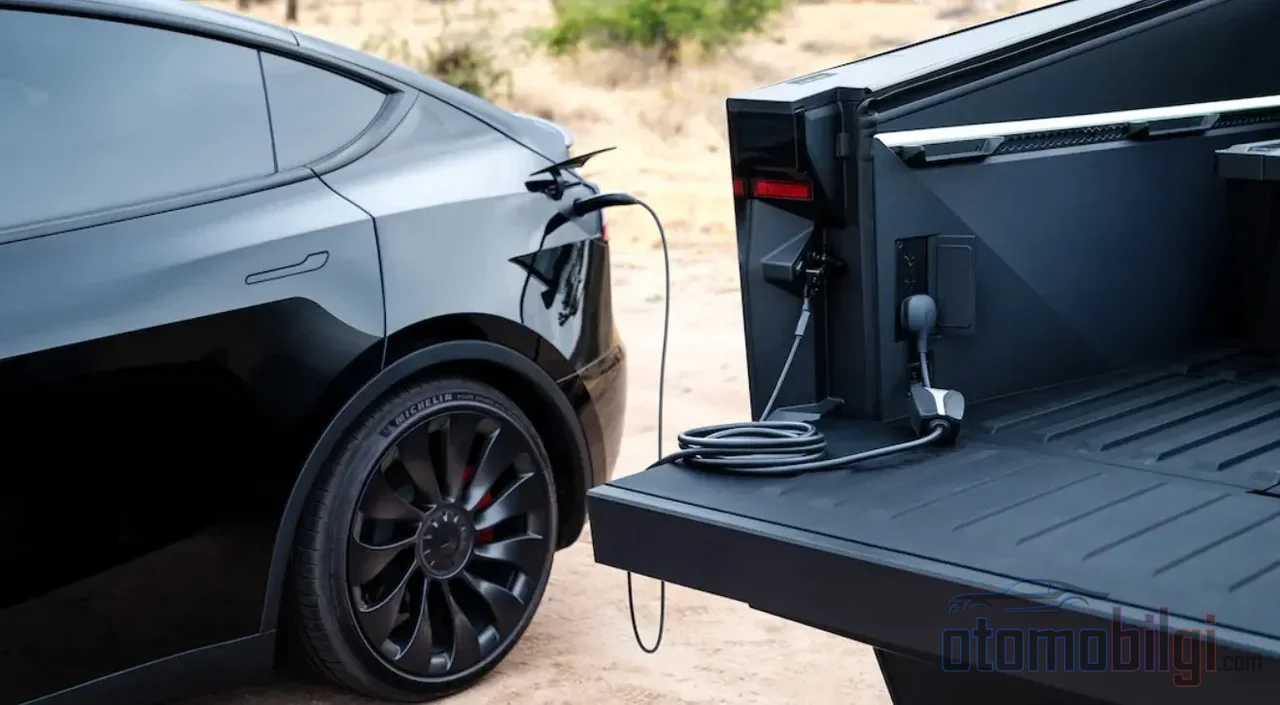
On the Tesla side, things are different: No Tesla model except the Cybertruck supports built-in V2L. The third-party "Tesla V2L adapters" sold on the market are mostly inverters connected to the vehicle's low-voltage auxiliary battery; they are not a real high-voltage port output. Look not at the product's name, but at which source it draws from.
How Many Watts Does It Deliver? How Much Are the Power Limits in Reality?
The number that determines V2L's practical value is the output power. In passenger vehicles, this ranges from the 2.3 kW level, which corresponds to the capacity of a standard home wall outlet, up to 3.6 kW, the ceiling for most models. Some trucks go far above this band: The Ford F-150 Lightning's Pro Power Onboard system offers 9.6 kW, and the Chevy Silverado EV and GMC Sierra EV offer 10.2 kW - these figures are already in the class that could cover the consumption of a small home.
| Model | Continuous V2L Output (AC) |
|---|---|
| Hyundai IONIQ 5 / IONIQ 6 | 3.6 kW |
| Kia EV6 / EV9 | 3.6 kW |
| Renault 5 E-Tech | 3.7 kW |
| BYD Seal | 3.0-3.3 kW |
| MG4 / ZS EV | 2.2 kW |
| BYD Atto 3 / Dolphin | 2.2 kW |
| Rivian R1T / R1S | 1.5 kW |
| Ford F-150 Lightning | 9.6 kW |
The output of the same model can also vary by market: While Hyundai, Kia and Genesis vehicles deliver 3.6 kW in Europe, they are limited to 1.9 kW in the US market. So when looking at a technical table, checking which market's hardware you are seeing makes your job easier.
Which Devices Can Be Run With V2L?
Once the power limit is understood, the device question answers itself. A 3.6 kW output can carry almost any household appliance on its own: Kettles, ovens, power tools, refrigerators of 2,000-3,000 watts. The only rule is not simultaneously - as long as the total load does not exceed the limit, there is no problem.
For vehicles in the 1.9 kW class, the calculation should be done a bit more carefully. A coffee machine (600-1,200 W), refrigerator (150-400 W), LED television (80-120 W), laptop (50-100 W) or CPAP device (30-60 W) are no problem at all. But a compressor, electric heater, hair dryer or circular saw can strain or even exceed this limit on their own.
- Camping and outdoors: A camping load of 1-1.5 kW can easily be covered for 2-3 days with a typical battery.
- Remote office: A laptop, monitor, modem and kettle together draw about 300-500 W - a light load for V2L.
- Construction site: Practical for power tools, but commercial use may require a declaration in your insurance policy.
- Emergency: During short power outages, the refrigerator, lighting and critical devices can be supplied; even emergency charging of another EV can be provided (roughly equivalent to 1-2 miles of range per hour).
Battery capacity also determines the math of the matter. A 77 kWh vehicle can carry a continuous 1 kW load for about 24 hours; using the same load for 5 hours roughly equals a loss of about 30 kilometers of range. This is a comparison that illustrates the scale of the energy stored in the battery quite well.
What Is the Difference Between V2L, V2H and V2G?
The three acronyms are often confused, but their technical thresholds are clear. V2L powers devices directly: you plug in and use it; it delivers energy neither to the grid nor to the house, and requires no installation. V2H powers the home's electrical panel and requires a bidirectional home charger and a transfer switch for this; output power is in the 7-11.5 kW range and installation costs reach thousands of euros according to sources. V2G, on the other hand, makes it possible to sell the generated energy to the grid; it requires the same hardware as V2H plus a supplier contract.
This is also the technical reason why V2L is far more widespread today: while V2H and V2G require complex bidirectional charging protocols such as ISO 15118-20 and infrastructure on the home side, V2L needs none of this ecosystem. The vehicle powers its own outlet with its own inverter, and that's it. The claim that a 50 kWh battery could run a house for a few days is a correct calculation, but that scenario is V2H's job - it is beyond V2L's capacity.
Safety Limits: What Should You Watch Out For When Using V2L?
The most critical technical fact is this: There is no protective grounding at the V2L output. For this reason, the system is designed to power single-load devices that do not require grounding; it should not be hard-wired to a house. Hyundai's official user manual also speaks plainly: do not use V2L with a connector, charging inlet, plug or cable that is damaged, corroded or rusty; do not touch the connector.
The second limit is the discharge threshold. Most vehicles have an adjustable discharge limit, and the system typically shuts off automatically at the 15-20% level. This is a safeguard to prevent the vehicle from draining to the "last drop" and becoming undrivable - and you should not make plans relying on reaching that threshold. The third note concerns the operating condition: V2L works only while parked; the moment you shift gears, the system shuts off immediately for safety reasons.
The question of battery damage also comes up often: manufacturers already allow V2L use within the warranty, and the effect of small discharge cycles on long-term battery degradation is negligible compared to DC fast charging.
Conclusion: Does V2L Mean Anything for You?
In summary, the self-contained answer to the question of what V2L is, is this: it is a power output feature that requires no installation, enabling an electric vehicle to convert the direct current in its high-voltage battery into 220-230 volt alternating current via the inverter inside the vehicle to power external devices. It operates in the 2.3-3.6 kW range in typical passenger vehicles, can carry one large household appliance or several small devices at the same time, and is active while the vehicle is parked.
As of 2026, this feature is moving away from being a rare privilege toward becoming almost standard equipment: It is becoming widespread in the Hyundai IONIQ 9, Kia EV3 and EV5, the new Nissan Leaf, the BMW iX3, and Polestar and Volvo models; Ford, Stellantis and Volkswagen are expected to offer it in more versions over the next two years. Manufacturers call the same feature by different names - Ford's Pro Power Onboard or simply "onboard power" - but the engineering behind it is the same: an inverter running in reverse from the direction we are used to. If your vehicle supports V2L and camping, construction sites, or outages matter to you, this feature is far more than a household appliance.
Sources
- Safety Precautions When Using the V2L Function - Hyundai Owners Manual
- What Is V2L? A Guide to Vehicle-to-Load Charging - Emporia Energy
- Vehicle-to-Load (V2L): What It Is, Which Cars Have It, and What You Need - Voldt
- V2L Explained: What Your EV Can Power (2026 UK Guide) - The Electric Car Scheme
- What is V2L (Vehicle to Load)? How it Works & Best V2L Adapters - AG Electrical Technology
- What Is Vehicle-to-Load (V2L) Technology? - J.D. Power
- V2G vs V2L | What's The Difference? - Octopus EV
- What is Vehicle to Load (V2L) for electric vehicles? - RACV