Can an Electric Vehicle Power Your Home? What Is V2L (Vehicle-to-Load) Charging?
Share This Page
An electric vehicle is not just a tank that accepts charge; with the right equipment, it is a power source that can deliver the energy in its battery to the outside. The technology that enables this is called reverse charging or bidirectional charging: V2L powers devices connected to the vehicle, V2H runs selected circuits of the home, and V2G means the vehicle returns electricity to the grid. So the short answer to the question is yes - but at which level and under what conditions depends on your vehicle and your infrastructure.
Highlights
- Most V2L vehicles 2.4-3.6 kW offer continuous output
- Ford F-150 Lightning 9.6 kWcan supply up to
- as of 2026 more than 75 global models support bidirectional charging in some form
- A 50 kWh battery can power a home for several days in a V2H scenario
- Typical battery warranties 8-10 years or 160,000 km guarantee 70% capacity retention at the end of the period
What Is Reverse Charging (V2L) and How Does a Car Become a Power Bank?
The energy in the battery is direct current; your home appliances want 230 V alternating current. The V2L system performs this conversion with the inverter inside the vehicle. The adapter plugged into the charge port (or, in some vehicles, an outlet placed inside the cabin) merely carries the load; the real work is done by the vehicle's own power electronics. Therefore, V2L does not require grid communication, a smart meter, or special permission - you park the vehicle, plug the device into the outlet, and the energy starts to flow.
There are two separate limits. The first is the upper power limit: the vehicle restricts via software the continuous power that can be drawn from the outlet at one time. The second is the vehicle usage state: while V2L is active, the vehicle usually must be parked, and no energy is delivered externally while driving. In addition, in most systems the lower discharge limit is adjustable; for example, the battery may stop supplying at 20%, leaving you a range buffer to reach a charging station.
The Difference Between V2L, V2H and V2G
The three abbreviations describe three levels of the same logic. V2L powers devices, V2H powers the home, V2G supports the grid. V2L is the simplest level: a direct connection between the vehicle and the device, with no special hardware other than the adapter. V2H (Vehicle-to-Home) goes one step further: the vehicle's energy is delivered to selected circuits of the home via a distribution panel; this requires a compatible bidirectional charger and load management. V2G is the most advanced level, meaning the vehicle returns energy to the grid, curbs consumption during peak hours, and participates in dynamic load management programs; certified equipment and grid operator approval are required.
How Many Watts Does It Deliver? V2L Output Powers and Realistic Limits
The most commonly encountered range in practice 2.2-3.6 kW. This value easily runs a kettle or microwave on its own; it can also power several mid-sized devices together. But if you are thinking about the entire home, the picture changes: motor-driven devices such as a water pump or compressor can draw a "surge" current of 2-3 times their rated power at startup, which may exceed the vehicle's output limit. When calculating power, you need to include not only continuous power ratings but also these startup moments.
| Output Level | What Does It Power? | Example Vehicle |
|---|---|---|
| 1.5-1.9 kW | Single device: phone, laptop, router, TV | Mitsubishi Outlander PHEV (1,500 W interior outlet) |
| 2.2-2.4 kW | Several small devices simultaneously | MG ZS EV, MG4, MG5 (2.2 kW) |
| 3.3-3.6 kW | Coffee maker, mini fridge, camping stove | Hyundai IONIQ 5, Kia EV6 (3.6 kW); BYD Atto 3, Seal, Dolphin (3.3 kW) |
| 7.2-10.2 kW | In some cases, almost full home backup | Ford F-150 Lightning (9.6 kW, built-in outlets) |
It is also worth noting the exception on the list: Tesla Model 3 and Model Y do not support this feature. The "V2L adapters" sold online for Tesla are actually third-party inverters connected to the vehicle's 16 V low-voltage battery; they do not provide true bidirectional output.
What Can V2L Power? Camping, Outage and Construction Site Scenarios
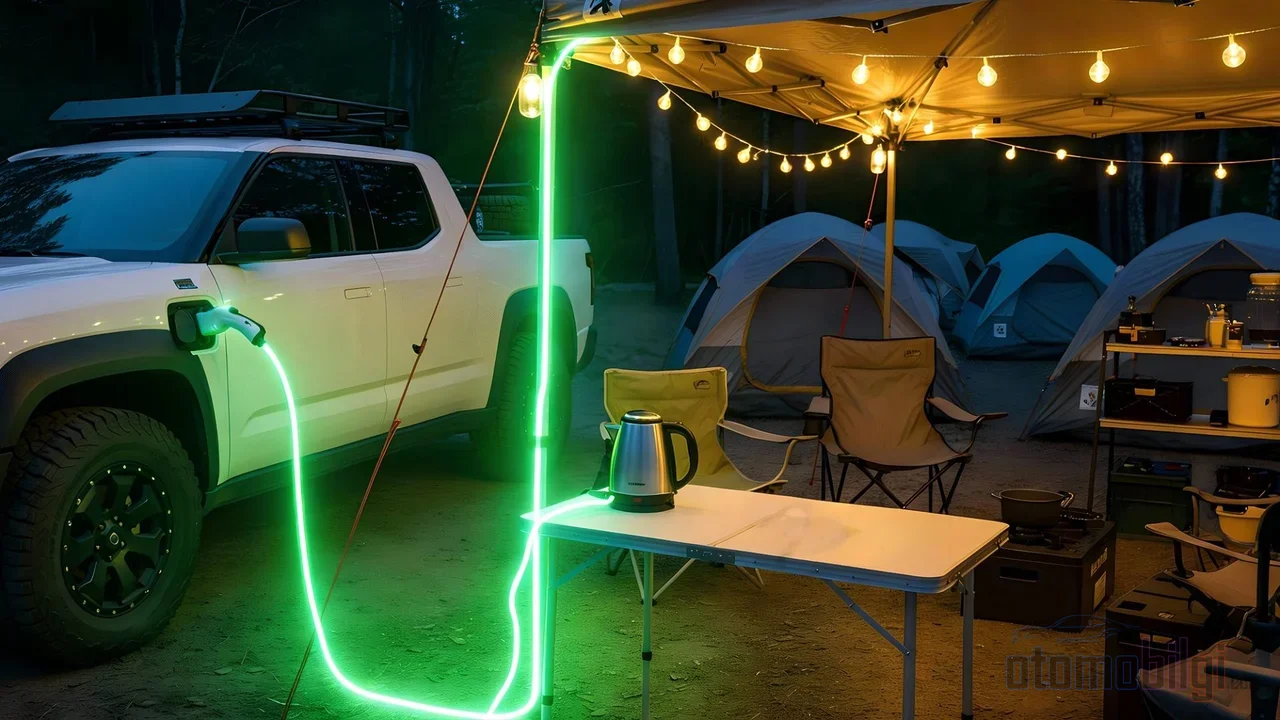
The most common use case is camping: odorless, silent electricity instead of a gasoline-powered generator. The second scenario is a power outage. Essential loads such as the refrigerator, Wi-Fi router and phone charging can be covered with an extension cord. There is a real-life example of this: in Australia, a family ran their son's dialysis machine by connecting it to a BYD Atto 3 during an outage; in the flood-hit town of Lismore, Ioniq 5 owners powered their high-pressure cleaning hoses from the vehicle. The third area is construction sites and workplaces: drills, saws and compressors run without a generator.
There are also two lesser-known uses. One is vehicle-to-vehicle assistance: getting a stranded EV with a dead battery moving again, slowly, with a portable charger. The other is home integration: with a change-over switch installed by an electrician, it is possible for the vehicle battery to power the home's critical circuits through the generator input. This can only be done with expert workmanship and in accordance with safety rules; issues related to disconnecting the vehicle connection have also been reported. A job that must be approached with strict rules.
Is Full Home Backup Possible with V2H?
In terms of capacity, yes: a 50 kWh battery can power a consumption-restricted home for several days. The problem is power and hardware. A few kilowatts from an outlet will not suffice for a home running an oven and air conditioner at the same time; panel-level home backup requires a bidirectional charger, load management and usually utility approval. Today, V2L is a practical solution designed for selected devices. Full home backup is still the job of V2H hardware.
Which Vehicles and Wallboxes Support Reverse Charging?
As of 2026, more than 75 global models support bidirectional charging in some form; however, of the roughly 70 models in the US, only about 14 offer true panel-level V2H. In other words, the "bidirectional" label tells you nothing on its own: the same feature can offer very different experiences depending on whether the adapter is included, whether the outlet is located inside or outside, and software support.
Main models offering V2L: Hyundai Ioniq 5/6, Kia EV6, Genesis GV60, BYD Atto 3/Seal/Dolphin, MG ZS EV/MG4, Rivian R1T/R1S and Ford F-150 Lightning. The flagship of bidirectional charging is still the F-150 Lightning; in some versions it acts almost like a mobile distribution panel with a feed rate of up to 9.5 kW. Among the newer arrivals are the Renault 5 E-Tech (bidirectional AC charging), the Peugeot E-3008/E-5008 which offers up to 3 kW of external V2L via its charging port adapter, and the Škoda Elroq/Enyaq which gains a 230 V interior outlet with its 2026 update. The Polestar 3 and 4, meanwhile, support V2L, V2H and V2V together.
On the wallbox side, options are becoming clearer: the Wallbox Quasar 2is a bidirectional charger delivering V2H/V2G at 12 kW with CHAdeMO and CCS2 support; the Ambibox, for its part, offers V2G and V2H at up to 22 kW. But an honest detail of the picture is this: according to go-e's 2026 assessment, there is currently no series-production vehicle with a built-in charger that supports standardized bidirectional AC charging. The need for hardware and infrastructure for V2H persists.
The Situation with Plug-in Hybrids
Reverse charging is mostly the domain of fully electric vehicles, but there are limited offerings on the PHEV side too: the Mitsubishi Outlander PHEV and Eclipse Cross PHEV (2023 model year and after) deliver up to 1,500 W of output inside the cabin; the BYD Shark 6 PHEV and Ford Ranger PHEV are also in this group. Since their capacities are small, expectations should be set accordingly.
Does Reverse Charging Degrade the Battery? What the Data Says
The correct answer to this question is not a single word, it is a matter of scale. V2L use in daily life typically means hours-long, intermittent discharge at moderate power; the additional cycle load this imposes on the battery remains low compared to the vehicle's normal use. With V2G, however, the vehicle discharges to the grid regularly, and this is where the debate intensifies.
There is a two-way body of literature, and both sides rest on numerical foundations. On one hand, Sagaria and colleagues' 2025 analysis shows that across 33 different charging/discharging scenarios, V2G contributed on average only 0.31% to total annual degradation; Zhao and colleagues found that V2G discharge increases cyclic aging rates, and Zhong and colleagues noted in their 2026 study that frequent charge-discharge cycles can accelerate battery aging. On the other hand, the University of Warwick's finding is that smart and integrated V2G use can improve battery life; smart management can deliver grid service with negligible impact on battery health by avoiding high and low voltage stress. Today's typical EV battery warranties guarantee 70% capacity retention after 8-10 years or 160,000 km; since regular V2G use could affect these warranty conditions, it is wise to read the warranty text before purchasing.
The engineering summary is this: well-managed bidirectional charging does not measurably degrade the battery; poorly managed or unlimited use needlessly increases cycles. Setting a discharge floor limit (such as stopping at 20% SOC) is the simplest and most effective measure for both range assurance and battery health.
V2L and V2G in Türkiye: Where Are We, Where Are We Heading?
V2L is the most accessible level in practice in Türkiye. With camping and outage scenarios made possible by adapters attached to or included in the trim of widely available models such as the Ioniq 5, EV6, BYD and MG, these use cases are practical today. On the wallbox side, devices that do V2H/V2G are limited; on the other hand, bidirectional charging has started to be covered in Turkish-language automotive media as well - what V2G is and how V2H syncs with the home grid are being explained in increasingly greater detail.
Two developments stand out on the regulatory front. According to Togg's announcement, the new connection and power increase procedures that came into force in June 2026 directly concern individual electric vehicle owners. In addition, a draft containing new rules for access to charging services has been prepared; prominent provisions in the draft include a ban on extra fees under names such as "charging service initiation" and a grounding requirement for charging station installation. On the charging price side, for 2026 AC charging (up to 22 kW) is running in the 8.50-11.50 TL/kWh band, and DC fast charging (60-150 kW) in the 11.50-13.50 TL/kWh band.
As for V2G, to be honest there is no concrete legislation: no implemented regulation yet exists for returning energy to the grid or for citizens earning income through this route. In other words, in Türkiye today the answer to the question "can my car sell power to the grid" is no; the nearest development is the renewal of the connection and power increase procedures. Those who want to set up V2H also need to produce a vehicle-specific solution with an electrician and installation approval.
How Should You Evaluate Bidirectional Charging When Buying a Car?
The "V2L available" note in the brochure alone is not enough; how the feature is implemented is the variable that truly determines the experience. Points to consider:
- Outlet location: Interior outlet or an adapter that plugs into the charging port? For camping and construction sites, an exterior outlet is practical; during an outage, the interior outlet is sufficient.
- Is the adapter included: For example, on the IONIQ 5 the V2L adapter is standard only at certain equipment levels; trim and market differences create a serious cost difference.
- Output power: Is it enough for your usage plan? There is a world of difference between 2.2 kW and 9.6 kW.
- Battery reserve setting: Can you set the discharge lower limit? It is essential for range assurance.
- Surge tolerance: Motorized devices draw 2-3 times the current at startup; ask whether the system can handle this.
In short: V2L is today's mature technology; it already works for camping, outages, and work use. V2H is possible in select projects with the right wallbox and electrical approval. As for V2G, although battery health data is largely reassuring, it is a future feature whose regulations are awaited in Türkiye. Thinking of your car not just as a consumer but as an asset that can generate when needed - it is now technically possible.
Sources
- What is Vehicle to Load (V2L) for electric vehicles?
- What is Vehicle to Load (V2L)? Best V2L Charger Guide
- What is V2L (Vehicle-to-Load)?
- Vehicle to Load (V2L): What is it and how does it work?
- Vehicle-to-grid impact on battery degradation and ...
- Research on Battery Aging and User Revenue of Electric ...
- An optimization framework for battery health management ...
- V2G found to improve the lifetime of electric vehicle batteries
- Vehicle-to-grid technology
- Which Electric Cars Have Bidirectional Charging (V2L ...
- These Are All The EVs That Come With Power Outlets And ...