Electric Vehicle Charging at the Workplace: Who Installs It, Who Pays for It?

Share This Page
Workplace EV charging means an employee charging their own vehicle with a charging unit at the workplace during working hours; the installation is undertaken by the employer or the business management, while the cost is shared under models ranging from the employer covering it entirely to the employee paying per kWh. For drivers without charging opportunities at home, it is in practice the strongest alternative, because the vehicle is already parked for 8-12 hours during the day.
Highlights
- A standard single-socket 7 kW workplace charger installation costs £800-1,500; a 20-socket multi-installation is in the £20,000-50,000 range.
- In Türkiye, an AC workplace station is around 30,000-50,000 TL ; installation can account for 60-80% of the total upfront cost.
- Practical planning ratio: one charging socket for every 8-10 registered employees .
- Energy (kWh)-based billing stands out as the most transparent model in terms of fairness among employees.
- Conditions for installing charging units in shared areas of residential sites and apartment buildings have been facilitated by the circular the Ministry sent to all 81 provinces.
Why Workplace Charging, and Why Now?
One of the biggest bottlenecks of electric vehicle ownership is the situation of drivers without enclosed parking at home. In the UK, about 47% of households do not have off-street parking; this ratio looks even less favorable in the metropolitan housing fabric of Türkiye. Workplace charging fills exactly this gap: since the vehicle is parked throughout the working day, it does not require fast charging; even a slow AC unit can easily bring it to a full charge over a standard working day.
The math also works for the employer side. Low-cost or free workplace charging becomes a tangible perk for existing employees and turns into an attractive benefit item in recruitment as well. A charging infrastructure established with a managed billing model can also shorten the payback period of the investment; compared to uncontrolled free charging, the managed model can increase the return by up to 30% .
Step-by-Step Charging Unit Installation at the Workplace
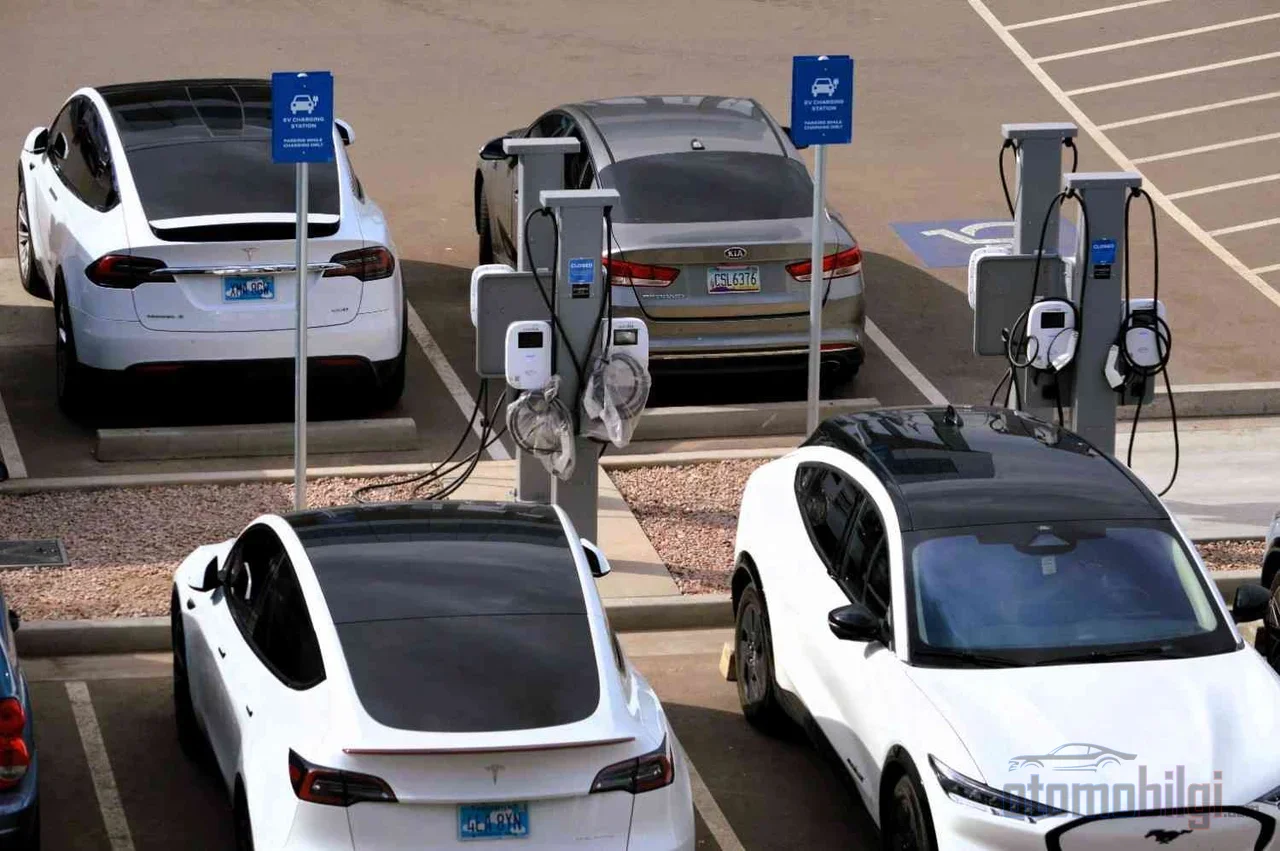
Installation is not a process that starts and ends with buying a device; it requires a sequential chain of decisions. If we approach the job with an engineer's eye, the steps become clear:
- Approval and decision: In a private business, the employer's management; for shared parking in residential sites, a general assembly decision. It is essential that the charging station agenda is explicitly stated in the meeting call; a unit installed without the approval of the property owners carries legal risk under the Condominium Law No. 634.
- Electrical project: In Türkiye, for installations for own use, an electrical project is prepared that includes running a separate line from the panel to the station, appropriate protective elements, and the correct power selection. Having this project signed by a licensed electrician is mandatory both for safety and for validity.
- Power and device selection: Details are in the section below; in short, 7 kW AC is sufficient for most offices, and dynamic load management is critical for installations with more than 5-6 sockets.
- Physical installation and commissioning: Wiring, mounting, protection testing and administrative procedures. This stage accounts for a significant portion of the total upfront cost: installation at AC workplace stations can cover 60-80% of the upfront costs.
- Management layer: Authentication (RFID cards are the dominant method in corporate use), and an OCPP-compliant software infrastructure for billing and reporting. OCPP compliance prevents lock-in to a specific device manufacturer.
Which Power Level Makes Sense?
The logic chain here is simple: the longer the vehicle stays at the workplace, the lower the power you need. Slow charging at 3.6 kW takes more than 16 hours to fill a 60 kWh vehicle and is unsuitable for a workplace. A 7 kW unit adds roughly 30-40 miles of range per hour; a full charge is possible within a standard 6-8 hour workday. That is why the recommended level for most workplaces is 7 kW.
22 kW and above requires three-phase power; it makes sense for fleet depots and high vehicle turnover areas, but counts as overspecification for a standard office. In the typical campus scenario where vehicles are parked for 8-12 hours, AC charging is more than sufficient for the vast majority of users. DC fast charging, on the other hand, is an investment of $20,000-60,000 per connection; there is no need for it at the office, and it is weighed for fleet and visitor areas. 11 kW units work with most buildings' three-phase connections; 22 kW requires a stronger three-phase infrastructure and 32A fuse capacity.
Installation Costs: Türkiye and International Comparison
The figures span a wide range depending on the power level, number of sockets and country; the values in the table should be read as approximate bands including installation.
| Installation type | Approximate cost |
|---|---|
| 7 kW AC, single socket (UK, installed) | £800-1,500 |
| Small hub with 5 sockets, pre-grant | £5,000-10,000 |
| Multi-installation with 20 sockets | £20,000-50,000 |
| AC station, Türkiye | 30,000-50,000 TL |
| Installation labor, Türkiye (starting) | from 35,000 TL |
| 80 kW DC station, Türkiye (installed) | 600,000-900,000 TL |
| DC Level 2 commercial connection, US | $2,500 / connection |
| DC fast charging installation, US | $20,000-60,000 / connection |
Economies of scale are decisive here: in a well-planned 20-socket installation, the cost per socket can drop to £1,000-2,000; with grant support, a mid-sized hub can often be kept below £30,000. The charger itself averages around €1,000 per port excluding installation, while device prices range from 15,000-60,000 TL depending on manufacturer and features. On the US side, the Federal Section 30C Tax Credit offers up to 30% of the equipment cost for commercial facilities put into service by June 30, 2026; in the UK, the Workplace Charging Scheme provides support of up to £350 per socket (75% of costs), with a maximum of 40 sockets per application. These models are not directly applied in Türkiye, but they offer templates showing how investment on the employer side is incentivized.
Who Pays? Cost Sharing and Pricing Models
In practice, three questions need to be answered: who bears the infrastructure investment, who pays for the electricity consumption, and how are visitors charged?
Investment and consumption
The infrastructure investment is mostly borne by the employer. For example, in most Australian workplaces, the employer covers both the installation and the electricity cost, either by paying for them directly or by reimbursing the employee. In hybrid working scenarios, a reimbursement model is used for employees who charge the company vehicle at home; smart home chargers can send data to a central dashboard, enabling automatic payroll integration.
Pricing models
Common options fall into four categories: hourly rates, per-kWh rates, flat session fees, and combinations of these. In Europe, dynamic tariffs are also added to this trio. Energy (kWh) based pricing stands out as the most transparent and fair model, because two vehicles with different efficiencies would otherwise pay the same amount for the same amount of electricity. For comparison: Level 2 charging can cost anywhere from 1-10 $ per hour.
There is a practical rule to prevent congestion: the workplace charging fee applied should be slightly above home electricity prices. This partially prevents the known problems of unmanaged free charging, such as blocking the spot with a fully charged vehicle ("charger squatting") and unauthorized use. For this purpose, an overstay fee can also be applied: after charging is complete, a 30-60 minute grace period is granted, after which a per-minute fee kicks in. Some businesses also offer free charging; a sample policy offers the first 3 hours for free and prices the rest at 25 $ per hour.
Legal and technical fine points
Once you start seeing the details, the business gets serious. If electricity is to be sold, kWh-based billing in the EU and the UK legally requires MID-certified metering; uncertified metering is considered invalid in tax audits. Under GDPR (KVKK), charging records must be anonymized after payroll processing. There is also the employee benefit side: in the UK, workplace charging provided by the employer is not counted as taxable income for the employee; since no similar exemption exists in Türkiye, the pricing of free charging as a fringe benefit must be clarified on the accounting and payroll side.
Legal Situation in Sites and Apartment Buildings in Türkiye
When workplace charging is mentioned, most readers think of office parks, but the common scenario in Türkiye is actually shared parking lots of residential complexes and apartment buildings. The Ministry of Environment, Urbanization and Climate Change, through a circular sent to all 81 provinces, has made it easier to install electric vehicle charging units in residential complexes and apartment buildings. A general assembly decision is required for installing charging stations in shared parking lots, and the charging station agenda item must be clearly stated in the meeting notice. This is an extension of the provisions of the Condominium Ownership Law regarding shared area use: units installed without the approval of property owners carry legal risk, and the Ministry has official correspondence regarding the process for the property owners' board for charging units in open or enclosed shared areas. So while the process may seem bureaucratic, there is now a clear roadmap.
Free or Paid? The Real Accounting of Policy Design
Free charging is a perk that is low in cost but difficult to manage. There are findings indicating that employers offering it for free positively influence vehicle usage and future electric vehicle adoption rates; on the other hand, uncontrolled free charging brings problems such as street blocking and unauthorized use. The two ends of the debate are as follows: a fee slightly above home electricity prices can make charging a deterrent, whereas low-cost or free charging is defended as a fringe benefit that boosts employee loyalty.
Tiered pricing that combines the two models is the practical solution to this dilemma: a subsidized rate for employees, an above-market rate for visitors. If the number of sockets is low and demand is high, adding a quota or session duration limit also makes sense. The right policy is not a single answer; no pricing model works unless vehicle dwell time, the number of sockets, and the user profile are determined.
Capacity Planning: How Many Sockets, How Many Kilowatts?
The first rule of planning is demand-based: one charging socket is foreseen for every 8-10 registered employees. The second rule is determined by the electrical side: 20 simultaneous 7 kW chargers theoretically draw 140 kW which strains or exceeds the existing rated power of most buildings. In installations with more than 5-6 sockets, dynamic load management becomes critical; by monitoring total draw and distributing instantaneous power to sockets, the system uses the building's installation capacity efficiently without the need for new transformer investment. Calculating the building's rated power and reserve capacity before starting the installation eliminates the most expensive surprise that could arise later.
Conclusion: A Practical Starting Recipe
For an employee without access to street charging, workplace charging is not a luxury but the main charging channel. The right thing to do on the employer's or building management's side is a small but well-designed start: have the electrical infrastructure assessed, set up a pilot with 5 sockets using 7 kW AC units, enable RFID authentication with OCPP-compliant software, determine a kWh-based and lightly subsidized employee tariff, and set a separate price for visitors. If demand grows, scale up the setup with dynamic load management; bring DC to the table only if a fleet or a high-turnover visitor area requires it. A business that follows this sequence keeps costs under control while establishing a lasting fringe benefit for its employees.
Sources
- Workplace EV Charging: Costs & Options 2026 - The Electric Car Scheme
- Workplace Charging Scheme: guidance for installers - GOV.UK
- How To Manage Employee EV Charging: The 2026 Professional Guide - ChargingShop.eu
- EV Charging Unit Installation in Housing Complexes and Apartment Buildings Made Easier - Ministry of Environment, Urbanization and Climate Change
- How to Install EV Charging Stations at the Workplace - Wat Mobilite
- Charging Station Installation Cost 2026 - OŞARJ
- Fast Charging Station (DC) Installation Costs in Türkiye - Elaris
- Electric Vehicle Charging Station Installation Cost - Helios Solar
- Electric Vehicle Charging Station Installation Prices 2026 - Power Enerji
- Cost of installing a charger for an electric vehicle - go-e
- Charging Station Installation for Housing Complexes and Apartment Buildings - Tuncmatik
- Charging Station Installation and Application Process (2026) - Bigstation
- EV Charging Stations in Common Areas of Housing Complexes - Bolt Energy Solutions
- Who Pays for EV Charging at Work? - EVSE Australia
- Electric Vehicle Charging at Work - UCLA Luskin
- Workplace charging - Electric Vehicle Council (AU)
- EV charging pricing models - Virta
- EV Charging Pricing Models - Emabler
- EV Charging Pricing Models Explained - AmpUp
- Should You Offer Free EV Charging? - Hypercharge
- Workplace EV Charging Benefits - Driivz
- Workplace EV Charger Benefits - Pod Energy
- Is Workplace EV Charging a Taxable Benefit? - EV-ON
- Advantages of Installing an EV Charging Station for Businesses - Charge Teknoloji
- What is the cost of EV chargers in the workplace? - EVBox
- EV Charging Station Cost in 2026 - TrendX Insights
- Workplace Charging Stations: Obligations, Costs - Qovoltis