Why Do Electric Cars Charge Slower in Winter?
Share This Page
Electric cars charge more slowly in winter because the chemical reactions in the lithium-ion battery slow down at low temperatures: the electrolyte thickens, ion movement becomes harder, and internal resistance rises. A cold battery accepts less current from the charger to protect itself; as a result, charging takes longer and range drops by roughly 10-30%. When the battery is preheated, fast charging speed is noticeably restored.
Highlights
- Range loss near freezing point is approximately 10-20%, and in harsh winter conditions it can exceed 30% .
- At moderate temperatures, a typical 20-80% DC fast charge takes 20-30 minutes ; with a cold battery, this takes longer.
- Preconditioning heats the battery to about 20-25°C, enabling full-power charge acceptance.
- The main cause of winter range loss is not the battery itself, but cabin heating.
- The loss is temporary: when the weather warms up, range returns to normal.
What Does Cold Air Do Inside the Battery? The Slowing of Chemistry
A lithium-ion battery relies on lithium ions shuttling back and forth between the electrodes to generate electricity. This movement takes place in a liquid medium called the electrolyte. As the temperature drops, the electrolyte thickens and loses fluidity; just like honey condensing in winter flows slowly, the ions circulate more slowly between the electrodes. Electron transfer between the electrodes becomes harder, the components physically contract, and the cell's internal resistance rises.
The result is twofold. First, range: the battery cannot deliver the same energy with the same efficiency, and at temperatures around freezing the loss is typically in the 10-20% band; in a mild winter this can climb to 30%, and even higher in harsh conditions. Second, charging: a battery with elevated internal resistance cannot safely accept high current, and charging speed naturally drops.
Lithium plating risk: why fast charging can be dangerous in the cold
The real delicate point here is this: if the ions cannot properly settle into the electrodes in the cold, metallic lithium can accumulate on the surface. This is called lithium plating. Charging a cold battery too fast accelerates this buildup; growing lithium dendrites can pierce the separator diaphragm between the electrodes, leading to an internal short circuit and even a battery fire.
Electric vehicles know this risk and act accordingly. The battery management system (BMS) limits the charging current when cell temperature is low. In other words, even if the unit at the socket can deliver 400 kW, your car refuses to send that power to a cold battery. This is not a malfunction, but a protection by design. It is the same physics as leaving your smartphone on charge in the cold and seeing it fill slowly; the difference is that vehicle batteries have a far more advanced thermal management system and apply this protection deliberately and measurably.
Why Does DC Fast Charging Stay Very Slow in the First Minutes in Cold Weather?
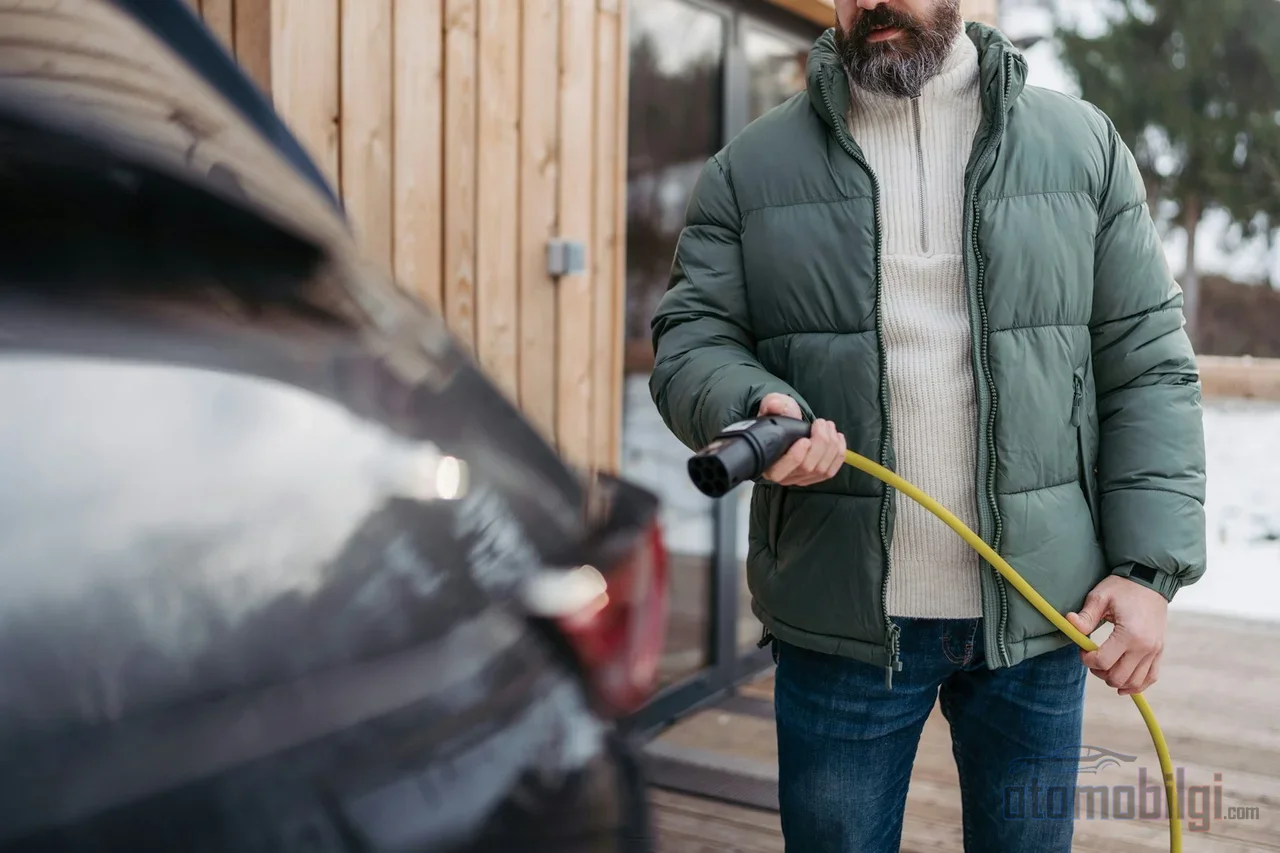
You should know that the DC fast charging speed is not actually a fixed value; power changes continuously along the charging curve and depending on cell temperature. When you look at a value measuring the ambient temperature - that is where the real catch is.
A cold battery limits the current it deems safe through the BMS. For this reason, in the first minutes after plugging into a fast charging station, you will see a value on the power screen well below your expectation. As the cells warm up, the current limit opens up gradually and power rises; at moderate temperatures, a typical 20-80% fast charge takes around 20-30 minutes to complete, and in cold weather this time increases noticeably. Charging stations 30-400 kW operate in the DC range and usually fill the battery to 80% in 20-40 minutes under moderate conditions; in winter, this picture falls short of the values above at best.
A practical note: a battery that has cooled down while parked charges much more slowly than a battery that has been used on the road. Even driving your car for 30-60 minutes before going to fast charge makes a difference on its own, because during use the cells warm up with their own internal reaction heat.
Preconditioning: Saving Time by Warming the Battery
Preconditioning is the process of heating the battery to its target temperature before arriving at the station. For the fastest charging, the target is around 25°C, and a reasonable level is a minimum of 20°C or so. A heated battery can arrive at the fast charger accepting full power from the very first moment. This process consumes some range; in return, the charging time it saves is worth more than the range spent.
The practice is simple in most vehicles: when you enter a fast charging station as a destination in the navigation, many models automatically start preparing the battery. Some manufacturers also offer this as a separate winter mode; Hyundai Motor Group's winter mode preheats the battery when it cools below a certain temperature, preserving both driving performance and charging speed. The most efficient method is to heat the battery while the vehicle is connected to the charging outlet, immediately before setting off; since this consumption is covered by the grid, it does not touch your range.
So is it worth it? Absolutely, especially on long winter journeys where you will use DC fast charging. There are peer-reviewed engineering studies showing that heating the battery shortens charging time and reduces total energy consumption; the 2024 study on fast preheating control strategies published in Applied Thermal Engineering is a quantitative expression of this. Only if you will charge within the city with low-power AC charging does preconditioning's contribution to this equation remain limited.
The Real Culprit of Range Loss: Cabin Heating
Contrary to popular belief, the main cause of winter range loss is not the battery itself but heating the cabin. An internal combustion engine heats the cabin for free with its waste heat; in an electric vehicle, producing this heat comes directly from the battery. In harsh winters, drivers can effectively lose up to a third of their nominal range, and measurements taken in real winter conditions show a drop in the range of 14-39% compared to the official range.
The most efficient technology here is the heat pump. It works like a reverse home refrigerator: it compresses cold outside air to release heat and delivers it to the cabin, providing the same comfort with far less energy than a resistive electric heater. It is standard or optional in many new electric vehicles; in winter, it means serious range.
Measurable Ways to Preserve Range in Winter
- Preheat the cabin and battery about 10-15 minutes before setting off, while the vehicle is plugged in.
- Instead of heating the entire cabin, use heated seats and steering wheel; per-person heating draws far less energy than an air-blowing heater.
- If possible, keep the vehicle plugged in at home; it draws a small current to keep the battery warm.
- Switch to Eco mode and lower highway speed reasonably; the increased air resistance in winter already raises consumption at high speeds.
- Park in a garage or enclosed space; keeping the cell temperature stable overnight is the most valuable gain for the morning.
One detail worth noting on icy roads: regenerative braking decreases when the battery is cold. The system itself does not stop working; range recovery continues with moderate driving.
Winter Charging Habits: Common Misconceptions and the Truth
Let us examine one by one the claims we hear most often about winter use.
| Misconception | Fact |
|---|---|
| "Electric cars are completely useless in winter." | Range and charging speed drop in the cold, but the vehicle remains usable; Norway, where winter temperatures fall below 0°C, is one of the world's largest electric vehicle markets. |
| "The range lost in winter is permanent." | The loss is temporary; when the weather warms up, range returns to normal. |
| "Only electric vehicles are affected by the cold." | Gasoline and diesel vehicles also run less efficiently in the cold and lose range. |
| "Charging to 100% every night in winter is the right thing to do." | For daily use, the 20-80% range is ideal; 100% makes sense only when a long trip is needed. |
| "Using fast charging at every charge is harmless." | Regular DC fast charging can wear the battery out faster than low-power overnight AC charging; slow home charging should be preferred for routine charging. |
One edge case must be honestly stated: batteries left parked for a long time in extremely low temperatures can suffer permanent damage. Since the cells heat themselves during use, this risk is low in daily use; the issue is a vehicle left outdoors in freezing conditions for weeks.
Winter Charging in Türkiye: The Reality of Central and Eastern Anatolia
In Türkiye, winter conditions differ sharply by geography. In Central Anatolian cities such as Kayseri, Ankara, and Konya, frost is routine; in Erzurum, Kars, or Agri, sub-zero temperatures can last for weeks. For a driver living in these regions, the physics above is not theory but an experienced reality every morning before getting behind the wheel: the range indicator can drop 20-40% below summer values.
The infrastructure has reached a level that can support this scenario. According to Ministry of Industry and Technology data, the number of high-speed charging stations in Türkiye has reached 16,650 reached and fast charging points are located roughly every 70-100 km across the country nationwide. The battery network serves all 81 provinces; on highway routes in Central and Eastern Anatolia, long-distance planning no longer requires hesitation.
Winter charging checklist at home and at the station
The basic options for home charging are single-phase 3.7 kW and 7.4 kW, and three-phase 11 kW and 22 kW wallbox speeds. In installation, the suitability of the electrical infrastructure, compatibility with the vehicle's on-board charger power, and cable planning are the determining factors; getting this equation properly set up before winter is the cheapest insurance against waking up to a 20% reduced range.
- Park the vehicle in a garage or enclosed space if possible.
- Plan overnight charging at around 7 kW AC power; it charges the battery gently and covers the morning heating energy from the grid.
- Before heading to a fast charger, enter the station into the navigation and trigger pre-conditioning.
- If the initial power value seems low, don't panic; power increases gradually as the cells warm up.
- If you're planning a long trip, select charging to 100% only for that day.
In summary, the cold is not the battery's enemy, it's a speed limit. The moment you manage the temperature that slows down the chemistry, both your charging speed and your range are largely restored; the remaining small loss is temporary and disappears with the arrival of spring.
Sources
- Do electric cars lose charge in cold weather?
- Lithium-ion batteries don't work well in the cold
- Low Temperature Batteries: How Does Cold Affect Power Sources?
- How to charge your EV in cold weather
- Why do EVs charge slower in winter, and how to speed it up
- Preconditioning and Cold-Weather EV Performance
- EV Charging in Cold Weather
- Cold Weather EV Charging: Range and Speed Explained
- Research on control strategy of rapid preheating for power batteries (Applied Thermal Engineering, 2024)
- EV Battery Preheating: Warm Up, Save Range
- How To Make Your EV More Electric - Hyundai Motor Group
- EV Winter Range Loss
- The EV range report 2026
- How much range does an EV lose in cold weather
- Electric Car Myths vs Facts
- The number of high-speed charging stations in Türkiye has reached 16,650
- What Is the Effect of Weather Conditions on Electric Car Charging?
- Can Electric Cars Be Used in Winter?
- 7 Practical Ways to Reduce Range Loss in Winter
- Electric Vehicle Winter Use
- Fast Charging Station Guide
- Türkiye Charging Map 2026
- Charging Stations Map
- How to Set Up Electric Vehicle Charging at Home
- Using Electric Vehicles in Winter