What Do Driving Modes Change in a Car, and What Do They Not Change?
Share This Page
The Eco, Normal, and Sport driving modes in electric vehicles do not change the vehicle's mechanical parts; they primarily change software response parameters: the accelerator pedal map, inverter output limits, regenerative braking behavior, and, in multi-motor vehicles, torque distribution are the main items of these calibrations. However, the depth of the modes' effects varies considerably from brand to brand; in some vehicles the difference remains limited to pedal feel, while in others the driving character changes fundamentally.
Highlights
- Switching from Eco to Sport mode typically brings a 10-20% reduction in range
- Incorrect mode use can lead to a 15-30% increase in energy consumption
- Eco mode can improve fuel economy by up to 20% can improve
- Air conditioning and cabin heating affect range by 5-40% depending on conditions
- Sport mode also changes torque vectoring calibration in some multi-motor vehicles
What Does a Driving Mode Technically Change?
In an electric vehicle, a driving mode is a set of software calibrations that coordinately change the vehicle's response to the driver and the road. No mechanical component changes; the motor remains the same motor, the battery the same battery. What changes is how the power electronics layer behaves toward this hardware. The power electronics controller manages the electricity coming from the traction battery and controls the electric motor's speed and the torque it produces - this is precisely the fundamental layer where the modes intervene.
On the inverter side, the picture works like this: the inverter output is a controlled AC current limited by the DC voltage. It can be assumed that power differences between modes are applied through such software output limits; however, this connection is not established the same way by every manufacturer. In some vehicles, the mode genuinely limits the maximum torque the motor can deliver; in others, the motor power remains almost the same, and only the speed of reaching that power changes. This distinction is the essence of the "are modes cosmetic?" debate.
Accelerator Pedal Map: The Most Tangible and Most Common Difference
The difference felt the same way by everyone between modes is the accelerator pedal mapping. The pedal's physical movement does not change; what changes is the curve by which the pedal position is translated into a torque demand. For example, in Toyota hybrids, Eco mode softens the throttle, while Sport mode (called PWR on some models) sharpens the throttle for a faster response. According to user experiences, in some models when the pedal is pressed all the way down in Eco mode, the throttle opens only about 50% while in Sport mode it opens 100% .
A fully electric example: MG4 EV owners report that Sport mode gives instant throttle response, Normal mode slightly softens the power delivery, and Eco softens it even further - and they say this is the main noticeable difference. Drivers also report that in the Econ, Normal, and Sport sequence, acceleration becomes noticeably stronger. In short, when making your first assessment, you can assume the following: in most vehicles, the biggest difference between modes is how much torque the same movement of your right foot is translated into.
How Does Regenerative Braking Change Between Drive Modes?
The basic mechanism of regenerative braking is simple: during deceleration, kinetic energy is converted into electricity and the motor temporarily takes on the role of a generator, sending energy back to the battery. Porsche calls this process "recuperation," using the motors as generators during deceleration and returning energy to the battery.
Most electric vehicles offer different levels of regeneration; some models allow you to turn regeneration off entirely or permit a free coasting mode. The relationship between drive modes and regeneration is an interesting detail: Rivian owners prefer All-Purpose mode instead of Conserve mode to maximize regeneration on long, steep descents. In other words, the mode that "looks most efficient" is not necessarily the one that recovers the most energy in every scenario.
There is also a debate running in the opposite direction: it is argued that due to its aggressive regeneration behavior, Eco mode can be less efficient than normal or sport modes in some situations. It is clear that mode selection can affect energy recovery; the best result comes from the mode that matches your driving scenario.
Is Sport Mode Limited to Just the Pedal?
Not in multi-motor electric vehicles. Electric motors offer a much faster response time and high torque flexibility compared to a conventional torque vectoring differential; this means the software can recalibrate torque distribution per wheel within milliseconds. Torque vectoring creates yaw movement - that is, the vehicle rotating about its vertical axis - by distributing variable torque between the two wheels of the same axle, significantly improving cornering response as well as active safety.
A research study offers a clear finding on this subject: Sport mode increases steering response speed by reducing the understeer gradient - the vehicle's tendency to understeer in corners. So in some multi-motor vehicles, Sport mode not only sharpens the accelerator pedal but also changes the chassis' torque vectoring calibration. At the opposite end are vehicles like the MG4: the difference mainly remains in the pedal map. The best proof that there is no universal answer to the question of "what does a mode change" is this gap between manufacturers.
How Approaches Differ Between Brands
| Approach | Example | Scope of the mode |
|---|---|---|
| Pedal map only | MG4 EV | Throttle response softens/sharpens, power remains nearly the same |
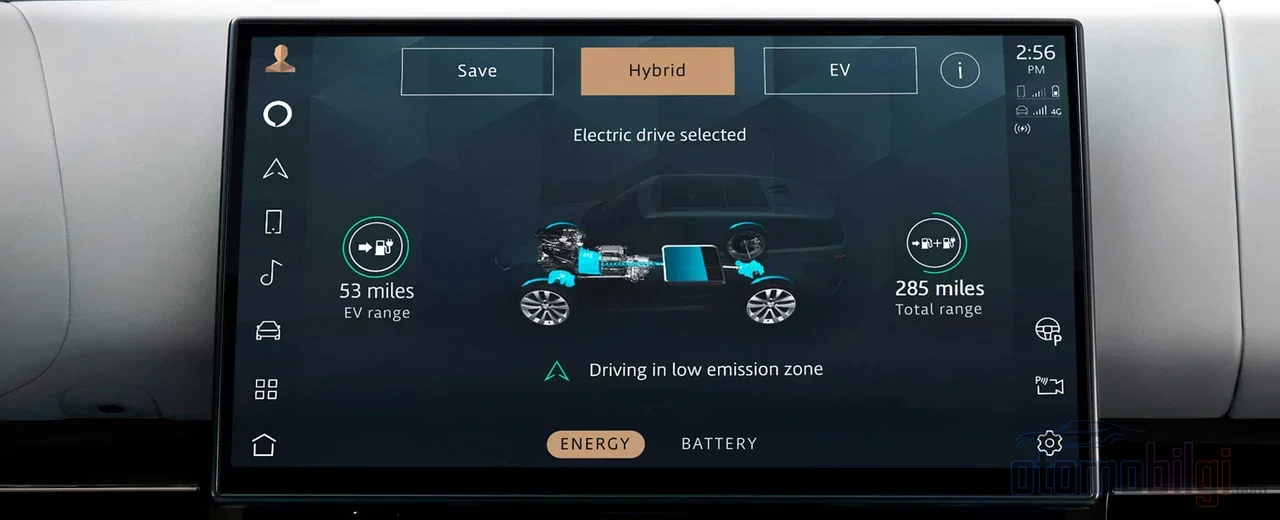
| Energy strategy selection | Land Rover PHEV | Modes are based on energy source selection such as hybrid/EV/Save |
| Chassis and power calibration | Multi-motor EVs | Torque vectoring and stability behavior change with the mode |
| Regeneration interaction | Rivian | On a long descent, the most efficient mode may be All-Purpose rather than Conserve |
Does Eco Mode Really Reduce the Air Conditioner's Power?
Short answer: it varies from brand to brand, even from vehicle to vehicle. In some vehicles, it is noted that Eco mode increases range by reducing the heating and cooling power of the climate control. In contrast, a Nissan Leaf owner's test suggests that Eco mode creates no noticeable change in heater and air conditioning power consumption. In other words, there is no systematic rule regarding the air conditioning's effect; your vehicle's owner's manual or your own observation is a more solid reference.
The air conditioning's effect on range, however, is measurable and its dimensions are clear: depending on outside temperature and model, the air conditioner can reduce range by 5-17% When heating is included, the picture grows - cabin heating and cooling can reduce EV range by an average of 30-40% depending on system size and driving conditions. It should also be added that in modern vehicles, the cooling-side effect is smaller than most people expect; the impact of the heat pump and air conditioning on efficiency is one of the main topics of efficient driving guides.
A detail different from gasoline vehicles: in an electric vehicle, the air conditioner's energy use makes no difference between driving and standing still. The concept of idling has no air conditioning cost in an EV.
What Does Drive Mode Selection Actually Cost Range and Efficiency?
Let's look at the numbers. Switching from Eco to Sport mode typically brings a 10-20% reduction in total range; in a vehicle with a range of about 480 km, this difference is large enough to be felt during the day. It is reported that Eco mode can improve fuel economy by up to 20% On the other hand, using the wrong driving mode can lead to a 15-30% increase in energy consumption - meaning it is not so much the mode itself, but a driving style that contradicts the mode and conditions that costs you money.
There is a strong view that the decisive factor is not the mode but driving style: the real difference is created by the driver who changes their own right foot, not the vehicle's response. A concrete piece of data supporting this: two different drivers in the same electric vehicle can see 20-30% different energy consumption depending on driving habits. This range is of the same order of magnitude as the typical range effect of modes - the difference between two drivers can be greater than the difference between two modes.
What Should You Expect From Each Mode?
- Eco: Softened throttle response, restricted power, restricted air conditioning in some vehicles; sensible for city and highway driving, but aggressive regeneration can reduce efficiency in some cases
- Normal: Balanced pedal map and regeneration; the manufacturer's reference calibration for most scenarios
- Sport: Sharp throttle, full power access, changing torque vectoring in multi-motor vehicles; range cost up to 10-20%
- Long steep descent: Choose the mode that uses regeneration best - the mode named most "efficient" may not always recover the most energy
Is It Harmful to Change Modes While the Vehicle Is in Motion?
This question comes up often, and technically there is no evidence of harm. A drive mode change is not a mechanical intervention but a bypass in software parameters; it is nothing like swapping a gear in the drivetrain of a permanent all-wheel-drive vehicle. The practical advice is simple: make the switch at an undistracted moment when the steering is straight. You will not want the surprise of pedal character changing in the middle of a braking distance.
Conclusion: The Real Trade-Off of Drive Modes
Drive modes change four things in an electric vehicle: the throttle pedal map, the power response the inverter allows, the regenerative braking behavior, and torque distribution in multi-motor vehicles. The effects in the second group -climate restriction, thermal management preference- vary so much from vehicle to vehicle that generalizing would be misleading. What does not change is basic physics: Sport mode does not create energy, it only accelerates spending; Eco mode does not work magic either, it only softens demand. The trade-off between efficiency and performance is measurable - roughly 10-20% of range - and instead of the mode's name, pay attention to how your own right foot behaves in that mode.
Sources
- EV sürüş modları: Eco, Sport, Snow ve diğer modlar ne işe yarar - evkx.net
- Tam Elektrikli Otomobiller Nasıl Çalışır? - Alternative Fuels Data Center
- Sürücü girdilerinin şarj edilebilir hibrit elektrikli araçlar üzerindeki etkisi (Karanam, 2022)
- Toyota Hibrit Sürüş Modlarını Anlamak
- Eco, normal ve sport modları arasındaki fark | MG4 EV forumu
- Farklı modlarda güç çıkışı nedir? - InsideEVs Forumu
- Elektrikli Araçlarda Rejeneratif Fren Sistemleri (Szumska, 2025)
- Rejeneratif Frenleme ile EV Menzili Nasıl Maksimuma Çıkarılır - go-e.com
- Porsche Rejeneratif Frenleme (Recuperation) Nedir?
- Entegre bir tork vektörleme kontrol çerçevesi (Mangia, 2021) - University of Sheffield
- Elektrikli araçlar için enerji verimli bir tork vektörleme algoritması (Chatzikomis, 2019)
- Elektrikli araç tasarımında tork vektörleme - Traxial
- EV İnvertör Teknolojisi: Son Gelişmeler ve Trendler - eMobility Engineering
- Sürüş Modları Rehberi - Land Rover ABD
- Sürüş Modları Açıklandı - Mazda ABD
- Arabanızdaki Tüm Bu Sürüş Modları Gerçekte Ne Yapar? - Nalley Cars
- Klimanın Elektrikli Araçların Sürüş Menzili Üzerindeki Etkisi
- Klima Kullanımı EV Menzilini Ne Kadar Etkiler? - Holman UK
- İklim Kontrolü EV Menzilini Etkiler mi? - Skywell UK
- EV'ler sıcak hava klima kullanımında neden o kadar menzil kaybetmez - Green Car Reports
- Sport Modunda Eco Moduna Göre Ne Kadar Menzil Kaybedilir? - Moore Cadillac
- Eco modu gerçekten iklim kontrolünün güç tüketimini azaltır mı? - MyNissanLeaf forumu
- ECO modu gerçekten normal/sport modundan daha az verimli mi? - Reddit r/PriusPrime
- Sürüş sırasında sürüş modları arasında geçiş yapmak zararlı mı? - Rav4World
- Sürüş Alışkanlıklarıyla EV Menzilini Maksimuma Çıkarmak - evdances.com