Why Does the Electric Motor Whine?
Share This Page
The whine of an electric motor is a combination of two physical sources: electromagnetic tones produced by the magnetic forces inside the motor and the high-frequency switching sound of the inverter; to these, the mechanical contributions of the reduction gearbox and bearings are added. As speed increases, the pitch of the whine rises because these tones shift in frequency in proportion to the rotational speed. Manufacturers soften this sound with spread-spectrum switching, active noise cancellation and sound design, or deliberately shape it.
Highlights
- Switching noise typically occurs in the 5-15 kHz range, that is, in the region where the human ear is most sensitive.
- An example calculation: At 4500 rpm, a 24th order harmonic produces a tone of 1800 Hz.
- Spread-spectrum switching distributes tonal noise energy across the frequency spectrum, lowering the peak level.
- In the EU, an artificial warning sound (AVAS) has been mandatory at low speeds since 2014.
When you start an internal combustion engine, the source of the sound is unquestionable: combustion, exhaust, mechanical movement. When you get into an electric vehicle, most of the familiar noises disappear, giving way to a sharp, tonal, rapidly rising whine. This sound is so characteristic that many people assume it comes from the motor itself. They are partly right; but the most interesting part of the story is that a significant portion of the sound is the work not of the motor, but of the power electronics that drive it. From an engineering standpoint, this whine is actually not evidence of a fault, but auditory proof that the system is working correctly.
Where does the whining sound in an electric vehicle come from?
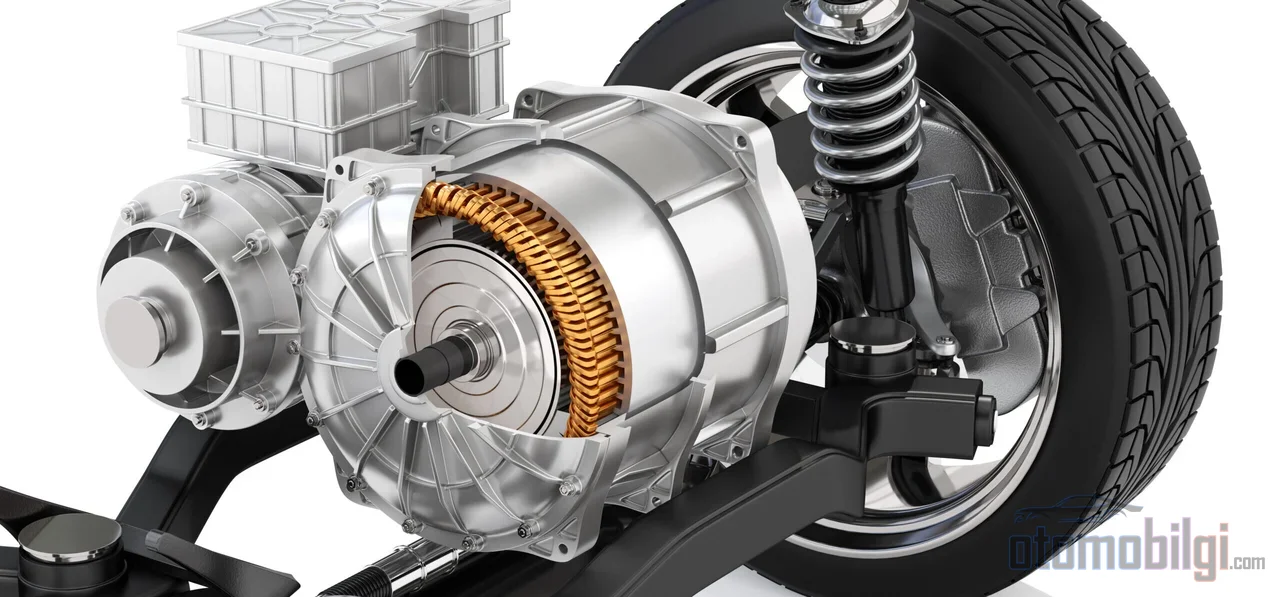
The origin of the whine falls under three main headings. The first is electromagnetic noise: the electric current entering the motor establishes a magnetic field between the rotor and stator; this field causes the forces in the air gap to fluctuate, and the fluctuating forces vibrate the motor body. Every vibrating structure radiates sound. The character of this noise is consistent and tonal, because its frequency is determined directly by the supply electrical frequency and its multiples - that is, its harmonics.
The second source is the inverter. The power electronics that convert the battery's direct current into alternating current suitable for the motor operate by switching the transistors at a very high speed. This switching operation produces noise at and around the switching frequency and its multiples; measurements show that this range typically falls within the 5-15 kHz band. Our ear is most sensitive precisely in this range - which is why the whine in an electric vehicle, despite its low absolute acoustic energy, can feel disturbing. The force fluctuations arising from switching also create structural vibration; this adds a subtlety that can be felt along with the sound. (This subtlety actually leaks into the cabin as well: the effects of three different PWM techniques on noise, vibration and harshness can be measured separately.)
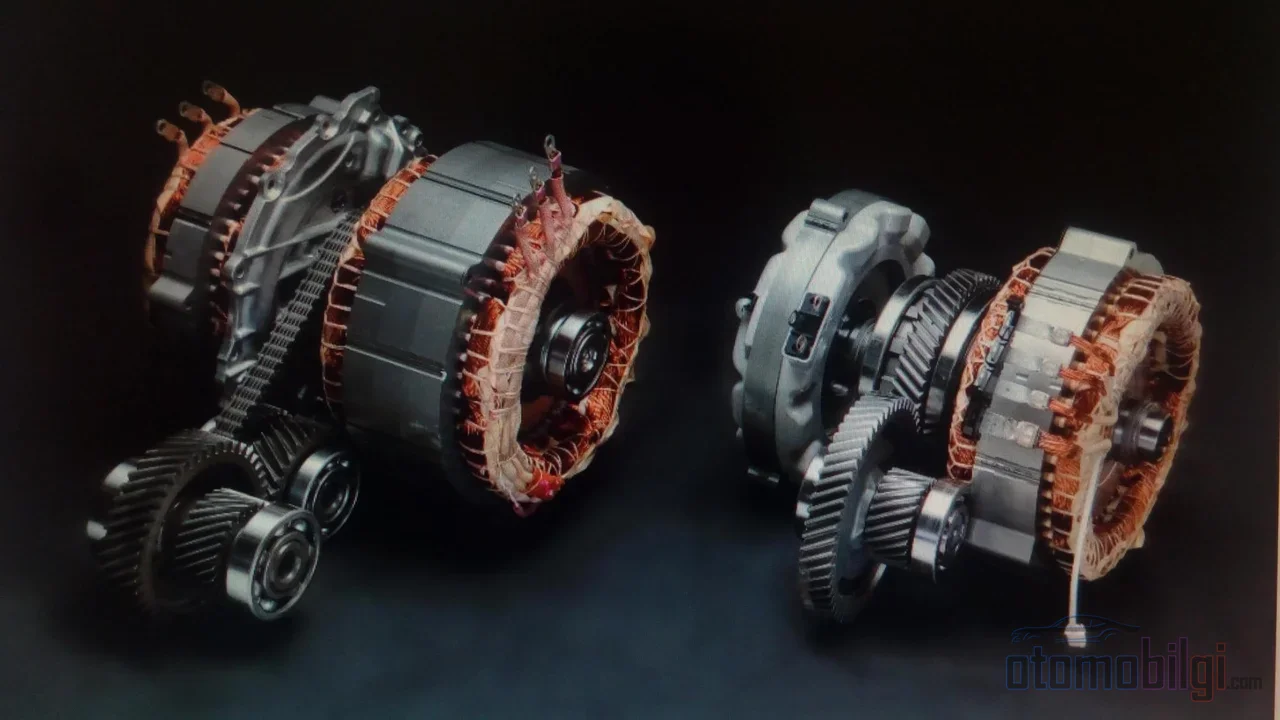
The third heading is mechanical noise: the reduction gearbox and bearings. EV motors, unlike internal combustion engines, can rev into the tens of thousands, so these components rotate at very high speeds. In permanent magnet drives, the smooth electronic whine that accompanies speed usually originates from the inverter's switching wave being applied to the motor; in some drives, a well-known 8th order electromagnetic tone is present, and a light form of it is completely normal.
How does the switching frequency determine the sound?
To understand the inverter's sound signature, one must look at the logic of PWM - Pulse Width Modulation. The transistors switch on and off at a fixed frequency, and by varying the on-time (duty cycle) in each cycle, the average voltage delivered to the motor is adjusted. What reaches the ear is this cycling process: a fixed-pitch, electronic-characteristic "eee" sound. In many electric vehicles, this short, steady tone heard before acceleration begins is exactly the normal operating sound of the PWM circuit; then, as the vehicle accelerates, the pitch rises.
The shift in pitch with rpm is an arithmetic consequence. The electrical frequency applied to the motor increases in proportion to rpm, and the electromagnetic forces vibrate at the harmonics of this frequency. Let's go through a concrete example: a 24th order harmonic at 4500 rpm corresponds to 1800 Hz. order harmonic corresponds to 1800 Hz. So the rising pitch of the sound as speed increases is not a defect, but a physical necessity. There is an engineering tension between keeping the switching frequency fixed and keeping it variable.
A fixed frequency makes electromagnetic interference (EMI) filtering predictable; but it causes a high-pitched, tonal, annoying noise to stay at the same point all the time. Variable switching frequency PWM strategies are used to reduce both inverter switching losses and system noise. This balance is still an active area of development; recently patented technical solutions include new methods that dynamically control the inverter switching frequencies to improve sound quality. new methods that dynamically control inverter switching frequencies to improve sound quality are among recently patented technical solutions.
the anatomy of mechanical whine In an electric vehicle, the transmission is usually a single-stage reducer, but in terms of noise it is not an empty task at all.
In an electric vehicle, the transmission is usually a single-stage reducer, but in terms of noise it is by no means an idle task. transmission whine and friction vibration originating from the gear surfaces. When the teeth come into contact with each other, metal-on-metal contact, combined with micro-scale deflections under load, passes vibration through the reducer housing to the body. Oil partially masks the sound created by this contact; so it is not surprising that the sound is more noticeable in the morning, when the oil's viscosity changes in cold weather. which is why it is not surprising that the sound is more noticeable in the morning, when the oil's viscosity changes in cold weather.
On the design side, the most effective solution is helical gears. Unlike spur gears, helical teeth engage gradually and in sequence, and this transition smoothness reduces noise considerably; one of the standard methods for reducing noise in electric vehicle transmissions.
Bearings, on the other hand, are part of the sound for two reasons. Mechanically, the source of a high-pitched whine may be the motor bearings or the reduction gear assembly; an increase in sound level or a change in character is a good early warning indicator of bearing health. Electrically, in inverter-driven motors, high-frequency switching can cause electrical damage in bearing races - meaning these components are both the source of the sound and the subject of the story the sound tells. The characteristic whine that motors emit regardless of load is also part of this mechanical contribution; the noise of the cooling fan, meanwhile, depends on motor speed but is independent of load.
Does motor type change the sound character?
The short answer: yes, to a measurable degree. The rotor magnetic field of permanent magnet synchronous motors is inherently established by the magnets rather than the stator inductance; this provides higher efficiency and torque density. Thanks to their ability to produce constant torque without fluctuation in the torque cycle, these motors can be designed to be very quiet and low-vibration. On the other hand, permanent magnet motors must operate with an inverter - meaning switching noise is always present. In these motors, the two main causes of vibration and noise are electronic and mechanical factors; pole and slot combinations, that is, the matching of the rotor pole count with the stator slot count, are a focal point of NVH research.
Induction motors, meanwhile, produce the rotor magnetic field through induction; they are generally larger, heavier, and less efficient, but their costs are low. Their sound character is also different accordingly: additional components dependent on slip frequency can be heard. The influence of motor design on sound is not limited to motor type alone; design parameters such as rotor skew, stator and rotor notching, and slot opening width directly determine the shape of the force wave in the air gap and are counted among the classic methods of noise reduction.
Spread spectrum: the technique that breaks up sound
One of the most elegant solutions to switching-related tonal noise is the spread spectrum switching technique, whose theoretical foundations date back to 1992. It is quite simple: you deliberately modulate the inverter's switching frequency within a small band. In this way, noise energy concentrated at a fixed frequency is spread across a wider spectrum, and peak energy at any single frequency drops. The ear perceives a narrow-band tone as far more annoying; a broadband, mild hum, however, is easily tolerated. The technique has also been proven in reducing EMI in switching power supplies; it can eliminate audible noise at the output and reduce it significantly at the input.
The place of this technique in the EV world is growing. In electric vehicles, high voltages and the dense number of chips make the system particularly sensitive to electromagnetic interference; smart sensor technologies designed to detect and reduce this sensitivity have also been developed. Sound quality methods that dynamically control the switching frequency are an extension of the same philosophy as spread spectrum: instead of a fixed, predictable tone, a noise that is spread across the spectrum or positioned dynamically.
Active noise cancellation and deliberate sound design
There are also technologies that attempt to eliminate sound entirely. The principle of active noise cancellation is classic: sound waves of equal amplitude but opposite phase are generated against the noise source, and the two waves cancel each other out. In electric vehicles, this approach works differently than in an internal combustion vehicle. Classic engine noise is already absent; the acoustic energy of the high-frequency noise of electric motors is relatively low. Therefore, modern systems continuously monitor the road, wind, and tire ambient noise entering the cabin and generate a counter-wave. Many manufacturers offer packaged solutions in this area; in some models, active sound design not only suppresses noise but also adds a deliberate sound character to the cabin.
But what about the sound outside? Because the electric motor's noise is low, pedestrians may not hear the vehicle's presence at low speeds. For this reason, artificial warning sounds designed to alert pedestrians to the presence of hybrid and electric vehicles - AVAS - have become standard: a hovering sound resembling air movement, produced by speakers at low speeds. The EU tied these sounds to its decision making them mandatory in 2014; in the US, too, artificial sound is mandatory below certain speeds. Sound design is developing as a discipline that brings this safety requirement together with user experience - it is also where every brand finds the opportunity to create its own acoustic signature.
When is the whine normal, and when is it a problem?
A rough rule: a smooth, tonal whine that follows speed is normal. The tone rising as you accelerate is the natural frequency shift of the electromagnetic harmonics; a steady-pitched electronic hum is the inverter's operating sound. The following situations, however, deserve a listen:
- If the whine has newly appeared or has risen noticeably compared to before,
- If the sound is accompanied by vibration or loss of power,
- If the character of the sound changes unexpectedly with speed and load.
These signs point to the mechanical side - especially the bearings and the reduction gear group. Noise level is a practical and cost-free way of monitoring bearing health; when the sound changes, get it checked before the fault grows.
| Sound source | Character | Relation to speed |
|---|---|---|
| Electromagnetic forces | Tonal, harmonic whine that shifts with rpm | Frequency shifts with rpm |
| Rising with rpm | Electronic hum, in the 5-15 kHz band | Depends on the switching frequency |
| Reduction gear | Gear growl | Scales with the gear ratio |
| Bearings | High-pitched, sometimes with electrical damage | Increases with rpm; a change is a sign of failure |
| Cooling fan | Fan rattle / hum | Increases with speed, independent of load |
Whining is not a defect, it is a design space
The whine of an electric motor is not the fault of a single part; it is the sum of the contributions of electromagnetic forces, inverter switching, gears and bearings. Every step forward on the engineering side - spread spectrum, variable switching frequencies, helical gears, active noise cancellation - is reducing the pressure of this sound inside the cabin or consciously shaping it. When you listen to the tone you hear as you accelerate in your next electric vehicle, you now know what you are hearing: not the motor, but the acoustic signature of an entire system.
Sources
- EV Motor Noise, Whine & Overheating: Causes & Fixes
- NVH Electric Vehicles
- Vibration and noise characteristics of an inverter for electric vehicle application
- New Inverter Switching Control Method to Enhance Sound Quality in Electric Vehicles
- Inverter Acoustic Noise: PWM Strategy, Magnetostriction and Cabin Perception in EVs
- Understanding the Operating Noise of Electric Motors
- Noise in Electric Motors: A Comprehensive Review
- Tackling EV noise reduction
- Noise Reduction Techniques for EV Transmissions
- Low noise modulation technique for PWM inverter drives
- The pros and cons of spread-spectrum implementation
- Researchers Develop Technology To Protect EVs from Chip Noise
- Active Sound Management
- What Is Active Sound Design On The EV6 & EV9
- Vehicle Electrification and Active Noise Cancellation
- Electric vehicle warning sounds
- Induction vs. Permanent Magnet Motors
- What Does Noise Tell You About Your Electric Motor?