D1GP Enters a New Era with D1 Lights and the Top 24 Format
Just think about this: beneath the world's most famous drift series, there's a little-known league that is the heart of the entire system. Its name is D1 Lights. And starting from 2025, this league is competing with a format no one has seen since 2014: the Top 24 knockout system. So why is a feeder series bringing back an abandoned format? And how is this change shaping the current structure of the giant organization known as D1GP? Buckle up, because on this page we're untangling drift's school system in Japan - yes, there is literally a ladder system.
First, let's make one thing clear: D1GP is well known, but what was D1 Lights, and why was Top 24 important? The answers lie in a feeder series history dating back to 2005, a tragic accident in 2016, and Hideyuki Fujino, who turned things around by reclaiming the championship in 2025. Let's go step by step.
What Is D1 Lights and Where Does It Come From?
D1 Grand Prix is a Japan-based professional drift series that ran its first season in 2001. It was born from the competitions organized by Daijiro Inada and Keiichi Tsuchiya in 1999-2000; the first event was held in October 2000 at Ebisu Circuit in Fukushima, with 40 cars and around 3,000 spectators. So even at its beginning, this series was not a story of solitude - it was an organization that drew a whole community from the very day it was founded.
But every major league needs young talent in some way, right? D1GP's feeder tier that answered this need carried the name D1 Street Legal (D1SL) for a long time. Introduced in 2005 at Odaiba, this series featured road-legal, plated cars - and with strict rules at that: the original engine, original dashboard and doors, a steril system, and a Japanese shaken inspection certificate were mandatory. The cars were transported by trailer between races; in other words, these were cars that truly lived on the street.
In 2006, D1SL became a regional series across four regions - north, south, east, and west - and anyone could enter without needing a D1 License. The regional champion earned a D1 License, meaning the door to the main series was cracked open. Sounds like a nice system, doesn't it? And it was - right up until 2016.
The 2016 Accident and the End of D1 Street Legal
During practice for the 2016 D1 Street Legal final round, a wheel that came loose caused the death of an official; the round was cancelled and the series did not enter 2017. In 2017, the organizers officially announced the end of D1SL. The closure of a feeder series is never just a name change - it is a breaking point where safety debates, responsibilities, and restructuring come together.
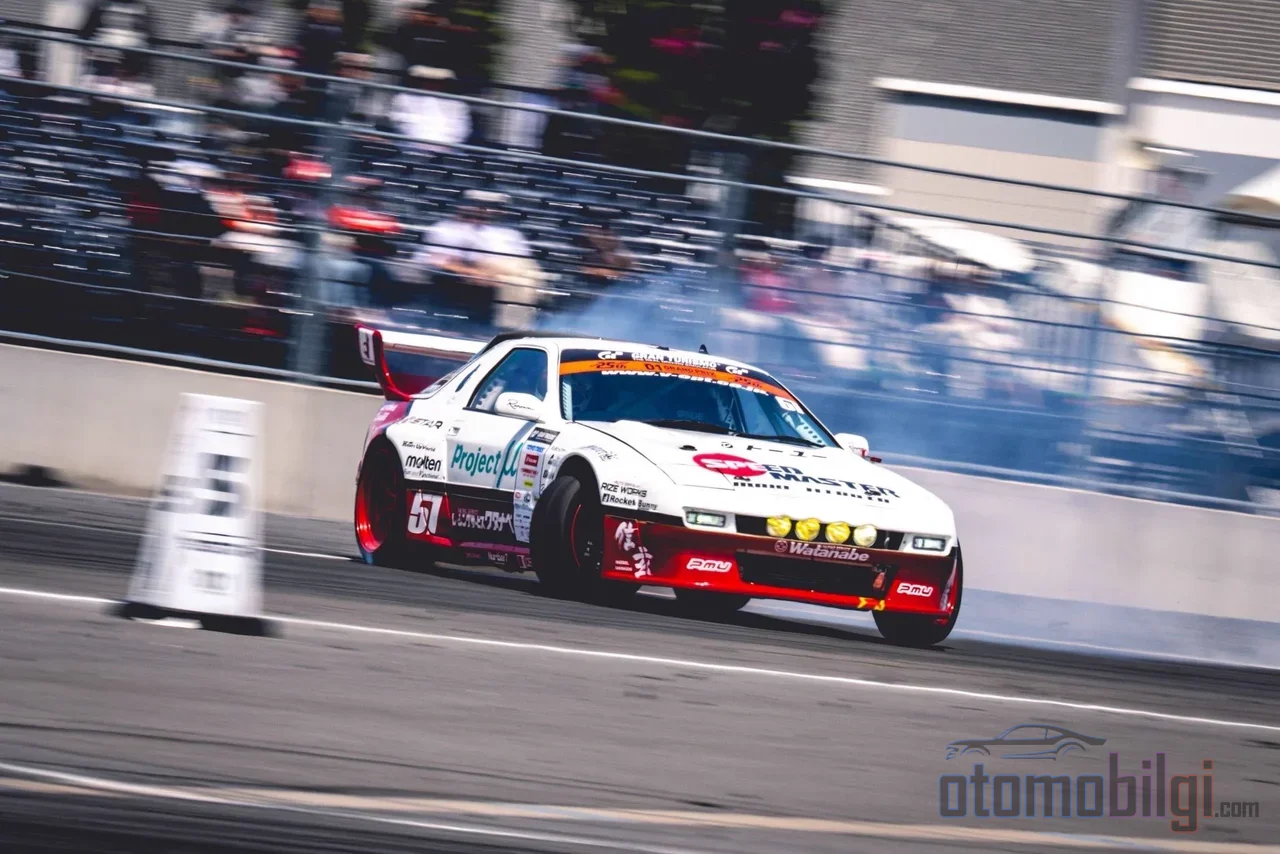
In 2018, D1 Lights stepped onto the stage, and the difference was not only in the name. In D1SL, cars had to be road-legal, even plated; in D1 Lights, cars were now required to be pure race machines, with no road registration required. This single-sentence change says a lot: the gap between the feeder series and the main series was being closed. As D1GP moved away from small circuits with more powerful cars, D1SL and D1 Lights stayed on small circuits - for example, the Enishi West course at Ebisu Circuit has been one of D1 Lights' regular venues since 2020.
Highlights
- D1 Lights replaced D1 Street Legal in 2018 and became D1GP's official sub-category
- The Top 24 format was tried in the last two rounds of 2024, and from 2025 onwards it became permanent in selected rounds
- Hideyuki Fujino, the 2025 D1GP champion; Team Toyo Tires Drift, teams' champion
- As of 2026, all D1 Lights champions have moved up to D1GP
- The 2026 D1GP calendar features 10 rounds; the new venue Aichi Sky Expo was added to the calendar
Tanso and Tsuiso: You Can't Understand Top 24 Without Understanding the Format
Now let's get into the technical part, but don't worry - I'll explain it with simple analogies. There are two basic competition formats in the D1 world. Tanso is solo qualifying runs: the driver drives alone, with angle, line and speed scored with the help of the DriftBox device; a maximum of 100.0 points can be earned. Think of it as a kind of exam that sets the grade average.
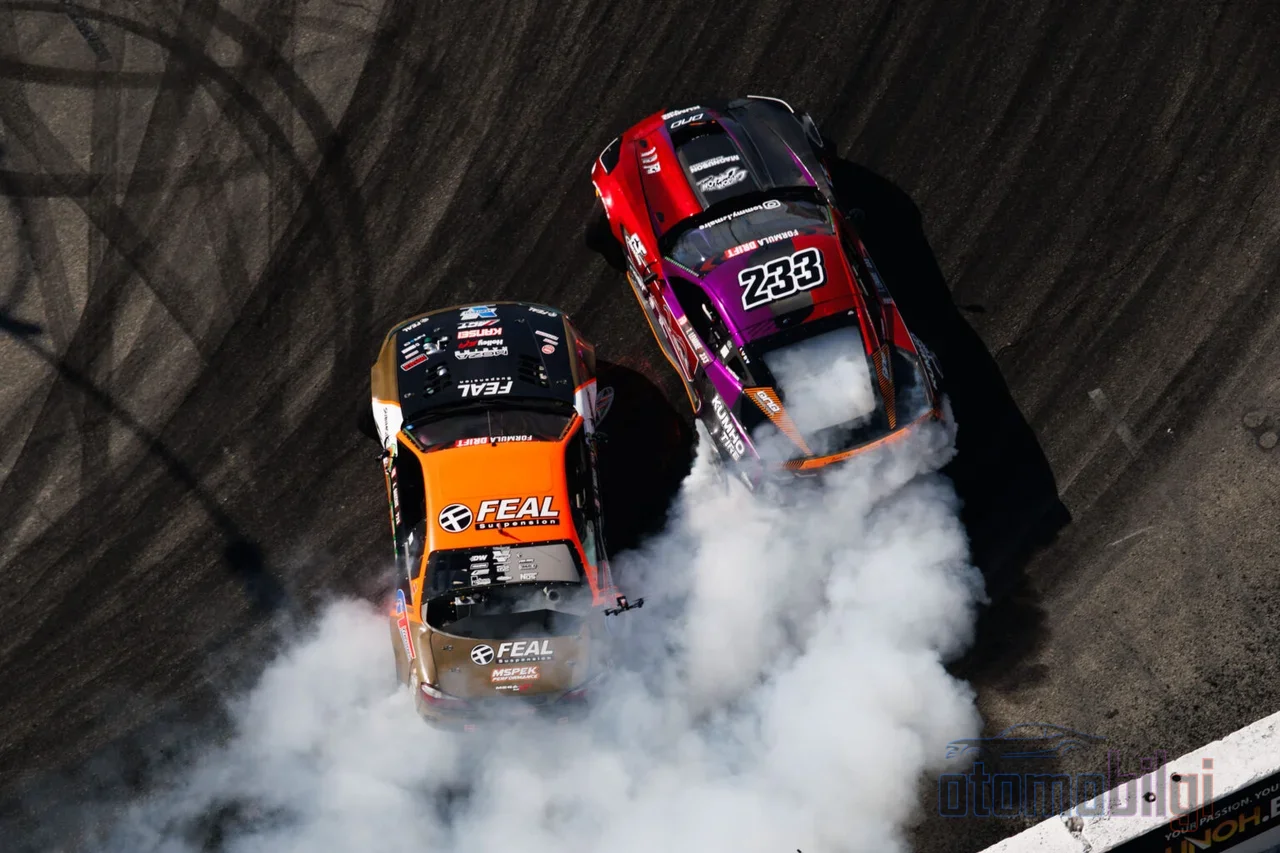
Tsuiso, on the other hand, is the real show part: two cars are on track at the same time, drifting meters away from each other. This duel format, the traditional practice of toge, i.e. mountain pass racing, has also carried over to drift events worldwide. While the lead car closes the inner line with the biggest possible angle, the chasing car runs a smaller angle but tries to stay as close as possible. Spinning, understeering or colliding means zero points in that duel, or even disqualification. So tsuiso is not an exam - it's mutual chess, but the loud, tire-smoke-filled version.
How Does the Top 24 Qualifying Format Work?
So if there's Tanso and tsuiso, where does this Top 24 come from? In the old D1GP system - according to the 2015 method - the top 16 drivers ranked 9th-24th in the Tanso final advanced to the tsuiso qualifying round; in other words, the Top 16. In 2014 the secondary (minor) tsuiso had also been abolished, and the Top 24 tournament was seen for the last time that season. After a long break, in the last two rounds of the 2024 season, D1 Lights tried this Top 24 tournament again and the goal was clearly set: to use this format in 2025 and beyond. And that's exactly what happened; the system was integrated into D1 Lights in selected rounds from the 2025 season onwards.
The logic is as follows: the best 24 drivers emerging from Tanso qualifying are matched up according to ranking and compete in single-elimination tsuiso duels. Why does it matter? Because more drivers make it to the duel stage, which means more exposure for both the audience and young drivers. While the main series still uses the classic Top 16 + seed structure, the sub-series operating with a different qualifying format is a choice that deepens the divergence between D1GP and D1 Lights. Isn't that what a sub-series exists for anyway: to try things out, to develop, to prepare?
The Ladder System: How Do D1 Lights Champions Get Into D1GP?
Here is perhaps the sweetest statistic on this page: As of 2026, all D1 Lights champions have moved up to D1GP. The 2024 season is proof of this: every former Lights champion up to 2023 was racing in the main series. During the D1SL era, there was no such mechanical structure; this is a genuine ladder system that came with D1 Lights.
And the names are no empty matter: the first D1 Lights race winner Daisuke Saito, the first series champion Junya Ishikawa (who moved up to D1GP the following year), and two-time race winner Naoki Nakamura, who regained his D1GP license and moved to the main series. The story of the 2025 champion Genki Mogami is a bit different - without being a Lights champion, he had run a single season in D1GP back in 2023, two years earlier. So the path upward is not a single track; but the championship is the most guaranteed ticket.
The broadcasting side has been thought through as well: D1 Lights has been on free YouTube streaming since 2018. In 2023, the broadcast moved from the D1GP Movie Channel to the Video Option channel; the English broadcast is handled by Noriyaro, that is, Alexi Smith, on commentary. The fact that a Japanese feeder series can be watched worldwide is the clearest sign that this ladder system has turned into an international talent pool.
2025 Season: The Year of Fujino and Team Toyo Tires Drift
The 2025 Gran Turismo D1GP series was the series' 25th season, and its finale was held at the Tokyo Drift event in Odaiba. The championship story was breathtaking: Hideyuki Fujino overcame a 19-point deficit, turned the championship around, and won his third D1GP title. Fujino, who had also been champion back in 2017, reached victory in the final round of the season with the Toyota GR86 ZN8, while on the solo (Tanso) side, Tetsuya Hibino came to the fore. On the team side, the picture was clear: Team Toyo Tires Drift won the teams' championship.
Fujino's story is actually one of the keys of this page, because Toyo Tires added him to the roster as a team driver in 2021 alongside Masato Kawabata - and up to that date, Fujino had won D1 Lights once. So today's champion is the product of yesterday's ladder system. A nice full circle, isn't it?
2026 Calendar and New Circuit: Aichi Sky Expo
So where do we stand right now? The 2026 D1GP series is planned over 10 rounds: Announced with an opening date of March 24, 2026, the calendar wraps up in Odaiba on November 15, 2026. And the most exciting part of it all: Aichi Sky Expo (Aichi International Exhibition Center) entered the calendar as a brand-new drift circuit specially prepared for D1GP. Rounds 1&2 were run there on May 9-10, 2026. The rest of the calendar features classic venues such as Tsukuba Circuit, Ebisu Circuit and Autopolis.
The D1 Lights side has not been idle either: the 2026 season opener was held at Nikko Circuit, and Rounds 9&10 were run at Tsukuruma Circuit Nasu on October 10-11, 2026. The feeder series continues to stay on small circuits - that is, new drivers meeting at their own scale in the rapidly growing world of the main series. It is precisely for this reason that the two are an inseparable whole.
Conclusion: Why Does This New Era Matter?
Let's wrap it up briefly, because this page promised a clear answer: D1 Lights is the official sub-category of D1GP; It replaced D1 Street Legal in 2018, where road-legal cars competed, and became a true stepping-stone league run with pure competition cars, systematically carrying its champions up to the main series. The Top 24 knockout format used in select rounds from 2025 onward brought back a system unseen since 2014, giving the sub-series its own character. The 2025 championship of Hideyuki Fujino and the double for Team Toyo Tires Drift, the Aichi Sky Expo novelty on the 2026 calendar, and the fact that all Lights champions have moved up to D1GP show that this structure now works on the track, not just on paper.
And what's the lesson for you? In the world of drifting in Japan, a championship is not a one-night show - it is a long road stretching from D1 Lights to D1GP, where the format, the car and the driver mature together at every step. And the final link of that road ends in Odaiba, in November, in smoke as always.