D1GP Tests Drift Scoring with Sensors-Equipped Judges
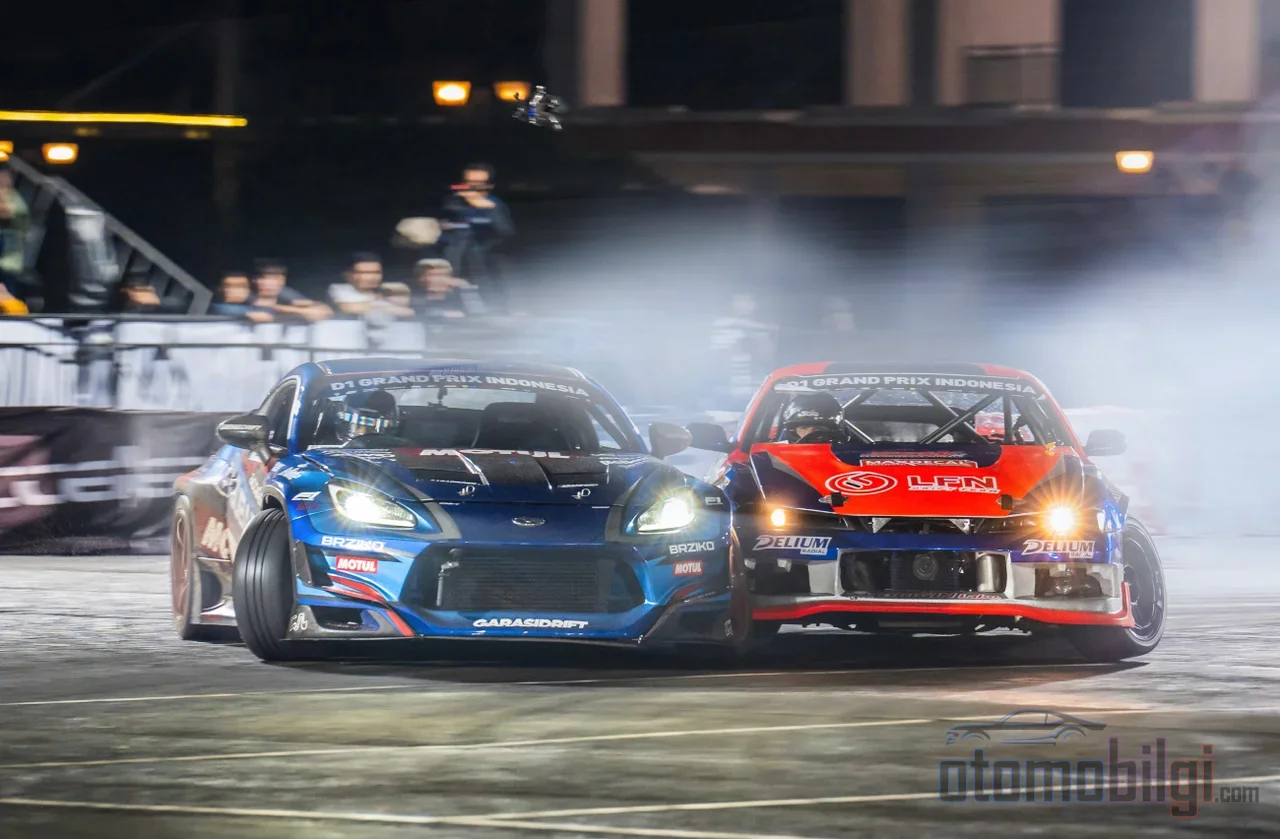
Imagine this: A pilot finishes his run, and before he even gets out of the car, before the tire smoke has even cleared, the score appears on the board - down to the decimal place. Five years ago, this would have been science fiction in the drifting world. Now, we are standing right in the middle of the debate: Is it still just the three people in the stands who award the score, or is it the sensors attached to the car and the satellite connection? From D1GP's sensor-based scoring system to the data-driven judging framework that Formula Drift is rolling out in 2026, we are right in the middle of the most current technological transformation in drift history. So, can a machine truly replace a human jury? If you're ready, let's take a look together.
Why Is Drift Scoring Such a Difficult Task?
First, let's clarify one thing: drift is one of the strangest disciplines in motorsport. Because the goal is not to be the fastest. D1GP's official rulebook defines the solo run as follows: driving a course with specified corners at a higher speed, with a bigger and more committed drift angle, and being able to transition angles more quickly. In other words, speed matters, but it has to be balanced against the angle; angle matters, but if it isn't committed, momentary big angles don't count for anything. On one hand, you have to stay committed to the corner; on the other, while sliding, you need to snap left and right like scissors.
D1GP's official formula is actually surprisingly simple: speed score multiplied by angle score, plus the swing score. The example calculation in the rulebook makes it clear exactly what this means: 9.8 x 9.7 + 0.5 = 95.56. There are 10.00 full points each for speed and angle; transition sharpness, i.e. swing, is scored in seven steps between 0 and +3. But here's the secret: who, or what, gives these three numbers? This is exactly where the whole debate erupts.
The backbone of drift scoring rests on three concepts: line (the line the car follows and how close it gets to the clipping points), angle (the drift angle) and style/impact (fluidity, impact, aggression). The weighting of these three changes from series to series, but the shared concern of them all is the same: distinguishing the winner when two cars are driven almost identically. For a jury sitting in the stands, this is a decision that must be made in seconds. And when it isn't, the debate begins.
Highlights
- At D1GP, scores are announced within seconds of the run ending, down to the decimal place.
- Formula Drift has handed roughly 80% of its qualification score over to telemetry in 2026.
- The DRIFT/RS system reads every car 20 times per second, with centimeter-level precision.
- In the judging of organizations like Drift Masters and the FIA, human judgment is still at the center.
D1GP and Sensor-Based Scoring: How Does the DOSS System Work?
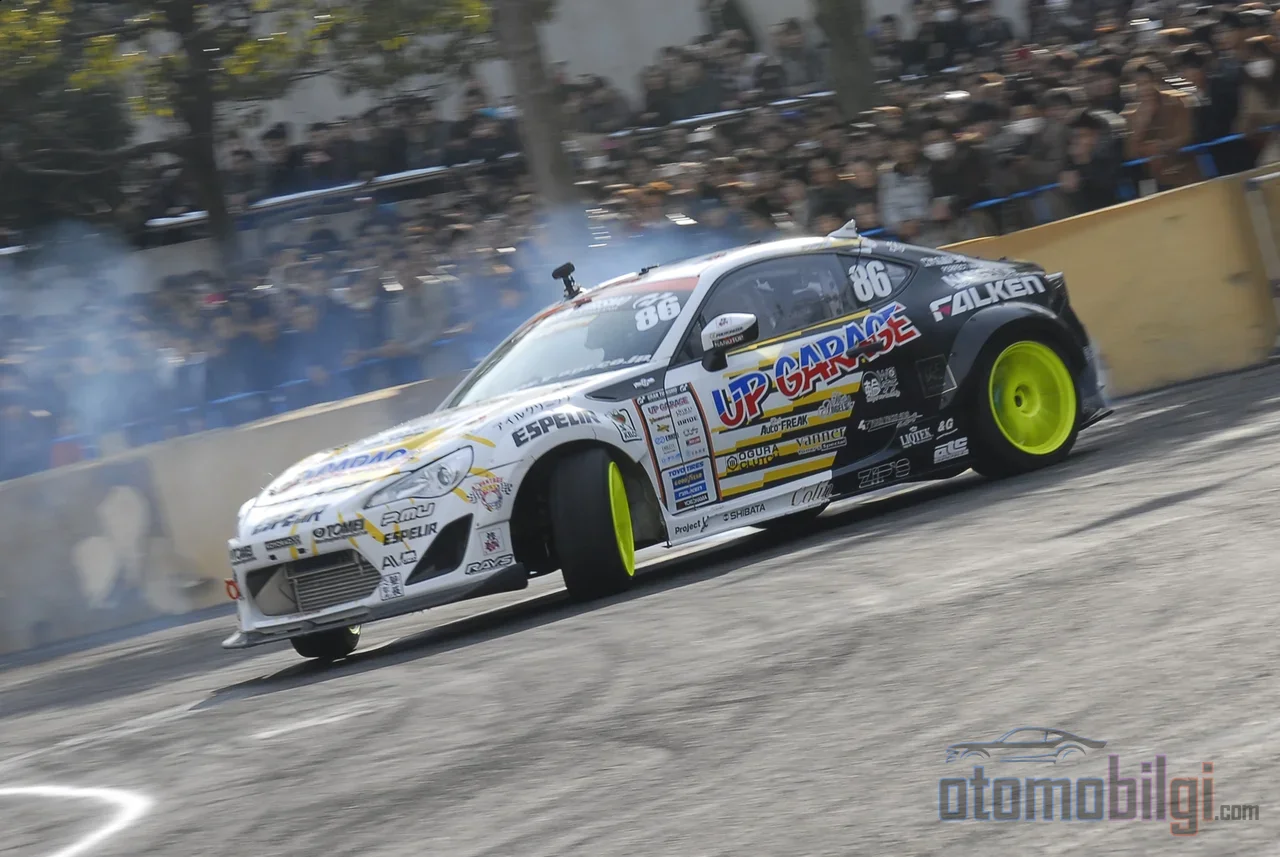
In Japan, the answer to this question has been very pragmatic: measure everything you can measure. D1GP's scoring, a machine scoring system called DOSS, is built on two solo runs, the TOP16 chase battles and interruption mechanisms. The nice thing about the format used in the season is that the scores are announced as soon as the runs end; the spectator sees the number on the screen before the car has even left the straight. This speed has completely changed the rhythm of the competition, especially in the elimination rounds.
But D1GP is not a locked door on this front either. The measurement provisions in the rulebook actually summarize the series' philosophy very well: if a measuring device is to be used in judging, the system must first pass the official approval of the D1 Association. And here is the critical part - measurable elements must in principle be scored only through measurement; the unmeasurable ones, such as the distance between the two cars and the causality of contact, should be assigned to the judges. In other words, D1GP positions the machine and the human not as rivals but as collaborators. The sensor reads speed and angle, while the human decides whose mistake whose mistake was.
Formula Drift 2026: 80% of the Score Now Comes from Telemetry
The development on the American side is even more radical. In the 2026 season, Formula Drift partnered with Race Data Labs to launch a data-driven judging framework called the Universal Drift Scoring Method (UDSM). In the new format, roughly 80% of the score in the PRO elimination round is automated: line and angle are measured instantly via telemetry coming from the car. The share left to human judges is roughly 20%.
So why did FD make such a decision? The series' own explanation goes like this: the system is intended as a solid reference tool that the judges will consult during the competition. The goal is to eliminate the dead air created by long jury deliberations - that is, those waiting moments lasting minutes between two pilots that cool down the audience. Just imagine: in a team battle both cars ran it by a hair, the jury deliberates for three minutes, and the stands slowly fall silent. UDSM steps in at exactly this point and puts the same physical data in front of the judges.
Of course, not everyone is convinced in this direction. Some pilots and fans argue that the system introduced to solve the judging crisis may itself become a new subject of debate. The most interesting objection from FD drivers is more philosophical: no matter how objective a computer judge may be, drift is above all a show built on impressing the jury and the crowd. So when the sensor determines the score, who will measure that effect factor standing tall in the stands, the one that makes your hair stand on end?
DRIFT/RS: An AI Judge That Reads 20 Times per Second
The most ambitious of the three systems we discussed is DRIFT/RS, officially adopted by the Drift Kings International Series in 2026. A self-learning artificial intelligence judging system. The system was deployed in the field at the season finale at Serres Racing Circuit on October 3, 2026, and was used on track at 2026 events. So how does it work?
What's on the Car?
Each car carries a box with two antennas and an RTK receiver; position and heading information comes directly from there. Speed, the true drift angle, throttle status, and the position of the four tires relative to the track limits are derived from this data. On the satellite side, there is a generous lineup: GPS, GLONASS, Galileo, and BeiDou are supported simultaneously, working with more than 30 satellites. Think of RTK measurement simply like this: normal GPS gives you a position with a margin of error of a few meters; RTK, thanks to a fixed reference station, brings this down to centimeter level. Centimeter precision is essential for measuring drift angle - to calculate the difference between where the car's nose is pointing and the direction it's traveling.
And the system reads each car 20 times per second, sharpening with every lap as it learns. There isn't even a throttle sensor; the system can infer whether the pilot has released the throttle from the deceleration (about −1.8 m/s², roughly 0.18 g).
How Is the 100 Points Distributed?
| Category | Points | Details |
|---|---|---|
| Line | 40 | Clipping points 30, connection 10 |
| Angle | 30 | Average angle 12, peak angle 8, correction 10 |
| Impact | 30 | Fluidity 15, stability 15, early initiation bonus +3 |
The weights are flexible depending on the event - line can be 40, 50 or 60 points while angle can drop to 30 or 20. The system's automatic detection list is quite comprehensive: an angle dropping below 2 degrees for 0.7 seconds counts as understeer and scores zero; if one wheel goes beyond the track limits, 2 line points are deducted, and if two wheels go out, the lap is reset. Contact and fault detection, the leader slowing down, overtaking the car ahead, an incomplete lap, even the follower getting on the throttle too early are all automatically caught.
In tandem battles, the follower; gets 50 points for proximity, 20 for mimicking the leader's driving, and 15 points each for their own line and angle performance; each lap is evaluated with a quality score between 0-10, and in the event of a tie, One More Time comes into play. And my favorite detail: on the 3D replay screen, a proximity halo appears beneath the follower - under 1 meter is green, under 3 meters is orange, and above that is red. Now, for the pilot asking "why did I get 77?", a report can be presented showing which measurement each point came from. On the transparency front, this is truly a big step.
Where the Human Jury Is Still King
So has the whole world surrendered to the machine? No - and that's the beautiful part. In the Drift Masters 2026 rules, angle is worth 20 points; in team battles, the lead lap gets a 10-point and the chase lap a 9-point jury evaluation, with the judges watching both laps and choosing the driver who performed better overall. In other words, the classic way: watch, compare, decide. Even the FIA's 2026 Intercontinental Drifting Cup regulations define a separate line jury and a separate angle jury; the angle jury scores the car's angle in every clipping zone. It's not that there's no electronic support, but there are still people sitting at the desk.
Regional diversity is another story. In the Saudi Toyota Championship, qualifying starts at 100 points and three judges make deductions for line, angle, speed and aggression. At Drift South in New Zealand, each lap is scored out of 100, with rankings based on the best single lead lap and the best single chase lap. Red Bull Car Park Drift, on the other hand, is a completely different format: the driver sets their own course configuration and tries to collect maximum points from the obstacles. Each series has built a scoring culture suited to its own climate.
Machine or Human? Drift's Answer Might Be Both
So let's return to the question at the beginning: can electronic scoring replace the human jury? Looking at all the evidence we have, the answer is this: on its own it cannot - but when working together, it radically changes drift scoring. D1GP leaves the measurable to sensors and leaves gray areas like contact and causality to the jury. Formula Drift positions UDSM not as a replacement for the jury, but as the jury's reference tool. DRIFT/RS, on the other hand, produces almost the entire score with its boldest move but still leaves points requiring human approval in its component list.
To be honest, this debate doesn't seem like it will ever end. One side defends the machine's objectivity: same lap, same score, no objections. The other side defends the soul of drift: you cannot measure the moment the crowd leaps to its feet with centimeter data. Drift Masters has even conducted a survey openly asking viewers whether judgment should be human, technology, or both. So the debate has now jumped from the paddock to the stands, and from there to everyone in front of a screen.
My view is this: sensor-based systems solve drift scoring's reliability problem, but not its character, because character lies precisely in that controversial, human, somewhat chaotic side. The next few seasons will show which of these hybrid models will survive. One thing is certain: the question of who gives the score will, from now on, be a topic discussed in drift circles as much as a 60-degree angle. What do you say - should a sensor or a human sit in the jury seat?
Sources
- Drift.RS - Self-Learning AI Judging & Race Management
- D1 Scoring Criteria - D1GP Rule Book 2024
- Universal Drift Scoring Method - Race Data Labs
- Formula DRIFT announces major competition format changes - Racer
- D1GP scoring explained: DOSS, battles and points - Arigato Japan
- D1 Grand Prix - Wikipedia
- The whole DRIFT/RS AI Judging system in 11 minutes - Drift Kings
- How is D1GP qualify scoring done? - Reddit