Do Knee Airbags Actually Protect Knees, According to Euro NCAP Data?

Just below the glovebox, there's a small fabric cover that nobody notices: the knee airbag, which deploys in a crash and inflates a small cushion in front of your knees. It's presented in brochures as part of the "full protection" package, and it's found in roughly half of vehicles worldwide (that was a 2018 model year projection), at least on the driver's side. So does it actually work? The answer isn't as clear-cut as you might think - and the most interesting part is how the story completely changes when you look at the measurement data.
On this page, we'll go through, one by one, the engineering logic of the knee airbag, Euro NCAP's lower extremity scoring, and the surprising picture revealed by real crash test data. If you're ready, let's duck under the dashboard.
What Is a Knee Airbag and How Does It Work?
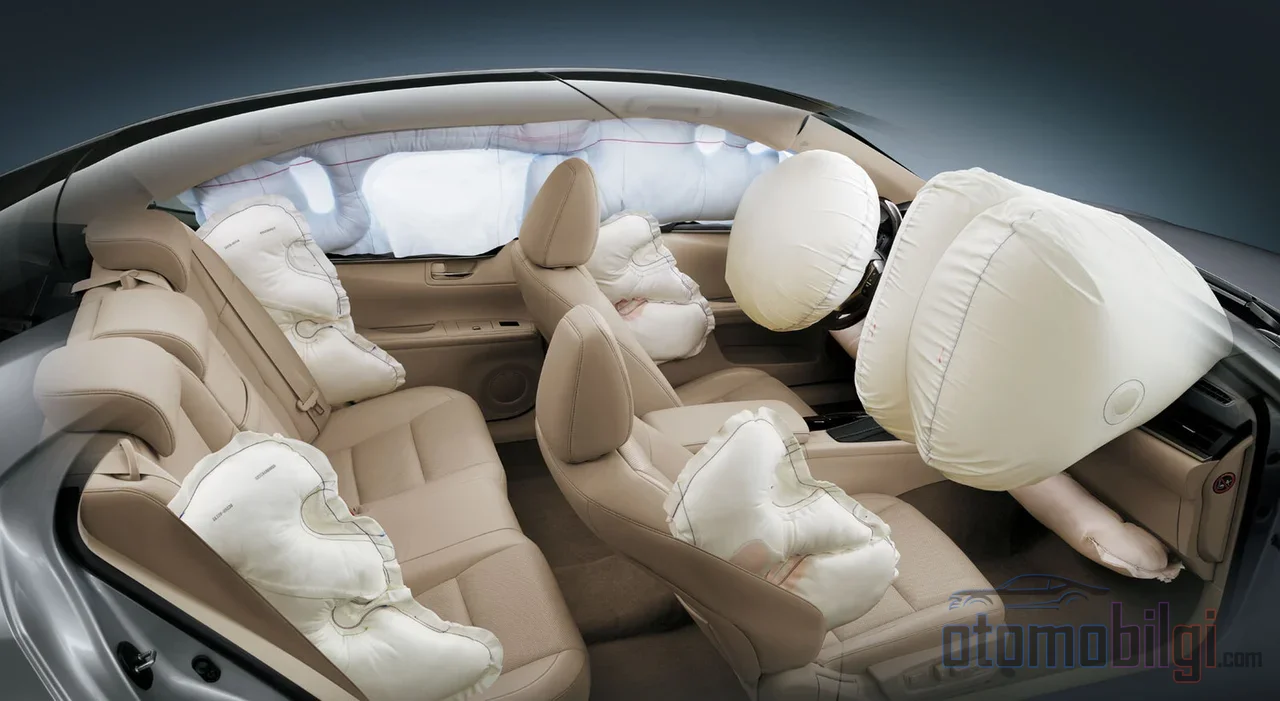
A knee airbag is a small airbag located in the lower section of the instrument panel - under the steering column on the driver's side, and under the glovebox on the passenger side. In a moderate frontal crash, the sensors trigger, the inflator produces gas, and the cushion fills the gap between the knees and the lower panel within milliseconds. The goal is to soften the direct impact of the knees and legs against the lower panel.
The engineering logic here actually rests on a very simple rule of physics: load distribution. If the knees hit a hard panel at a point, the entire impact force concentrates in a small area. A cushioned surface, on the other hand, spreads the same force over a larger area, extends the impact duration, and therefore reduces the loading rate. Whether the same force is transmitted in a short or long time - like catching a ball with your bare hands or with gloves - determines the intensity that reaches the bone.
A knee airbag has a second job as well: reducing the forces on the chest and abdomen by controlling the forward movement of the lower body - in other words, keeping the driver in the correct position. That's why manufacturer manuals don't refer to it merely as "knee protection"; it is part of cabin interior motion management.
Highlights
- By distributing the load on the lower panel over a wider area, the knee airbag softens the force applied to the knee and femur.
- In IIHS's 2019 analysis, no significant benefit was found in any body region in moderate overlap tests.
- While the risk of patellar fracture was halved in small overlap tests, tibia and femur risks increased.
- In Euro NCAP, the Knee, Femur & Pelvis region is worth 4 points; in the event of submarining, all 4 points are deducted.
- In Europe, there is no mandatory unbelted crash test; knee airbags are mostly added for US requirements.
How Does Euro NCAP Score Knee and Hip Injuries?
In Euro NCAP's adult occupant protection protocol (version 9.3, applied from 2024 onwards), the lower body is evaluated as two separate regions: Knee, Femur & Pelvis (knee, thigh and hip) is worth 4 points, and Leg and Foot (leg and foot) is also worth 4 points. Axial forces passing through the femur and knee of the crash test dummies are measured; the sliding distance of the kneecap on the lower panel also enters the scoring through a measurement called the knee slider.
There are two critical details here. First: if the pelvis slides under the lap belt in the tested vehicle, i.e. if submarining occurs, the Knee, Femur & Pelvis score is directly reduced by 4 points. Second: Euro NCAP applies a separate knee mapping sled test protocol to map which points of the knee area make contact and with what loads; if this data is not provided for the driver, scoring cannot be performed.
What Does the 10 kN Threshold Mean?
The injury threshold of the knee-thigh-hip complex is defined, for a 50th percentile male in US federal test regulations, as an axial femur force of 10 kN. In other words, as the compressive force passing through the dummy's thigh bone approaches this value, the risk of fracture weighs more heavily in the scoring. This is exactly the point where the knee airbag comes in: by offering an alternative load path through the femur, the airbag aims to help keep this threshold from being exceeded.
So What Do the Real Data Say?
This is where things get complicated. A comprehensive effectiveness analysis published in 2019 examined 414 laboratory frontal crash tests (309 moderate overlap, 105 small overlap; all structurally rated "good", 2011 and later models) and 14,599 real-world two-vehicle frontal collisions from 14 states. The results are very different from the picture in the brochures.
Moderate Overlap: Zero Effect
In moderate overlap tests, the knee airbag did not affect injury outcomes in any body region. The overall injury risk was 66% in vehicles with knee airbags and 65% without - statistically identical. The reason is simple: when the seat belt is fastened, the belt already does the job the knee airbag is supposed to do. The pretensioner removes the slack from the belt at the moment of impact, and the load limiter spreads the force on the chest in a controlled manner; the lap portion of the belt takes care of the femur load. There is almost no marginal benefit left for the knee airbag.
Small Overlap: Here's the Surprising Picture
In small overlap tests, however, a complex result emerges: in vehicles with knee airbags, the risk of skull fracture drops from 1.16% to 0.63% - a near halving, statistically significant. But in the same tests, the upper tibia (shin bone) injury risk increases markedly: on the right from 1.1% to 1.7%, on the left from 1.8% to 2.7%. The lower tibia and mid-foot region risks rise similarly (right: 2.5%→3.7%; left: 3.8%→5.3%). In fact, for the right femur, the knee-thigh-hip injury risk rises from 0.380% to 0.516%.
In real-world data, the overall injury probability also drops from 7.9% to 7.4% - but when vehicle weight, model year and driver characteristics are controlled for, this difference is not statistically significant. The essence of the analysis is this: the data do not show a clear benefit of knee airbags, and their real effect on driver safety is likely negligible.
The Counterargument: Is the Knee Airbag Completely Useless?
Writing it off entirely is not right either. A modeling study published in 2020, based on national crash databases, showed that knee airbags could be protective against knee-to-hip injuries with an odds ratio of approximately 0.6; there is also a reducing trend for upper-body injuries. However, the same study points to an increased risk of lower-leg injuries in both models - though not significantly.
The early design literature was also promising: A 2004 study showed that knee airbags carried potential, particularly in reducing knee-region loads and chest compression. In short, the theory is right, the measured benefit is debatable. Different studies approach the issue from different angles: while laboratory test data raises doubts, models based on real-world crash data suggest partial protection in the knee-hip region.
Why Is It Being Removed from Some Vehicles?
This is the least known part of the story. Interviews with manufacturers reveal that the primary motivation for installing a knee airbag is often to meet the unbelted occupant protection requirements in US federal regulations: in unbelted crash tests, the knee airbag provides an additional load path through the femur. Since vehicles designed for the European market are not required to take this test, the knee airbag is added when the same model is adapted for sale in the US. So that fabric cover is sometimes not an engineering necessity, but regulatory compliance.
In contrast, seatbelt pretensioners, load limiters, and continuous improvements in cabin structure already cover most of the function the knee airbag performs. Structural integrity is also critical: if the cabin structure behind the knee airbag collapses in a crash - that is, if there is intrusion - the airbag's protective capacity is severely limited. This is also why the analyses are limited to vehicles rated "good" in structure.
The cost-justification balance also plays a role: manufacturers had previously dropped inflatable seatbelts when they could not justify their high cost. A similar pattern applies to the knee airbag - if there is no measurable benefit left, that money is spent on another passive safety feature. On the other hand, development has not stopped: In 2025, ZF Lifetec introduced an active heel airbag that will work together with the knee airbag to protect the lower extremities of front-row passengers.
Does the Knee Airbag Protect? The Clear Answer
What the measurement data tells us is this: knee airbags provide protection in theory by distributing knee and femur loads, but real-world test data does not show a clear benefit; their effect in belted drivers is negligible. In moderate overlap tests, there is no difference at all; in small overlap, it reduces head injury risk while potentially increasing tibia and femur risks; its meaning is greater for unbelted occupants, but this scenario is not tested in Europe.
So does this mean we wouldn't want to buy a vehicle with a knee airbag? No - no one should give up a vehicle because of this. But the assumption that "there's a knee airbag, so my legs are safe" is not supported by the data either. The real protective power still lies in the same trio: a quality cabin structure, a well-calibrated seatbelt with pretensioner and load limiter, and the main airbags deploying at the right moment when needed. The knee airbag is a supporting piece of this system - not the star.
Sources
- Effectiveness of knee airbags across two crash paradigms
- Euro NCAP Assessment Protocol - AOP - v9.3
- Evaluating the influence of knee airbags on lower limb and whole-body injury
- Lower extremity injuries and associated injury criteria
- Driver Lower Extremity Response to Out of Position Knee Airbag Deployment
- IIHS - Airbags