How Does the Seatbelt Pretensioner Take Up Slack in the First Milliseconds?
Share This Page
The front pretensioner is a small but critical safety component that fires with pyrotechnic fuel to remove the slack in the belt and secure the occupant to the seat within the first milliseconds of a collision. It works together with the force limiter that limits chest load; together, the two further reduce the belt's fatality risk by an average of 12.8% in cars.
Key Highlights
- The front pretensioner removes the slack in the belt 10-15 ms within
- Its activation threshold is lower than the airbag's: 15-25 km/h it can fire in a crash of
- The shoulder belt applies roughly 2 kN (~200 kg) of force in the tensioning phase
- The force limiter keeps the chest load in the 4-6 kN range
- The pyrotechnic pretensioner is single-use, replaced after it has fired
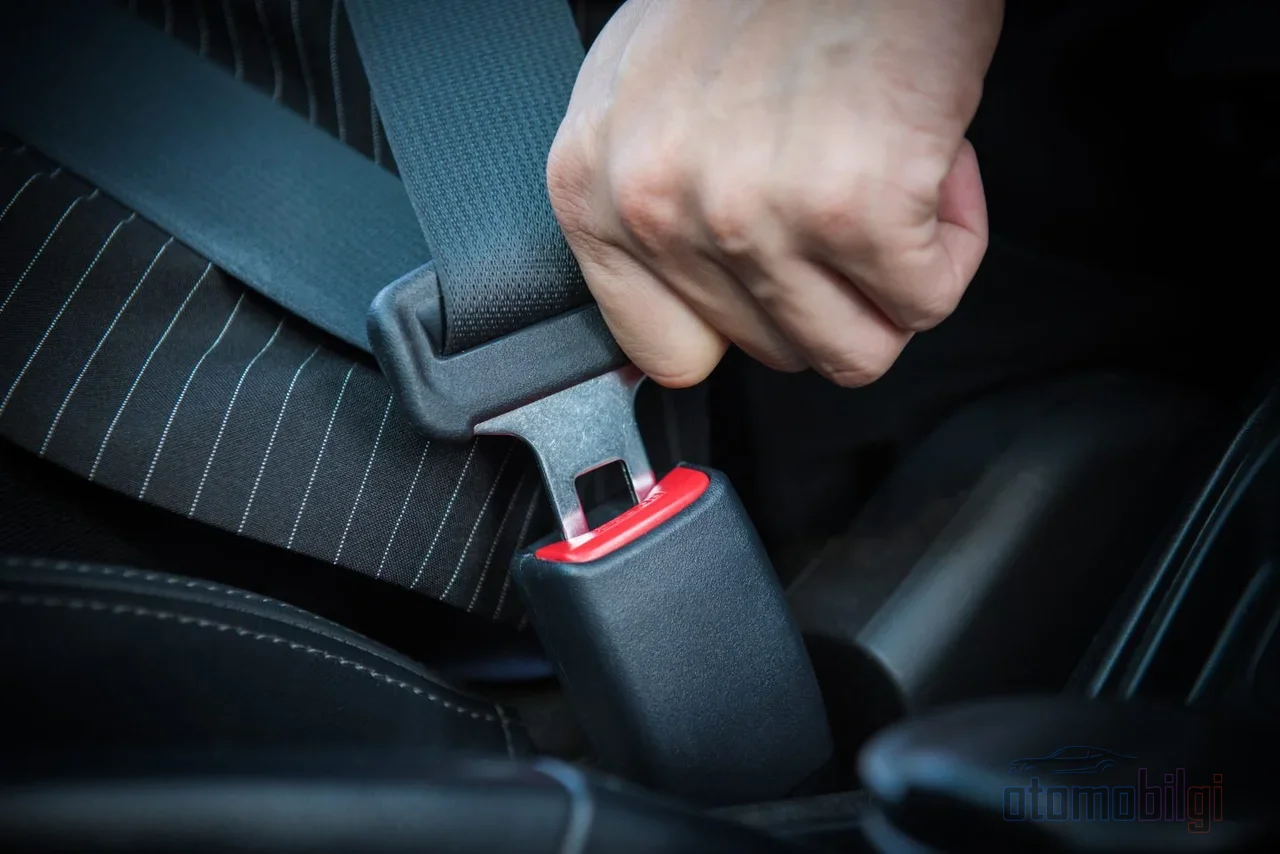
When we say seat belt, we all picture the same thing: that famous strap hanging from the retractor, clipped into the buckle - the belt that makes you buckle up. But how many of us know that what truly turns the belt into a belt is hidden inside the retractor? I thought I knew everything up to a point, but when I learned about the pretensioner, my entire view of the seat belt changed completely. Just imagine: the moment a collision happens, 20-30 centimeters of loose belt attaches to you in less than one hundredth of a second. How does this magic happen? Let's break it down step by step.
What is a pretensioner and why is it necessary?
Think of it this way: if there is a gap between the eraser at the tip of a pencil and the paper before you press it down, does the eraser still work? It works, but much worse. The same goes for the seat belt. In daily driving, the belt sits a bit loose - slack between the shoulders, a thick jacket, your seating position... it easily adds up to a 20-30 centimeter gap (called slack ). At the moment of a collision, your body freely traveling through that gap means you reach a much higher speed by the time the belt catches you. Even that small amount of slack can dramatically increase the forces acting on your body.
This is exactly where the pretensioner comes into play. A small pyrotechnic mechanism hidden inside the retractor collects the excess length of the belt the instant a collision is detected and presses you into the seat. In other words, the pretensioner actually makes the belt effective from "the moment of first contact." A small but super critical job.
How is this system working in milliseconds triggered?
Let me walk you through the process step by step, because the timing here is the most cinematic part:
- The vehicle's crash sensors detect the sudden deceleration and send this information to the airbag control unit.
- When the signal exceeds a certain severity threshold, the control unit fires the small pyrotechnic charge in the pretensioner.
- The resulting gas pressure accelerates the steel balls or piston, which retracts the belt by up to 15 centimeters within milliseconds.
- All of this happens in 10-15 milliseconds; after crash detection, the systems deploy within 15-30 ms, positioning the occupant correctly before the airbag.
The surprising detail here is that the pretensioner's activation threshold is lower than the airbag's. In other words, the pretensioner can fire before the airbag deploys. In a fixed barrier impact at roughly 15-25 km/h, the pretensioner activates while the airbag (with its 25-50 km/h threshold) usually does not deploy. If you learn that in a moderate collision the belt held you in the seat but the airbag did not inflate, don't panic; it means the system worked exactly as it should.
Pretensioner types: rotary, buckle and electronic
They don't all do the same job; there are three different approaches. Rotary pretensioner, rotates the reel gear inside the B-pillar using steel balls to wind up the belt; this is the most common type. Buckle-type pretensioner works under the seat: a piston pulls the buckle downward, tensioning the belt from below. The third type is a bit more different - electronic pretensioner (for example Mercedes' PRE-SAFE system) can use an electric motor to tighten the belt before a threat and loosen it if no collision occurs. In other words, it's reversible. In contrast, a pyrotechnic pretensioner is single-use; once fired, its job is done.
What the belt does after tightening: the role of the force limiter
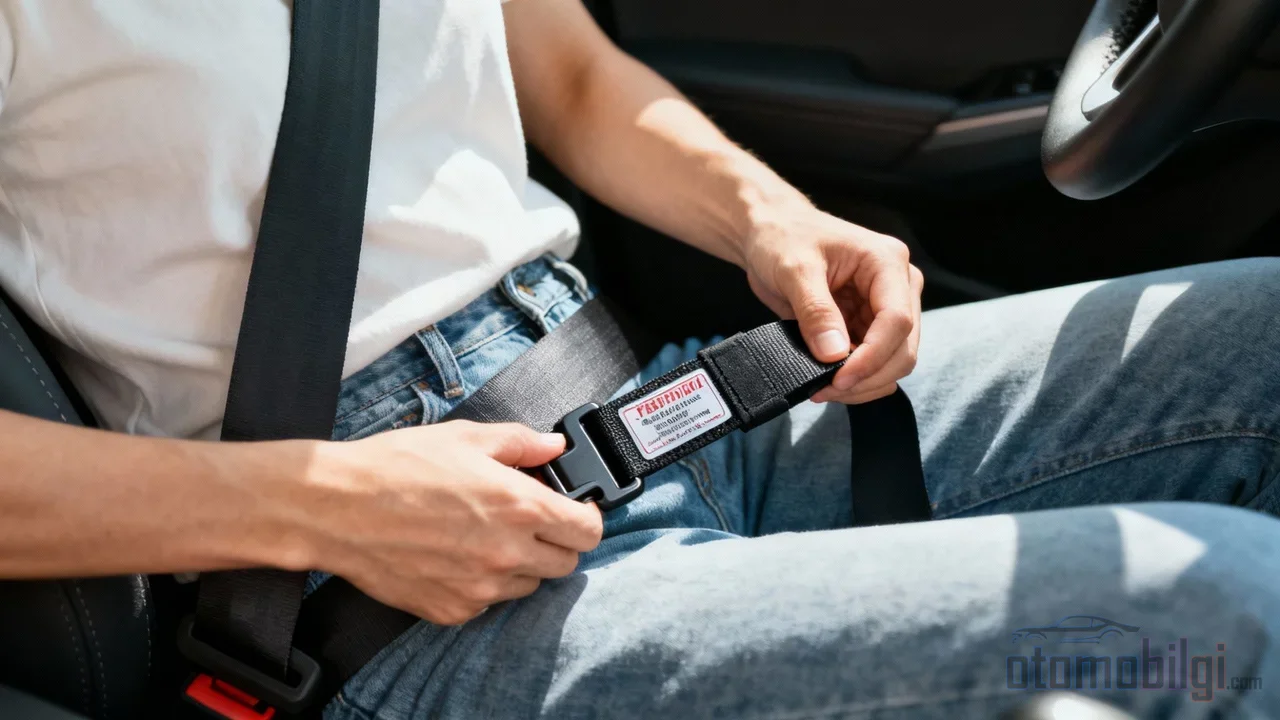
Now there's a part that works in reverse; when I first read it, I said "wait, does this make sense?" The pretensioner holds you tightly, but the collision continues and your body's forward momentum loads the belt. Yet if you apply infinite force to the rib cage, the belt, while trying to protect you, could itself cause injury. So what's the solution? Give the belt a bit of give!
This is where the load limiter comes in. When the force on the shoulder belt exceeds a predetermined level, the reel feeds out a little more belt in a controlled manner. But this is not a fault or a loss of protection; on the contrary, it works like a shock absorber. It softens your forward momentum, distributing the energy over time and distance. In the pretensioner phase, a force of about 2 kN (approximately 200 kg) is applied at the shoulder, while after the limiter, it tries to keep the load on the chest in the range of 4-6 kN .
So the two components have opposite yet complementary tasks: one tightens, the other loosens in a controlled way. They work in sequence on the same belt. While the pretensioner takes up the slack in the very early phase of the collision, the limiter kicks in later, when the passenger begins to load the belt. You can think of it as reducing the impact delivered to the body rather than the head; if you take a punch, a pushing hand causes far less harm. Increasing the duration and spreading the force is always better.
Why should the load on the rib cage be limited?
In frontal (head-on collision) accidents, chest loading caused by the shoulder belt increases the risk of serious chest (thoracic) injury more than other parts of the body. The force the belt applies to the chest creates a risk of rib bending (deflection) and fracture; it has been shown that injury risk is determined primarily by the peak load of the belt. For this reason, engineers try to keep chest deflection within a certain millimeter limit - for example, it has been proposed that an approach limiting deflection to 34 mm would reduce serious chest injury among belted occupants in frontal crashes by 16-24%.
The balance here is actually very human: it must both hold you and not crush you. That's why the load limiter is not a luxury, but part of the protection. The limiter is also thought to help control the rebound of the body and head; in other words, after catching you forward, it shakes you less.
Does this technology really work?
Now let's get to the real question. A comprehensive analysis by NHTSA (the road safety agency of the U.S. Department of Transportation) examining crashes between 1986-2011 showed that the risk of death for belted drivers and front passengers in the car, CUV and minivan class with pretensioners and force limiters was 12.8% lower In other words, not only buckling up but also riding in vehicles equipped with this technology adds roughly an extra 5-7 points to belt effectiveness. Since this figure is wide in terms of confidence interval, the effectiveness has not yet been measured very precisely; a significant effect has not yet been demonstrated in heavy pickup truck-based vehicles (pick-ups, body-frame SUVs, full-size vans).
Improvements have also been observed in the head injury criterion (HIC) and chest acceleration: the combination of pretensioner and limiter is estimated to reduce chest acceleration by an average of 6.6 g and lower the HIC by 232 points. Crash testing organizations such as Euro NCAP also include features like the belt load limiter in their evaluations. In short, this is not a marketing gimmick; it is a measurable engineering gain that test protocols also follow.
Let's take a brief tour of history: pretensioners first appeared in some cars in 1981, while force limiters entered the scene in 1995. Industry-wide adoption began around 1998, and by the 2008 model year it had become standard in the driver and front passenger seats of all new vehicles in the US. NHTSA never mandated these technologies, but it encouraged manufacturers by continuing to list them in brochures.
Frequently asked questions: what happens after it fires?
In this section, let me gather a few practical questions people wonder about, because they are all genuinely useful things to know:
- Does it work on an empty seat? No. The pretensioner does not fire unless the conditions of an occupied seat and a fastened seat belt are met.
- Can it be used after it has fired? The pyrotechnic pretensioner is single-use and must be completely replaced. The belt can be fastened manually, but the retraction function is no longer there; additionally, the airbag warning light stays on continuously and crash data is recorded to the control unit.
- Does it activate in a side impact? It depends on the severity and the model. The control unit itself decides which components will fire based on sensor data.
- Is it a part that wears out over time? No. It does not have a limited lifespan; it only needs to be replaced after activation.
- Does the tensioner cause harm? When used correctly, a force of approximately 2 kN usually remains at the level of bruising or minor abrasions; such serious side effects are rare.
Are electronic and pyrotechnic tensioners used together?
Yes, in modern vehicles the two are usually found together. The electronic tensioner works like a preventive layer: when the system anticipates a threat, it pulls the belt with an electric motor, and if the danger passes, it loosens it back. But if an actual collision occurs, this reversible system is not enough; at that point, the pyrotechnic tensioner's single-shot, much more powerful compression kicks in. So you can think of one as the warning and preparation, and the other as the final rescue move.
Looking at this whole picture, we have to admit that the seat belt is a far smarter system than we think. It is not just a strap; it is a defense line consisting of sensors, a control unit, a pyrotechnic propellant, and a mechanical energy manager, working in a planned way from the first milliseconds to the last moment. Next time you buckle up, don't forget to say "thank you" to the reel - that little box may be managing the most critical fifteen milliseconds of your life without you noticing.
Sources
- Effectiveness of Pretensioners And Load Limiters for Enhancing Fatality Reduction by Seat Belts (NHTSA DOT HS 811 835)
- NCAP Test Improvements with Pretensioners and Load Limiters (NHTSA 809562)
- When Does Seat Belt Pretensioner Activate?
- What is the purpose of a seatbelt pretensioner?
- Load Limiters – How Seat Belts Work
- US20060017276A1 – Seat belt pretensioner
- Euro NCAP Glossary