Pop-up Hood and Pedestrian Airbag: Preparing the Body Before the Collision
Share This Page
Pop-up hoods and pedestrian airbags are exterior body safety technologies that activate just before a vehicle hits a pedestrian, raising the hood by approximately 100 mm and covering the hard windshield area with an airbag. The goal is not to protect the head completely, but to soften the severity of the impact within milliseconds. On this page, I will explain the engineering chain of these systems, from sensors to actuators, without any marketing language.
Highlights
- The pop-up hood raises the rear section approximately 100 mm upward before the head touches the hood.
- Honda announced its system in 2004 and brought it to series production in 2008; Nissan, meanwhile, announced its system on August 2, 2007.
- In an example simulation, the pedestrian was detected at second 2.3 , and automatic braking engaged at second 2.4
- . In a comparative test, injury rates decreased by 82.2% and 95.4%
- respectively in vehicles with pop-up hoods and pedestrian airbags. Pedestrian safety can affect up to 20%
of the Euro NCAP star rating. Imagine this: a car is heading toward a pedestrian, and a collision is almost inevitable. What does the vehicle do at that moment? It brakes, yes - but the more interesting part is that its body also enters a state of preparation measured in thousandths of a second. The hood rises, the airbag deploys, and the bumper changes its behavior. In other words, safety begins not after the collision starts, but before it. I love this idea of "pre-collision body preparation," because most safety articles focus on the passenger inside and forget the person outside. Now let's unravel that chain, link by link.
Why does pedestrian safety begin before the collision?
Let's first put the harsh reality on the table: in pedestrian-vehicle collisions, the most life-threatening injury is often the head striking the hood or windshield. The source of the problem lies here: the engine is a huge, solid mass sitting directly beneath the hood. If the gap between the hood sheet metal is small, the head hits not the soft sheet metal but the engine block directly. This difference becomes incredibly evident in the measurement called the Head Injury Criterion.
There are two engineering approaches from here. The first is passive: designing the underside of the hood and the bumper to absorb impact in the first place. The second is active: detecting the collision in advance and preparing the body for that moment. This page mainly covers the second approach, but you will see that the two are actually two sides of the same coin - the active system ultimately hands the job over to the impact-absorbing structure.
How the pop-up hood works: milliseconds from sensor to actuator
The heart of the system is a decision chain. When the pressure sensor or speed sensors in the front bumper detect a collision, the information goes to the pop-up control unit. The control unit answers the question, "Is there really a pedestrian collision right now, do I need to raise the hood?" and if the answer is yes, it triggers an actuator. Before the pedestrian's head touches the hood, the rear edge of the hood rises approximately 100 mm - that is, ten centimeters - upward. By the way, it's nice to know that the actuator is mostly pyrotechnic, meaning it works with a small explosive charge: a member of the same family as the seatbelt pretensioner. What else would launch the rocket, after all?
Let me make an analogy from everyday life: think of a phone falling onto a table. On a hard surface the screen shatters; if it falls on a thin duvet, it survives. The pop-up hood does exactly this - by raising the hood and creating a gap in the engine bay, the hood crumples more easily when a head hits it, and the impact duration is extended. When the same energy is applied over a longer time, the peak force drops. If you remember the topic of elasticity and impact duration from physics class, this is exactly that.
Why is there a 25 km/h threshold?
According to Honda's system, activation kicks in at approximately 25 km/h and above speeds. The logic is simple: at very low speeds a collision does not already pose a serious head risk, and every deployment results in an expensive, single-use outcome. But let's be honest about this too: according to Honda, the system may not work in every situation depending on the position and angle of the collision. No safety system is 100% guaranteed - that's the rule.
An elegant solution to the low hood problem
If you ask whether the designers or the engineers won: if the bumper is low, meaning there is very little space between the hood and engine components, providing head protection passively is difficult. A high hood, on the other hand, can restrict the driver's view and increase the likelihood of a collision. The active hood enters the scene here like a superhero: it preserves a sleek, low design while making it possible to reduce head injury. Nissan's 2007 statement was exactly this - combining sporty design with pedestrian head protection in the same hood.
Pedestrian airbag: covering the hard windshield with a cushion
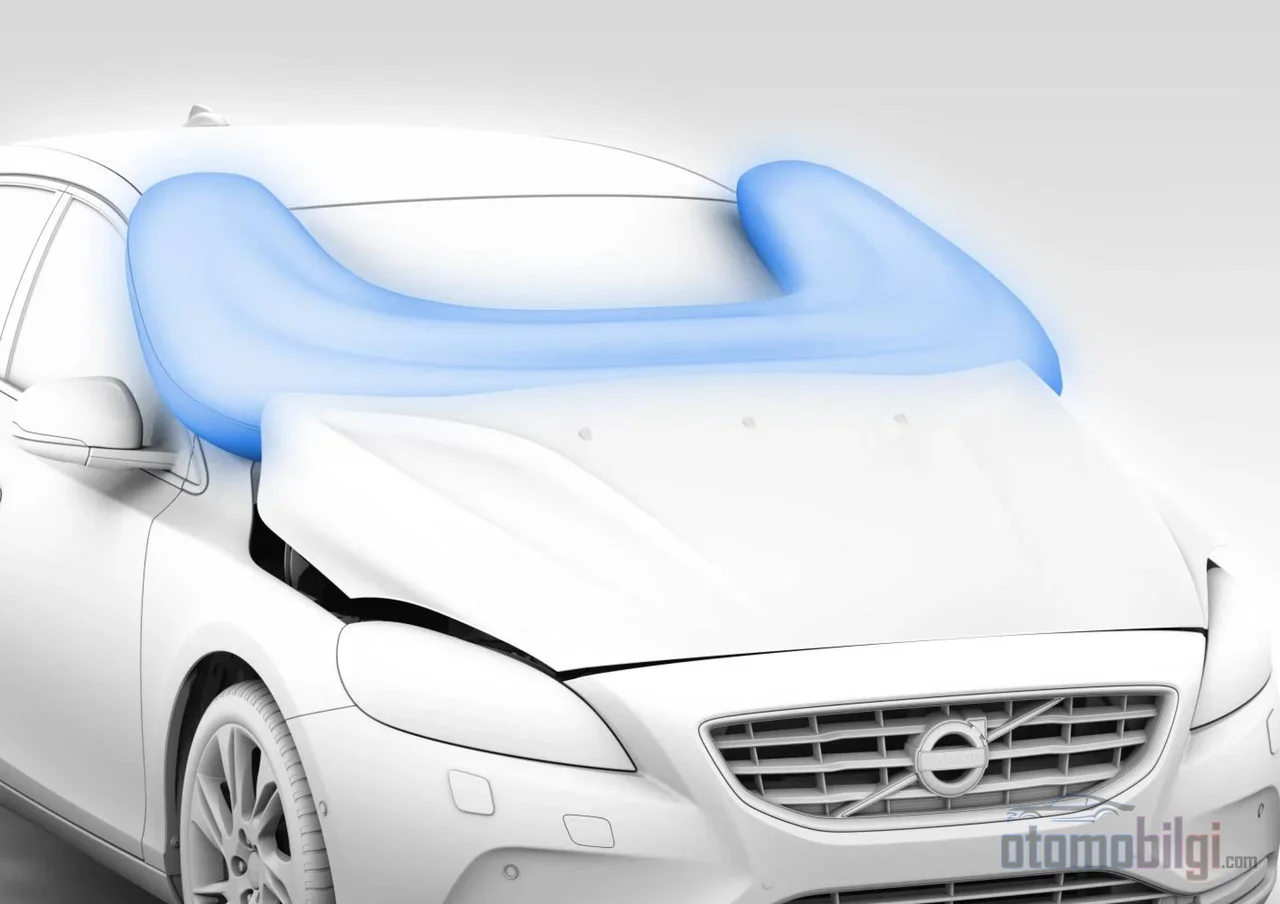
Even if the hood rises, the danger does not end, because the pedestrian's head usually slides off the hood toward the windshield and the A-pillar. This is where the pedestrian airbag enters the scene: when a collision is detected, an external cushion deploys from beneath the hood and covers the hard windshield and A-pillar areas. Where it will deploy is known, because the head trajectory is quite predictable in collision kinematics - that's why the cushion deploys not "into empty space" but at the exact target point.
The most well-known production example is Volvo's pedestrian airbag technology. It first went into series production in the V40 model and brings several components together in one package: when a collision is detected, the hood is raised, the airbag increases the distance to the underlying structure along with the rising hood, and with the head acceleration the HIC value drops significantly. In other words, hood lifting and the airbag work as a single system here - the cushion is not on its own, but hand in hand with the rising hood.
Like interior airbags, the pedestrian cushion deploys via a pyrotechnic process and is single-use. This is a common feature of "right decision if right once" systems: as with the interior airbag, the system is designed with the logic of the seatbelt's supplementary restraint, and once it fires, there is no going back. That's why the control unit saying "maybe" is an unattainable luxury - the decision must be certain at the moment of decision.
Comparison: pop-up hood or pedestrian airbag?
When we put the two systems side by side, let's look at what they do - because they don't do the same job; they are different links in the chain:
| Feature | Pop-up Hood | Pedestrian Airbag |
|---|---|---|
| Target zone | Gap between hood and engine | Windshield and A-pillar |
| Actuation mechanism | Raising the hood by ~100 mm to create crush space | Covering the hard surface with an airbag |
| Trigger | Bumper sensors + control unit, pyrotechnic actuator | Collision detection, pyrotechnic deployment |
| Example effectiveness | 82.2% reduction in injury rates | 95.4% reduction in injury rates |
| First production example | 2008, Honda | Volvo V40 |
Read the percentages in the table with caution: that data comes from a single article, and it is not entirely clear from the text whether the 95.4% figure refers to the airbag alone or in combination with the raised hood. Still, there is strong support that both systems significantly reduce injury rates - vehicles with pop-up hoods received on average better pedestrian protection scores than equivalents without the rising hood. On the other hand, there are those who believe the performance of combined systems is still inadequate. In areas like safety, the word "adequate" is always a temporary state.
The early links of the chain: sensor fusion and AEB
The pop-up hood and pedestrian airbag are the last links of the chain; but the chain starts much earlier. Pedestrian detection systems generally use a combination of a radar integrated into the grille and a camera placed in front of the interior rearview mirror. In examples like Mercedes' Pre-Safe + system with pedestrian detection, a stereo camera + radar duo detects the pedestrian ahead. Why two sensors? Because the camera "sees" while the radar "measures" - one tells the shape, the other tells distance and speed. This cooperation is called sensor fusion, and it is essential for reducing false positives, meaning errors of mistaking road signs or shadows for pedestrians.
Let's make the timing concrete. In an automatic emergency braking (AEB) simulation, events unfold as follows: the sensors detect the child pedestrian for the first time at the 2.3rd second, the warning is activated immediately after, and at the 2.4th second automatic braking is applied. Look at what happens in the tenth of a second you are talking about - this is why engineers live in milliseconds. Predictive AEB systems continuously evaluate the pedestrian's trajectory, vehicle speed, distance, and road conditions to estimate the probability of a collision; if braking is sufficient, the collision never happens; if it is insufficient, the pop-up hood and airbag are activated.
Where does the limit of detection begin?
Sensors are not magic wands. They are assumed to be effective while within their functional range; outside the range - depending on darkness, speed, distance, and viewing angle - their effectiveness drops. Manufacturers acknowledge this too: pedestrian detection emergency braking does not work in every condition and does not replace safe driving. In other words, active body systems can only be prepared at the right moment if the detection chain ahead of them works correctly. The weakest link of the chain is almost at the very beginning, not at the end.
The silent side of the body: impact-absorbing bumper and under-hood space

Active systems get all the headlines, but the job of actually absorbing the impact falls to the body's passive architecture. At the front end, the first area to contact the leg, energy-absorbing structures have become standard. The common material is EPP, expanded polypropylene foam - think of it as a lightweight sponge that sits inside the bumper and converts energy into heat as it crushes. As an alternative, polymer injection-molded absorbers made up of equally spaced lobes that absorb energy by crushing have also been patented; there are even X-shaped designs with modified deformation modes that meet both pedestrian safety and low-speed collision requirements at the same time. What's interesting is this: even when you replace the bumper with a simple cover and void, sufficient stiffness to stop the leg can be achieved.
On the leg side, tests are done with a flexible leg impactor called Flex-PLI - meaning a prosthesis that bends like a human leg is swung into the structure and how well it absorbs the impact energy is measured. On the hood side, the classic problem was this: in the vast majority of vehicles sold in the US, the hood carries support brackets that collapse under an impact from above - that is, deliberately weakening the brackets instead of increasing the underhood clearance. The active hood, rather than establishing this clearance permanently, creates it at the moment of need - in my view one of the finest examples of design intelligence.
What is changing on the testing and regulation side?
Pedestrian protection is now a serious item on the scoreboard: in Euro NCAP assessments, pedestrian safety performance can account for up to 20% of the vehicle's total star rating. And the field is moving. In September 2024, NHTSA proposed test procedures reproducing head-hood contact based on the global technical regulation GTR No. 9; in November 2024, it decided to adopt Euro NCAP test devices and procedures for bump-protected pedestrian protection, with some differences. On the Euro NCAP side, protocol changes - the biggest revision since 2009 - will take effect in 2026.
Let's add this too, because balance is needed: the criticisms of the test setup are not nonexistent. There is discussion that the setup, in which the free-motion head form strikes the hood at a fixed angle, may not fully reflect real-world conditions. There is also talk of unintentional triggering cases for the systems - in a single-use system, the hood rising on its own has serious practical consequences. These are not problems that block the technology, but part of its maturation process.
Frequently asked questions: even if the hood rises, won't my head hit it?
It will, most likely. The system's purpose is not to prevent the head from touching the hood; even if it touches, it aims to prevent it from hitting hard parts like the engine beneath the hood. With the hood raised, the head strikes a softened surface and part of the impact energy is absorbed by the hood collapsing. The difference can be between life and death - which is a striking enough sentence for me.
The second common question is how much the hood rises: about 10 cm. The third is whether the system always works: no - depending on the location and angle of the collision and the vehicle's speed, it may not activate. This may be the most important sentence you take away from this page: active body systems are not an insurance policy wrapped around the steering wheel, but a last line of defense that reduces the cost of a collision.
Closing: the safety chain - no single link is enough on its own
When I think to myself, what affects me most is this: none of these systems are playing the hero, each adds a small contribution in turn. Sensor fusion detects the pedestrian, AEB brakes, the hood rises for the remaining energy, if the head trajectory slides toward the windshield the airbag deploys, and at the moment of contact the bumper foam and under-hood clearance absorb the energy. It is not a single technology protecting the chain, but the chain itself. And saying chain means that when one link breaks, the whole weakens. When buying your next car, I say take a look not just under the hood but at the hood itself - the engineering there sometimes saves as many lives as what's inside.
Sources
- Pop-up Hood System | Honda Technology
- Pop Up Engine Hood For Pedestrian Protection | Nissan
- Nissan reveals new 'Pop-up Engine Hood' safety technology
- Pedestrian Airbag Technology - A Production Reality (Volvo/ESV 2013)
- Active Hood - Tesla Model 3 Owner's Manual
- Airbags - IIHS
- Vehicle Air Bags and Injury Prevention - NHTSA
- Development of the Pop-up Engine Hood (Inomata et al., ESV)
- Pop-Up Hood Pedestrian Protection (Ames, 2015, TRID)
- FMVSS No. 228 Pedestrian Head Protection - Federal Register
- NCAP Final Decision Notice: Pedestrian Protection - NHTSA
- Euro NCAP announces 2026 protocol changes
- Current Trends in Bumper Design for Pedestrian Impact (Schuster, 2006)
- Design of a Conceptual Bumper Energy Absorber (Mo et al., 2018)
- US20120061978 - Energy absorber with lobes patent
- Improving Pedestrian Safety Through Vehicle Design - Edmunds
- AEB with Sensor Fusion - MathWorks
- Exploring the Promise and Limits of Pedestrian Detection (Combs et al., 2019)
- Pre-Collision Assist with AEB - Ford
- Effectiveness of Active Hood and Pedestrian Protection Airbag (KoreaScience, 2014)
- What is the safety effect of a pedestrian-friendly car front? - SWOV