How Do Night Vision Systems Read the Road by Seeing Heat?
Share This Page
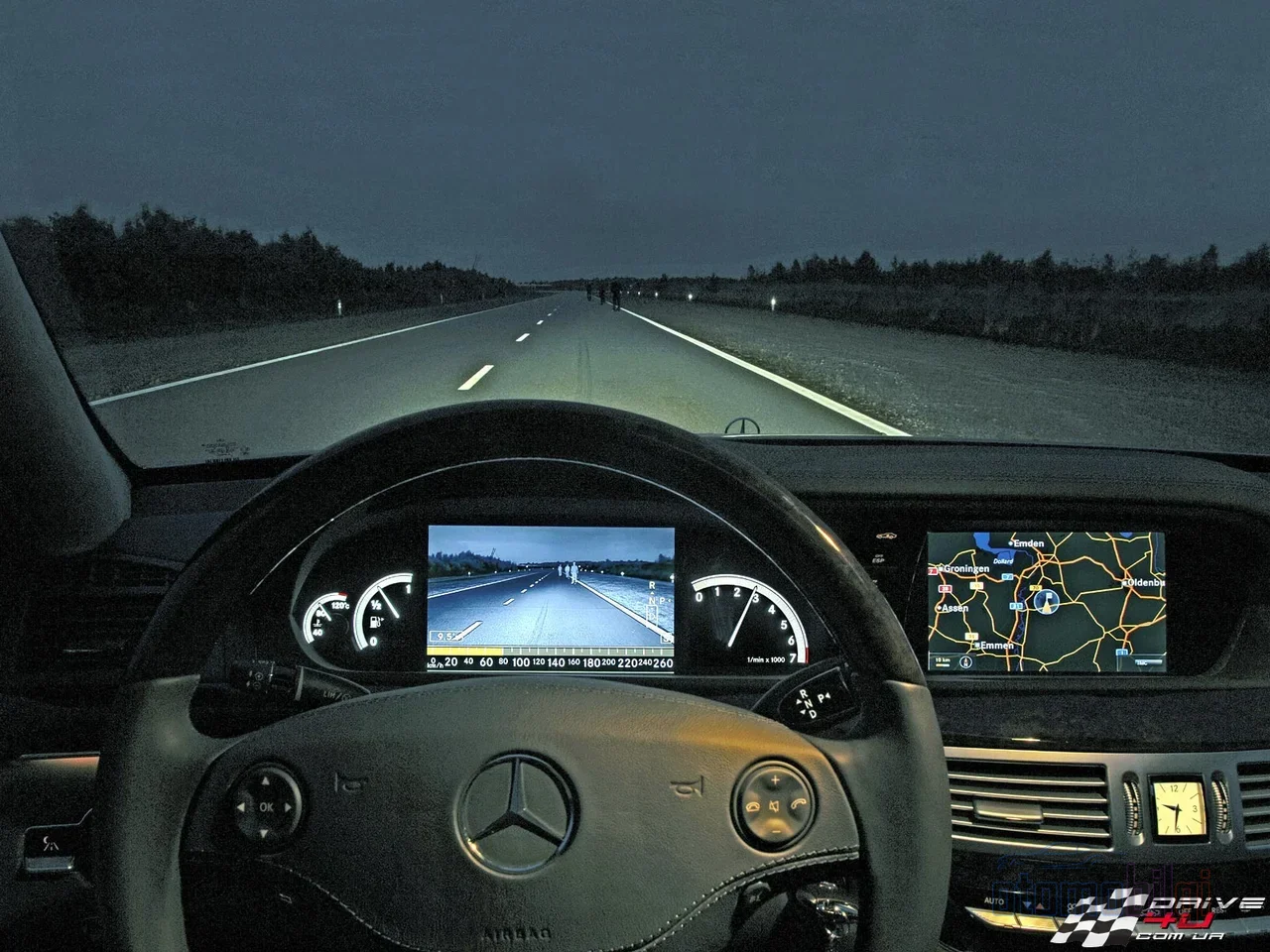
Night vision systems detect pedestrians and animals beyond the reach of your headlight beam in two different ways: thermal (LWIR) cameras read the heat that objects emit themselves, while active infrared (NIR) systems convert the reflection from an invisible infrared projector into an image. Both perform pedestrian, animal and vehicle classification through software, warning the driver beyond headlight range. So how exactly do these systems work? Let's take a look step by step - because a cow emerging from behind a hill on the road at night may owe far more to this camera's friendliness than to your headlights!
Highlights
- Thermal cameras 8–14 µm (LWIR) band and require no light source even in complete darkness.
- Automotive thermal cameras can detect heat signatures 300 m away, well beyond headlight range.
- The illumination range of NIR systems is typically limited to 100–150 m .
- According to IIHS data, pedestrian AEB reduces daytime collision risk by 32–33% ; in darkness, its effect could not be measured.
- Euro NCAP's 2026 protocol puts nighttime vulnerable road user scenarios in the spotlight.
How Is Heat Converted Into an Image? The Principle of Thermal Cameras
Thermal imaging is a completely passive technology: it sends no light into the environment, it only senses. Every object above absolute zero emits infrared energy due to its temperature. A human body, a building, or a car that has just parked - all radiate their own heat into the surroundings as invisible radiation. The thermal camera captures this radiation and converts temperature differences into shades of gray (or colors in some displays) to produce an image. To make an analogy: a normal camera's eye sees reflected light, while a thermal camera's eye reads the heat radiating from every object's body. That's precisely why it works even in total darkness - it doesn't need light because it doesn't measure light!
A small but impressive detail: modern thermal cameras can distinguish temperature differences as small as 0.01 °C . So a person wrapped in a dark jacket practically glows against the backdrop of cold asphalt. Visual camouflage cannot fool a thermal camera; no matter the clothing, the human body's heat stands out against a cool surface.
The LWIR band and microbolometer sensors
Before diving into the technical detail, let's say this: not all infrared is the same. Objects at terrestrial temperatures - humans, animals, machines - produce their peak heat emission, where heat radiation is strongest, in the 8–14 µm LWIR (long-wave infrared) band. Much hotter sources such as engine blocks and exhausts glow in the MWIR (3–5 µm) band. This is exactly why automotive thermal cameras choose LWIR: the heat signature of humans and animals lies precisely in this band.
LWIR systems typically use uncooled microbolometer sensors (VOx or a-Si materials). These are tiny detectors that are extremely sensitive, changing their resistance with small heat variations. Being uncooled means the system consumes low power, is compact, and can be produced at a reasonable price - all three requirements for automotive use at once. The more sensitive MWIR detectors, on the other hand, require expensive Stirling cooling; which is why they are not a practical solution for cars. Conclusion: LWIR is the sweet spot for automobiles in terms of both cost and size.
Active NIR Night Vision: How Does the Invisible Lantern Work?
While a thermal camera reads heat, NIR (near infrared) systems work with a much more familiar logic: send light, collect what is reflected. The vehicle sprays near infrared light, which the human eye cannot see, onto the road with a special projector; the camera detects this reflection and produces a black-and-white, highly detailed image. In short, the system carries its own special, invisible lantern. You can think of it as a big brother lighting your way in the dark - but the lantern's light is invisible to our eyes.
The strength of this method is visual detail: details such as signs, license plates, and vehicle surfaces can be read in the NIR image. Its weakness, however, is range. Since it depends on the illumination power, the typical automotive range of NIR 100-150 m remains around; in good conditions, person detection can drop to about 50-100 m. Moreover, oncoming headlights can temporarily disrupt the image, and fog or dust scatters the projector light, blurring the image. There is also a privacy aspect: NIR radiation can be detected by other devices sensitive to infrared.
Thermal or NIR? Range and Detail Comparison
Now let's put the two technologies side by side. The question of which is "better" is actually the wrong question; the right question is "for what?". If detecting pedestrians and animals at a distance is the priority, thermal is ahead; if visual detail matters, NIR has the advantage. On the factory side, BMW and Mercedes-Benz have used thermal-based systems; some manufacturers have preferred NIR-based solutions.
| Feature | Thermal (LWIR) | Active NIR | |
|---|---|---|---|
| Operating principle | Passive: the object's own heat emission | Active: reflection of projector light | |
| Typical range | Up to 200-300 m for pedestrian/animal/vehicle | Illumination 100-150 m, person detection ~50-100 m | |
| Complete darkness | Works without issue | Works (carries its own light) | |
| Oncoming headlight effect | Not affected | Can temporarily disrupt the image | |
| Visual detail | No color, license plates/signs unreadable | High detail, signs readable | |
| Fog performance | Better in light fog, weakens in dense fog | Projector light scatters in fog |
A note about range figures: it is normal to hear different numbers in different contexts. In manufacturer promotions, a detection range of 200-300 m stands out for automotive thermal cameras; in general thermal data aimed at the defense sector, persons 500 m+, vehicles 1000 m+ detectable from that distance. For a camera fitted to a car, the cautious, realistic figures for the automobile are the values in the first group. So when you do the accounting of the "kilometers of vision" claim you hear in advertising, it helps to ask about the context.
The Software Side: How Does It Turn the Camera Image into Pedestrians and Animals?
The camera shows a raw heat map; it is the software that turns this into the information "there is a pedestrian in that shadow ahead." In modern ADAS systems, convolutional neural networks (CNN) do this job: by analyzing the thermal video stream frame by frame, they detect large animals, pedestrians, and vehicles just as in conventional images. Among classical computer vision algorithms, Haar cascades and HOG (Histogram of Oriented Gradients) methods stand out; machine learning based systems go beyond detection and track the target, trying to predict its direction and even its intent. In other words, the system doesn't just say "there is something there"; it can say "that something may be about to enter the road."
For pedestrian-vehicle detection in infrared images, fast salience-based algorithms using multi-feature fusion and support vector machines (SVM) have also been proposed. For embedded platforms, thermal IR + deep learning architectures designed jointly in hardware and software are coming to the fore; in one university project, an AI-based detection and avoidance system was developed in which the IR camera works together with the RGB camera for nighttime pedestrian detection. The warning logic is simple and clever: the software classifies the target, calculates its distance and closing speed, and if the danger grows it first gives a visual/audible warning, going as far as brake intervention if the system is integrated with AEB. What I'm curious about is this: is this warning fast enough to reach us in time? Usually it is - but that is precisely why range is so critical.
What Does Headlight Range See, What Does the Camera See? The Difference in Stopping Distance
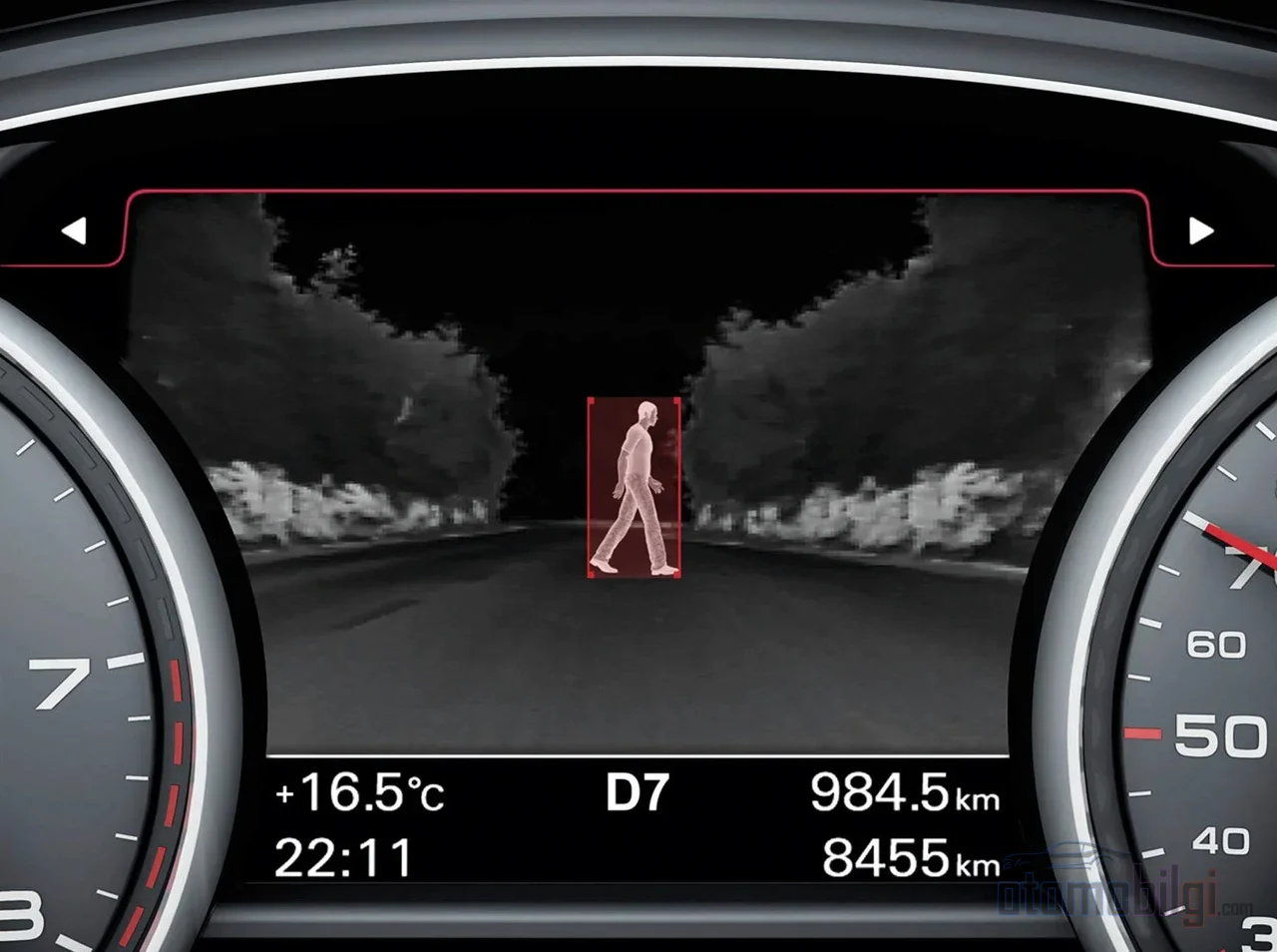
There is a rough equation for night driving: stopping distance = reaction distance + braking distance. Since headlights carry light only a certain distance, every object seen beyond that distance eats into your reaction time. This is where the thermal camera comes in: automotive thermal systems can detect heat signatures at a 300 m distance, far beyond headlight range. A deer seen seconds earlier is exactly the extra distance you need to start braking. Seeing early is more valuable than braking - because no brake can stop a driver who cannot see.
That is why IIHS has demanded that pedestrian AEB operating in darkness be made mandatory. Night tests have revealed serious gaps in current sensor packages; long-range, all-weather radars are among the solutions aiming to close this gap.
Fog, Rain and Other Limitations: Reality, Not Marketing
Claims like "thermal cameras see through fog and work perfectly in rain" circulate widely online. The technical reality is more nuanced. According to FLIR's own statement, fog and rain can seriously limit the range of a thermal system because water droplets scatter the infrared signal. Dense fog and heavy rain weaken the signal reaching the camera; a peer-reviewed study has defined "heavily degraded fog" conditions in which the thermal camera becomes unreliable. In other words, thermal imaging doesn't win the fight against fog - it only reduces the loss.
On the other hand, light to moderate rain does not significantly affect thermal detection, because raindrops do not scatter infrared radiation the way they scatter visible light. In light fog, thermal outperforms NIR, whose projector light scatters; in very dense fog, both technologies degrade. Let's also clear up a common myth: a thermal camera cannot see through walls or any body; it only detects heat radiating from a surface and does not pass through solid objects. And if you want to read license plates, thermal imaging won't help you - text and color don't appear in a heat image. Additionally, the "night vision" label sometimes causes confusion: NIR-illuminated systems and true thermal imaging are not the same thing; it's worth checking which technology it is on the purchase page.
AEB Integration and the 2026 Table in Night Safety
The camera's output doesn't end at an indicator display; the real value emerges when it communicates with the braking system. The table here is interesting: pedestrian AEB reduces the risk of pedestrian collision in daylight conditions by 32-33% but the risk reduction in darkness could not be measured. NHTSA has also cited night pedestrian detection as one of the most challenging problems for AEB and has taken steps toward making AEB mandatory. The optimistic side is this: according to AAA's October 2025 study, night pedestrian detection systems, which prevented 0% of collisions in 2019, by 2025 were preventing 60% of them. So great progress has been made in a short time - but the goal has not been fully reached.
2026 is a landmark year in this field. Euro NCAP is implementing its biggest protocol revision since 2009 in 2026: with the new "Four Stages of Safety" structure, nighttime vulnerable road user (VRU) scenarios take center stage, and the 2026-2028 test scenarios include nighttime conditions alongside daytime ones. The expanded evaluation of driver monitoring systems is also included in the update. This development lifts night vision and thermal camera technologies from being marginal features to the center of the agenda for star ratings. On the thermal camera side, products introduced as the first ASIL-B certified automotive LWIR cameras are also an example of this momentum.
In summary: The Eye That Reads Heat Wakes You Up Early
Let's wrap it up briefly: a thermal (LWIR) camera reads the natural heat radiation of objects without needing any light at all, and looks not at hundreds of meters but 200-300 meters; a NIR system, on the other hand, carries its own invisible flashlight and offers a more detailed black-and-white image at shorter distances. What makes both valuable is not the raw image, but the software behind it: CNN and similar models classify pedestrians, animals, and vehicles, buying the driver - and AEB, if integrated - critical seconds. Knowing the limits is just as important: dense fog and heavy rain challenge every sensor, and thermal imaging cannot read license plates. If you want a slightly wider field of view on night roads, the answer lies in heat and in the software that reads it. If it were up to you, which system would you want in your vehicle - range or detail?
Sources
- Are Infrared Imaging and Night Vision the Same?
- How Do Thermal Cameras Work?
- Can Thermal Imaging See Through Fog and Rain?
- The Differences Between SWIR, MWIR, and LWIR Cameras
- Night Vision vs Thermal Imaging for Cars - Which Is Better?
- Euro NCAP announces 2026 protocol changes
- Euro NCAP 2026 Raises the Bar for Nighttime VRU
- Euro NCAP Test Scenarios 2026-2028
- AI Unlocks the Safety Potential of Thermal Night Vision Cameras
- NHTSA Wants Mandatory Automatic Emergency Braking
- IIHS: Regulators should require pedestrian AEB that works in the dark
- Nighttime Pedestrian Detection Systems Improve
- Mind the Sensor Gap: Why AEB Needs Perception Radar
- Analysis of Thermal Imaging Performance under Extreme Fog
- Can Thermal Cameras See through Fog, Rain, and Smoke?
- Pedestrian Detection with Machine Learning
- AI-based Pedestrian Detection and Avoidance at Night
- Nighttime Pedestrian and Vehicle Detection Based on a Fast Saliency and Multifeature Fusion Algorithm