What Does the Blind Spot Radar See, and What Does It Miss?
Share This Page
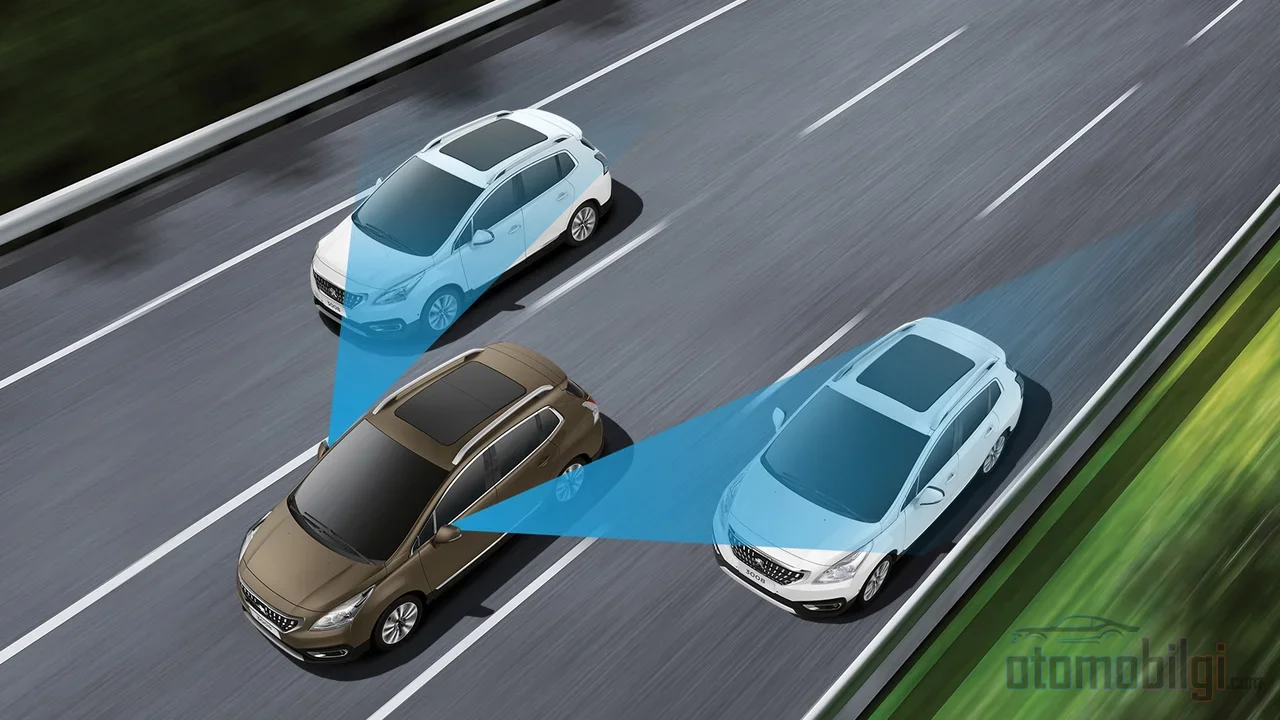
Blind spot radar is an active safety system that monitors vehicles in adjacent lanes using 77 GHz radar sensors hidden in the vehicle's rear corners, but it does not see everything: it does not always detect low radar cross-section targets such as pedestrians and cyclists, warnings may come too late for fast-approaching vehicles, and most systems stay completely silent below a certain speed threshold.
Key Highlights
- Modern blind spot radars operate in the 76-81 GHz
- band; they offer the industry scanning bandwidth of up to 4 GHz. 77 GHz radar provides roughly 20 times
- better range resolution compared to 24 GHz (~4 cm versus ~75 cm). Most systems do not activate until you exceed about 32-56 km/h.
- Warnings for fast-approaching vehicles often come too late.
- Pedestrians, cyclists, and pets are not recognized by every blind spot system.
Where Is the Radar Sensor Hidden and What Does It Do?
When most people see the small icon on the mirror, they look for the system's brain there. But the real players are hidden behind the vehicle's rear bumper, near the corners. We call these "corner radars"; functions such as blind spot detection (BSD), lane change assist, and rear cross-traffic alert (RCTA) all draw on these very same sensors. These short-range radars typically operate at a range of 20-50 m with a wide beam spreading across 30-60 degrees.
The system does not read the rotating echo like a "ping-pong" ball. FMCW, or frequency-modulated continuous wave radar, sends a "chirp" with a continuously rising frequency and continuously measures the difference between the returning signal and the one sent. This difference carries the target's distance, speed (via the Doppler effect), and angle. Much like a film frame, a point cloud renewed dozens of times per second is obtained. To measure the angle, the sensor contains multiple receiver antennas spatially separated within it.
And there is a practical beauty: since the wavelength of 77 GHz is one third that of 24 GHz, an antenna delivering the same performance can be made about 3 times smaller in each dimension and 9 times smaller in area. The result is a compact sensor hiding behind the bumper completely unseen. The fact that single-chip radar sensors cost in the 5-15 dollar range at high volume is also why the system now appears in almost every vehicle class.
Why Did 77 GHz Beat 24 GHz?
The technical summary of the story is this: the radar's ability to distinguish two nearby objects, that is, range resolution, is inversely proportional to the scanning bandwidth - not to the carrier frequency. While the 24 GHz ISM band offers about 200-250 MHz of bandwidth, the 77-81 GHz band provides up to 4 GHz of width. Speaking with the figures from Texas Instruments: resolution at 24 GHz is ~75 cm, while at 77 GHz it is ~4 cm. That is, a twenty-fold difference.
What is the concrete meaning of this difference at the blind spot? A crude sensor may read the car in the lane and the motorcycle squeezing past beside it as a single object. A high-resolution sensor sees them as two separate points, and can even distinguish a cyclist standing next to the car. The situation is similar in speed measurement: since speed resolution is inversely proportional to RF frequency, 77 GHz provides roughly 3 times better speed accuracy. High resolution also produces a dense point cloud, and this cloud feeds machine learning-based target classification.
You may ask why the transition took so long. For a while, both bands were used side by side; but the 24 GHz UWB band was removed from automotive use in Europe and the US by regulatory decision as of January 1, 2022 . Narrowband 24 GHz is still a legitimate option; but no major Tier-1 supplier is developing new 24 GHz radar anymore. All new ADAS designs are targeting 76-81 GHz.
What the "77 GHz" Label Does Not Guarantee?
This is where a fine line between marketing and engineering begins. "77 GHz" is the name of a band; it does not say how much of those 4 GHz the sensor actually sweeps. Two products operating in the same band can have completely different ranges: some motorcycle blind spot radars operate in the 0.2-50 m range, while others can see up to 70 m. The band is a ceiling; it is not the sensor's specification. The fact that "77 GHz" appears in an advertisement does not mean the two systems have the same capability.
So when buying a car or examining an accessory radar, what you should look at is not the frequency, but the range, resolution, and the speed range in which it is active. The real difference between two products bearing the same 77 GHz label lies in these three lines.
What Does Radar See, What Does It Miss? The Physics of Target Discrimination
For radar, not every object reflects equally. The key concept here is RCS, or radar cross-section: a measure of how strongly the target reflects the radar signal back. A car's RCS is between 10-100 m² ; while a pedestrian's at 77 GHz is only 0.5-2 m². The difference is 10-50 times. A concrete example: a radar that sees a car at 200 m can only detect the same pedestrian at ~112 m. The answer to the question "is pedestrian detection possible": yes, but with challenges - low RCS and classification difficulty are always on the table.
At the same time, there is a promising picture. When the centimeter-level resolution of 77 GHz combines with Doppler information, radar can read walking rhythm and arm movement, and classify the target with machine learning at accuracy exceeding 95% . The new generation we call 4D radar measures elevation in addition to azimuth and range; that is, it can distinguish a vehicle on a bridge from one on the road. The classic question of the blind spot, "is something in the zone and is it approaching me," does not require centimeter discrimination, so narrowband 24 GHz sensors served this purpose for years - which explains why past systems still worked reasonably well.
Why Does the Warning Come Late or Never Come at All?
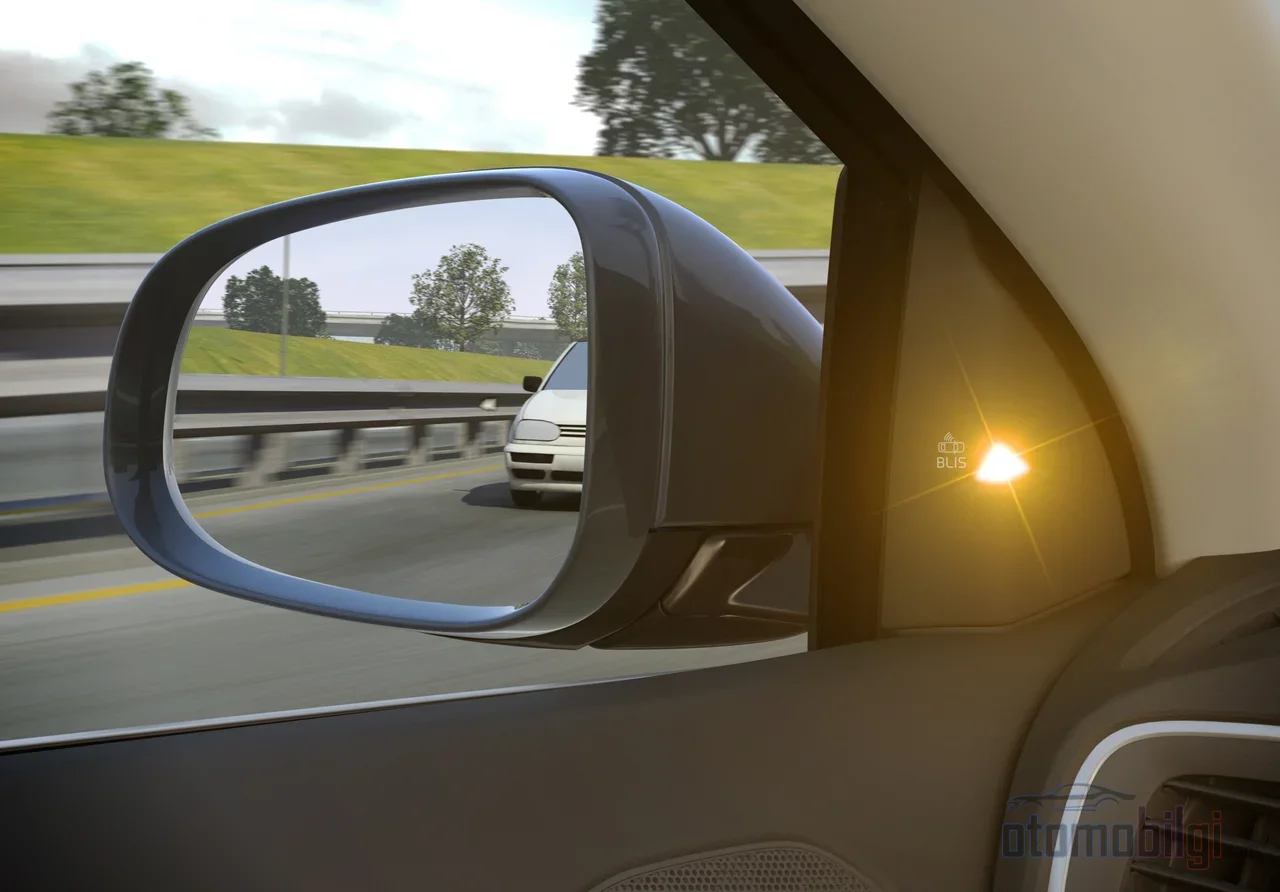
The most painful limitation of blind spot systems: fast-approaching vehicles. Independent tests show that when merging into a busy highway, systems struggle to detect vehicles coming at lightning speed from behind, and the warning usually only lights up once the vehicle is already alongside you. At that moment, whether the warning is of any use depends on you having already canceled your lane change. The radar's cutoff range is finite; a target closing at a very high relative speed physically narrows the window in which the sensor can say "approaching and dangerous."
The second limitation: the speed threshold. Most systems activate at speeds above about 32-56 km/h . The reason is reasonable - a flashing icon for every pedestrian and fixed pole in a parking lot dulls the driver to warnings. But the price is this: during low-speed urban maneuvers, your blind spot stays truly silent.
The third and least discussed limitation: what the system is watching you for. Not every blind spot monitoring system recognizes pedestrians, cyclists and pets; manufacturers openly state this. Each system's scope and conditions are different - learning what your own vehicle's system does from the user manual is just as important as trusting the technology. Even the smartest radar cannot guarantee the driver's response to the warning; the decision always rests with the person at the wheel.
Side Perceptions: Why Does the Radar Go Off for No Reason?
What the radar hates most is the laws of physics playing games with it. Meaningless warnings when reversing out of a parking spot or onto the street are a well-known complaint among users. Curb refuges, barriers and walls are reflective surfaces in the radar's eyes; the sensor says "there's something there" but that something has zero chance of running you over. Also, incorrect positioning or faulty mounting of the sensor can cause delayed warnings - sensor alignment after a bumper replacement or collision should be taken seriously.
On the RCTA side, the scope is drawn even more clearly. The rear cross-traffic alert uses the same sensors as the blind spot system but is only active in reverse and at speeds below about 8 km/h ; it is also designed for approaching vehicles traveling at 8-29 km/h . In other words, the system that monitors what's behind you while driving forward and the Cross Traffic Monitor that works when reversing out of a parking area share the same sensor but operate in different scenarios. The system may not mark everything you mark as a danger; that is not a bug, it is the software's defined area of responsibility.
Where Is the Regulation: How Do the 2026 Tests Look at the Blind Spot?
Safety star-rating systems guide the technology's development through test protocols. Euro NCAP's 2026 protocol changes move to a new structure called "Four Stages of Safety" and cover new areas such as distraction and fatigue detection. An interesting detail regarding the blind spot: the evaluation in the lane departure collision protocol, in blind spot monitoring tests visual blind spot information is taken as a criterion. In other words, it's not just about "the system issues a warning" - it also scores whether the driver can visually see that blind spot. In ASEAN NCAP's 2026-2030 roadmap, BSD and Blind Spot Visualization (BSV) are among the rewarded technologies.
In short, the industry now measures the blind spot not as a "blinking icon" but as part of the driver having complete awareness of the surroundings. The fact that radar sensors are increasing to 4-8 per vehicle and exceeding 12 in L3+ autonomy is physical proof of this.
Should We Trust Blind Spot Radar?
Let me start this question with a reality check: the systems are not equal to one another, and some work very limited depending on conditions. In forums, some say "it's not even a safety feature," while others say "a deciding factor in vehicle choice." The truth lies between the two views: a well-calibrated 77 GHz sensor with sufficient resolution is a serious second pair of eyes when changing lanes; but it is neither a protection that can prevent a fast-approaching motorcycle, nor an assistant that can look for you at low speed.
My formula is this: use radar as support, and never take your eyes off the over-the-shoulder check when you're unsure. Mirror, shoulder, signal, and radar - these four together make a safe lane change. Radar alone isn't even half as useful. So, on your last lane change, did you trust the mirror or the icon? See you in the comments.
Sources
- Moving from legacy 24 GHz to state-of-the-art 77 GHz radar - Texas Instruments
- 24 GHz vs 77 GHz Automotive Radar Comparison
- 77 GHz vs 24 GHz Motorcycle Radar: What Changes
- Blind-Spot Monitoring and Lane-Departure Warnings - AAA
- Blind-Spot Monitors: Everything You Need to Know - KBB
- How blind-spot monitoring works - CNET Roadshow
- Blind Spot Monitoring in Light Vehicles - System Performance (NHTSA)
- Blind Spot Monitor with Rear Cross-Traffic Alert - Toyota Support
- Rear Cross Traffic Alert
- Blind Spot Detection for Autonomous Driving - IOP
- Understanding FMCW Radar Technology
- Euro NCAP announces 2026 protocol changes
- Euro NCAP Crash Avoidance Lane Departure Collisions protocol
- The Ratings Explained (2026-2030) - ASEAN NCAP
- In-Vehicle Millimeter-Wave Radar Sensor - ZLY TECH