Where Does the Line Between Passive and Active Safety Begin?

Share This Page
Passive safety is the sum of the systems (crumple zones, seatbelt, airbag) that reduce injuries during and after a collision; active safety is the name for the systems (ABS, ESC, brake assist, driver assistance systems) that try to prevent the accident before it even happens. The fundamental criterion separating the two is simple: does the system come into play before the accident, or is it a structure that waits until a collision is detected? Don't worry, we will draw this line below with examples, one by one.
Highlights
- The seatbelt reduces the risk of death in frontal collisions by 75%.
- The airbag inflates within just 20-30 milliseconds after an impact is detected.
- ABS prevents wheel lock-up by modulating brake pressure 15 times per second.
- The combination of forward collision warning and automatic braking significantly reduces injury-causing accidents.
- The Euro NCAP star rating measures both passive protection and accident prevention effectiveness at the same time.
What is the difference between passive and active safety?
Think about it: imagine a car as a castle. Passive safety is the defense at the moment the enemy has already reached the walls - the stones of the walls (rigid safety cell), the guards at the gate (seatbelt and airbag). Active safety, on the other hand, is the patrols that turn the enemy away while it is still on the road: brake systems, electronic aids that correct skidding, sensors that give warnings. One protects you after the event has happened, the other works so that the event never occurs at all.
The classification criterion engineers use is exactly this: timing and level of intervention. Active systems work continuously before the accident and, if necessary, can take direct control of the brakes, steering, or speed. Passive systems are structures and equipment that remain motionless until a collision is detected. Actually, the terminology is subtle: international standards use the terms "primary safety" for active safety and "secondary safety" for passive safety; this naming is also common in the UK.
There is also an interesting second usage: the concept of active safety has gradually expanded to include not only accident prevention but also systems that try to reduce the impact of a missed accident (such as brake assist, collision mitigation systems). So the line really is blurring - and that is the main theme of the rest of this article anyway.
Passive safety: the protective shield that kicks in at the moment of collision
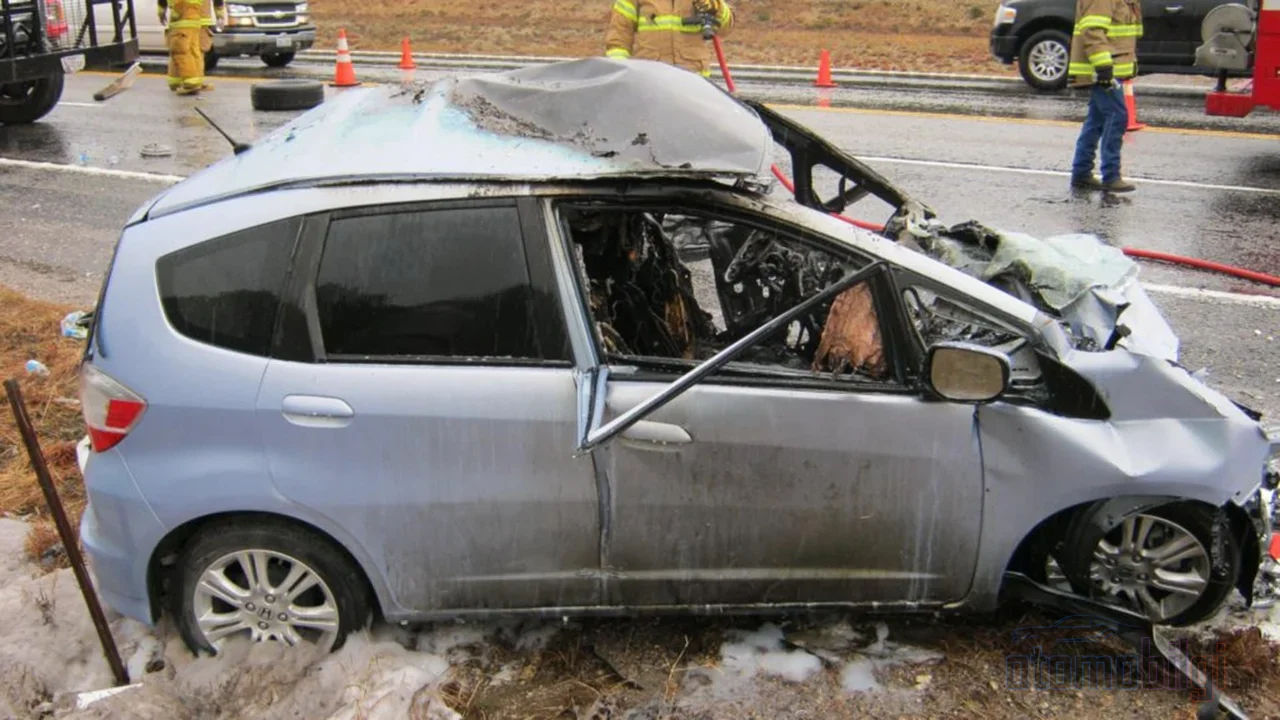
Crumple zones: the parts designed to deliberately crush
If you think "My car shouldn't crumple, it should be solid!", stop for a second. Physics says exactly the opposite: the longer the car takes to stop, the lower the average impact force acting on the person sitting inside. The crumple zones at the front and rear exist precisely for this reason - they deliberately fold and absorb kinetic energy. Around them, a rigid safety cell where the passengers sit, like an iron protective cage, remains standing.
So the body crumpling is not a flaw, it's engineering calculation. Think of it like pulling back your arm mid-fall before it hits the ground - you spread the impact over time, reducing its intensity.
Airbags and seatbelts: a race of milliseconds
If the collision is severe enough, the sensors send a signal to the inflators, and the airbags fill with gas in a fraction of a few seconds. The time from the moment the impact is detected until inflation is complete is only 20-30 milliseconds - far below even an eye blink. Today's vehicles have an entire army of airbags inside: front, side, curtain, and knee airbags; what's more, they reduce your head and upper body from hitting interior surfaces and require no routine maintenance.
But none of them works without a seatbelt, because at the top of the hierarchy sits the three-point belt: it locks you into the seat by gripping you at the hip and shoulder. It is no coincidence that it reduces the risk of death in frontal collisions by 75%. Modern seatbelts also feature pretensioners that tighten within milliseconds and load limiters that cap the force applied to the chest - the belt first catches you, then "gives back" a little as if saying "sorry" so it doesn't injure you while catching.
The rest of the list
- Headrests that prevent your head from whipping back in a collision
- ISOFIX-anchored child seats
- Laminated glass
- Correctly positioned fuel tank and fuel pump cut-off switch
As you can see, passive safety is not a single part; it is a design philosophy extending from the body to the seat, from the glass to the fuel line.
Active safety: systems that prevent the accident from ever happening
ABS: no locking of the wheels allowed
The greatest danger in emergency braking is wheel lockup; a locked wheel skids on the road, and even if you turn the steering wheel, the vehicle won't listen to you. ABS steps in exactly here: by modulating the brake pressure 15 times per second, it keeps the wheels turning, so steering control stays in your hands. A simple yet life-saving idea - and one of the classic examples of active safety.
ESC: the system that turns a skidding car in the direction you intended
Electronic stability control consists of sensors and a microcomputer, and continuously monitors how the vehicle responds to the driver's commands. When it detects loss of steering control - say, a car whose rear slides on a wet surface - it applies the brakes to individual wheels one by one to steer the car in the direction you intended, and reduces engine power if necessary. This is why it is regarded as one of the fundamental active safety systems: it both monitors and intervenes.
ADAS: the warners and the steering-touchers
Today's most crucial distinction is here. Driver assistance systems fall into two boxes, and these boxes are where the passive-active boundary is most hotly debated:
- Passive ADAS (warning only): Lane departure warning (LDW), forward collision warning (FCW), blind spot monitoring (BSM). The warning can be audible, visual, or haptic - like the steering wheel or seat vibrating. But the decision always rests with the human.
- Active ADAS (intervening with the vehicle): AEB that brakes automatically if the driver fails to react, LKA that touches the steering wheel to correct the lane, ACC that slows down automatically to maintain a safe following distance.
The critical difference is this: a passive system asks the driver to trust its warnings; an active system asks the driver to trust the steering wheel and the brake. Since the human decision layer is removed, a fault on the active side directly affects vehicle control - which is why the calibration of these systems is a serious matter (I will touch on this shortly).
| System | What does it do? | When is it active? |
|---|---|---|
| Deformation zone | Absorbs energy by crumpling | At the moment of collision |
| Seat belt | Locks the passenger into the seat | At the moment of collision |
| Airbag | Inflates within 20-30 ms | When an impact is detected |
| ABS | Prevents wheel lock-up | Before an accident, during braking |
| ESC | Corrects skidding with individual wheel brakes | Continuous monitoring + instant intervention |
| AEB | Brakes automatically if a collision is unavoidable | Immediately before an accident |
So why is the line blurring? Camera and radar are combining the two worlds
Here is the heart of the article. In the past, these two fields were technologically completely separate: the passive side was mechanical and structural, while the active side consisted of braking hardware with a few sensors. Today, cameras, radar, lidar and ultrasonic sensors scan the vehicle's surroundings; by combining internal and external sensor data, even the driver's attention status can feed into collision avoidance decisions. Researchers are developing pre-collision protection solutions that link the two fields into a single system - that is intertwining at the engineering level.
The layered working logic is best seen with a chain example: forward collision warning (FCW) first warns you; if you do not react, automatic emergency braking (AEB) kicks in. The same goes for the lane side: if you ignore the LDW warning, LKA steers you back into the lane. Systems like City Safety, which try to completely avoid collisions at low speed but brake at high speed in a way that softens the impact, single-handedly get involved in both. So which box are you going to put such a system in? This is exactly where the debate begins: some manufacturers can even list collision mitigation assistants under passive safety.
A calibration error in a warning system leads, at worst, to a false warning - there is still a human decision in between. But if there is a fault in an active system, vehicle control is directly affected; an incorrectly calibrated active system can cause an accident instead of preventing it. Since a windshield replacement, bumper repair, or even a wheel change can throw off camera and radar alignment, post-repair calibration has now become a must. If you are wondering which group a system is classified in, ask these two questions: does it work continuously before a collision and physically control the vehicle? If the answer is yes, it is on the active side. If it only kicks in when a collision is detected, it is passive. The thing is, the newest systems answer "yes" to both questions.
Euro NCAP and mandates: two domains, one score - not two separate exams, but a single test
Convergence shows up not only in the lab but also at the evaluation desk. Euro NCAP, which has tested more than 1,800 new vehicles and published over 600 ratings since 1997, calculates its star rating from both passenger protection (passive) and crash avoidance performance (active); vehicles are rated between 0 and 5 stars. So when awarding stars, it asks both "how well does the car protect you in a crash" and "how well does it prevent the crash" together.
The regulators aren't sitting idle either: As of July 2022, emergency braking systems, lane keeping assist, fatigue detection, reverse gear warnings, event data recorders, and intelligent speed limiters are mandatory in all new vehicles in the EU. Looking back at history, the line has always been moving: in 1968, shoulder belts became mandatory in the front seats; development extended from belts to airbags, from multiple airbags to ADAS, and from there to AI-powered systems. Since the passive side has matured considerably, the industry's focus has now shifted to crash avoidance systems. Even insurance companies offer 5-15% discounts on vehicles with advanced active safety - a concrete indicator of how much risk has actually dropped.
Which one matters more: passive or active?
I see this question all the time, so let me be clear: both. The point where sources agree is this - active and passive safety are not alternatives to each other, but complements; vehicles that score well in both have noticeably lower real-world fatality rates. Moreover, passive warnings (like FCW and LDW) resolve the situation in most cases without any active intervention at all - the driver receives the warning and applies the brakes themselves. So saying "it only gives a warning" doesn't mean "less valuable."
But there is a shadow on the table, and let's be honest: as systems become more sophisticated, questions about "driver autonomy" and "when should the system intervene?" come to the fore. Where does the point begin where the car decides for you? The Euro NCAP star system is criticized for being able to award 5 stars even to vehicles that score below 90% in any of the four domains; some safety enthusiasts say they therefore prefer the methods of different testing organizations. Rather than blindly trusting the stars, it's worth looking at the scores in all four domains too.
Final word: the line is shifting, the rule is constant
The boundary between passive and active safety is fading a little more each year thanks to hybrid systems fed by cameras and radar. But the compass of the classification doesn't change: does the system work before the crash, or does it wait for the collision? In your next car review, when flipping through the catalog pages, ask these two questions; you'll see that you can classify which system does what yourself. So if it were you, would you put your money into the newest active-side sensor, or into the body structure? I'll be waiting in the comments!
Sources
- Active safety
- Passive vs. Active ADAS Safety Systems
- Active and passive safety: what they are, key differences and examples
- Active vs. Passive Car Safety Features
- Vehicle Air Bags and Injury Prevention
- Driver Assistance Technologies
- How Vehicle Safety Has Improved Over the Decades
- Airbags
- Crumple zone
- How Crumple Zones Work
- Electronic stability control
- Electronic Stability Control
- Active safety systems: what are they and how do they work?
- The stars explained
- Euro NCAP
- Active and Passive Car Safety: An Integrated Approach
- Intelligent safety systems integrating active and passive safety
- Smarter Safety Through Interior and Exterior Sensor Fusion