How Does a Car Detect a Rollover? Rollover Protection System
Share This Page
How does a car know it's rolling over? In short, like this: Sensors measuring lateral acceleration, vertical acceleration, and angular velocity calculate the vehicle's likelihood of rolling over within milliseconds; once this decision reaches the control unit, the curtain (side) airbags inflate within the first 10-20 milliseconds and the seatbelt pretensioners are activated. In other words, at the moment of a rollover, an incredibly fast reflex circuit is at work inside the vehicle.
Highlights
- Rollover detection algorithms work with three signals: lateral acceleration, vertical acceleration, and angular velocity.
- Curtain airbags designed for rollover scenarios inflate within the first 10-20 milliseconds .
- Unlike normal side airbags, these airbags can stay inflated for 10 seconds or longer .
- The fundamental measure of rollover resistance is the SSF formula: half the track width divided by the height of the center of gravity.
- The capacitors in the system hold reserve power for up to 10 minutes even if the battery is cut off.
To picture it in your head, think of it like this: You've only just noticed that something has gone wrong behind the steering wheel, but the computer inside the car had already calculated that moment three times over, made its decision, and taken action. The airbag control unit measures the vehicle's deceleration every 1 millisecond . One thousandth of a second! Once you understand how a system running at this speed catches a rollover, you'll never look at your car the same way again. I promise.
What do rollover sensors tell the car?
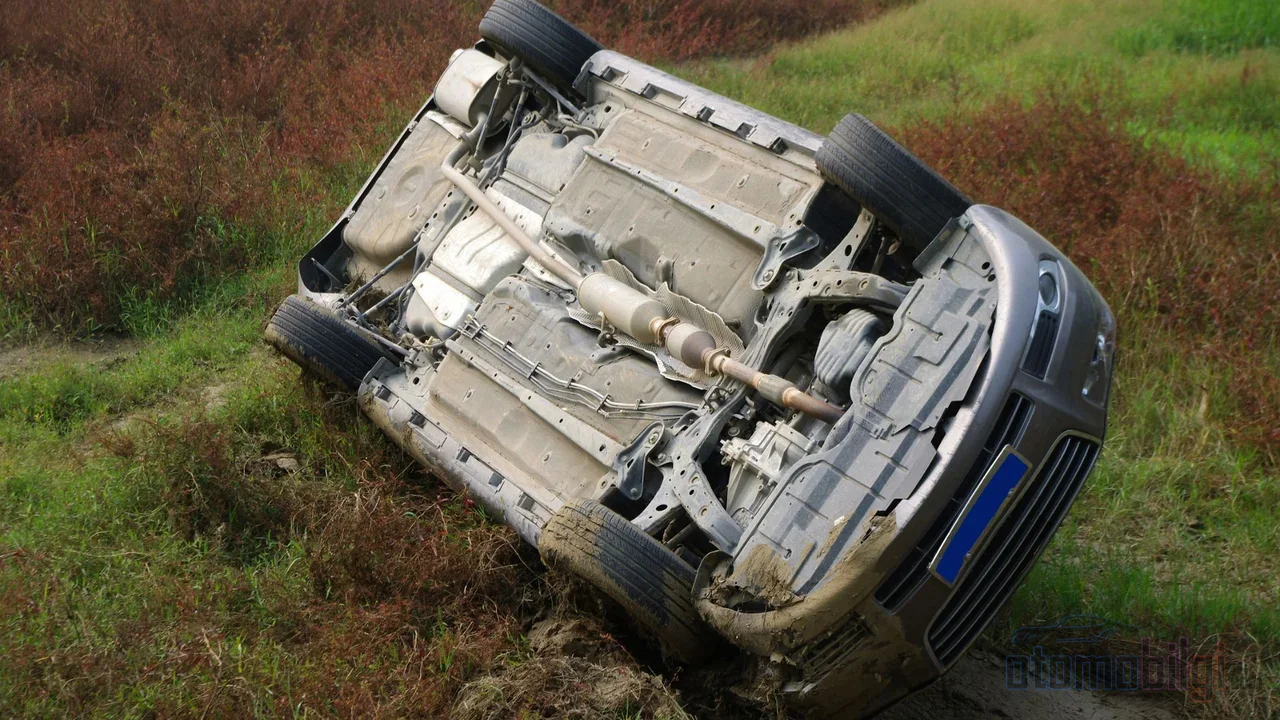
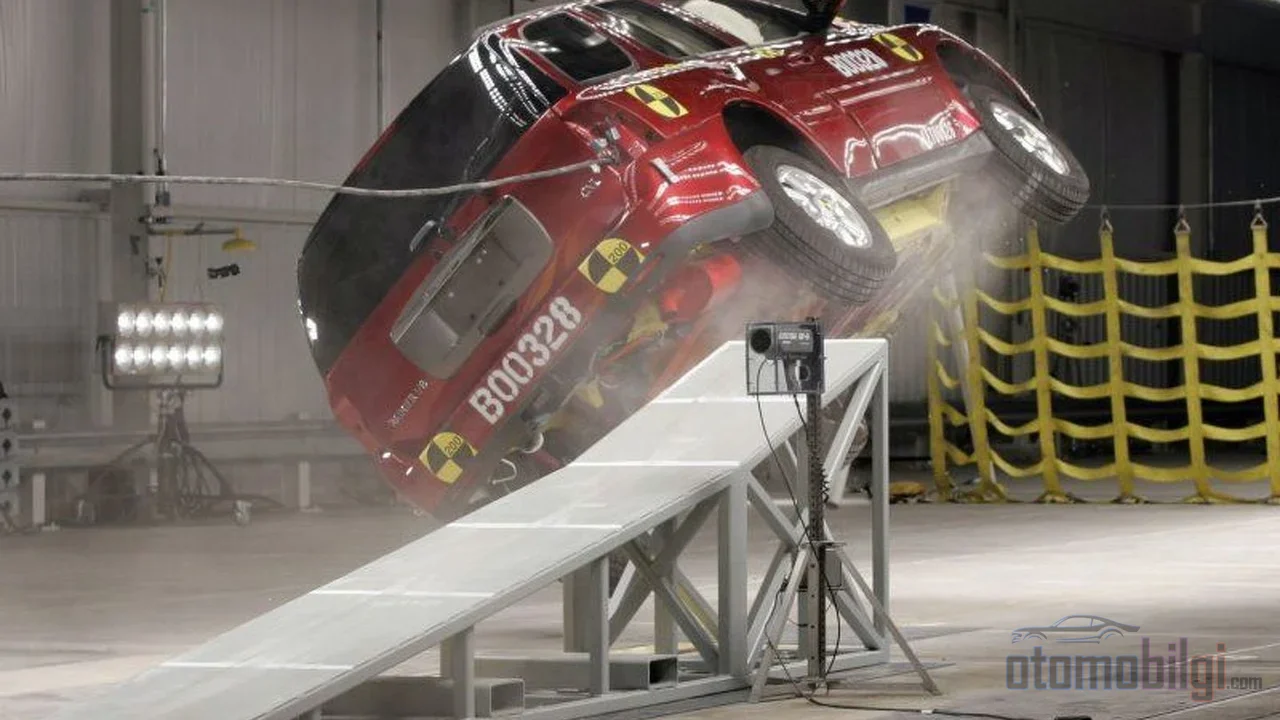
A car starting to roll over is actually a flagrant violation of the laws of physics: As the vehicle begins to tip sideways, it both accelerates laterally and starts rotating around its own axis. Rollover detection systems measure exactly these two movements. The trio of lateral acceleration (how quickly the vehicle accelerates side to side), vertical acceleration (the change along the up-down axis), and angular velocity (how fast the car is rolling) are the fundamental inputs of the detection algorithms. When these three signals are read together, the algorithm can understand that a rollover is about to occur.
The interesting part is this: These algorithms are completely secret. In other words, exactly which speed, acceleration, or displacement values a manufacturer uses as its rollover threshold is not public knowledge; the algorithms are proprietary. What we know are the general principles derived from patents and testing. For example, the side sensors can evaluate the lateral acceleration signal with their own microcontrollers and decide which airbags should deploy. In other words, the decision-making process is not concentrated in a single center; there are small brains distributed throughout the vehicle.
What about hitting a speed bump? Let me put your mind at ease right away: the airbag will not deploy. The control unit classifies the type of event by evaluating not only acceleration but also engine load, stability system signals, steering angle, and brake status. Additionally, a dual-sensor logic applies: at least two independent sensors must agree, and a safing sensor prevents a false trigger from a single faulty sensor. In other words, the system has already thought ahead and taken precautions in case your airbags deploy while one of you crosses a cursed speed bump.
The trigger chain: milliseconds from sensor to airbag
The decision has been made, so what happens next? First, let's take a rough look at the timeline:
- 0-1 ms: The control unit continues measuring acceleration; the collision calculation begins once the threshold is exceeded.
- Trigger decision: When the velocity change (delta-V) and acceleration threshold are exceeded, crashes are divided into four severity levels: from no deployment at all to two-stage full inflation.
- First 10-20 ms: The curtain airbags designed for rollover scenarios begin to inflate.
- Around 30 ms: The driver airbag deploys; the passenger airbag follows it 10 ms later.
- Around 55 ms: The driver's airbag is fully inflated. Even a blink of your eye takes about 300 ms; do the math.
When I first read these figures I couldn't believe them: the driver airbag deploys within 30 ms of impact and is fully inflated at 55 ms. By the time you realize what has happened, everything is already over. Modern MEMS accelerometers are the heroes of this speed; inside tiny structures whose mass moves with acceleration, capacitance changes, and this change is converted into acceleration and continuously streamed to the control module. It's in the name: micro-electro-mechanical system. A piece the size of a cross-section of your fingernail saves lives.
Why do curtain airbags inflate differently?
Curtain airbags designed for rollover scenarios have two major differences from normal side airbags. First, they stay inflated for much longer: 10 seconds and beyond. Why? Because when your car rolls multiple times, it tips to the side and rights itself several times; the airbag has to stay behind you for the second and third impacts. Second, they are designed to cover the window opening and inflate harder than normal to prevent the occupant from being thrown out of the window. In other words, their job is not just to take the impact, but to build a kind of wall.
Manufacturer manuals confirm this: according to one model's manual, curtain airbags deploy in significant side impacts or when the rollover sensor detects a certain rollover probability. Another manufacturer also states that the airbags are designed together with the rollover sensor and aim to protect the head and body of the outer-row occupants. And let's add an honest note: governments do not specifically mandate this rollover capability; but manufacturers started using these airbags to meet the requirement that all 2018 and later vehicles prevent occupant ejection through side windows. In other words, the law banned window ejections, and rollover airbags became the solution.
Also, every rollover may not be followed by the deployment of the curtain airbag. It is known that the sensor and algorithm decision is specific to each crash; if the sensor did not detect a loss of stability, the airbag may not inflate. The system does not fire all airbags in every crash, it fires the ones required for that particular crash. It may sound lazy, but it is actually the exact opposite: responding specifically to each scenario is one of the most challenging engineering tasks.
Why do SUVs roll over more easily? Physics' merciless answer
Now let's get into the physics side of it, because this part is very clear. The most common measure of rollover resistance is the Static Stability Factor, or SSF. The formula is simple: you divide half the track width (T/2) by the center of gravity height (H). As the result rises, the rollover risk decreases. Think about it: of two vehicles with the same center of gravity, the one with the wider track allows the body to lean further to one side without the load tipping it over. It's like the difference between a table and a stool.
From here, the situation of SUVs emerges on its own: According to NHTSA data, SUVs are among the groups with the lowest rollover resistance; a 1999 study shows that SUVs have the lowest SSF values, while cars have the highest. A high center of gravity is the main reason that lowers the SSF. This is why the rollover protection chain is especially critical in tall vehicles.
| Measure | What does it indicate? |
|---|---|
| SSF = T/2H | Half the track width divided by the center of gravity height; as it rises, rollover risk decreases |
| Lateral acceleration | The vehicle accelerating left and right; one of the fundamental inputs of rollover detection |
| Angular velocity | The vehicle's rotation speed around its own axis; a direct sign of rolling |
| Vertical acceleration | Change along the up-and-down axis; the third input of the detection algorithm |
Let's add a critical note: SSF is not a single figure that explains everything. The manufacturer side treats this measure simply as a geometric calculation and says that real vehicle dynamics cannot be explained by geometry alone; a fair point, because tires, suspension and loading conditions also come into play. But for a first approximation, SSF is still the most commonly used measure.
How does ESC prevent rollover from happening in the first place?
The best rollover protection is never letting a rollover happen in the first place. This is where electronic stability control (ESC) has its moment to shine. When it detects a loss of steering control, it automatically engages the brakes; by braking individual wheels and reducing engine speed, it ensures the vehicle goes in the direction the driver intended. Automatically braking one or more wheels when the steering angle does not match the vehicle's actual direction is the most effective way to maintain control.
So what does this have to do with rollover? A lot: by preventing lateral skidding and loss of control, ESC reduces from the start the situations that can lead to a rollover. Vehicles with a high center of gravity also have a continuously operating rollover mitigation function. The chain of thought goes like this: the car starts to skid, the skid turns into a slide, the slide turns into a roll. ESC cuts the first link. That is why ESC should be seen as the first and quietest hero of the rollover protection chain.
A bitter note from history: early ESC systems were not initially offered to the vehicles that would benefit most. In other words, the tall vehicles that needed it most only got this technology later. Fortunately they did, because today the safety equation of SUVs cannot be imagined without ESC.
What do seatbelt pretensioners do at the moment of a rollover?
Airbags alone are not enough; what really keeps you in place is the belt. Pretensioner systems retract the slack in the belt almost instantly during a crash, pressing the belt tight against the body. Then load limiters kick in and control the belt tension; that way you are not slammed into a belt as hard as a skull impact - the tension is released gradually. The two work together as a pair.
The activation logic follows the same channel as the airbag: when the impact detected by the control unit's crash sensors exceeds a certain severity threshold, the pretensioner activates. According to manufacturer manuals, the pretensioner system can activate in certain frontal or side collisions or in rollover situations. However, there is a small ambiguity here: whether the pretensioner activates during a rollover can vary by model. Manuals generally use phrasing like "in certain situations"; so you cannot count on automatic pretensioner deployment in every roll - the system can differ from vehicle to vehicle.
Power supply: How does the airbag fire after the car has rolled over?
Here is the question most people never think about but engineers rack their brains over for hours: What happens to the battery when the car rolls over? If the battery is damaged, will the airbags not deploy? No. Airbag systems carry reserve electrical energy; even if the battery is destroyed in a frontal crash, this reserve ensures the airbags inflate. Capacitors can hold power for up to 10 minutes after the battery is cut, and power below 9 volts can be enough to fire the airbag. In other words, the system carries its own batteries for the worst moment.
The wiring side is not that simple either. The airbag wiring harness is designed to withstand more than a decade of crash-free use; the materials need to resist aging, extreme temperatures, moisture, and corrosive effects. Just think: even if your car goes 12 years without a single accident, those cables have to work like on day one. That is why workshops are advised, before working on the SRS, to wait 10-15 minutes after disconnecting the battery's negative terminal to reduce the risk of accidental deployment. The capacitors may still be charged, don't forget.
If the battery is disconnected, will the airbag deploy?
A dilemma, yes; but thanks to the reserve, it doesn't lose its function. Even if the battery connection is cut, the capacitors hold backup power for up to 10 minutes, so the system retains its ability to fire. In fact, the waiting time in service procedures exists precisely for this reason: you wait for the reserve to discharge in order to make the system safely touchable.
Where is rollover protection technology heading?
This field continues to gain momentum. In vehicles with sunroofs, the risk of ejection through the roof glass was a serious problem; NHTSA determined that between 2000 and 2015, 260 people were ejected through sunroofs. The answer came in 2017: the first panoramic roof curtain airbag preventing ejection through the sunroof in a rollover was introduced. I absolutely loved the idea of passing protection over the roof glass, the car's most prized feature visually.
There are also developments on the side-impact side that intersect with rollover. In 2020, Euro NCAP introduced a new side-impact test encouraging far-side airbags; the far-side airbag maintains passenger position both in far-side crashes and in rollovers. In 2025, an active pedal airbag was introduced to protect the leg area in the front seat. As we can see, the protection chain adds one more link each year: sensors detect, airbags position themselves, belts tighten, and the system tries to prevent rollover from the very start. All of it in a tiny slice of a second.
And there's a recall lesson too: The Takata crisis began in 2015 and became the largest recall in US history; by 2022, approximately 67 million vehicles were affected, resulting in 23 confirmed deaths and more than 250 injuries. The message is clear: even a single component's defect in these systems can be catastrophic. No matter how astonishing the technology inside is, don't neglect its periodic maintenance. You now have the answer to how a rollover is detected; the rest is remembering that you owe the engineers who protect you in that moment.
Sources
- Airbags - IIHS
- What Triggers the Airbag? Sensors Explained - Airbag24
- Air Bag Deployment Criteria - Solomon & Kendall
- Airbag actuation event discrimination system - US Patent 6460882B1
- Side Curtain Airbags with Rollover Sensor - Honda Info Center
- How Do the Side Curtain Airbags Work - Ford Owner Manual
- Electronic stability control - Wikipedia
- Electronic stability control - Transports Canada
- Trends in the Static Stability Factor - NHTSA 809868
- Vehicle Dynamics - National Academies
- SUV Rollover in Single Vehicle Crashes - Kallan et al. 2008
- Living with Air Bags - MOTOR Magazine
- Airbag Basics - Body Shop Business
- Automotive Airbag Wire Harness - cableharnessassembly.com
- Essential Safety Measures Before Working on SRS - myairbags
- Pretensioner seat belt - Hyundai Owners Manual
- When Does Seat Belt Pretensioner Activate? - Airbag24
- Effectiveness of Pretensioners and Load Limiters - NHTSA 811835