Why Does the Steering Column Deliberately Collapse in a Crash?
Share This Page
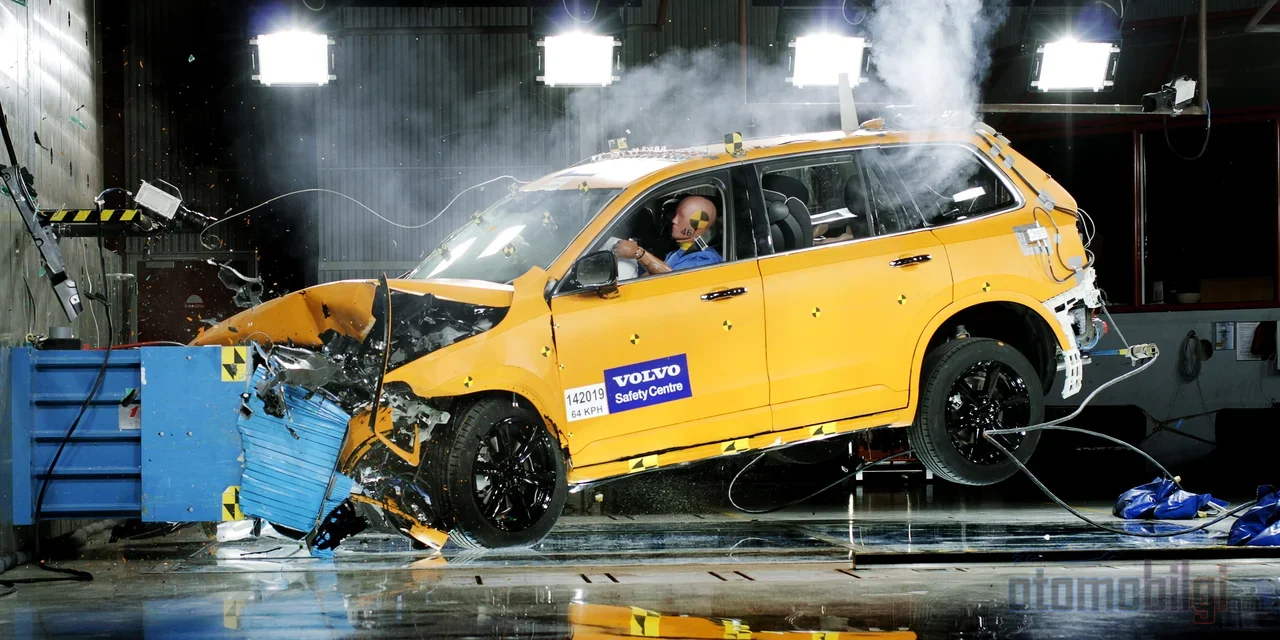
The steering column collapses in a controlled manner when the designed force threshold is exceeded during a collision, absorbing the impact energy; this way, the steering wheel is not pushed toward the driver, and the risk of chest injury is significantly reduced. It sounds strange, doesn't it? How can a part breaking on purpose be a safety feature? That is exactly what I will explain in this article.
Key Takeaways
- Collapsible steering columns have been mandatory in the US since the late 1960s.
- Collapsible columns can absorb a load of approximately 15 kN in a collision; rigid columns absorb no energy at all.
- The airbag has to inflate before the column completes its collapse stroke.
- Modern columns can offer two- or three-stage collapse depending on vehicle speed, driver weight, and seatbelt status.
The Rigid Column Era: The Shaft That Impaled Drivers
First, let's look at the bad old days, because that's where the real story begins. In early cars, the steering column was a single-piece, long, and rigid steel shaft connecting the steering wheel to the steering box below. No springs, no joints, just straight iron. Of course, it did its job just fine in normal driving.
But what happened in a collision? When the front end crumpled, this stiff shaft was pushed into the cabin without cutting off the force. So, since the steering wheel was attached to the steering shaft, it came at the driver's chest like a spear. It was so serious that the literature uses the word "impale" to describe this situation. This was precisely one of the most frequent causes of fatal injuries in severe frontal collisions. So when engineers said "since this shaft can't move, let's make it able to move," a revolutionary idea in passive safety was born.
How Does the Collapse Mechanism Work? Physics and Design Principles
Now, let's get to the main point. The basic logic of the collapsible steering column is this: the column stands rigid until a certain force threshold is reached, and once that threshold is exceeded, it deliberately shortens. This way, the collision energy is spent on the column's deformation rather than the driver's body. Think of the push-pull balance you remember from physics class: if you spread the same energy over a longer distance, the peak force drops. The column collapses to provide that distance, and the energy is converted into mechanical deformation.
Tube-in-tube and steel balls
The earliest designs worked on the "tube-in-tube" principle: the inner and outer jackets consisted of two telescoped tubes; in a collision, the inner one slid telescopically into the outer one, shortening the column. In a common version, steel balls are placed between the two jackets and held by a strong safety resin. When the resin reaches a certain pressure, it fractures, the balls are released, and the inner jacket begins to slide. In short, they tied the column's resistance to the strength of a glue - an immensely elegant solution, in my opinion.
In another approach, in expanded-tube type columns, a friction component called the "collapse ring" determines the friction force between the column body and the main tube. The slight inclination and steps in the ring guide where and how the tube will deform as the collapse progresses. In other words, the collapse is not a random crushing, but a process managed step by step.
Who sets the threshold: pins, strips and pyrotechnic fuses
So who tells the column when it should collapse? The answer: design. Activation methods are divided into three main groups:
- Shear pin: A mechanical pin that breaks when a certain force is reached; when it breaks, the shaft is freed and the upper shaft can slide over the lower one.
- Controlled deformation: A metal part that deliberately deforms at a certain pressure; a strip extending along a track on the body, plastically compressing, acts as an energy-absorbing element.
- Pyrotechnic device: Small actuators that instantly release the mechanism; common in modern vehicles.
One patent principle particularly appealed to me: the breaking pressure of the collapsible tube should be designed lower than the breaking pressure of the steering wheel. Why? Because if the column is the first link to break in a collision, the steering wheel remains intact and the energy is absorbed exactly where it is desired, in the column. Knowing deliberately where to place the weak link - that is the beauty of engineering.
Adaptive collapse: every collision is not the same
Modern systems are not even single-stage. Some designs offer two or three load stages: minimum, medium and maximum. Sensor data measuring vehicle speed, driver weight, seat position and whether the seatbelt is fastened makes the stage selection. For a small-built or belted driver, the low load stage is activated, while for a heavy or unbelted driver or in a high-speed collision, the high load stage is selected. In other words, the column is adjusted for you from collision to collision. This means passive safety is becoming virtually personalized.
The difficult part of the design is actually this balance: if the resistance is low, during normal driving - under the torque loads you apply in corners - the column could collapse on its own. If the resistance is too high, not enough energy is absorbed in a collision and the force returns to you again. Engineers are walking a fine line between these two extremes.
Synchronization with the Airbag and Seatbelt: Team Play
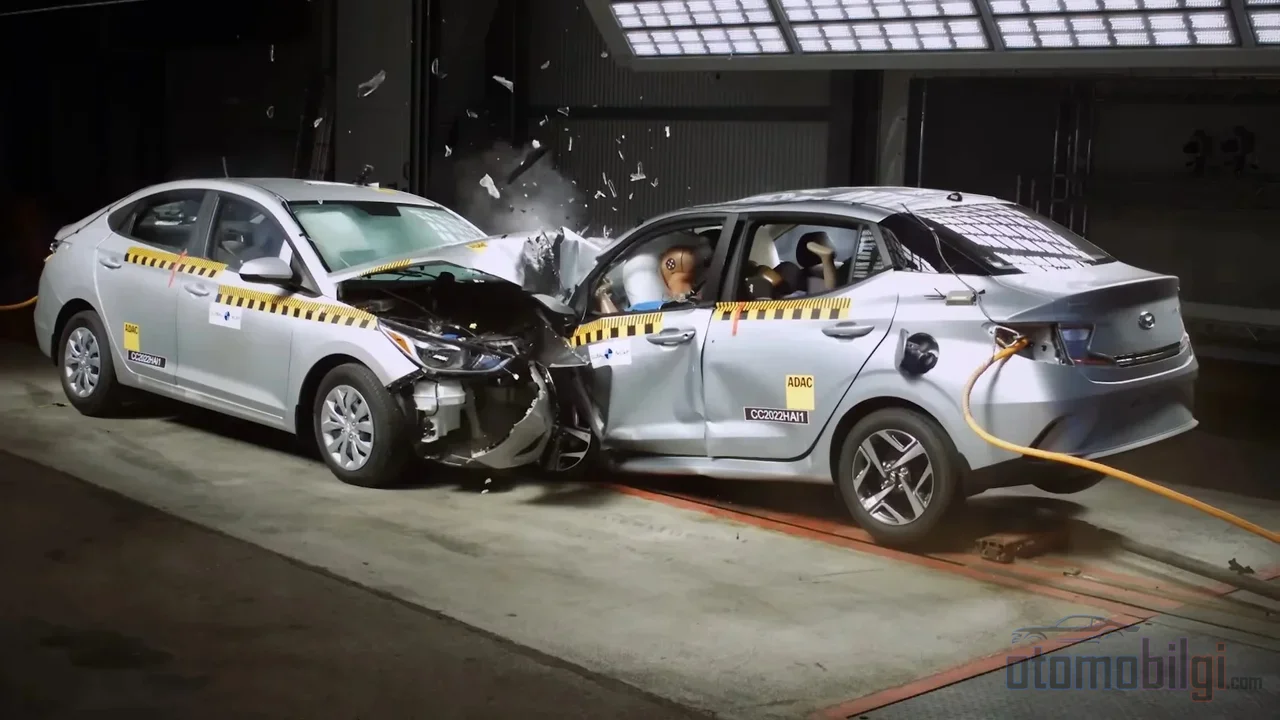
The steering column never works alone. In a collision, within tiny fractions of a second, three protectors engage simultaneously as if they had choreographed it. As soon as the airbag control unit detects the collision, it triggers the seatbelt pretensioner, securing you to the seat, and at the same time inflates the steering wheel airbag.
Timing is critical: the airbag must be inflated before the column completes its collapse stroke. Thus, while you are thrown toward the steering wheel, a fully inflated bag comes between you, and your chest hits a soft surface, not a collapsing wheel. If you reverse the order, the bag could push you toward the collapsed wheel - the exact opposite effect.
Moreover, this synchronization is so fine-tuned that the column's position and deformation can directly affect the airbag's performance. In severe frontal collisions, excessive column movement has been linked to the mannequin's head passing through the airbag and striking the steering wheel directly; in other words, uncontrolled or excessive collapse can reduce the airbag's effectiveness. More collapse is not always better under every condition - controlled collapse is everything.
Then there is the matter of collision severity: modern vehicle bodies are designed to preserve the integrity of the passenger cell up to impact speeds of about 64 km/h. At higher speeds - for example, in an 80 km/h full frontal impact with a rigid wall - mannequin results show a very low chance of survival. The column is a component that does its job within the limits of the body; unfortunately, it cannot cancel the laws of physics.
Its history: From the 1967 Chevrolet to Today
This idea has a history worthy of a museum. We see energy-absorbing steering columns in 1967 Chevrolet models; at that time, different designs such as scissors, piston and spring mechanisms were proposed. A "mesh", that is a woven/ring structure used in the Chevy II, absorbed the energy by slowing down the impact. Shortly afterward, in the late 1960s, collapsible steering columns became mandatory in the US - a step considered a milestone in passive safety history.
The impact was also tangible: according to data, having collapsible steering columns in all vehicles could have prevented about 1,300 deaths and 23,000 injuries per year. In my opinion, the magnitude of that figure shows how many lives a seemingly insignificant shaft can save.
Is the situation the same today? Yes, and it has developed even further: modern columns still retain their collapse and energy absorption capability, with the addition of adaptive stages and sensor integration. The mechanical simplicity of the early designs evolved into pyrotechnic and electronically controlled systems; but the basic principle - collapse in a controlled manner once the threshold is exceeded - has never changed.
After a Collision: Can a Collapsed Column Be Repaired?
Now let's ask you: if the steering wheel still looks solid and intact after an accident, is everything fine? Unfortunately, no. If the column has collapsed in a collision, the energy absorption mechanism is single-use - once it has deployed, it can no longer provide the same protection. For this reason, many manufacturers recommend that the column be checked and measured after a collision; some manufacturers mandate column replacement if the energy absorption mechanism has deployed.
Moreover, since the system can be computer-controlled, fault codes are recorded in the event of a malfunction and may need to be read with a scan tool. In other words, the column is no longer a purely mechanical part, but a component connected to the vehicle's safety network. In a high-severity collision, if the column cannot collapse, the force directed at the driver can cause serious injury - which is why saying "it looks fine, so there is no problem" is a dangerous shortcut.
Frequently Asked Questions
With airbags, is steering column collapse still necessary?
Yes, it is. Although this question has been discussed both in forums and in expert literature, the answer is clear: an airbag is a system that can start deflating within a second and inflates only once. The column, on the other hand, continues to absorb force throughout the entire duration of the collision. Modern columns also retain their collapsing and energy-absorbing capability; the airbag does not replace this capability, it works together with it.
What is the collapse threshold?
It is difficult to give a single precise number, because the threshold varies by design. While a single source mentions a threshold of approximately 11,000 Newtons (about 2,500 lbf), academic studies indicate that collapsible columns can absorb loads of around 15 kN in a collision. The two figures measure different things: one is the force threshold that triggers collapse, the other is the column's total load-bearing capacity. That is why the answer to "how many Newtons does it collapse at" varies by vehicle and design.
Does every car have a collapsible column?
In vehicles in advanced markets it is almost standard, because the requirement has existed since the late 1960s. Still, it is known that some economy models in the past still used rigid columns; today this situation is largely a thing of the past, but in used cars, especially older models, it is not a bad idea to check this detail.
Final Word: The Part That Looks Weak Is Actually a Hero
The story of the steering column, in my view, tells the essence of passive safety philosophy all by itself: energy is not destroyed, it is only transferred. The column is designed to spend that energy on its own body instead of your chest. So being able to lean on the steering wheel after a collision and say "good thing the column collapsed" owes a debt to one of engineering's quietest and most effective achievements. The next time you turn your steering wheel, remember that that ordinary-looking shaft under your hands actually carries a plan prepared for you. So have you ever looked at a vehicle's safety equipment list to see the steering column? Try looking - when you see the phrase "energy-absorbing column" there, you will now know what it means.
Sources
- A Literature Review on Collapsible Steering Column - IJIRST
- What's In A Steering Column: Energy Absorbing Column - I-CAR
- An Evaluation of Federal Motor Vehicle Safety Standards - NHTSA
- 1967 Chevrolet Energy-Absorbing Steering Column - Smithsonian
- US3401576A - Collapsible steering column - Google Patents
- US6652002B2 - Crash responsive energy absorbing device - Google Patents
- Potential of a Time-Triggered Crash System of a Steering Column - SAE Mobilus
- Steering Column Movement in Severe Frontal Crashes - TRID
- History of Collapsible Steering Columns - AutoPartEx
- How Steering Columns Work - RepairsAdvisor
- Troubleshooting Collapsible Steering Columns - MyAirbags