What Does a Car Record During a Crash? The Event Data Recorder
Share This Page
At the moment of a crash, your car writes data such as speed, braking, throttle, steering, and seatbelt status to the event data recorder, or EDR, for a few seconds before the collision. This device does not record sound like an aircraft's black box; it only saves technical data related to the collision in permanent memory and is used in crash analyses.
Highlights
- The EDR typically records the vehicle's data for the 5 seconds before a collision.
- In most vehicles, the EDR function is located within the airbag control unit.
- In the US, the EDR is mandatory in most passenger vehicles produced after September 1, 2014.
- The typical threshold for triggering a recording is the measurement of a rapid change in speed.
- The EDR does not record sound; it never records passenger conversations.
What Does Your Car Record at the Moment of a Crash?
Imagine this: you're behind the wheel, suddenly you hit the brakes, honk the horn, turn the wheel sharply, and then the collision. In those seconds, a small chip inside your car captures the collision like a slide film camera; but with data instead of pixels. This chip is called the event data recorder, or in short the EDR (Event Data Recorder).
It's commonly referred to as a black box, but that comparison is a bit unfair. An aircraft's black box records sound and the cockpit, accumulating hours of data. The EDR, however, records no sound at all and stores much less data; it accumulates only a brief technical snapshot related to the collision, measured in seconds. So your car isn't listening to your private conversations; it's simply taking notes on the data of the laws of physics.
Where Is the EDR Actually Located and How Does It Work?
Here's my favorite part: The EDR is often not a separate box, but a function living inside an existing module. It's found within the vehicle's engine control unit or, most commonly, in the airbag control module. This module is usually placed near the vehicle's center of gravity; because it senses acceleration most cleanly from there. You can think of it like this: your balance is better because your brain sits in the middle of your head.
The recorder's working logic is simple but clever: as long as the vehicle is running, it continuously processes the data but does not yet write it to permanent memory. Much like a security camera that only starts recording when something happens. When an event occurs, the EDR writes the short period of data before the collision, and after it if necessary, to permanent (non-volatile) memory and keeps it there.
So who gets access to the data? There are two ways: connecting to the vehicle via cable through the diagnostic port while it's powered, or removing the module and reading it in a laboratory. Specialized reading devices are widely used for this purpose in passenger vehicles.
How Is a Recording Triggered: Where Is the Threshold?
Not every bump or lane crossing triggers the EDR to record; otherwise the memory would fill up within seconds. Instead, the recording is triggered by a threshold indicating the severity of the collision. According to U.S. regulation, in passenger cars produced after September 1, 2012, an event is recorded if the vehicle experiences a speed change (delta-v) of 5 mph in 150 milliseconds. In older vehicles, this threshold can be different. The same regulation also requires EDR data to be stored if the airbag control system measures anything above 8 km/h.
When you first hear it, the concept of delta-v sounds complicated, but it's actually very simple: how much and in which direction did the collision change the car's speed? If it was a slow parking bump, the delta-v is small and may not be recorded; if it was a hard intersection crash, the delta-v is large and the recorder's memory starts to fill up.
Recorded Data: The Car's Report Card
So what exactly does this memory note down at the moment of a crash? Official requirements mandate certain core data; in addition, there are extra parameters recorded under some conditions. The mandatory list is as follows:
- Forward collision speed change (delta-v), maximum delta-v, and the time from the start of the collision
- The vehicle's cruising speed
- What percentage the accelerator pedal was used
- Whether the brake was pressed and whether ABS engaged
- Whether the driver's seatbelt was fastened or not
- Whether the front airbag warning light was on
- Deployment times of the driver and front passenger airbags
- Number of ignition cycles, number of recorded collision events, and whether the EDR completed the record completely
In addition, conditional parameters that vary by vehicle and model can also be recorded:
- Lateral speed change
- Engine speed (RPM)
- Steering angle
- Roll angle
- ABS and ESC status
- Deployment of the belt pretensioner
- Seat positions and occupancy information
- Side airbag status
A comprehensive record can contain between 55 and 75 data points. The data is grouped into five main categories: pre-crash vehicle dynamics and system status, driver inputs, vehicle crash signature, restraint system usage and deployment status, and post-crash data. If you've noticed, the list contains everything about what a driver did; nothing about why they did it. This distinction will become very important later.
The Dual Role of the Airbag Control Unit
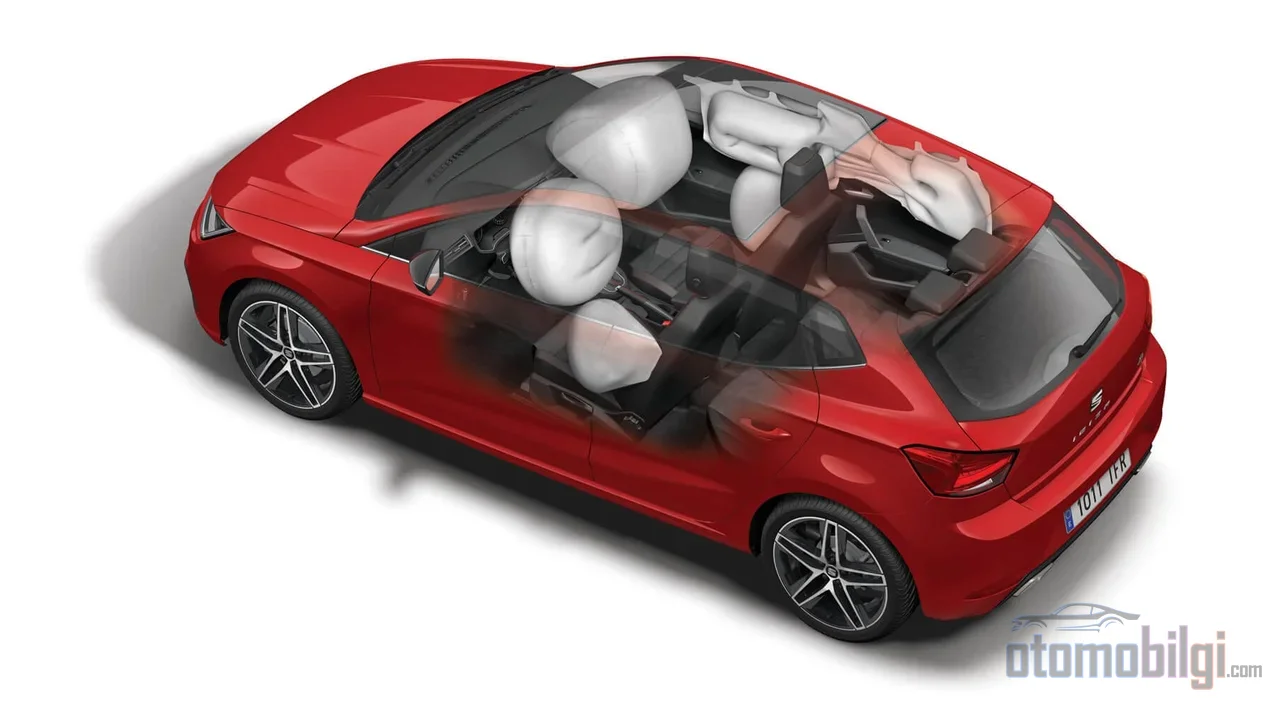
The relationship between the EDR and the airbag control unit is one of the most elegant aspects of the machine. Think of it this way: the system that decides whether the airbag deploys is already the system that detects the crash fastest. It has sensors monitoring acceleration in fractions of milliseconds, and algorithms calculating crash severity. The EDR function works precisely inside this brain, as a function integrated into the airbag control unit.
Recording happens in two forms. The first is the deployment event, where the airbags deploy; the second is the non-deployment (near-deployment) event, where the crash is not severe enough or the airbag came close to triggering but did not deploy. So don't assume the car didn't record the event just because the airbag didn't deploy; if an impact occurred at or above the threshold level, the data can still be written. Advanced EDRs can record the deployment times of first and second-stage airbags, and even the status of the belt buckle.
There's another practical consequence of this connection: the EDR's memory is limited, and when a new event comes in, the old record can be overwritten. Also, in a hard collision the module itself can be damaged and the data may not be readable. So you shouldn't expect a perfect record from every accident just because you think of it as a black box.
The Five-Second Window: For How Long and How Often Are Data Recorded?
Here's that question everyone is curious about: how many seconds before the accident does the car remember? The answer is elegant and clear: the recording interval is usually the 5-second period before the impact. Throughout this window, values such as vehicle speed, engine rpm, brake switch and throttle position can be recorded, with some EDRs sampling once per second. In some records, belt status and the airbag warning lamp are sampled up to 1 second before the collision; the critical data that is needed more frequently comes from more recent moments.
Five seconds may sound short, but when you consider how quickly things unfold in accidents, it's actually a huge span of time. Even a lane-change maneuver takes a second or two. So the EDR's window is wide enough to show what the driver did immediately before the collision, yet narrow enough not to bloat the memory. The text of the US regulation also defines the recording interval precisely as between 5.0 seconds before the impact and 0 seconds.
EDR in Accident Reconstruction: It's Not Enough on Its Own
When an accident expert arrives at the scene, what do they look at? Tire marks, debris distribution, the damage profiles of the vehicles, the geometry of the road and the final resting positions. EDR data is a powerful layer added on top of these classic reconstruction methods. When the two are combined, the whole picture of the accident emerges: not who managed the car, but what the car experienced.
Let me give a few examples of how they use this in real life:
- Collision severity: Delta-v and g-forces are used when testing whether injury reports are consistent with the severity of the collision.
- Vehicle history: The ignition cycle count shows how many times the vehicle was started after the accident. For example, if the vehicle was started 42 times after the alleged accident date, this raises suspicion of a late report or fraud.
- Inconsistency screening: Data that doesn't match the damage claim, claims of seatbelt-free trips, or suspicions of staged accidents can be caught with EDR data.
- Safety development: Pre-crash data variables are an objective source for the development of active safety systems; statistical accident data collection is also one of the EDR's core missions.
So this chip works not only to explain accidents, but also to make future cars safer. In my opinion, this is the most impressive part: the data you generate feeds into the design of a system that helps keep people alive tomorrow.
What the EDR Cannot Tell You: Knowing Its Limitations Matters Too
Now let's get our feet back on the ground and talk about what the EDR cannot do; because the most critical misunderstandings arise from exactly this. First of all, the EDR does not know why the driver braked or did not brake. Distraction, fatigue, visibility conditions, perception-reaction time... None of these are in the recording. The EDR records what you did, not why you did it. You can think of it as being recorded the moment you brake while looking at your phone behind the wheel: the action is recorded, the intention is not.
The second important limitation: in most passenger cars, steering angle or lane position is not stored. Steering angle appears in the official list as a conditional optional parameter, meaning whether it is recorded varies by manufacturer, model and year. For this reason, it is entirely possible that an evasive maneuver or a lane change cannot be determined from EDR data. Parameters can also be defined differently and recorded at different sampling rates.
Third, not every collision produces a recording. The airbag may not have deployed, the impact may have been below the threshold, or there may have been electrical damage or data overwriting. And a question many people wonder about: is the date and time of the event recorded? Most EDRs do not record it; the event is associated by comparison with physical evidence. Although the accuracy of the data is generally good, it must be interpreted correctly and used together with other well-established accident reconstruction methods. Accident reconstruction is not a data download exercise; the EDR is one part of the information you have, not the whole of it.
Regulations: Mandatory in the US, a New Era in Europe
The legislative side of the EDR world is also interesting. In the US, the 49 CFR Part 563 regulation came into force on September 1, 2012; it standardized the data elements, data format, capture requirements and owner's manual information. EDRs became mandatory for most passenger vehicles, multipurpose vehicles, trucks and buses produced after September 1, 2014. And the legislation is not standing still: a final rule published in December 2024 amended the regulation to extend the recording duration for time-based data metrics; the implementation timeline for expanded pre-crash data requirements was postponed, and EDR-equipped vehicles produced on or after September 1, 2027 are expected to comply with the updated requirements.
The picture is different on the European side. EDRs were not mandatory in Europe for years; but a 2014 study revealed that almost all new passenger cars sold on the continent already had EDRs comparable to US requirements. Subsequently, UNECE Regulation 169 came into force for heavy vehicles; according to this regulation, the EDR must store the data until it is retrieved and overwritten, and must be able to hold at least five different events. EDR requirement for heavy vehicles applies to newly type-approved vehicles as of January 7, 2026; From the beginning of 2026, new vehicle types will need to be equipped with EDR, and from 2029 all new vehicles. In other words, for European vehicle owners, this technology will evolve from an exception into a standard within a few years.
Why Is Your Vehicle's Memory So Valuable?
Let me summarize: The EDR is a silent witness. It is a technology that works with a five-second window, records no audio, understands no motives, but notes data such as speed, braking, throttle, seatbelt and airbag with millisecond precision. On its own it does not tell a story; when combined with tire marks, damage profiles and expert analysis, it reveals the truth of the accident. And don't forget: these data may one day contribute to the development of the very system that makes your own car safer. Don't you think cars having memory is still strange but also pretty cool?
Sources
- Event Data Recorder - NHTSA
- 49 CFR Part 563 - Event Data Recorders (eCFR)
- Event Data Recorders - Federal Register (December 18, 2024)
- Event Data Recorders - Federal Register (May 18, 2026)
- Passenger Vehicle Event Data Recorders - Explico
- Event Data Recorders - Clemson Vehicular Electronics Laboratory
- How to Read an Event Data Recorder Report - Ethos Risk
- What is an EDR - Collision Sciences Australia
- Limitations of EDR Data in Accident Reconstruction - Garrett Forensics
- EDR: A Simple Intro (UNECE R169) - CSS Electronics
- EU and UN ECE Develop New Regulations on EDRs - Interregs
- Why Precise Vehicle Data Is Now Mandatory - Swoboda
- EDR Pre-Crash Data: Methodology - Traffic Injury Prevention
- An Approach for Robust System Testing the Event Data Recorder - MDPI
- Event Data Recorder - Wikipedia