How Does Automatic Emergency Braking (AEB) Protect You from Collisions?
Share This Page
Autonomous emergency braking (AEB) is an active safety system that combines data from sensors such as radar, camera and lidar to calculate collision risk within milliseconds, and takes over braking itself if the driver fails to react in time. In other words, it steps onto the scene not at the moment of an accident, but before one occurs. So how exactly does this silent helper inside your car work? Let's dive into the world of sensors!
Highlights
- Euro NCAP has included AEB systems in since 2014 its safety ratings.
- Most AEB systems operate in a range of approximately 10-80 km/h ; pedestrian detection is generally limited to lower speeds.
- The NHTSA rule in the USA requires, from 2024 onwards, vehicles to 145 km/h automatically brake for vehicles at speeds up to 72 km/h and for pedestrians up to
- New generation systems were able to prevent all forward collisions up to 56 km/h in tests.
- AEB effectiveness was around 46% in older generations, while in newer generations it rose to 52%- meaning there is still plenty of room for improvement.
The Difference Between Passive and Active Safety: Where Does AEB Stand?
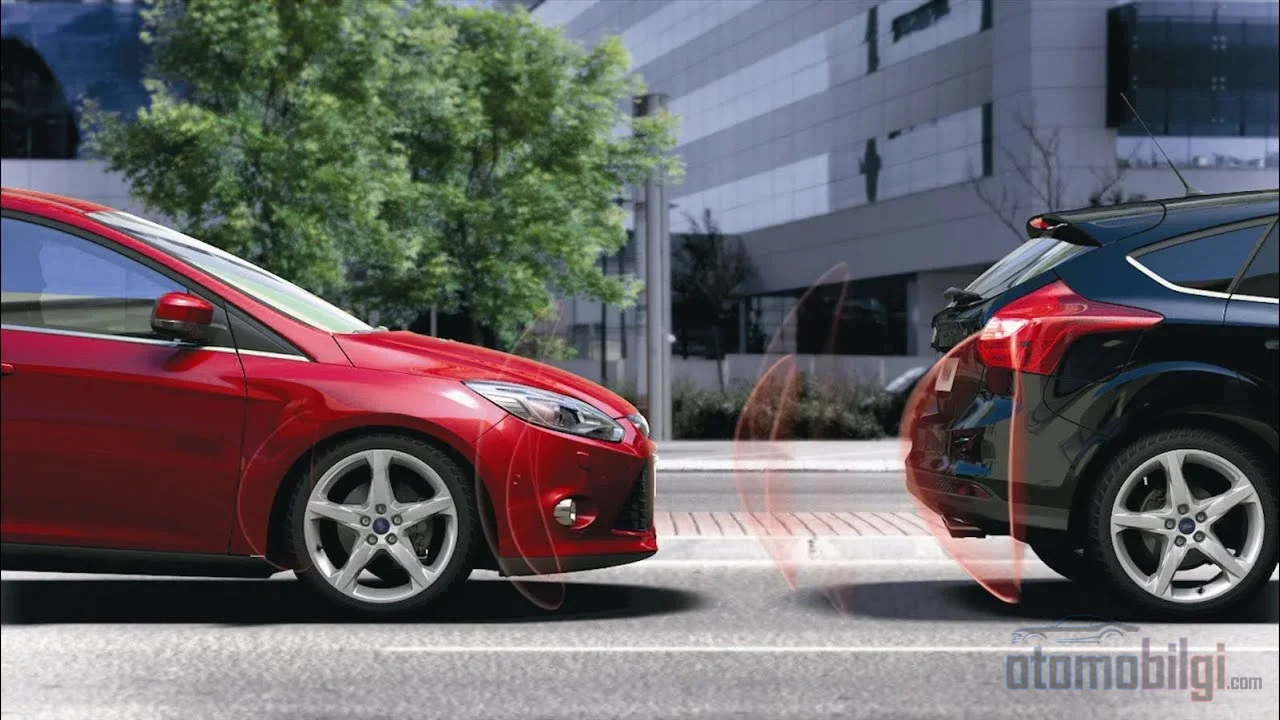
Let's start with this question: while the airbag is helping you, you've already had the accident, right? Airbags, seat belts and crumple zones belong to the world of passive safety . These protect you during and after a collision. AEB works with exactly the opposite logic: its goal is for that collision never to happen at all. That's why it belongs to the family of active safety ; it plays on the same team as systems like ABS, ESP and traction control.
You can also think of the difference this way: passive ADAS systems only warn the driver of danger but do not intervene. AEB, on the other hand, if a warning isn't enough, takes the wheel - pardon, takes the pedal itself. This is why Euro NCAP takes AEB very seriously: since 2014 it has included city and interurban AEB systems in its star ratings. So if you're buying a 5-star car today, you know there is at least one AEB system behind it.
Another important detail: AEB is the last line of defense designed for situations where the driver is distracted or brakes incorrectly. It is not a system that always drives the car on your behalf; it only intervenes when the risk threshold is exceeded.
AEB's Eyes: How Do Radar, Camera and Lidar Work?
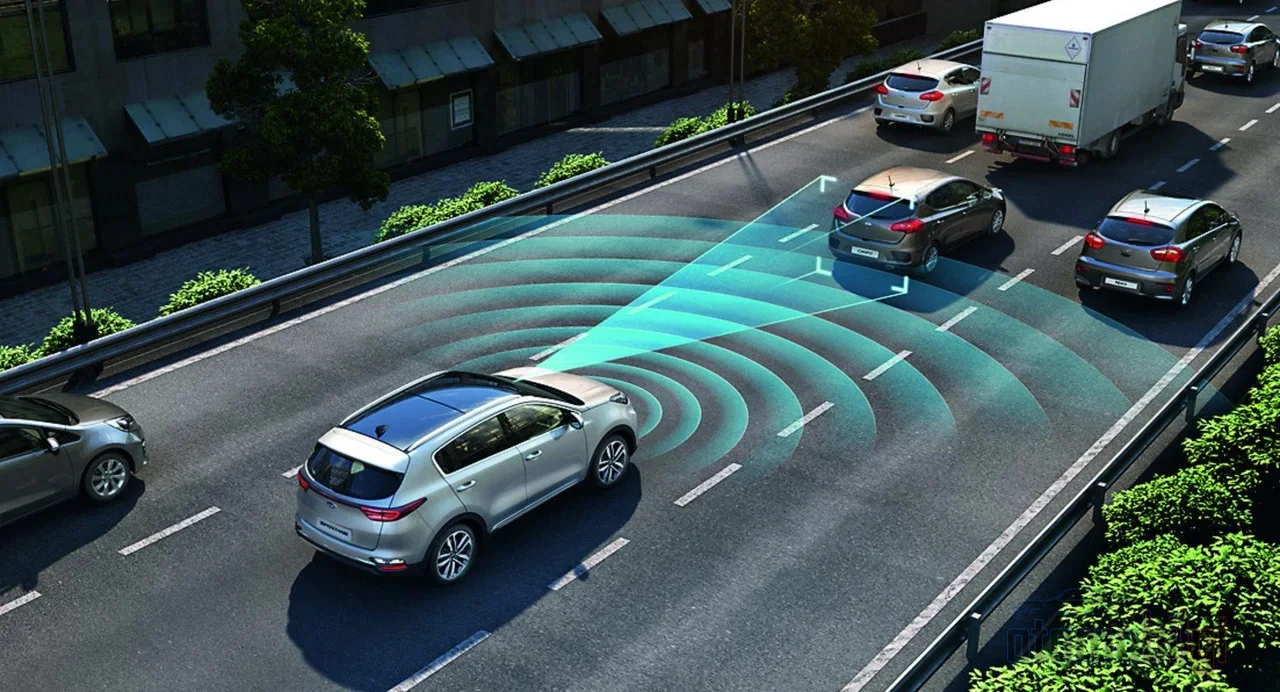
AEB's superpower is not a single sensor, but the combination of all three. This is called sensor fusion and each sensor has a superpower as well as a weakness.
- Radar: It sends out radio waves and, from the returning signal, calculates distance, relative speed (thanks to the Doppler effect!) and direction of movement. It doesn't care about fog, snow or darkness, and has a long range. But its spatial resolution is low, and it cannot tell what the object it sees is (a pedestrian or a traffic cone?). "Ghost object" reflections can even occur on metallic surfaces.
- Camera: The champion of visual object recognition. It recognizes lane markings, traffic signs, pedestrians, and cyclists using deep learning models (such as YOLO and Faster R-CNN). But it struggles in low light, fog, and rain; a mono camera naturally cannot measure depth.
- Lidar: It sends pulsed laser beams, measures the return time, and produces a 3D "point cloud" map of the environment. It provides distance accuracy down to the centimeter and works even in complete darkness. Unfortunately, it has no color information and is affected by severe weather conditions.
See? None of them is perfect on its own. Radar says "something is there and it's coming," the camera says "it's a pedestrian," lidar says "it's exactly that far away." Combining the answers of all three produces a reliable and robust perception - and it is precisely this combination that minimizes false alarms. One of the current developments is 4D radar: it adds height data to classical radar, offering a richer perception of the scene.
How Is Collision Risk Calculated Within Milliseconds?
The sensors have collected the data, so what happens next? You can think of a typical AEB architecture as a chain: sensors and environment perception → sensor fusion and tracking (objects being merged and continuously monitored) → decision logic → AEB controller → vehicle dynamics. At the fusion stage, all detections are combined into a single list, and a multi-object tracker monitors each object in real time; an extended Kalman filter (EKF) is usually used for position estimation. It sounds like science fiction, but it all happens and finishes in fractions of a second!
TTC: Time to Collision
The key concept at the heart of the system TTC - meaning "time to collision," the time remaining until a collision. Using the distance to the vehicle ahead and its relative speed, the system continuously calculates this time. The logic is very simple: if the TTC is shorter than the time you need to react plus the time the brakes need to come to a complete stop, the first stage kicks in: FCW, meaning forward collision warning. Not a horn, but a beeping sound - the car tells you "wake up already!"
If you still don't react, things get serious. AEB applies staged braking : first multiple partial braking stages, then full braking. Imagine a simulation example: in the first 2.3 seconds the sensors cannot even see a child pedestrian darting onto the road; at second 2.4 the first partial braking engages, at second 4.1 the car comes to a complete stop, and the collision can be entirely avoided with about 2.1 meters to spare. That's the magic engineering performs in a few seconds!
There's also an interesting technical debate: the classic TTC calculation assumes that the relative speed of the two vehicles remains constant. But in real life, brakes are slammed suddenly! That's why engineers are developing smarter models such as ETTC and second-order TTC that also take relative acceleration into account. In short, algorithms study hard and improve themselves, just like us.
What Happens If the Driver Doesn't React to the Warning?
This is AEB's defining moment. If the driver fails to react to the warning in time, the system acts independently of the driver: when collision risk increases and the vehicle is not slowing down, automatic emergency braking is applied immediately before the collision. The system can slow the vehicle down, and in some scenarios even bring it to a complete stop. There are also systems that flash the brake lights to warn drivers approaching from behind during sudden decelerations - clever, right?
The critical point here is this: when AEB takes over braking, it does not allow driver control. The aim is to compensate for inattention or a moment of panic. That's why mistaking AEB for "autopilot" is a big mistake; it is only a backup cry in the most critical seconds.
Does AEB Work at All Speeds? Speed Thresholds and System Limits
No - and the answer to this question might be the most surprising part. Most AEB systems are designed for low-to-mid speeds and typically operate in a range of about 10-80 km/h . High-speed AEB systems, on the other hand, are 80-100 km/h designed to prevent or mitigate serious crashes at speeds around. Pedestrian detection is usually limited to lower speeds; in older vehicles this limit could stay in the 40-60 km/h range.
The picture looks exactly like this:
| System coverage | Typical speed limit |
|---|---|
| Operating range of most AEB systems | Approximately 10-80 km/h |
| High-speed AEB systems | Approximately 80-100 km/h |
| Upper limit prevented by new-generation systems (test) | All collisions up to 56 km/h |
| NHTSA mandate: collision with a lead vehicle | Up to 145 km/h |
| NHTSA mandate: pedestrian collision | Up to 72 km/h |
| Upper limit of the heavy-vehicle AEB test rule | 80 km/h |
The most striking row in this table is NHTSA's final rule published in April 2024: in the US, light vehicles must perform automatic braking up to 145 km/h when approaching a collision with a lead vehicle, and up to 72 km/h in pedestrian collisions. The agency had also proposed banning manual deactivation of the system at speeds above 10 km/h. In other words, AEB is no longer an optional extra - it officially becomes mandatory equipment.
There is also tangible progress on the effectiveness side: while the effectiveness of older-generation AEB systems was around 46% , in new generations this rate 52% has risen to. In tests, new-generation systems 56 km/h were able to prevent all forward collisions up to. But let's be honest: this also shows that nearly every other risk still goes unprevented. The technology is not magic - it is an evolving field of engineering.
Euro NCAP Tests: How Are Pedestrians and Cyclists Tested?
Euro NCAP tests AEB not only in car-to-car scenarios, but also as Vulnerable Road User (VRU) part of protection. The current protocol covers Vehicle-to-Pedestrian, Vehicle-to-Cyclist, and Vehicle-to-Motorcyclist scenarios. Cyclist detection and prevention tests began in 2018; for the first time, the Nissan LEAF and the automatic braking with cyclists was tested and the car received 5 stars. In the pedestrian protection assessment, both headform, upper legform and lower legform impact tests and AEB test data are used together. In other words, what happens to your head, hips and legs is measured separately - brutal but realistic!
The test scenarios are incredibly detailed. For example, in the "child pedestrian, crossing near the road" scenario, the gradual braking stages are tracked with color codes: gray (system disabled), yellow (stage 1 partial braking), orange (stage 2 partial braking) and red (full braking). In car-to-car scenarios, different situations such as approaching a slowing or stopped vehicle ahead are also tested separately. There are dozens of scenarios in total; manufacturers really have to fine-tune their systems to pass these tests.
Phantom Braking: Why Does AEB Brake for No Reason?
Now let's get to the annoying side of the matter. Phantom braking, that is, ghost braking: when AEB or adaptive cruise brakes suddenly when there is no real risk of collision. When you're sitting in the middle of the car and it brakes for no reason, you're both startled and the driver behind you might curse at you!
So why does it happen? There are several culprits:
- Environmental factors: Shaded areas, low-angle sun, and bad weather conditions can make the system think there is an obstacle that isn't there.
- Misreading the scene: An overpass or a manhole cover on the road can be mistaken for a solid object.
- Dirty or misaligned sensors: Camera and radar rely on very precise calibration; if a sensor is dirty or misaligned, the system becomes prone to errors.
This is exactly where another value of sensor fusion emerges: reducing false positives by balancing one sensor's error with the others. This is also the main goal developers focus on - optimizing braking algorithms to minimize false positives and conducting comprehensive real-world testing. It is also being discussed that phantom braking poses a serious liability burden for fleet operators.
The Future of AEB: Where Are Sensors and Algorithms Heading?
There are exciting innovations on the radar front: 4D radar, which adds elevation data, 4D radar, high-resolution radar arrays, software-defined radar, and machine learning integration. Patent applications are also being seen for systems that combine lidar, radar, and camera - manufacturers are investing seriously in the triple sensor setup. There are even university projects that collect scattered signals with radar devices placed in roadside infrastructure, determining target directions far faster than conventional radars.
One final critical point: no single system is sufficient on its own. Evaluating active and passive safety functions together produces far more safety benefit than any one of them alone. In other words, the real winner is the combination of AEB + strong body structure + airbags + seatbelts. In the exam, we score high as a team, not as individuals!
In short: AEB is the smartest seatmate trying to prevent a collision. Radar tells you the distance and speed, the camera tells you what it is, lidar gives the precise position; the TTC calculation measures the risk, and if you're too late, it takes over the braking. It still has limits, it still sometimes sees phantoms - but it gets better with every new generation. So, does your car have AEB? Don't forget to ask this question when choosing your next vehicle!
Sources
- Autonomous Emergency Braking with Sensor Fusion
- Euro NCAP AEB LSS VRU Test Protocol - v4.4
- NHTSA Final Rule - Automatic Emergency Braking Systems, Light Vehicles
- Out with the Old AEB, In with the New - AAA
- Automatic Emergency Braking - Transports Canada
- Intelligent Emergency Braking - Nissan Global
- New LEAF charging ahead with 5 star result - Euro NCAP
- Sensor Suite: How Cameras, LiDAR, and RADAR Work
- Second-Order Time to Collision With Non-Static Acceleration
- The Evaluation of Safety Benefits of Combined Passive and Active Safety
- Safety Systems May Cause 'Phantom Braking' - Automotive Fleet
- Automatic Emergency Braking in Cars - NCSR Safety