How Did Mick Doohan Win Five Consecutive Championships?
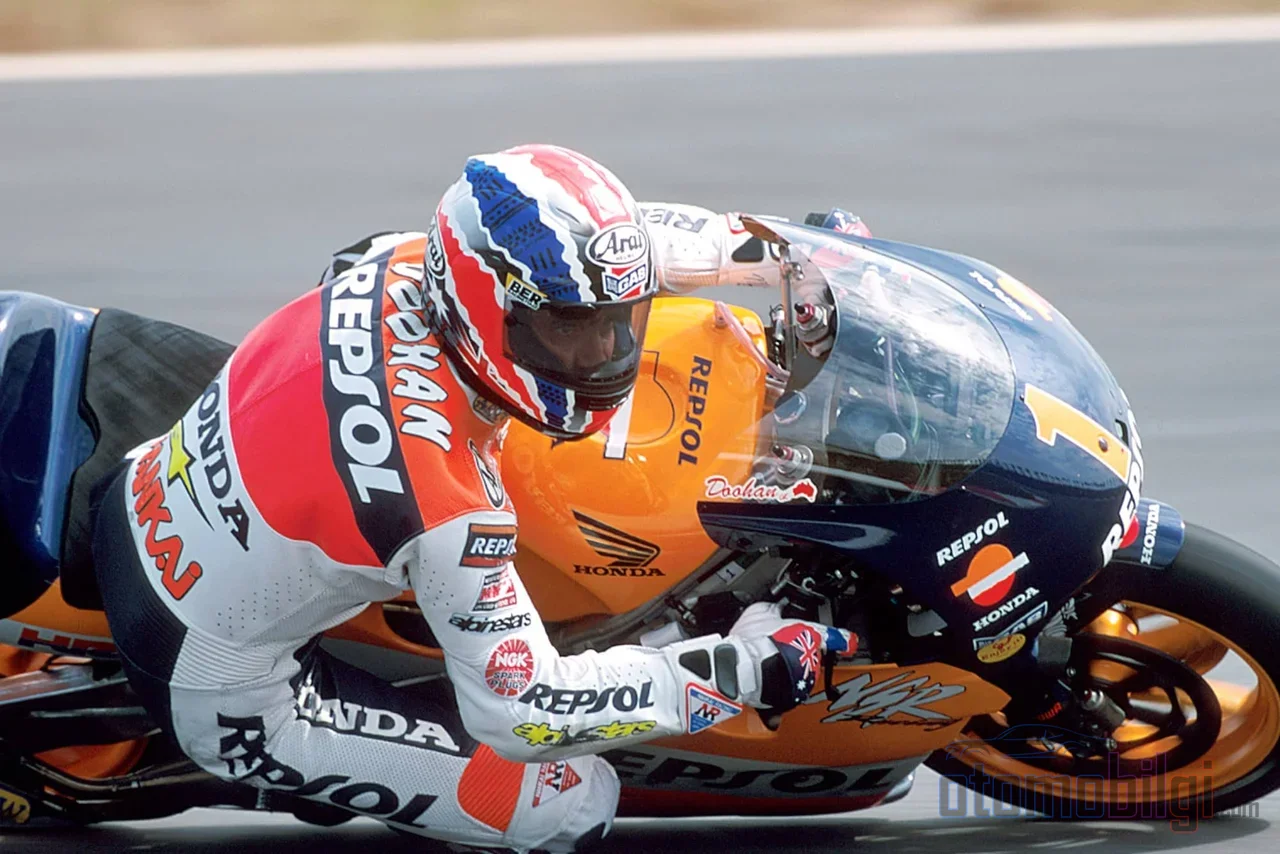
June 1992, Assen. A spiral fracture of the right tibia, compartment syndrome developing within hours, a leg starved of blood, and a 24-hour surgery ultimatum. Just as doctors were about to amputate, one surgeon tried another solution: sewing the legs together. Eight weeks later, the same man was back on the race track. And what came after? Five consecutive 500cc world championships between 1994 and 1998. Mick Doohan's story is not only the wildest comeback in motorcycle racing history - it is also a textbook example of pure tactical brilliance, showing how to make an engine's throttle obey. So how does a rider whose leg was nearly amputated become the champion of champions?
Assen 1992: The Leg Was Nearly Lost
The Dutch TT of June 26, 1992 had begun like an ordinary race weekend on Doohan's road to the peak of his career. He was 53 points ahead of Kevin Schwantz in the championship, meaning everything was under control. Then he crashed in the second practice session. The next day, he crashed again, likely hitting a fluid spilled onto the track by another motorcycle. He suffered a distal spiral fracture of his right leg - the kind of break in the lower part of the bone that twists like a drill bit and burrows into the flesh.
Terrifying enough already, right? But the real disaster came after the surgery. Local doctors repaired the leg using a plate, screws and an epidural; within hours, compartment syndrome developed. Think of it this way: the muscles in your calf are wrapped in a sheath, and when they swell, this sheath compresses blood flow. As the pressure rises, circulation is cut off and tissue begins to die. Doohan's leg was struck by exactly this.
Amputation of the leg came onto the agenda. The surgeon said he would amputate if it did not improve within 24 hours. At that point, Dr. Claudio Costa stepped in and flew Doohan by air ambulance to his clinic in Bologna - a rather risky move, since the use of blood thinners posed a general health risk. When hyperbaric oxygen chamber treatment proved insufficient, Costa applied the cross-leg flap technique, using the blood flow of the left leg to keep the right leg alive. The result? Doohan's legs were joined together in a cast for 14 days. Yes, they really were sewn to each other - this is not an urban legend, it is a medical fact.
Years later, Doohan would say he had stopped counting how many surgeries he underwent, and that the wound opened roughly 10 centimeters. Permanent damage remained too: a loss of sensation in the leg and a 20-degree misalignment. The leg could only be straightened at the end of 1993, using the external fixator method known as the Ilizarov technique. It was so bad that during a test at Phillip Island, he ground down half of his numb toe without noticing.
Highlights
- Five consecutive 500cc world championships between 1994-1998
- Throughout his career, 54 wins, 95 podiums and 58 pole positions
- The 1994 championship was won by a margin of 143 points
- 1997: 12 wins from 15 races - his most dominant season
- After Assen 1992, the legs were joined in a cast for 14 days
A Comeback in Eight Weeks: What the 1992 Season Took Away
Now take a look at the scenario: if I had told you just now that someone whose leg was nearly amputated would race in the 500cc Grand Prix eight weeks later, you probably wouldn't have believed it. But that is exactly what happened. Doohan returned to the track at Interlagos 8 weeks after the accident and finished 12th; then he took 6th place at Kyalami. Wayne Rainey won the 1992 championship by just 4 points.
And here's an interesting detail: 1992 was the only season that awarded points only to the top 10. Doohan had taken more wins; in any other year, the points system could have handed him the championship. So that nearly amputated leg was lost by a margin cheap enough to cost a world championship. It sends a chill down your spine when you think about it, doesn't it?
The Thumb Brake: The Marvel of the Left Thumb
The technical side of the comeback is my favorite part of the story. Doohan could not move his ankle; therefore, he couldn't use the rear brake. For a motorcycle racer, the rear brake serves not only to slow down but also to stabilize the bike in corners. Doohan's solution was pure engineering genius: he designed a thumb brake operated with the left thumb - that is, a thumb brake. You can think of it as someone unable to use their right hand learning to steer with their left - but in a far more precise way.
The adaptation worked instantly: he made the podium in the second race of his comeback, and won at Mugello four races later. That was his first victory after the accident. Can an athlete, when a part of their body is lost, replace it with another part and get even faster? Doohan's answer was clear.
A Tactical Partnership with the Honda NSR500
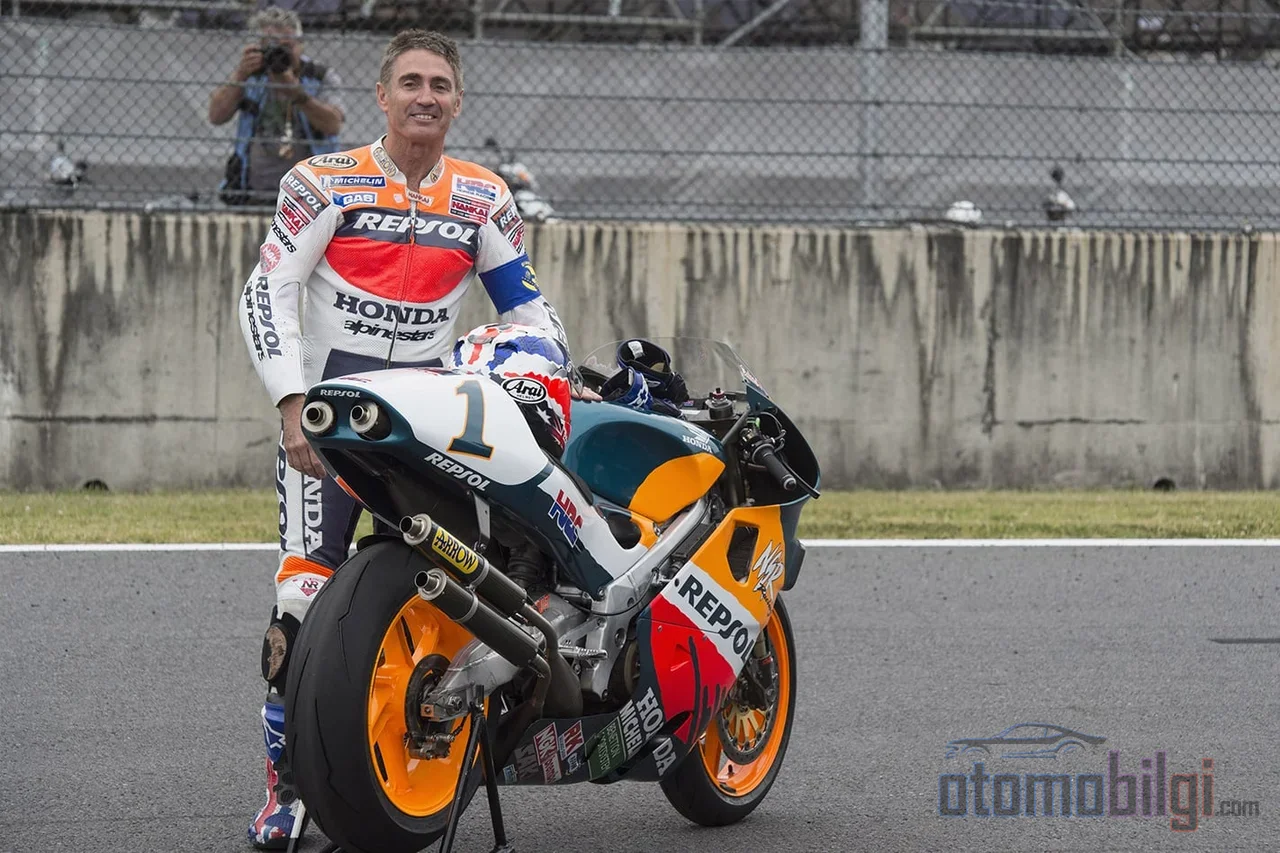
Doohan's five championships were written on the back of a single motorcycle: the Honda NSR500. This machine is known as a live beast whose front wheel lifts dangerously under aggressive throttle. According to test riders, you'd think you had opened the throttle two or three quarters, when in fact only a very small fraction of the throttle was actually usable - the engine was that laggy and that explosive. Doohan describes this engine as a "dead spot" requiring gentle touches on the throttle and disciplined throttle cut-off; in other words, reading the engine correctly was faster than forcing it.
During the race, Doohan shifted his body forward to transfer his weight onto the front wheel; thus physically compensating for the engine's tendency to lift its front end. The interesting thing is: Doohan himself didn't even believe his riding style was the ideal match for the NSR500. He also refused to soften his 1997 NSR500 - he wanted a lively and aggressive response. In short, the engine didn't crush him; he imposed his own discipline on the engine.
How Were Five Consecutive Championships Won?
Here's the real question you're looking for: how does one win five championships in a row? The answer is not a single superpower, but the overlap of several factors. First, that thumb brake adaptation, because it gave him complete braking control despite his numb leg. Second, physical compensation - by shifting his weight forward, he solved the front-tire problem for the engine. Third, throttle and speed discipline: while everyone tried to use the full power of the NSR500, Doohan knew when to back off. Finally, the long-lasting technical partnership he built with the Honda NSR500 gave him a platform he remained loyal to throughout his career.
The numbers tell the story:
| Season | What Happened |
|---|---|
| 1994 | 9 race wins, championship with a 143-point margin |
| 1997 | 12 wins from 15 races, his best season of his career |
| 1998 | 8 wins, fifth championship secured with the Australian GP |
| 1994-1998 total | 44 wins and 15 second places in 71 races |
| Career total | 54 wins, 95 podiums, 58 pole positions |
Five consecutive premier class championships is an achievement recorded only alongside Giacomo Agostini and Valentino Rossi in all of MotoGP history. A man who started 137 races over his career and won 54 of them - meaning a career in which half of his race starts ended in victory. His premier class win rate is around 49.1%. Racing with that ratio means you have a chance of winning every other race. Even a 15-year-old would lose their mind over these numbers, right?
1999 Jerez: The Crash That Ended His Career
Every legend has a final chapter, and Doohan's unfortunately carries a cruel symmetry. During practice for the 1999 Spanish GP at Jerez, he crashed on his Repsol Honda at a speed exceeding 200 kilometers per hour. His right leg, shoulder and left wrist were broken. In August 1999, surgery to remove the plate and six screws from his left wrist came up. In December 1999, Doohan announced his retirement.
Think about it: The man who nearly lost his leg in 1992 had his career ended once again by a crash. But Doohan explained that he found this acceptable, because this time the injury was the reason he was quitting racing. It was not hard to accept - perhaps what he had already learned from his leg's story was the cost of denying the body's limits.
Legacy: Rossi or Doohan?
Now let me give you my favorite debate: Who is greater, Rossi or Doohan? Doohan's race engineer Jeremy Burgess approached this question with a nice distinction: Valentino enjoys racing, while Mick Doohan enjoys winning. In other words, for one, racing is a passion; for the other, winning is a necessity. Both are among the best in the world; both are in the club of five consecutive championships. But even Doohan himself used to say that Rossi was ahead of him by 10 years and that everyone would surpass his achievements. In my opinion, a champion showing such open admiration for the very man likely to break his records only makes his legacy stronger.
Today, while watching the battle for supremacy in the 2026 season between Ducati, Aprilia and the others, Doohan's name is still being talked about; he remains in the spotlight both through the years he served again as race general manager and through his prominent comments on this championship battle.
So What Does Doohan's Story Teach Us?
Mick Doohan nearly lost his leg at Assen in 1992; He won five consecutive 500cc world championships between 1994 and 1998 thanks to the invention of the thumb brake, his ability to compensate physically, the throttle-cutting discipline he imposed on the Honda NSR500, and his long-lasting collaboration with Honda; The 1999 accident at Jerez ended his career, but etched his name among the greatest in motorcycle racing history.
Sources
- Mick Doohan and MotoGP's greatest comeback
- Mick Doohan - Wikipedia
- Mick Doohan: How I rode
- SR Archive: Riding Mick Doohan's Honda NSR500
- RETROSPECTIVE | Mick Doohan & the Honda NSR500
- MotoGP Q&A - Mick Doohan
- Doohan's career comes to the end
- Burgess: Rossi versus Doohan
- Mick Doohan: The man, the myth, the legend
- Mick Doohan - MotoGP Riders