How Did Nils Bohlin Invent the Three-Point Seatbelt?
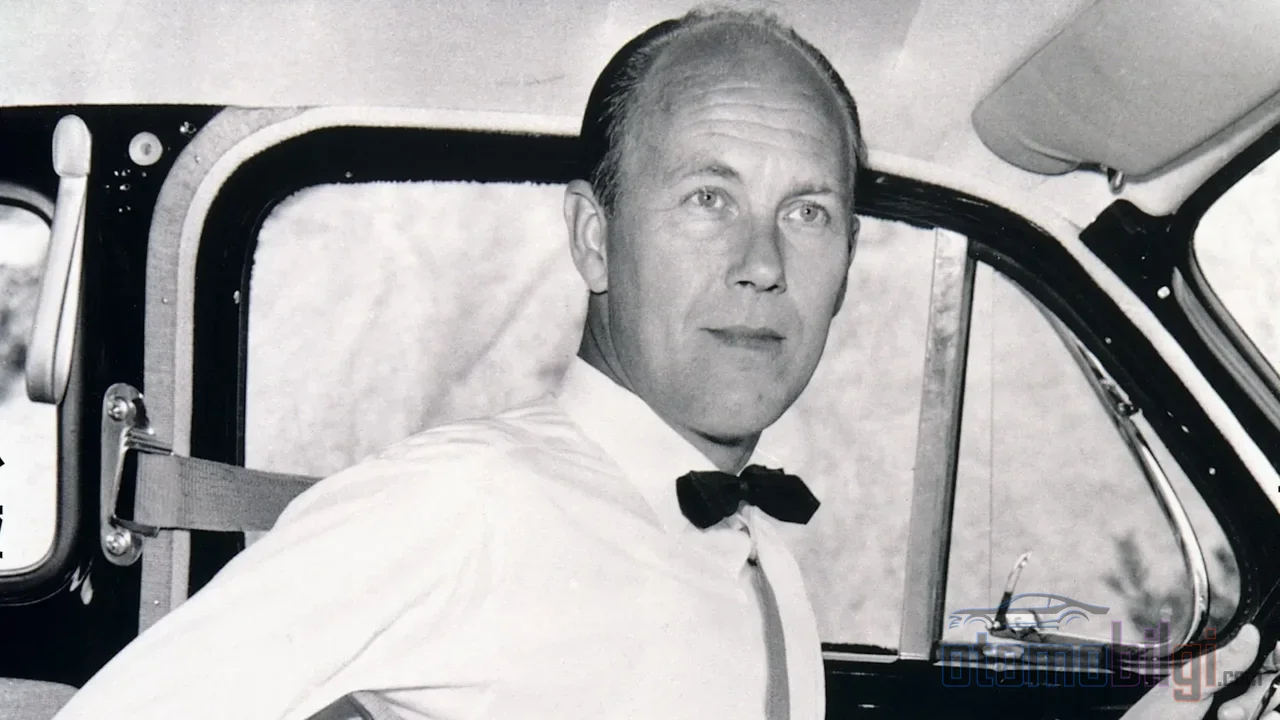
Take a moment to think: Almost every car you get into today, that single motion we make with our arm to fasten a seat belt, took shape on an engineer's desk in Sweden in the late 1950s. Perhaps you've heard how Nils Bohlin invented the three-point seat belt. But did you know that the belt grew out of his work on ejection seats at an aircraft company, and that its patent was licensed completely free of charge from start to finish? This story contains both engineering brilliance and a decision by an automotive giant that is generous enough to surprise you. If you're ready, let's begin.
From the Ejection Seat to the Car: Who Was Bohlin?
Nils Ivar Bohlin was born on July 17, 1920, in the city of Härnosand, Sweden. He received his mechanical engineering diploma in 1939, and in 1942 he started working as an aircraft designer at the aircraft manufacturer Saab. His job there was anything but ordinary: he contributed to the development of the ejection seats that saved pilots' lives. In other words, Bohlin had learned how to secure the human body against tremendous forces in the most demanding environment of all: in the air.
In 1958 he moved to Volvo as a safety engineer; he was the brand's first safety engineer in this field. Just think about it: Someone who had spent years designing systems that catapulted pilots out of an aircraft in seconds was now going to do exactly the opposite. He would build a system that did not throw the pilot out of the vehicle, but kept him inside it during a collision. It is the same physics, working in the opposite direction; the belt's tying of the body to the carrier was what saved a person in both cases. Bohlin got to work, and after about a year of effort he introduced the three-point belt to Volvo in 1959. A patent application was filed in the United States the same year (patent no. 3,043,625); the application was submitted in August 1959 and registered in July 1962.
Highlights
- Bohlin joined Volvo in 1958 and introduced the three-point belt in 1959.
- The belt was first offered in the Volvo PV544; the first car was delivered in August 1959.
- The three-point belt reduces the risk of serious injury by 60%.
- Volvo opened the patent to the entire industry free of charge.
- It is estimated that the belt has saved at least 1 million lives to date.
How Does the Belt Protect the Body in a Collision?
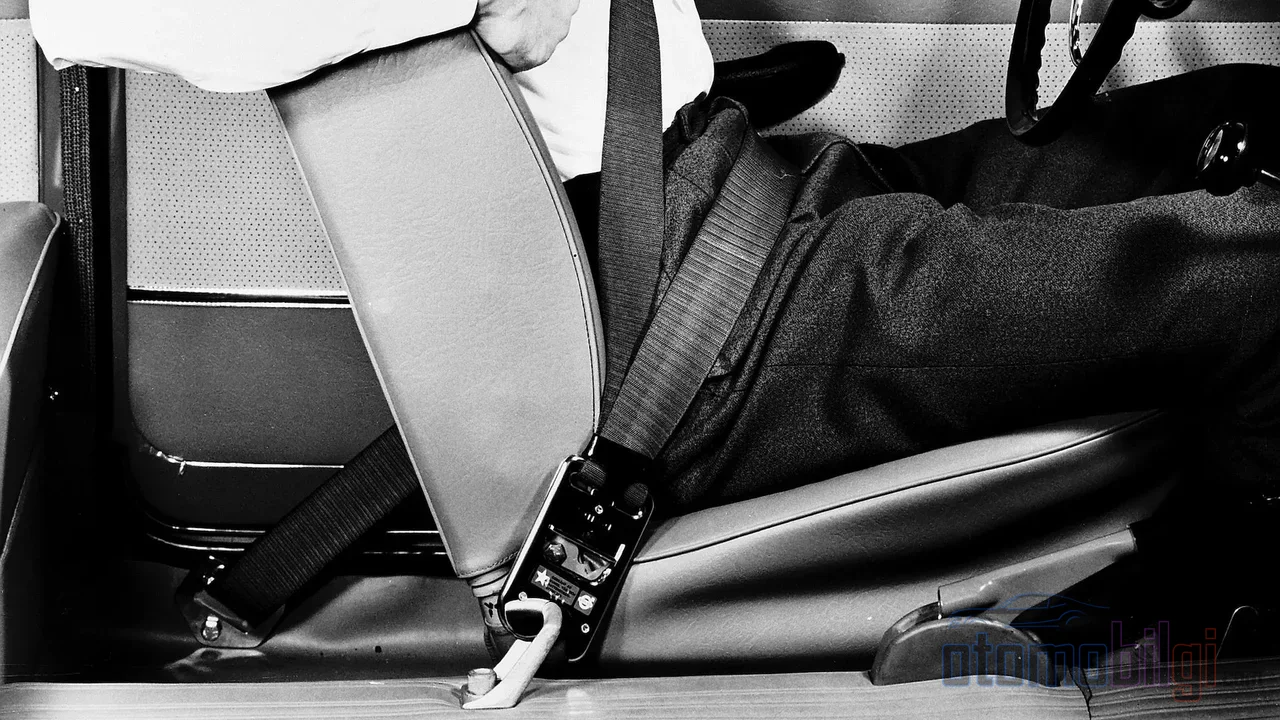
The mechanical side of the story is where things get really exciting. The common solution back then was the two-point lap belt: it held the pelvis, but the upper body remained free. A collision means a massive force trying to throw not just your hips but your entire body forward. While the lap belt held the hips, the upper body lunged forward, creating serious danger for the chest, head and neck.
One Strap, Two Jobs
The essence of Bohlin's invention is remarkably elegant: a single strap that combines the lap band and the diagonal body band into one piece, anchoring to a lateral point at hip level. Thus a single anchoring point holds both the pelvis and the upper body over the shoulder. The patent text summarizes it in technical language: the belt effectively and physiologically favorably prevents the forward catapulting of the wearer's body. In other words, it distributes the collision load across the two most resilient areas of the body, the shoulders and hips. And it was designed so cleverly that it could be fastened with just one hand; Bohlin had anticipated from the start the fact that nobody would use safety equipment that was not easy to operate.
How Big Is the Difference Between Two-Point and Three-Point?
The numbers speak: among those using three-point belts, the rate of serious injuries is 60% lower, and other injuries 41% lower. The belt also softens the second collision, that is, the passenger striking interior parts of the vehicle, and prevents ejection from the vehicle; passengers without belts are at far greater risk of ejection. This means the belt does not trap the passenger inside the car, but absorbs the energy in a controlled way, bringing it down to a level the body can withstand.
1959: PV544 and Series Production
When the design was ready, Volvo did not hesitate. The three-point belt was introduced in 1959 on the PV544 model, and the first PV544 with belts was delivered in Sweden in August 1959. Within a short time the belt became standard equipment on all Volvo models, and Volvo went down in history as the first manufacturer in the world to fit three-point seat belts as standard in its vehicles. Not Renault, not Mercedes; a small Swedish brand. This stubborn pioneering on safety was no coincidence.
How Did Bohlin Prove His Claim?
A beautiful design is not enough; the automotive world wants results. Before introducing the belt to the US market, Volvo carried out a series of crash tests that confirmed the claims. And in 1967, at the 11th Stapp Car Crash Conference, Bohlin presented the results of a study covering 28,000 accidents in Sweden. The findings were striking: while unbelted passengers suffered fatal injuries across the entire speed range, in accidents below 60 mph no belted passenger had been fatally injured. As long as the passenger cabin remained intact, no fatal outcome was seen among belted passengers.
This data set spoke not with words but with tens of thousands of real accidents, and its impact was enormous. The study pushed the US Department of Transportation to make the three-point belt mandatory; in 1968, all new vehicles sold in the US were required to have belts fitted. One engineer's year of design work had changed the traffic rules of the world.
Why Did Volvo Give the Patent Away for Free?
Now for the part of the story that is as impressive as the engineering. Volvo opened Bohlin's patent for use by the entire automotive industry without charging any fee. The official account is clear: the patent was gifted to the industry with no payment or conditions demanded, and the invention thus became the world standard. The rationale was not marketing, but safety; the belt's benefit was far too great to be limited to the customers of a single brand. The brand's own assessment supports this: the patent is believed to have saved at least 1 million lives worldwide. According to NHTSA estimates, belts save approximately 15,000 lives every year in the US alone.
The funny thing is, this hardware that seems ordinary today was not welcomed by everyone in 1959. When the implementation in the PV544 first came out, some circles found it excessive, and it was even met with backlash. People were not used to a belt restraining them. Time proved Bohlin right; today, wearing a seat belt is legally mandatory in almost every industrialized country, and the three-point belt is standard in nearly every car produced in the world. Volvo continues this tradition of open sharing: the brand still shares its crash research data as open source today.
An Engineer's Legacy
Bohlin built his career at Volvo on safety; in 1969 he headed the brand's Central Research and Development Department, and in 1985 he retired as a senior engineer. The awards he received take up pages one by one: the 1974 Ralph Isbrandt Automotive Safety Engineering Award, membership in the Safety and Health Hall of Fame in 1989, the gold medal of the Royal Swedish Academy of Engineering Sciences in 1995, and the Automotive Hall of Fame in 1999. On September 21, 2002, he passed away at the age of 82; after his death, he was inducted into the National Inventors Hall of Fame.
How the Three-Point Belt Was Invented: Short Answer
The summary of the summary is this: Nils Bohlin moved to Volvo in 1958 with the experience he gained at Saab in pilot ejection seats of stabilizing the human body against forces, worked for about a year, and designed the three-point belt that combines the lap belt and chest belt in a single strap, distributing the load across the shoulders and hips. The belt hit the road in the Volvo PV544 in 1959, and Volvo opened its patent free of charge to the entire industry, turning the invention into a world standard.
The next time you get into a car and hear that familiar click, remember that behind it lies a 67-year-old decision of engineering and conscience. Not just an ordinary belt; the part that has saved the most lives in the world.
Sources
- Volvo Group - The three-point safety belt
- Nils Bohlin - Wikipedia
- University Volvo Cars - Automotive History 101
- DPMA - Three-point safety belt
- Volvo Cars - Pioneering automotive safety
- Seat belt - Wikipedia
- Wired - 3-Point Seat Belt Patented
- National Inventors Hall of Fame - Nils I. Bohlin
- Car and Driver - The Three-Point Seatbelt Turns 60
- Forbes - Volvo's Gift To The World