Why Does the Body Intentionally Deform? Crumple Zone Engineering
Share This Page
The crumple zone, meaning a deliberately deformable region, is a structural safety zone designed to absorb collision energy by intentionally crushing at the moment of impact. So our car being crushed is not a defect; quite the opposite, it is the engineers' greatest gesture: the body sacrifices itself, the passenger cabin is protected. But how is metal designed to crush so intelligently? That is exactly what we will discuss on this page.
Highlights
- The concept belongs to Mercedes-Benz engineer Béla Barényi; it was patented in 1952 under number 854157.
- The first full application was seen in the 1959 Mercedes W111 "tail fin" model.
- The passenger cell is made of ultra-high-strength steel and boron alloys, while the deformation zones are made of mild steel and aluminum.
- Hollow steel profiles called crash boxes protect the main structure in light collisions of up to about 20 km/h.
- Advanced high-strength steels can reduce vehicle weight by up to 25% .
Why Does Crushing Save Lives? Physics' Brutal But Clear Answer
First, let's clear up the wonderful question in our heads: "If the car is solid, I'm safe, right?" No! The golden rule of collision physics is this: the change in momentum is constant, but the longer this change takes, the lower the force involved. We can summarize the formula as F·t = m·v; that is, the average force is inversely proportional to the duration of application.
Now let's connect this to real life. Imagine you're running toward a wall and can't stop, so you crash - there are two scenarios: either a hard wall, or a giant cardboard box. The cardboard crushes and slows you down, while the wall stops you instantly. Same impulse, completely different outcomes. In fact, in a fully elastic, i.e. bouncing, collision, the impulse acting on the vehicle and its occupants can even double; the crumple zone exists precisely to prevent this.
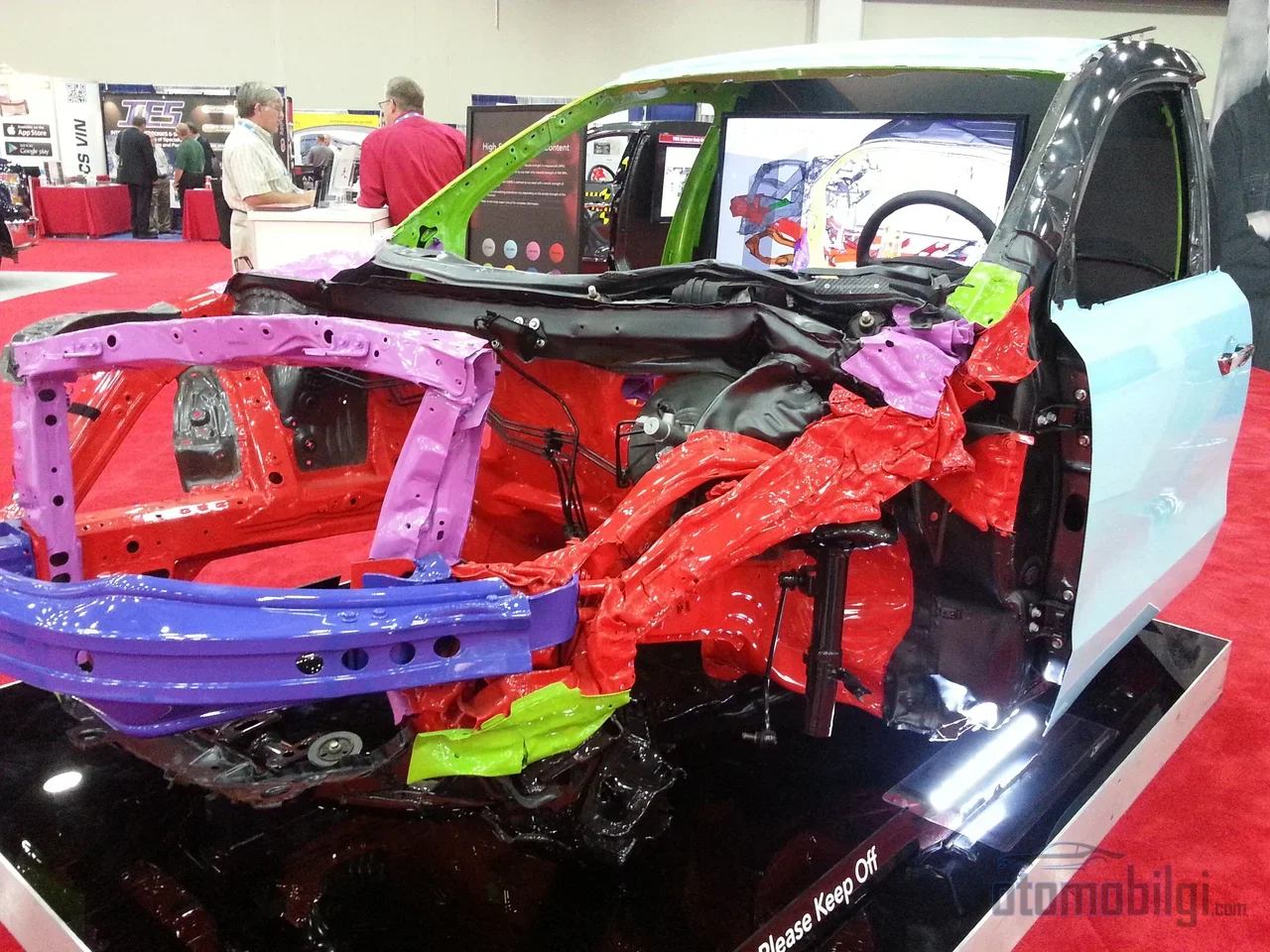
The crumple zone does two things at once: it reduces the initial force of the collision and redistributes the remaining force before it reaches the passenger. Kinetic energy is converted into heat and structural deformation energy as the front frame rails, called the longitudinal members, and crush tubes fold inward. The crushing metal acts as a kind of energy-absorbing sponge. Pretty logical, right?
Béla Barényi and History's Best "Bad Idea"
Béla Barényi, a Mercedes engineer, went down in history by questioning the prevailing view of his era that "a safe car must be rigid." He patented his first idea in 1937 and its refined form in 1952. His genius was dividing the body into three parts: a rigid passenger cabin in the middle, and deliberately deformable zones at the front and rear.
The 1953 Mercedes "Ponton" was a partial implementation of these ideas; the first full implementation came with the 1959 W111 "tail fin". In that model, the middle of the body was a flat and rigid safety cell, while the front and rear supports were designed to deform while remaining curved, absorbing energy. What followed developed quickly: telescopic "crash can" structures weakened with vertical and horizontal ribs were added to longitudinal members, and in the early 1990s Volvo introduced the side crumple zone concept with a side impact protection system called SIPS.
There is also a legendary test showing how much of a difference it made: an offset crash test between a 1959 Chevrolet Bel Air and a 2009 Malibu laid bare just how superior modern design is. The old car's cabin was shattered to pieces; in the new car, the cabin remained intact. In other words, the phrase "cars used to be built like rocks" shows exactly the opposite: a car built like a rock transmits a rock-solid impact to the passenger.
How Is the Body Designed? The Balance of Soft Zones and a Strong Cell
This is where engineering's most elegant balance begins. If you make everything from the hardest steel, there is nothing to absorb energy and the impact goes straight to the passenger. If you make everything soft, the cabin gets crushed. That is why the body is divided into zones, like the test tube of a chemist who has practiced: easily crushed mild steel and aluminum in the deformation zones, and ultra-high-strength steel and boron alloys in the passenger cell.
This is precisely the core of crashworthiness design: calibrating the crumple zone, down to the millimeter, in advance to absorb the vehicle's kinetic energy in a collision. In a well-designed crush zone, deformation grows only at selected locations and in a controlled manner, allowing maximum energy absorption to be maintained. In other words, crushing is no accident; it follows a map drawn by the engineer.
AHSS: The Balance of a Material That Is Both Strong and Light
"But how do strength and crushability fit into the same car?" you may ask. The answer lies in materials science: advanced high-strength steels (AHSS) perform better in collision energy management than classic HSLA steels while also offering better formability. High-strength steel sheet has higher yield and tensile strength than mild steel; this opens the way to reinforcing the safety cell while lightening the body. Current AHSS grades can reduce structural weight by up to 25%, which lowers lifecycle CO2 emissions by up to 15%. In other words, safety and efficiency shake hands.
There is another small but critical part: the crash box, or crash tube. These hollow steel profiles used in bumper mounting, at approximately 20 km/h, converts energy by rolling up its profile in light impacts up to a certain speed, preventing damage to the main load-bearing structure. That moment when you look at the car you lightly bumped in the parking lot and say "the bumper is reset, we got lucky" actually involves serious engineering. The racing world isn't sitting idle either: impact attenuators made of aluminum, carbon fiber honeycomb, or energy-absorbing foam distribute energy with much smaller volume and weight than road cars. And a fun detail: since electric vehicles have no engine block at the front, engineers can design deeper front crumple zones.
Power Transmission Paths: The Route Drawn So Energy Never Reaches the Passenger
Absorbing energy isn't enough; the portion that can't be absorbed must also be directed to the right address. This is where the concept of load path comes into play. Engineers direct collision energy around the passenger cell using controlled deformation zones and load paths; the design goal is to minimize the load transferred to other structures. In a frontal collision, the front structure and crumple zones must absorb energy in a controlled manner through plastic deformation.
Why is this route more developed at the front and rear? Here's an interesting statistic: 65% of damage in passenger vehicles occurs at the front, 25% at the rear, and the remaining 10% on the sides. That's why the largest crumple zones are at the front. New developments have been added on top of this; new load transfer structures that increase load at the onset of a collision and suppress body deformation are still being researched. Crashworthiness optimization of thin-walled S-frames is also an active research topic. And there are radical ideas too: the 2004 experimental Pininfarina Nido tried a design that places crumple zones inside the survival cell - the cell on a sled is decelerated. Volvo also developed a similar sliding seat concept for small cars; the seat slides forward by up to 20 cm and a shock absorber absorbs the peak energy.
How Does Body Structure Determine Scores in Euro NCAP Tests?
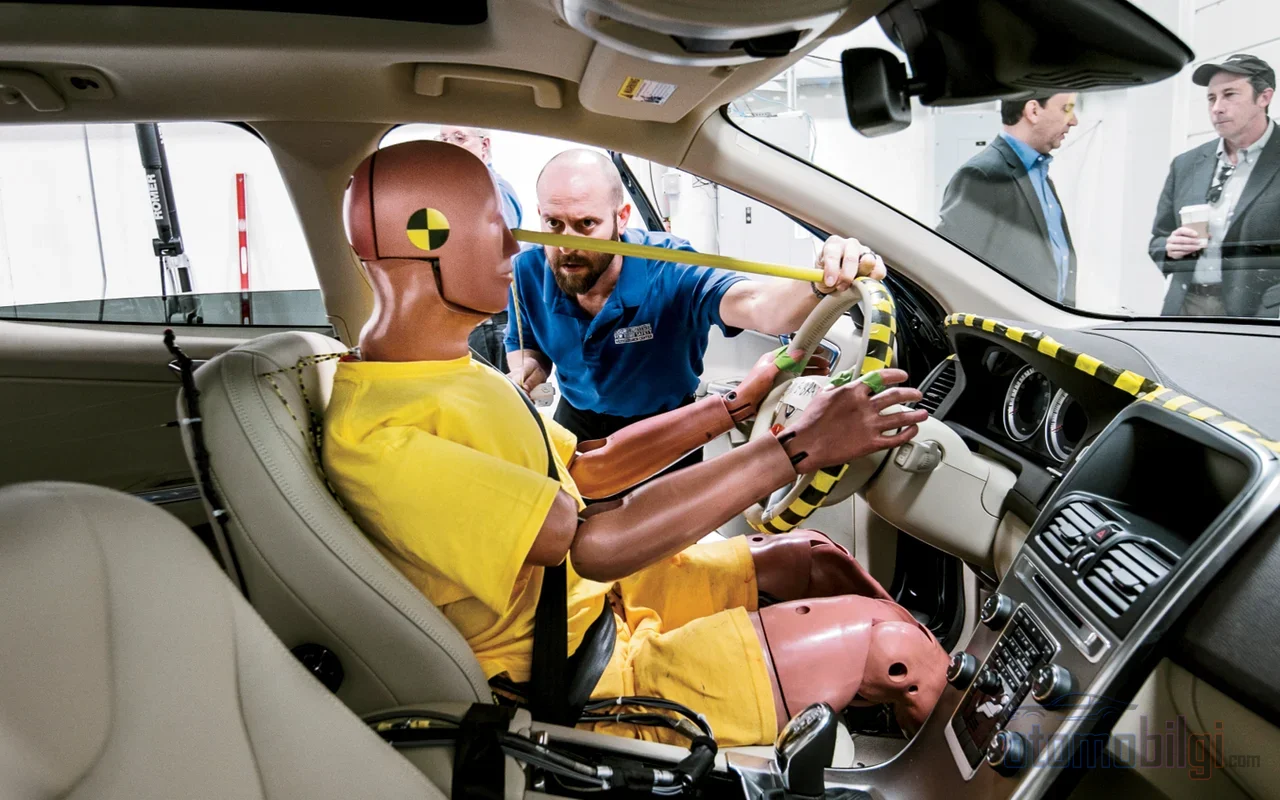
Theoretical engineering is nice, but doesn't it need proof on stage? This is exactly where Euro NCAP comes in. The assessment analyzes measured collision forces to examine the probable injury severity to critical body regions such as the head, pelvis, and legs. The protocol's fundamental principle is very clear: structural integrity is to be preserved and the risk of passenger ejection is minimized. Forces are measured for test dummies in four main regions: head-neck, chest, pelvis/femur/knee, and lower leg/foot/ankle.
The basic test format is the offset deformable barrier test, simulating a 50 km/h head-on collision with 50% overlap between two vehicles of equal mass; the Global NCAP version is conducted at 64±1 km/h. And here are concrete examples of how body structure directly affects the scores: in one model's test, failure at spot welds during the collision caused the structure to lose its integrity and increased the risk of deformation around the cabin - so even weld quality affects the stars, in other words. In a 2018 test, footwell deformation showed that the structure had reached its integrity limit. One more small note: getting five stars is not a guarantee of good performance in low-speed collision tests. The stars focus on cabin protection; they don't get involved with bumper-level matters.
| Region | Material and Role |
|---|---|
| Front/rear crumple zone | Soft steel and aluminum; absorbs energy by folding |
| Longeron rails | Designed to crush with accordion-type folding |
| Crash box | Rolls up its profile in a light collision up to ~20 km/s, protecting the main structure |
| Passenger cell | Stays rigid with ultra-high-strength steel and boron alloys |
| Side structure (SIPS) | A separate deformation zone for side impacts since the early 1990s |
Frequently Asked Questions and Confusing Facts
"Why don't modern cars look as solid as old cars?"
Because looks are deceiving. Controlled deformation is intentional; a rigid body would not absorb energy and would transfer it directly to the occupant. What made the old ones "take little damage" was exactly what made them deadly: since the rigid frame did not absorb energy, the force passed directly to the occupant, and the deceleration time did not lengthen. Vehicles with crumple zones may take more damage when colliding with stiff SUVs, but their occupants are generally less affected. Moreover, since SUVs' "hard points" on the chassis rails are higher than those of cars, they can bypass the other vehicle's crumple zone; that's why sub-frame structures are added to new SUVs so that the opposing side's deformation zone can engage.
"Does the crumple zone replace the seatbelt and airbag?"
No, and this is very important. The crumple zone reduces the force reaching the passenger compartment; the seatbelt and airbag hold and cushion the occupant. Some unabsorbed force inevitably remains, and that is where the seatbelt comes in as a complementary element. They work together as a system - none of them is sufficient on its own.
"Can a crushed car be repaired?"
Generally yes, if the deformation has not compromised the cabin's integrity. But pay attention here: even a rail misalignment of a few millimeters can affect suspension geometry and ADAS sensor positions. That's why returning to OEM specifications with electronic measuring systems is essential during repair. The era of "we'll hammer it straight" is long over.
Let me leave you with one final sentence: the next time you see metal crushing in a crash test video, don't get upset - that crushing is the gentlest outcome in the scenario for the dummy in that cabin.
Sources
- Crumple zone
- What Is a Crumple Zone? How Cars Absorb Impact
- How Crumple Zones Work and Save Lives in Car Crashes
- Crumple Zone - an overview
- Crash Archives - AHSS Guidelines
- Types of High Strength Steels in Cars
- Design of Vehicle Structures for Crash Energy Management
- Modelling and Analysis of the Crush Zone of a Typical Vehicle
- How cars are tested for safety - Euro NCAP
- Euro NCAP Assessment Protocol - AOP - v9.1.3
- An Evaluation of the EuroNCAP Crash Test Safety Ratings
- Why do modern cars crumple up when they crash