How Do Dirty Cameras and Sensors Affect ADAS?
Share This Page
You got in your car in the morning, turned the ignition, and a warning you never expected appeared on the dashboard: camera dirty, system unavailable. Yet when you look at the windshield from the mirror, it appears spotless. This is precisely the most insidious enemy of ADAS: a thin, invisible film of water, a greasy wiper streak, a crust of ice, or a layer of mud stuck to the grille. So which sensor is where, what does dirt disrupt, and what should you do?
Your Car's Sensor Map: Where Are the Camera, Radar, and Ultrasonic Sensors?
A modern car does not see with a single eye; it is practically surrounded by a network of sensors. The forward-facing camera is usually mounted on the windshield, right near the interior rearview mirror, and looks at the road through a specific viewing area of the glass. The front radar, the heart of adaptive cruise control, is hidden behind the grille, the emblem, or the front bumper. The ultrasonic sensors we call parking sensors are placed in the bumpers, while the radars for blind spot warning are located in the rear bumper or door area. For parking and surround view, external cameras also come into play.
This distribution is very important, because each sensor has its own weak point. An insect residue stuck to the windshield blinds the camera while not bothering the adaptive cruise control at all. But snow and mud smeared on the front of the grille can render the radar completely inoperable. In other words, there is no single cleaning routine; each sensor has its own surface.
How Does Dirt Really Blind the Sensors?
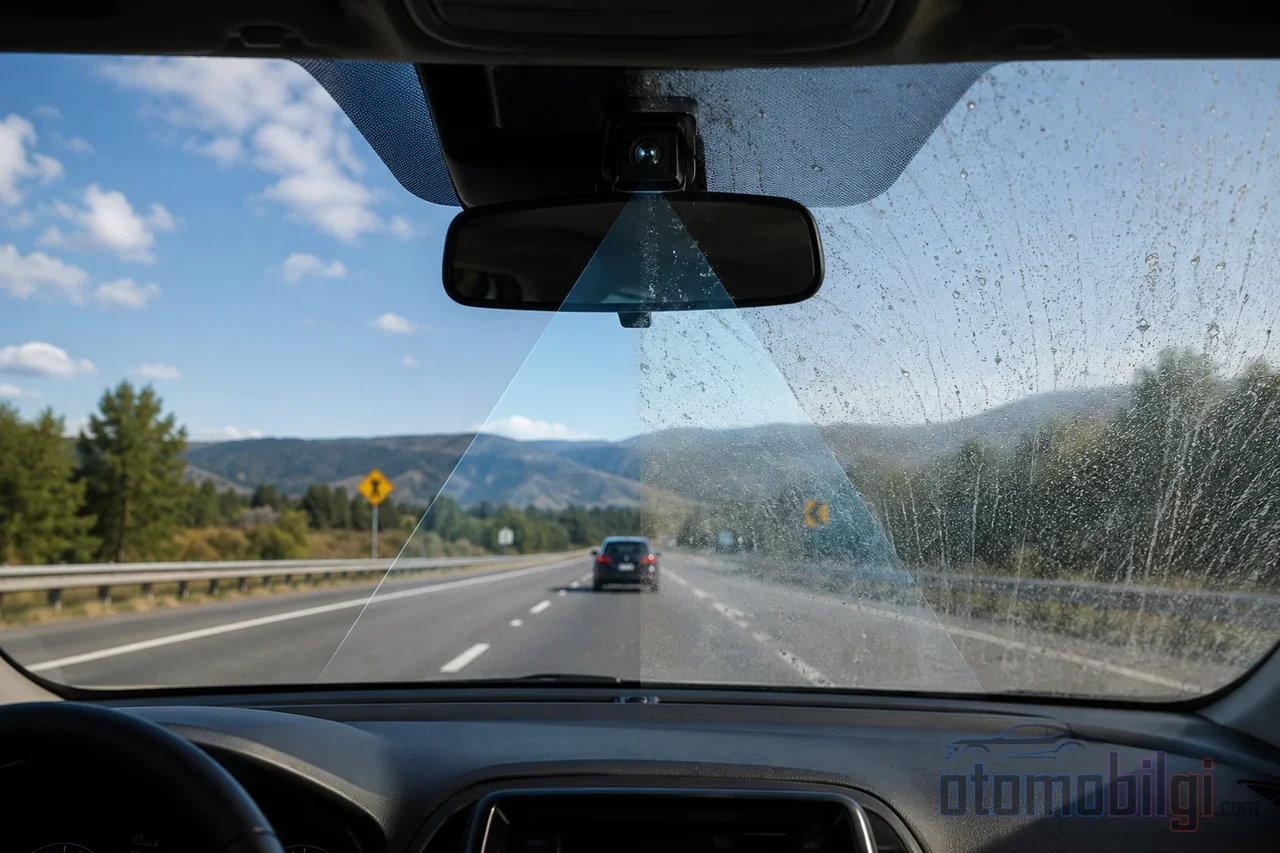
A camera does not perceive like a human. It recognizes the lane line, signs, and the vehicle ahead by processing contrast, edges, and shapes. Dirt covering the camera area, a film of water, wiper streaks, snow, or ice reduces the contrast of this image. The result? The system cannot see the lane, cannot read the sign, and may detect the vehicle ahead late. Even if the sensor itself is fine, if the information reaching it is corrupted, the system is the same: it cannot see.
The most crucial detail is this: there are obstructions the driver cannot notice. A thin film of water, a transparent sticker or film, greasy cleaner residue, fogging on the inner surface of the glass, fine scratches, washer fluid droplets... Even a dashcam, phone holder, or a textured badge can block the camera's field of view. Depending on light conditions, something completely invisible to your eye can lock up the entire system. So just because you cannot see it does not mean the camera cannot see it either.
Highlights
- The forward-facing camera is usually located near the interior rearview mirror, and the front radar behind the grille or emblem.
- Lane keeping, traffic sign recognition, forward collision warning, and some automatic emergency braking systems are directly affected by camera contamination.
- Adaptive cruise control is not affected by a dirty windshield; but its own radar surface can be covered by snow and mud.
- If the warning message does not go away after cleaning, the problem may be a scratch, a chip, or a calibration shift.
Which System Is Affected? Camera or Radar?
The answer depends entirely on which sensor the system relies on. Here is a practical summary:
| Sensor | Location | Affected Systems |
|---|---|---|
| Forward-facing camera | Windshield, area around the interior mirror | Lane keeping/warning, traffic sign recognition, forward collision warning, some AEB |
| Front radar | Behind the grille, emblem or bumper | Adaptive cruise control, some forward collision systems |
| Ultrasonic sensors | Front and rear bumpers | Parking assist |
| Side/rear radars | Rear bumper or trunk lid area | Blind spot warning |
| External cameras | Around the body/bumper | Parking and 360-degree view |
The summary of the table is this: a dirty windshield does not disable all ADAS. Camera-based features drop out, while radar and ultrasonic-based ones keep working as long as their own surfaces are clean. In hybrid systems, that is, vehicles using both camera and radar, the job is a bit more complicated; the logic varies from vehicle to vehicle, so it is worth checking your vehicle's manual.
Does the System Notice When It Gets Dirty? Warnings and Behaviors
Modern vehicles often notice the blocked camera and display a clear message on the instrument panel: warnings such as "camera dirty, system currently unavailable." A similar scenario occurs when the radar surface is covered with snow or ice; in some vehicles, messages telling you to clean the radar directly appear. When a warning appears, the affected feature is usually disabled or works in a limited way.
The golden rule here is: if the warning disappears after cleaning, the problem was most likely on the surface. But if a blur or glare persists despite cleaning, the issue may be more serious; it could be a problem caused by a scratch, chip, crack or glass quality. And be careful: the system is not obliged to warn you in every case. In some situations, performance may silently decrease. That is why taking precautions instead of waiting for a warning is much smarter.
Proper Cleaning: What Should You Do, and What Should You Absolutely Not Do?
Safe Cleaning Steps
First the outer surface: wipe the camera's field of view with a suitable automotive glass cleaner and a clean cloth. If you can safely access the inner surface, clean it with the same care, because internal condensation and inner surface dirtiness can really cause problems. Make sure the washer fluid reservoir is filled with a fluid suitable for your climate; a clogged spray nozzle leaves the camera area dirty. Be gentle when cleaning the sensors in winter; salt and sand can both damage the paint and scratch sensitive surfaces; you can dry them with a clean paper towel or cloth.
Things Not to Do
- Do not remove the camera cover or touch the optical components; do not attempt calibration on your own.
- Do not apply harsh materials or excessive pressure to ADAS camera windshields; the alignment can be thrown off.
- Do not use the wiper blades as an ice scraper; freezing can damage the mechanism, the arm, and even the motor. Let the ice melt first.
Do not forget that manufacturers are also on this case. In some vehicles, sensor cleaning systems such as rotating lens covers, camera wipers, washer fluid spraying or heating come as standard. So the problem is so serious that the entire industry is developing solutions.
Winter's Biggest Enemy: Snow, Ice and Road Grime

Winter conditions are a separate exam for sensors. Ice, frost and road grime can blind sensors and camera lenses without any warning; forward-facing cameras in particular are very sensitive to ice. Fog, blowing snow and sunlight reflecting off icy surfaces also weaken the system's vision; heavy snow can completely hide lane markings. A picture similar to a dirty camera losing lane markings forms much more easily in winter.
AAA's controlled test reveals an interesting nuance: moderate simulated rain affected the tested automatic emergency braking and lane-keeping systems; but the simulated dirty windshield condition did not noticeably degrade performance. So not every smudge means the system will fail; what matters is the amount and type of dirt combined with light conditions. Still, if you want to stay on the safe side, the rule is simple: reduce your speed in snow and ice, increase your following distance to at least three times the normal, and check the sensor surfaces before setting off.
Slipping Instead of Dirt? The Calibration Connection
Sometimes the problem isn't solved by cleaning, because the actual issue is the sensor's angle. After a windshield replacement, camera and radar calibration is mandatory for most manufacturers; even a 1-degree shift in the camera's angle can mislead the systems. Minor collisions, suspension work or part replacements can also change the sensor angle. Static calibration is done in the workshop with targets, dynamic calibration on a controlled road; some vehicles require a combination of both. In short, if the warning persists even after cleaning, an expert should take a look.
The Driver's Real Responsibility: ADAS Is an Assistant, Not a Chauffeur
Everything I have explained so far fits into a single sentence: ADAS is not self-driving, it is the driver's assistant. It can intervene in emergencies, but attention and control are always yours. Even the rear-view camera is not a substitute for the mirror and turning your head; if you don't clean and check them, the system can quietly go blind. Even if no warning appears, watching your speed, following distance and visibility is your job.
So the answer to the question is now clear: dirty cameras and sensors quietly weaken ADAS perception; which system is affected depends on which sensor, and a warning usually comes but not always. Before setting off, spare 30 seconds, review the camera area and grille, and defrost the windshield properly in winter. Such a small habit makes a big difference on the road. Don't you think a small cloth and a two-minute check are worth all these systems working safely? Absolutely, in my opinion.
Sources
- How a Dirty Windshield Can Affect ADAS Performance - TOPEX
- How to Keep Your Car's Safety Sensors Clean During Winter - Consumer Reports
- How To Maintain Your ADAS Technology - ADAS Solutions USA
- The Different Sensors ADAS Systems Use - CarADAS
- Driver Assistance Technologies - NHTSA
- Driving with Clean Sensors on the Road, Rain or Shine - Genesis Newsroom
- Understanding Adaptive Cruise Control - MN ADAS
- Winter Safety Tips for ADAS Calibration - Siouxland Glass