How Are ADAS Systems Affected When Towing a Trailer or Caravan?
Share This Page
The moment you attach a trailer or caravan, your vehicle's ADAS systems lose their effectiveness: adaptive cruise control recalculates the following distance based on the trailer, blind spot monitoring watches behind the vehicle but not behind the trailer, and the rear radar sensors are blocked by the trailer body, so they either work incorrectly or shut off completely in some vehicles. In other words, even though the systems appear to still be working, you are actually driving not a vehicle but a vehicle-plus-trailer combination, and the computer cannot see half of it.
Highlights
- Blind spot monitoring watches only about 3 meters from behind the vehicle; the trailer body remains outside this zone.
- GM recommends disabling park assist, automatic reverse braking, rear cross traffic alert, and lane change alert when towing a trailer.
- It is recommended not to use adaptive cruise control with an aftermarket trailer brake controller; it may not work correctly with the system.
- In February 2026, Side Blind Zone Alert that monitors the entire trailer was announced for the Silverado, and in December 2025, ACC capable of working with a trailer was announced for the Ram 2500.
- No driver assistance system replaces the driver; hands should always be on the wheel.
Does Adaptive Cruise Control Work With a Trailer? An Answer That Varies From Brand to Brand
The short answer: yes in some vehicles, no in others, and never recommended without the proper equipment. Adaptive cruise control (ACC) tracks the vehicle ahead using a forward-facing camera or a camera-radar combination. If the road ahead is clear, it drives at your chosen speed; if a vehicle enters your lane, it automatically slows down and maintains your selected following gap with that vehicle. But that's not where the good part ends, because if the vehicle ahead stops very suddenly, ACC has limited braking capacity; beyond that point, you receive a warning and braking is left to you.
When you attach a trailer, however, things change. For example, on GMC models, ACC can be used with trailers that are electrically connected and within approved size/weight limits; while towing, the system adjusts the following gap, acceleration, and braking rates according to the trailer. When you change the gap setting, a "TRAILERING" icon appears on the instrument display - if that icon is not there, your vehicle is not equipped for ACC with a trailer and you should not use ACC. A smart warning system, in my opinion.
Why doesn't everyone agree?
Some brands completely shut off cruise control the moment a trailer is detected at a campsite. The logic of those defending this approach isn't bad either: the computer cannot know the trailer's road behavior - its swaying, its extended braking distance. On the other side, manufacturers like GMC and Ram allow ACC to be used with adjusted parameters when using an approved trailer and the correct equipment. For example, it was announced that in the 2026 Ram 2500 ACC can manage speed while a trailer is attached. Researchers are even working on this: in 2025, "Smart Tow Assist" algorithms that automatically change ACC's time gap when towing heavy trailers were published. So there is no clear standard in the industry - but for you the rule is very simple: check the owner's manual, look for the trailer mode icon, and if it isn't there, leave ACC alone.
There's one more trap: aftermarket trailer brake controllers. Official recommendations advise against using ACC with these devices, because they may not work correctly with the system. Imagine ACC braking hard in an emergency while the trailer's own brakes don't engage - the rear is pushing you forward. A frightening scenario, isn't it?
Which Part of the Trailer Does Blind Spot Warning Actually See? None of It, Really
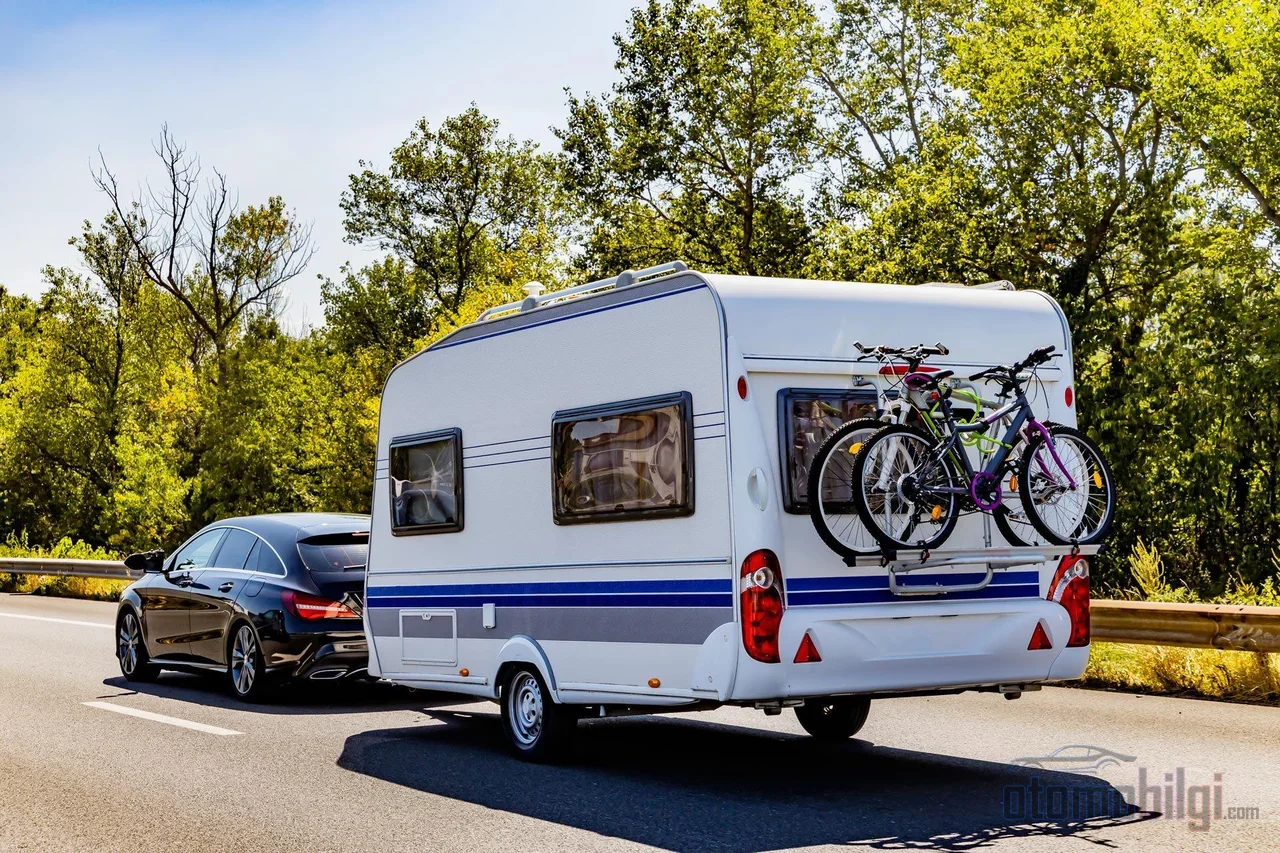
Blind spot warning sounds like a system that sees everything, but the detection area of the radars in the rear bumper extends from the side mirrors to about 3 meters behind the rear bumper. On the side, it scans a strip of roughly 0.5-3.5 meters from the vehicle body. Now let's do the math: when you attach a 6-meter caravan, the end of the trailer ends up about 9 meters away from the vehicle. That zone simply doesn't exist on the system's map - meaning the trailer becomes one giant blind spot that the blind spot warning can't monitor.
You'll like this analogy: the system is like a flashlight, illuminating only a small area right behind you. The trailer, meanwhile, is a dark wagon beyond that light. Ford's official service documentation explains the situation clearly: trailer coverage is restricted or completely disabled when one or both of the rear radar sensors are blocked, or when the attached trailer isn't configured correctly. Owners complain about and discuss this limitation too; one pickup owner shared that the system only monitors up to 33 feet(about 10 meters) for the trailer, while a significant portion of their 40-foot trailer remains completely unseen.
So is there no solution? There is, but it's not common. Trailer-specific dual radar kits aim to offer full coverage for long trailers along with rear cross-traffic alert. And there's a nice development: in February 2026, it was announced that the Chevrolet Silverado Trailer Side Blind Zone Alert system, which focuses on the entire trailer, automatically adjusts when a suitable trailer is attached. So manufacturers have clearly noticed this gap.
Why Do Systems Disable Themselves in Trailer Mode?
The logic here is actually very simple: the rear sensors are mounted on the vehicle's bumper and need a clear view behind them. The moment a trailer or something attached to the tow hitch blocks the rear, the sensors either constantly sound alarms or detect nothing at all. Neither is useful. That's why manufacturers prefer to switch some systems off - but how they switch them off is exactly where the mess begins.
- GM recommends disabling parking assist, automatic reverse braking, rear cross-traffic alert, and lane change alert when towing a trailer.
- In BMWs, the system shuts off the reverse sensors itself the moment it detects a trailer electrical load on the tow hitch.
- In Ram vehicles, the rear parking sensors switch off automatically with a 7-pin connector and an electrically braked trailer; with a 4-pin connection, they don't.
- Toyota RAV4 Prime owners manually disable their parking assist systems from the instrument panel.
As you can see, there are three different approaches: automatic deactivation, manual deactivation, and no deactivation at all. Things get annoying with the last group - some vehicle owners complain that the rear parking sensors don't turn off when towing a trailer, because they're bombarded with beeping on every reverse maneuver. The sensor deactivation button in some vehicles also can't control the front and rear separately; it turns them all off at once. So you lose the front sensors too.
What Does the Lane Keeping Assistant Do on a Vehicle with a Trailer?
The lane departure warning (LDW) gives a visual, audible, or vibration warning when the vehicle is leaving its lane but never touches the steering wheel. The lane keeping assistant (LKA), on the other hand, goes one step further and tries to keep the vehicle in its lane based on the lane markings it reads with the camera. Without a trailer, this duo can truly be a lifesaver. With a trailer, the story is different: caravan owners discuss on forums that LKA slightly nudges the steering wheel and reduces its intervention during an unsignaled lane marking crossing - meaning the system can misread your deliberate maneuver and get it wrong.
What's more critical is this: the camera sees the lane ahead but doesn't see what's coming up alongside the trailer. When changing lanes, only you can notice the vehicle next to the trailer. For a driver who relies on the lane assistant and maneuvers without checking the mirrors, this would be a danger beyond description. In a vehicle with a trailer, LKA should remain a "helper" - it should never be the "pilot."
As a Driver, Where Should You Focus Your Attention?
As NHTSA also emphasizes, all of these systems are meant to assist - not a single one of them replaces the driver. Even when the assist features are active, your hands must be on the steering wheel. When towing a trailer, this responsibility grows even bigger because, as you've seen, some systems don't work, some work partially, and some are completely off.
I recommend focusing your attention in this order:
- Mirrors: They are your only real source of vision with a trailer; if necessary, fit extension mirrors.
- Following distance: If you're using ACC, set the gap to its widest level; if you're not, leave much more space than usual.
- Trailer brake gain: Set the Trailer Gain correctly, and select Tow/Haul mode on steep hills.
- System display: Track which features are turned off via the in-vehicle indicator or messages.
- Speed: As speed drops, everything - braking, swaying, reaction time - works in your favor.
A study examining drivers' awareness of system limitations shows that this awareness directly affects safe use even among experienced drivers. In other words, knowing what the system you're using can and cannot see is not a luxury - it's a safety necessity.
Conclusion: The Systems Assist, but You're the Captain of Trailer Towing
When you attach a trailer, half of the car's brain disconnects from it: ACC can be adjusted for the trailer or switched off entirely, blind spot monitoring cannot see behind the trailer at all, the rear radars are blocked, and lane assist cannot detect vehicles alongside the trailer. Manufacturers are gradually closing this gap, but until then the formula is clear: know the system, learn which features are disabled, and trust your mirrors and your distance. We love hitching up a trailer with excitement, but the one sitting in the captain's seat is still you.
Sources
- About Adaptive Cruise Control
- Smart Tow Assist for Adaptive Cruise Control
- Does Adaptive Cruise Control Work While Towing on the 2026 Ram 2500
- Blind Spot Assist with Trailer Coverage Limitations
- Blind Spot Warning & More
- Maximizing F350 Blind Spot Camera Coverage for 40 ft Trailers
- How Trailer Side Blind Zone Alert Works on a Silverado
- Towtal View LaneGuard
- GM Recommends Disabling These Safety Features While Towing
- Disable backup sensor warning during towing?
- Trailer connected and rear parking off issue
- Parking sensors don't deactivate when towing
- Lane Keep Assist Safety Feature
- Lane Keep Assist, Auto Braking and Caravans
- Towing with new TV safety systems
- Driver Assistance Technologies
- Drivers don't need to learn all ADAS limitations
- No Cruise Control when pulling a trailer