False Alarm or Real Danger? The Limits of ADAS Sensors
Share This Page
ADAS warnings do not always mean a real danger; likewise, a system staying silent does not mean everything is fine. Driver assistance systems that gather information from radar, camera and ultrasonic sensors can be delayed under conditions such as rain, snow, dirty sensors and low sun, produce false alarms, or go completely blind. That is why these systems do not take over the driver's responsibility; they are assistants that support the driver's perception.
Highlights
- Front radars work with a range of up to about 300 meters and operate even in rain and darkness.
- Ultrasonic sensors 2.5-4.5 meters have an ideal range and are not used at high speeds.
- Low sun can blind the camera, causing adaptive cruise control to shut down.
- If the radar of a vehicle in the adjacent lane is misaligned by only a few degrees detection can shift.
- False activation counts as a defect under the manufacturer's responsibility according to AEB regulations.
How Do ADAS Sensors See? Radar, Camera, Ultrasonic and LiDAR
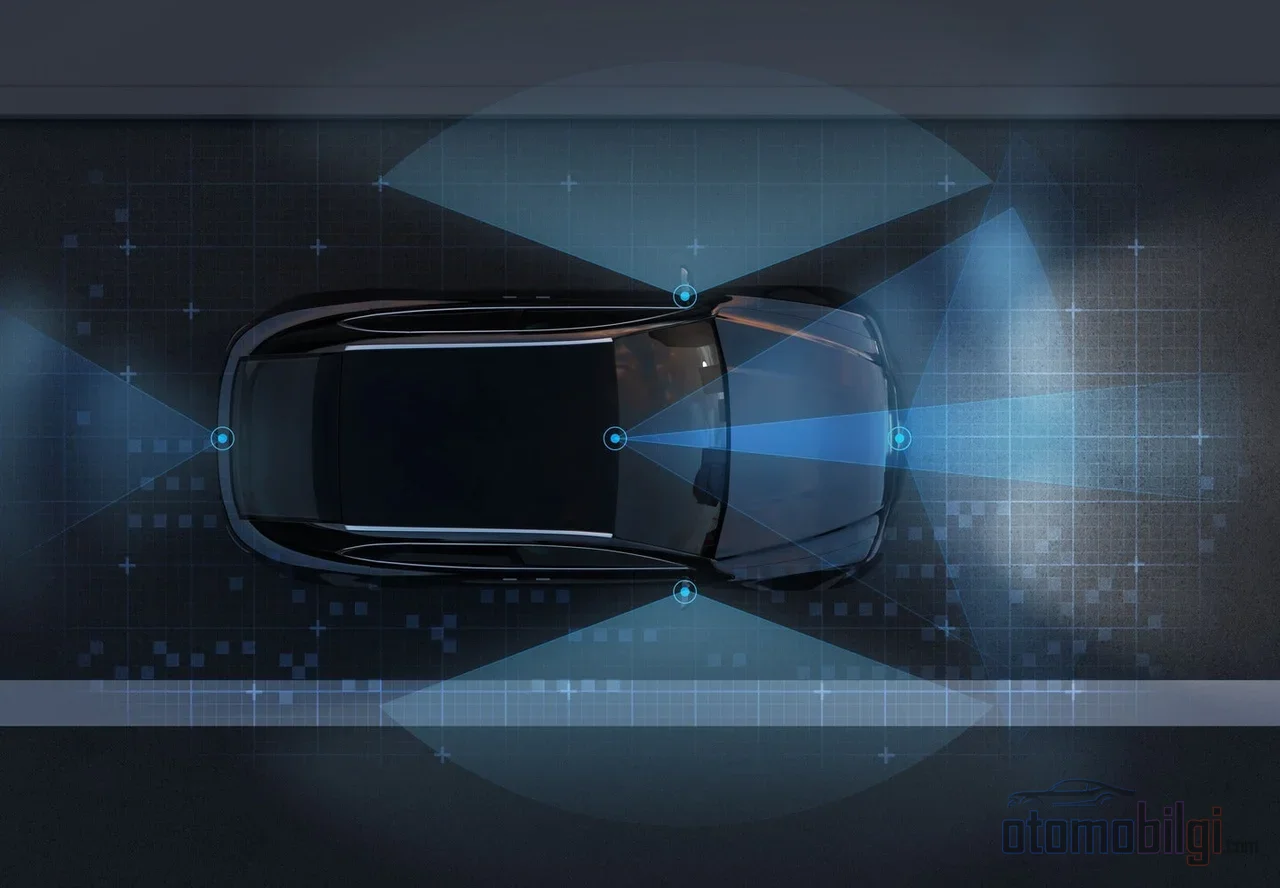
While driving, there is actually a team of detectives working around the vehicle. One measures distance with radio waves, one takes photos and reads lines, and one listens to the immediate surroundings with high-frequency sound waves. Together, they all decide what the vehicle sees. The nice thing is: none of them is a hero on their own - it is all teamwork.
Radar: The Silent Hero of Long Range
Radar emits radio waves and calculates an object's size, distance and relative speed by measuring how long the reflections take to return. The typical frequency in automotive is around 76.5 GHz signals reach about 300 meters ahead of the vehicle. It works well in darkness, rain, fog and dust, and is particularly successful at detecting metal objects, that is, cars, trucks and buses. It is the backbone of systems such as adaptive cruise control, blind spot warning and collision warning. It is usually mounted behind the front grille or inside the rear bumper: the front radar feeds AEB and traffic jam assist, while the rear radar comes into play for rear cross-traffic alert and blind spot monitoring.
Camera: The Eye That Reads Lines and Signs
The camera sees what radar cannot: lane markings, traffic signs, pedestrians and colors. It can distinguish a red light or the brake lights of the vehicle ahead; this is something LiDAR cannot do. That is why the camera is the main sensory component in most manufacturers' systems. In systems like Subaru EyeSight, twin front cameras are used instead of a single camera to increase forward detection accuracy. But what about the weak point? Darkness and dense fog, rain, snow. When visibility is restricted, the camera's vision is restricted too - and very quickly at that.
Ultrasonic and LiDAR: Close Surroundings and Long Range
Ultrasonic sensors detect nearby objects using sound waves at frequencies of around 48 kHz which humans cannot hear. Their ideal range is 2.5-4.5 meters; they cannot see objects smaller than 3 centimeters. Since they are affected by wind noise, they are useless at high speeds - which is why they are preferred in parking and reverse gear rather than in adaptive cruise control. They work day and night without distinction and are economical.
LiDAR, on the other hand, measures laser time-of-flight; up to a range of 300 meters, it produces a three-dimensional point cloud with approximately 1 centimeter precision. Darkness, sunlight, and oncoming headlights do not affect it, but fog, smoke, and rain reduce its performance. It cannot see color. This is why some manufacturers have explained that they prefer radar-supported cameras instead of LiDAR, citing LiDAR's being affected by rain and snow as justification. There is also GNSS: it provides location but becomes useless in tunnels, enclosed parking garages, and city streets lined with skyscrapers; short-term tracking is done with a gyroscope-based inertial measurement unit.
Rain, Snow, and Fog: Why Doesn't ADAS Work Exactly as You Expect?
You think radar, a marine technology, doesn't care about snow and fog, right? You're partly right: radar is the sensor most resistant to weather conditions. But for the job to be complete, the camera is also in play, and the camera is seriously affected by rain, snow, and fog. Moreover, the problem isn't just the weather. When rain, snow, dust, and road grime stick to the sensor surface, sensor function is blocked; even a small amount of dirt can reduce performance. If snow, mud, or dust accumulates on the surface of the sensor or windshield, it can completely block the cameras and sensors.
What is the concrete result of sensor function failing in winter conditions? Delayed braking and missed detection. In other words, the system may not see the obstacle ahead or may notice it too late. There are also studies showing how much weather conditions strain the system's perception, and that rain and snow, as external environmental factors, directly reduce ADAS performance. According to one industry claim, ADAS systems fail once every 8 miles in adverse weather conditions - this figure should be read with caution since it is a single company's own data, but it summarizes the trend.
The practical takeaway is this: while maintaining a 3-second following distance in heavy rain or on a snowy road, don't assume the system is doing the same. If the sensor's eye is dirty, your eyes must be its eyes.
Low Sun, Dirty Sensor, and False Alarms: Real Scenarios That Confuse the System
Why Does the Camera Give Up When the Sun Gets Low?
You're driving into the late afternoon sun, and suddenly a warning appears on the instrument panel and the adaptive cruise control shuts off. Does this sound familiar? This scenario is real: in user forums of an electric vehicle, it has been recounted many times that ACC stops and gives an error message when driving against a low sun, and returns to normal once out of the sun. The reason is simple: the camera cannot detect objects due to glare, especially vehicles in the same lane. Reflections from wet road surfaces make the job even harder. That's why you should stay alert against late detection and sudden braking in low sun, and take "sensor blocked" style warnings seriously.
The Price of a Few Degrees of Deviation
The front radar module demands perfect angular alignment; even a deviation of just a few degrees can shift its detection. A minor collision, a bump on the bumper, a repair without calibration - all of these shift the system's view of the world. Blind spot monitoring, on the other hand, typically stops working due to dirty or blocked sensors, or physical damage to the bumper or sensor area; low voltage, moisture, and calibration issues also lead to the "unavailable" warning. The blind spot system has another limited aspect: since audible alerts depend on turn signal use, if you don't signal, extra protection is disabled. Reduced accuracy at low speeds is icing on the cake.
Why Does AEB Sometimes Brake for No Reason?
Automatic emergency braking has two failure modes: misjudging a threat and never engaging at all (a false negative), and needlessly engaging for a threat that isn't real (a false activation). The latter, meaning a sudden and unexpected stop, disrupts the driver's action plan; the driver may be forced to react in exactly the opposite way. That's why false alarms aren't just annoying - they erode trust in the technology and can even lead some drivers to disable the system entirely. Safety regulations also take the matter seriously: unreasonable false activation that creates a safety risk is defined as a defect that manufacturers are responsible for reducing. One impact study shows that when the activation rate and three fundamental limitations are taken into account, AEB's realistic benefit is roughly 2/5 of its theoretical maximum. It's still a valuable system, but not an unlimited safety net.
ACC has a classic weakness too: vehicles that change lanes and cut in ahead. Traditional adaptive cruise control cannot effectively recognize these "cut-in" scenarios or react early. So misleading silence is possible here as well. An interesting detail: it has been shown that trust in ACC doesn't significantly change a driver's reaction at the moment of a malfunction, but a driver who has experienced a malfunction once develops a more realistic mental model of the system. In short, humans learn a lesson once they see themselves proven wrong - unlike a machine, they actually handle this better than machines do.
Does Lane Keeping Assist Steer for You?
The short answer: no. Lane keeping assist and lane centering are meant to prevent the vehicle from unintentionally drifting out of its lane; they are designed for the safety of a sober and alert driver, not as a safety net for a negligent one. The system makes steering corrections, but your attentiveness is still essential. If you feel it conflicting with your own input, a situation known as the system wrestling with the driver arises - some drivers turn the system off completely, whereas the right approach is to use it knowing its limits.
The same logic applies to blind spot monitors: they are a complementary second pair of eyes, never a substitute for mirrors and shoulder checks. Legal circles also emphasize these limits; because the system depends on signals and speed, it is not a box that promises complete protection. Ask yourself this question: if one of all these systems stays silent, will you still be able to see that gap? Your answer needs to be yes.
Responding Correctly to Warning Sounds and Indicator Lights: A Mini Usage Guide
You need to listen when the system speaks. According to the logic conveyed by Ireland's road safety authority, when a potential collision is detected the system alerts you with visual, audible, or vibrating warnings; AEB can also kick in using radar or a camera. If the warning light is not recognized, taking action is delayed and a small problem can turn into a serious incident. Here is a quick response guide:
- Red icon: A critical issue requiring immediate action - pay attention right away.
- Flashing symbol: The vehicle may need to be safely stopped; do not ignore the warning.
- ADAS warning light: One of the systems has detected a fault or calibration issue - check the sensor area for dirt and ice.
- Audible collision warning: Ease off the accelerator, and if necessary brake gently to carefully bring the vehicle down to a safe speed.
The last point is important: when the warning sound comes, the key is not panic braking but controlled slowing down. Of course, placing a person or obstacle in front of you to test the system is not sensible either; but modern test regimes are now moving toward more realistic approaches such as full-system-level verification and measuring driver interaction instead of isolated sensor performance. For example, the mandatory regulation published for AEB in 2024, and the evaluation cycles by European and Australian safety organizations that measure real-world robustness as of 2026, show that these systems are now being tested outside the laboratory, in real life. For you, this means: the systems are becoming more reliable, but driver interaction - that is, your role - will always be part of the measurement.
False Alarm or Solid Data? The Art of Interpreting Signals
Let's do a final synthesis. Both a false alarm and false silence stem from sensor logic: every sensor is strong under certain physical conditions and weak under others. Radar is king in range and speed, useless at reading colors and lines; the camera extracts meaning but goes blind in darkness and when dirty; ultrasonic is great in parking, useless on the highway; LiDAR is precise but loses to fog. When you get a warning, ask yourself three questions: is my sensor surface clean, are weather conditions challenging perception, and can I see the gap ahead with my own eyes? If you can answer all three, you have interpreted the signal correctly.
Never forget this: no ADAS system eliminates the driver's responsibility. These are great helpers, but the steering wheel and the decisions are still yours. Knowing what your sensors can and cannot be trusted with makes for far safer driving than simply turning them off. The next time a warning appears on the dashboard, you won't be surprised - you'll already know what triggered it.
Sources
- Types of ADAS Sensors in Use Today
- The Different Sensors ADAS Systems Use
- Analysis of Impact of Rain Conditions on ADAS
- Will Your Driver Assistance Systems Fail in the Rain or Snow?
- AEB Final Rule (NHTSA, 2024)
- Driver Assistance Technologies
- Adaptive Cruise Control for Cut-In Scenarios
- AEB System Impact Assessment
- Lane-Keep Assist Failures: Driver and Manufacturer Responsibility
- Advanced Driver Assistance Systems (ADAS)
- Guidelines for Testing Drivers in Vehicles with ADAS
- Why Euro NCAP Is Shifting the Rules of ADAS Testing