How Vanishing Point's Dodge Challenger Became a Cult Classic
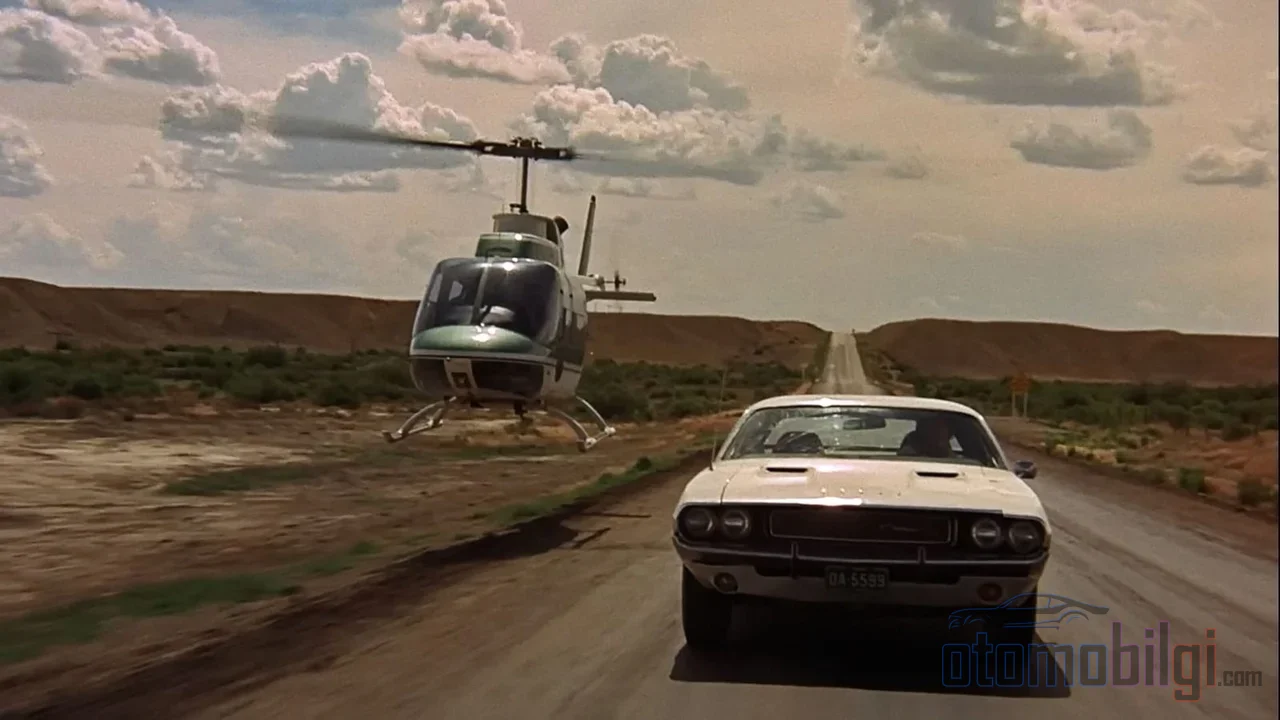
A white Dodge Challenger R/T is speeding through the middle of the desert with the throttle wide open. With police cars behind it, helicopters casting shadows overhead, and the support of a blind radio DJ from a school for the deaf. A man trying to get from Denver to San Francisco in 15 hours, and beneath him, that magnificent machine. The name of the film: Vanishing Point. So how did this film, which bombed at the box office in 1971, become one of the most sacred cinematic moments in muscle car history?
The answer to that question is one of the most fascinating stories where cinema and automobiles intersect. Let's take a look together: how does a movie car die, then rise again and become a legend?
Who Is Kowalski and What Happens in the Film?
The film's hero, Kowalski, is played by Barry Newman. His past is quite colorful: a former Vietnam veteran, a former racer, and even a former police officer. But now he is a man transporting drugs, and he finds himself facing a strange wager: he will deliver the 1970 Dodge Challenger R/T in his possession from Denver to San Francisco in just 15 hours. The journey is around 1,200-1,300 miles, and Kowalski uses amphetamines throughout this period.
His only supporter along the way is a blind radio DJ called "Super Soul". By listening to police radios, he learns where Kowalski is and reports it to his listeners. The film's ending is one of the most debated conclusions in cinema history: Kowalski deliberately crashes at high speed into the police barricade in the town of Cisco on the California border, and the car burns in flames. Even its name is already a reference to an optical illusion; the point where parallel lines converge in perspective is called a "vanishing point". The film ends exactly there.
The Technical Spec Sheet of the Car in the Film: The 440 V8 Reality
Now let's move on to the real star. The vehicle used in the film is a 1970 Dodge Challenger R/T hardtop; Alpine White, that is a white body with a black vinyl interior. Under the hood, we are looking at a 440 CID V8 "U" code engine: 375 HP of power and 480 ft-lb of torque, a single 4bbl carburetor, an A-833 4-speed manual transmission, and a Sure-Grip differential with a 4.10:1 ratio. Even the gear shift lever is iconic: it looks like a pistol grip.
| Feature | Value |
|---|---|
| Model | 1970 Dodge Challenger R/T hardtop |
| Color | Alpine White, black vinyl interior |
| Engine | 440 CID V8 "U" code, 375 HP |
| Torque | 480 ft-lb |
| Transmission | A-833 4-speed manual |
| Differential | 4.10:1 Sure-Grip |
| The film's advertising trick | The car did not actually have a supercharged system |
I especially liked one detail: When the film is mentioned, the car is referred to as "supercharged", but in reality it was not. So we can just say it was Hollywood's first exaggerated advertising strategy. The reason white was chosen was purely practical: White was the color that photographed best against the desert landscapes of the Southwest. Think about it, could an orange car have become this legendary against that dusty, rocky backdrop?
Highlights
- Vanishing Point, which failed at the box office in 1971, rose to cult status over the years.
- The car in the film was a 1970 Challenger R/T with a 440 CID V8, 375 HP engine; it was not a Hemi.
- The vehicle that explodes in the film's finale was not a Challenger, but an explosive-laden 1967 Chevrolet Camaro.
- The chase scenes were shot with real cars, without CGI; in the deserts of Nevada and Utah.
- Tarantino's 2007 film Death Proof contains a direct reference to the white Challenger.
How Many Challengers Were Used and Where Are They Now?
Here is one of the most talked-about questions in the world of movie cars. Two witnesses give two different numbers: the lead actor Barry Newman and the legendary stunt driver Carey Loftin say 5 cars were used; the director Richard C. Sarafian, meanwhile, mentions 8 cars on the 2005 DVD. It is known that Chrysler rented the five cars to Cupid Productions as a promotion: four were 440/4-speed, and one was a 383/automatic used as the camera car.
The cars were hardly touched at all. The only special modification was the heavy-duty shock absorbers on the car in the bridge jump scene. Also, even the car that explodes in the final scene was not a Challenger! It was an explosive-laden, engineless 1967 Chevrolet Camaro; a 383-powered Challenger towed it into place with a bulldozer. That's sometimes exactly how the magic of cinema works.
One license plate detail has also caught attention: the car carries a Colorado plate, OA-5599, and appears right-hand drive in one scene. The result? All of the cars from the 1971 film are believed to have been scrapped. Chrysler was not pleased that its new muscle car was being associated with amphetamines and anti-establishment behavior, and is thought to have scrapped the damaged cars rather than repair them. So the white "Vanishing Point" Challengers roaming the market today are not the original film cars but replicas.
The Real Chases: No CGI, Plenty of Desert
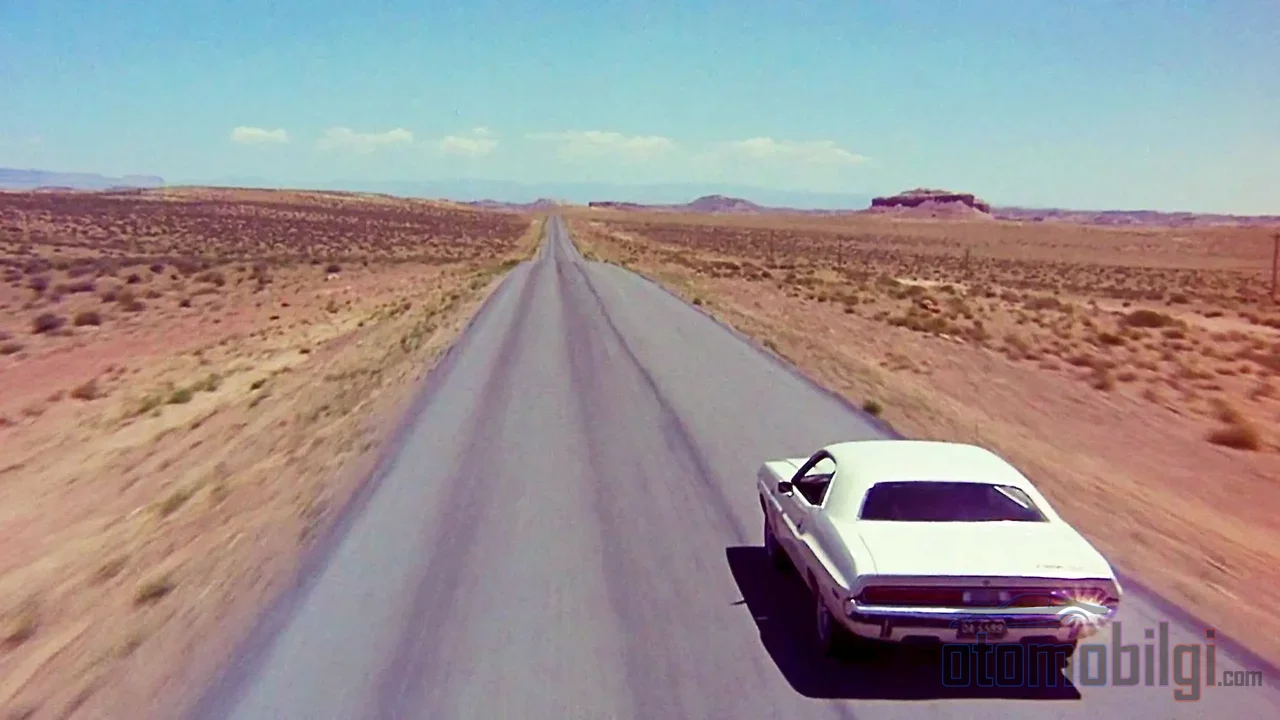
If you're wondering why the film is still so impressive, the answer is very simple: everything is real. The chases were filmed with real cars and real drivers; not a single computer effect. The real locations in the deserts of Nevada and Utah make the film a breathtaking experience even today. However much you think about it, that's quite a bold choice for a 1971 film, isn't it?
From Box Office Flop to Cult Classic: How Did the Transformation Happen?
When Vanishing Point was released in the US on March 13, 1971, the reviews were mixed. Some critics saw the film as pure exploitation-style entertainment; one writer described it as essentially a 90-minute Dodge commercial. The box office wasn't very bright either, and the film slipped into oblivion for a while. But this is exactly where the story turns around: the film gained a loyal cult following in Europe and over the years became a cult art-house classic.
Today, different circles evaluate the film in different ways. To some, a simple car movie; to others, a portrait of the post-Woodstock counterculture: rebellion, drugs, rock music, and the search for freedom. An essay published in an art magazine in 2024 positions the film as a work worshiped by a wide circle ranging from gearheads to post-structuralists. Even muscle car magazines commemorate it as much as cinema magazines do. Such an intersection is very rarely seen in cinema history.
Its Impact on Culture: Tarantino, Music, and Dodge's Answer
The film's influence did not stop with movie lovers. Quentin Tarantino directly uses the white 1970 Dodge Challenger in his 2007 film Death Proof; the characters in the film even try to buy this car. Same color, same model, same spirit. Tarantino's move turned the white Challenger into a symbol of freedom and power for a new generation. The film's influence also extends to music videos and different corners of car culture; it has been an inspiration to a wide audience from musicians to collectors.
Dodge also recognized this legacy. The brand honored the film with the Kowalski Edition Challenger and brought back the original's striking white look in modern interpretations. As you may notice, the modern Challenger has sold more than 775,000 copies since 2008, and the legacy left by old films undoubtedly has a share in this lasting rebirth. It is a truly remarkable story for one movie car to change the fate of a model so profoundly.
The 1970 Challenger R/T in the Collector's World
Now let's get to the main point: what would happen if you wanted to buy a 1970 Challenger R/T today? The production numbers tell the whole story. 1970 Challenger R/T hardtop production was 14,889 units (base price $3,266), while the R/T convertible was only 1,070 units ($3,535). Total 1970 Challenger production was around 84,037 units. So the R/T was a truly special part of the model lineup, and its standard equipment included a 383 cid V-8, the Rallye gauge cluster, Rallye suspension, and heavy-duty drum brakes.
Today's market values, however, are far too high to compare with the nostalgic prices. About $27,900 is paid for a typical 1970 Challenger two-door base model. The R/T Convertible, on the other hand, trades at around $123,739, which is roughly 3,400% above the original sale price. In current listings, R/T 383 Magnum examples are listed at figures like $89,990, and the range stretches from $37,993 to $229,900. The rare Hemi Challengers can reach the $3 million level when the right car is found.
And here is the most crucial detail: since the original film cars are believed not to have survived, there is no such thing as "the real Vanishing Point car" in the collector's world. The white Challengers on the market hold clone or replica status. In other words, the legendary car effectively went to the scrapyard; but thanks to its story and imagery, its cult status has been immortalized. Strange, isn't it? A film whose car was lost, only for the car to become a legend years later.
And There Is a 1997 Remake: The Viggo Mortensen Version
The 1997 TV remake, however, arrived with an entirely different car: 426 Hemi, with 425 HP of power. All five 1970 Challenger R/Ts used in this version survived and were bought by a single collector; one was restored, while the other four were preserved as they were. So this remake, which caused no storm among film lovers, produced the luckiest vehicle fleet in history in the collecting world.
What Does the Legacy of Vanishing Point Tell Us Today?
Let's sum it up briefly: Vanishing Point, which flopped at the box office in 1971, turned into a cult classic over the years, especially in Europe. The film's car was a white 1970 Dodge Challenger R/T with a 440 CID V8; it was neither a Hemi nor supercharged. Even the car that exploded in the finale was a Camaro. But the real car chases shot without CGI, the desert aesthetic, and the counterculture spirit turned the film into an icon referenced everywhere, from Tarantino to music videos. Today, even a white Challenger replica commands serious money in the collecting world; because the real value lies not in the metal, but in the story.
If it were you, would you put that white desert monster in a collection, or would you want to drive it on the road and drink in its essence? Whichever your answer, the comeback of Vanishing Point is one of the sweetest lessons of car culture: sometimes failure gives birth to the brightest legend.
Sources
- Vanishing Point (1971 film) - Wikipedia
- Vanishing Point Car: Kowalski's 1970 Dodge Challenger R/T - Muscle Cars Illustrated
- 1970 Dodge Challenger R/T - Vanishing Point
- Vanishing Point | Film Locations - Movie-Locations.com
- Not Running, Just Going - Gagosian Quarterly
- Death Proof - Wikipedia
- 1970 Dodge Challenger R/T Value - Hagerty Valuation Tools
- Dodge Kowalski Edition Challenger - Hemmings
- 'Vanishing Point Forever' Examines the Cult Movie - Yahoo Autos
- Modern-Take On The Iconic Vanishing Point Dodge Challenger R/T - MoparInsiders