Nissan Ariya Review: e-4ORCE and Japanese Minimalism
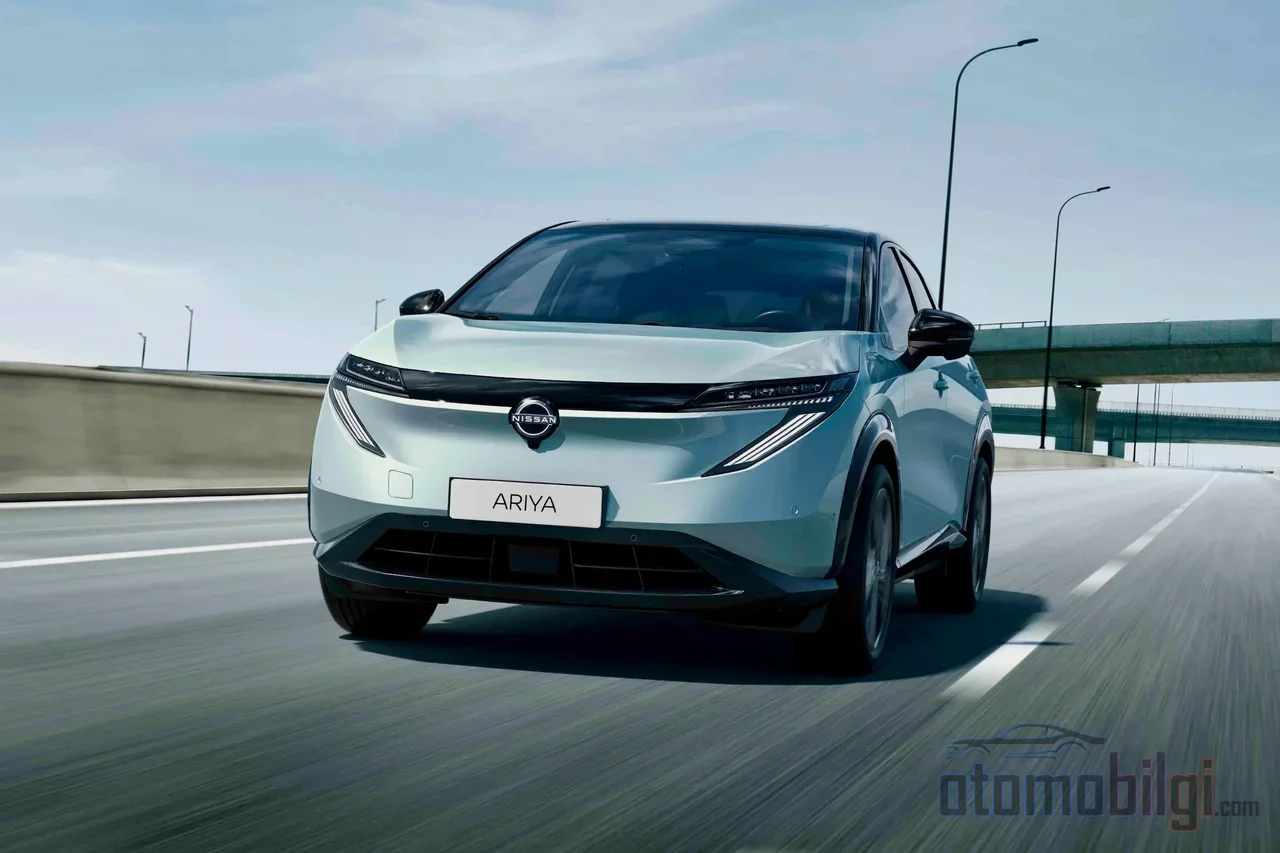
In the C-SUV segment, electric models are now more numerous than ever, yet their design philosophies are becoming increasingly similar. This is exactly where the Nissan Ariya takes a different path: a flat-floor battery architecture, e-4ORCE torque distribution that works within seconds between the two electric motors, and an interior approach that carries Japanese minimalism into every detail of the cabin. So do these three elements really set the Ariya apart from rivals like the Volkswagen ID.4 or Tesla Model Y? The answer lies in the technical specification.
The Ariya's Segment Identity and Global Position
The Ariya is Nissan's fully electric (BEV) model in the C-SUV class; it is offered with a 5-door, 5-seat "Coupé Crossover" body type. Its design roots go back to the Ariya Concept, unveiled at the 2019 Tokyo Motor Show. With this model, Nissan represented not just a product, but also a new phase in the electric vehicle journey that began with the Leaf; the manufacturer's global EV sales passed the 1 million unit threshold.
On the market side, the picture is more complicated. The facelifted Ariya for the 2026 model year was announced in October 2025 with a preview and unveiled at the Japan Mobility Show; it went on sale in Japan in 2026. In contrast, in the US market 2025 was the model's final sales year, and the manufacturer lists the Ariya among discontinued models on its official website. Sales continue in Europe, but monthly volumes hover in a tight competitive zone similar to rivals like the Skoda Enyaq. While the global EV market is expected to reach around 23 million units in 2026, with total sales at 28 percent, the Ariya's fate appears to depend more on market choice than on the market itself.
Highlights
- Two battery options: 63 kWh and 87 kWh usable capacity
- e-4ORCE Performance: 290 kW / 600 Nm, 0-100 km/h in 5.1 seconds
- DC fast charging at 130 kW; 10-80 percent charge in about 34 minutes
- Real-world mixed range of approximately 500 km for the 87 kWh version
- 4,595 mm length, 2,775 mm wheelbase, 466-liter trunk
Battery Architecture: Flat Floor, Two Capacities, Realistic Range
The Ariya's fundamental architectural decision is the full integration of the battery pack into the cabin floor. This flat-floor approach has two concrete results: a low center of mass and a wide field of vision inside the cabin, contributing directly to the comfort tuning of the running gear and the perception of the interior.
Two packages are offered: 63 kWh usable (65 kWh total) and 87 kWh usable (90 kWh total) capacity. Range figures vary by version: With the 63 kWh battery, an indicated range of 385 km is given in the Australian market, while in Canada the 66 kWh SV front-wheel-drive version offers 341 km and the e-4ORCE SV+ offers 406 km. In the US, the Venture+ front-wheel-drive version with the large battery delivers a range of 304 miles per charge; UK figures show up to approximately 530 km on a full charge.
On the real-world side, the band for the 87 kWh e-4ORCE is between 290 and 585 km; around 405 km in city use and in cold weather. With real-world consumption of about 17.4 kWh/100 km, a practical range of around 500 km in the combined cycle is a reasonable figure. In short, the Ariya is not the range champion of its class, but it offers a window wide enough for daily use.
Charging Character: Correct But Not Fast
Peak power in DC fast charging is 130 kW. In the 63 kWh front-wheel-drive version, AC charging at 7.4 kW adds roughly 35 km of range per hour; In the NISMO version, the 10-80 percent charging time is about 34 minutes, with an average charging power of 82 kW. The large-battery version gains around 350 km of range with a 30-minute fast charge. Some trims also include a heat pump and 22 kW AC charging on the list. To be honest, 130 kW remains modest next to rivals drawing over 200 kW with 800-volt architectures; this is the Ariya's most obvious weak point.
e-4ORCE: The Torque Management That Sets the Ariya Apart
The element that truly defines the Ariya's technical identity is e-4ORCE. This dual-motor all-wheel-drive system distributes torque between the electric motors on the front and rear axles within milliseconds, without any intervention from the driver. The goal is not only traction safety; by curbing body movements during acceleration and braking, it creates a driving character that especially preserves passenger comfort. In sources, e-4ORCE is consistently highlighted as the distinguishing feature of the AWD versions.
The power scale is clear: The 63 kWh front-wheel-drive version completes 0-100 km/h in about 7.5-8 seconds with 160 kW (214-218 hp) and 300 Nm. The 87 kWh front-wheel-drive version produces 239 hp while doing 0-100 km/h in 7.6 seconds. On the e-4ORCE side, the 63 kWh pack drops to 5.4 seconds with 340 hp and 560 Nm; the peak is the 87 kWh e-4ORCE Performance: 290 kW (394 PS), 600 Nm, 5.1 seconds and a top speed of 200 km/h. The NISMO version rises to 320 kW (429 hp) of power. Due to market-specific tuning, different horsepower figures can be seen with the same battery-motor combination; the figures given here are the manufacturer's base values.
| Version | Power | Torque | 0-100 km/h |
|---|---|---|---|
| 63 kWh FWD | 160 kW (214-218 hp) | 300 Nm | ~7.5-8.0 s |
| 87 kWh FWD | 239 hp | 300 Nm | 7.6 s |
| 63 kWh e-4ORCE | 340 hp | 560 Nm | 5.4 s |
| 87 kWh e-4ORCE Performance | 290 kW (394 PS) | 600 Nm | 5.1 s |
| NISMO | 320 kW (429 hp) | 600 Nm (443 lb-ft) | around 5.1 s |
Interior: The Tangible Expression of Japanese Minimalism
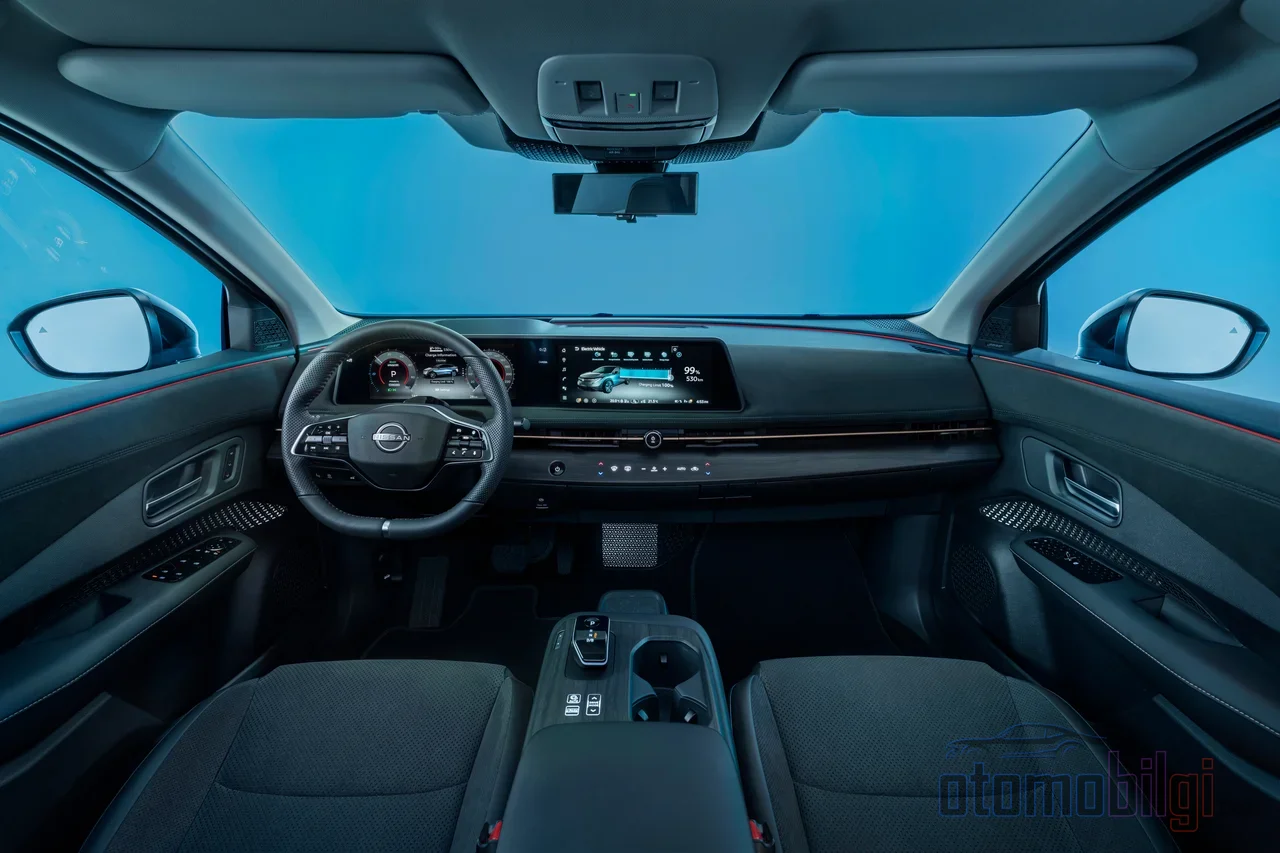
The Ariya's cabin is a disciplined pursuit of simplicity rather than a luxury claim. The buttonless and keyless panel design, the horizontally aligned dual information displays, and the "zero gravity" seats are the visible faces of this philosophy. Ambient lighting patterns inspired by traditional Japanese Kumiko woodwork, together with Japanese motifs hidden at specific points of the vehicle, create a layer of detail that a careful eye will discover.
Its technology equipment is above the segment standard: dual 12.3-inch TFT display (instrument cluster + navigation), wireless Apple CarPlay and Android Auto, wireless phone charging, Nissan Voice Control, ProPILOT driver assistance system, Around View Monitor, Bose 10-speaker audio system, heated seats and steering wheel, and a hands-free power tailgate. Suspension is MacPherson at the front, multi-link at the rear; e-Pedal Step is offered for one-pedal driving.
The dimensions fit the segment perfectly: 4,595 mm in length, 2,775 mm wheelbase, 1,660 mm height (1,650 mm in some equipment and market combinations) and 235/55 R19 tires on 19-inch wheels. Trunk capacity is 466 liters with the seats up, 1,350 liters with the seats folded; in some versions, a figure of 408 liters also appears. The towing capacity of 750 kg is given as the same for braked and unbraked trailers. Curb weight varies between 1,920 and 2,259 kg depending on the version.
What Sets It Apart from Its Rivals: Against the ID.4 and Model Y
Compared with the Volkswagen ID.4, Ariya's cards are on the table: a quieter and more premium-feeling cabin, effective e-4ORCE all-wheel drive, and accordingly a smoother power distribution; the ID.4, in turn, responds with a clear fast-charging advantage. Visually, Ariya's 1,650-1,660 mm height draws a fuller, more settled silhouette compared to the ID.4's 1,619-1,640 mm range.
In the Tesla Model Y comparison, the distinction is philosophical: while Tesla focuses on outright speed and its charging network, Ariya blends its power range of up to 389 hp with a softer, more comfort-oriented character. In owner feedback, comfort, quietness and spaciousness are praised; the most common objection is directed at the flush door handles. On the reliability side, there is a rating of 8.0 out of 10 for 2023-2025; the most frequently reported problems are DC fast-charging errors and early-production software inconsistencies. For 2023-2024, there were also recall processes covering EV system shutdown and 12V battery overcharging. The single-motor version's "predictable" driving character, however, is not a criticism but is evaluated mostly as a positive feature.
Why Is the Ariya Different? The Clear Answer
In short: The Nissan Ariya is not a car trying to win the range or charging-speed race in the C-SUV segment. What makes the Ariya different is the comfort-oriented character of its e-4ORCE torque management, paired with its flat-floor battery architecture, and its presentation of Japanese minimalism as a cabin philosophy rather than an equipment list. Its 130 kW charging power and efficiency figures are not class-leading; in return, the Performance version, which drops to 5.1 seconds, along with its 466-liter trunk and disciplined cabin, delivers a balanced, distinctive package. At a time when the facelifted model is progressing in Japan while the US is winding down, the Ariya positions itself in the global market as a niche but characterful option.
Sources
- Nissan ARIYA | All-Electric SUV | Specifications
- 2025 Nissan Ariya Review, Pricing, and Specs
- Nissan Ariya e-4ORCE 87kWh - 290 kW (MY23-24)
- Nissan Ariya e-4ORCE 87kWh Performance Specs
- Nissan Ariya e-4ORCE 63 kWh
- Nissan Ariya - Wikipedia
- Nissan ARIYA (discontinued) - Nissan USA
- Compare All Nissan Ariya Models | Specifications & Info
- Nissan global EV sales surpass 1-million-unit milestone
- Executive summary - Global EV Outlook 2026